Showing posts with label Academy of the Underrated. Show all posts

Monday, August 27, 2012

Academy of the Underrated: Flash Gordon (1980)

Flash Gordon poster and Amazon link

Of Hollywoods' attempts to jump back into the sci-fi game in the late 70s and early 80s, none is quite so endearingly crazy as Dino de Laurentiis' feature film Flash Gordon. It was misguided from the start, a throwback to the deliberate camp of 60s films like Barbarella rather than believable fantasy worlds, but while it was a recipe for commercial disappointment it's become an utterly charming cult film. With a gorgeous candy-colored visual style, wonderfully over the top actors, and a hilarious rock score with songs by Queen, it was the Speed Racer of its day, and it has everything you could want apart from a good lead performance. Oh, well, you can't have it all.

Wednesday, June 06, 2012

In Theaters: Battleship

Battleship movie poster
Poster via IMPAwards.com

The sad irony of Battleship is that it would probably be doing just a little bit better- or at least receive a little more goodwill- if it weren't named after a board game in an attempt to create profitable corporate synergy. The same public that had no problems patronizing the Marvel Studios uber-franchise or a live-action Smurfs movie have drawn their line in the sand, and a film based on a boardgame is a step too far no matter how good or bad it is.

But hear me out on this. It's actually pretty good. However cynically calculated the initial boardroom meetings that produced this movie may have been, at some point director Peter Berg and writers Erich and Jon Hoeber (as well as any others who may have been involved) and the rest of the filmmakers decided to actually try and make a good, sincere sci-fi/war movie based on the simple premise of the Navy fighting aliens, and their efforts paid off. Battleship works on a simple but satisfying level, and it has the important lesson that you shouldn't judge a film by its premise.

Friday, November 25, 2011

Academy of the Underrated: Dune (1984)

Dune cover and Amazon link


Over four years ago, when I reached my one hundredth post, I introduced the Academy of the Underrated, dedicated to defending the disliked, the disregarded, and the despised. Since then, one entry has been inevitable, but I've been waiting for the right time. Four hundred posts later, the proper moment has arrived.

Thursday, November 24, 2011

Academy of the Underrated: Explorers


The success of Super 8 this past summer had me thinking of how "Spielbergian" used to be a category of movies all its own. Throughout the Eighties, filmmakers and studios made many, many attempts to capture audiences with stories about the magic of childhood and stories of ordinary people encountering the otherworldly. Explorers was Paramount's big-budget attempt to follow in E.T.'s footsteps, but with Joe Dante at the helm and a particularly offbeat script by Eric Luke, the film is both quirkier and more personal than a typical summer offering then or now. Though it's not really consistent, it has an innocence and whimsy that makes it more effective than most attempts at sci-fi-tinged nostalgia.

Friday, November 11, 2011

In Theaters: In Time

In Time poster and IMPAwards link

Andrew Niccol is probably one of the most undervalued filmmakers around today. While Gattaca and The Truman Show both caught attention, not much of what he's done in this millennium has met with acclaim. But he's always working with interesting ideas and applying a distinct low-key touch to his films. In Time is an unexpectedly relevant film, a picture about the growing divide between haves and have-nots released just as a lot of the have-nots have finally become vocal, and it couches this in a metaphor that's both obvious and powerful. It's high concept, but makes sure to ground the concept in genre convention, this time a thriller. The blend of concept and genre is rough around the edges, but it works more often than not.

Monday, July 04, 2011

Academy of the Underrated: The Return of Captain Invincible

DVD cover and Amazon link
This Fourth of July, America’s got all sorts of problems, from a bad economy to unpopular wars we can’t quite seem to end to the fact that the usual political infighting has degenerated into all-out warfare. Patriotism itself is being used as a political tool, with the implication that anyone who likes “freedom” and “liberty” must invariably also hate the existence of social welfare programs. Times are tough, so we get angry and selfish. But once in a while it helps to look up to the skies.

The Return of Captain Invincible is a genuine obscurity, released just as its distributor was going out of business and more or less vanishing from view for a very long time. It’s a fascinating and very odd picture whose execution doesn’t match its conceptual potential, but as superhero comedy musicals go, it is... well, the only one I know of so far. Leave it to the Australians to come up with one of the most interesting patriotic American movies ever, one that satirizes the shortcomings of our nation while holding up its ideals.

Alan Arkin stars as the titular Captain Invincible, the Man of Magnets, the Legend in Leotards, a superhero who fought gangsters and Nazis all through the period which just happens to be the comics Golden Age. As the 1950s dawned, however, the Captain fell afoul of HUAC, and fled from questions about why he was helping the Russians (during World War II), flying without a license, and wearing his underwear in public. He disappeared into drink and has ended up in Australia, apparently shot down by Skylab and now not knowing where he is or how to use his powers. When an American base in Australia is raided and thieves make off with an experimental hypno-ray, the US President (Michael Pate) puts out an APB on the MIA superhero. Fortunately, Sydney detective Patty Patria (Kate Fitzpatrick) has just recently happened across a drunken vagrant who flipped a car into the air just by standing in its path, and she and the President persuade the Captain to try and sober up and help the free world once more. The Captain and Patty soon find out that the hypno-ray has been stolen by arch criminal Mister Midnight (Christopher Lee), who is using it in an elaborate scheme to ethnically cleanse Manhattan, driving minorities into suburban housing developments that will then be targeted by nuclear missiles.

The casting of Arkin in the lead was something of a stroke of genius. He can’t sing that well, which is a problem, but he captures that paternal wisdom and affability that we expect from our superheroes, especially the ones that wrap themselves in the red, white, and blue. With a grab bag of powers (flight, magnetism, and an amazing computer brain, all voice-activated), and a memorable if busy costume, Invincible is a little bit piecemeal, but Arkin finds a certain reality to his disillusioned self, and his likability gets us in the movie’s corner as well. It helps that he doesn’t look like most movie superheroes- he doesn’t have the square-jawed ethnically-indistinct face we expect, and the actor’s Russo-Germanic-Jewish origins tie in not just to the movie’s plot, but to the fact that Superman, Captain America, and many other legends of that time were generally the creation of first- and second-generation immigrants.

The songs for this film are an odd lot, composed by a number of different teams. It’s no surprise that the most memorable of the lot- including the two showcases for Lee as Midnight- are by Richard O’ Brien and Richard Hartley, of Rocky Horror and Shock Treatment fame. (If such a thing as Shock Treatment fame exists, and it ought to.) The very first song is simply the President singing the word “bullshit” over and over again, and while Arkin has a bit of trouble with the singing bit, Fitzpatrick is dubbed over completely in her character’s one number. The music works more often than it doesn’t, but the uneven quality and the rather abrupt shifts into musical mode mean this doesn’t feel a lot like a proper musical, more a comedy with some numbers on top.

If there’s one thing that dogs this picture it’s inconsistency. It can never quite figure out the tone of humor it’s going for, from vulgarity to broad slapstick to subtler jibes (the Captain fingers a traitor at a Jewish deli when he puts mayo on a pastrami sandwich.) Some of it is quite funny, but you’ll get whiplash. The film was budgeted at five million dollars Australian, and though I’m not sure how strong the currency was back then it didn’t seem to buy a lot- the special effects extend mostly to rear projection and a lot of stock footage, and all sorts of shortcuts are apparent in the more elaborate scenes. Director Philippe Mora’s editing style is a bit clumsy, though he does get some very striking visuals. A certain sloppiness extends a bit to the characters and plot as well- the idea of a traitor in the group rehabbing Invincible is never quite explained, and the film is somewhat undecided as to whether Mr. Midnight is specifically racist or if he’s a primal force of terror (who would then, logically, want everyone of all ethnicities to suffer).

So what saves this film? Well, a lot of it is the sheer charm of it. Arkin, as explained above, is wonderful, and Christopher Lee is in his element. (You will note I did not criticize his singing. That is because there is not a damn thing wrong with it.) Fitzpatrick is sharp and charming as well, and she and Arkin play off each other nicely. Both the actors and the characters they portray are compelling, and even if Captain Invincible’s world isn’t as explicitly developed as a proper comic hero’s, it has that certain mythic resonance.

What’s more, the film seems sincere in a way that not many are. The filmmakers, not Americans themselves, are willing to show off the country's faults but also respectful of the dream. Like Superman and Captain America, Captain Invincible’s allegiance is not to the President or the flag or our country right or wrong, but to the ideas behind the country. And specifically he is devoted to the melting pot, to the Golden Door, to the nation of immigrants who have made America what it is. There’s a simple beauty in the film’s final images under the credits, affirming that belief and holding out a wistful hope that just maybe everything could be just great again.

Written by Andrew Gaty and Steven E. DeSouza (additional dialogue by Peter Smalley)
Directed by Philippe Mora

Grade: B

Monday, March 28, 2011

Academy of the Underrated: Zardoz

Zardoz DVD cover and Amazon link
I’m not sure what this says about my personality, but often when there’s a movie about which it’s said “You’ll either love it or hate it”, I will instead come down nearer the middle. Works like these tend to have very obvious flaws but also very clear strengths, and while I’m almost never at the absolute median point, it’s nice to be able to see both sides.

Zardoz is a movie that invites such responses, because it is gorgeous and stately while also being goofy as hell and, worse, pretentious as fuck. In short, it’s a John Boorman movie. Of the many, many dystopian futures predicted in 1970s science fiction, none is quite so unusual as what he’s presented here, in an elaborate fable about mortality, civilization, and testosterone. It’s confusing and strange and sometimes slow, but also thoughtful and compelling both in its concepts and its presentation. It’s basically what would happen if an art filmmaker adapted a cheap postapocalyptic dime novel from one of the smuttier newsagents.

Zardoz is the god of the wastelands, a giant floating stone head who commands bands of roving Exterminators to kill the Brutals who populate the Earth, leading them with the now-infamous cry, “The gun is good! The penis is evil!” Zed (Sean Connery), one of the more inquisitive Exterminators, hides inside the stone head and finds it taking him to the Vortex, a paradise zone inhabited by the Immortals- the elite scientists and aristocrats who survived the apocalypse by walling themselves off and discovering the secret of eternal life. Ages of eternal bliss have made them decadent, impotent, and largely bored, and while the wise Consuella (Charlotte Rampling) advises that the brute be killed, they want him around in hopes that they can learn a few things, including how to make their men potent again. The increasingly cynical Friend (John Alderton), however, has a more subversive and ambitious plan: he thinks Zed can discover how to make them all mortal again, so that they can finally get around to dying.

Though an original creation of John Boorman’s crazed imagination, Zardoz plays like it could be an adaptation of a book. It has many of the earmarks of written postapocalyptic sci-fi, from a virile alpha-male barbarian protagonist to a society written as clear commentary on modern decadence / sterility / whatever-issue-is-bugging-the-writer-at-the-time, with an emphasis on matters sexual. It’s actually a surprisingly well-thought-out and coherent society that only requires a little handwaving as to how immortality was uncovered. Zardoz’s message of death makes sense as the Immortals’ attempt to keep the Brutal population in check, and ironically it’s when they change their mind and Zardoz tells them to use the Brutals for slave labor to grow food instead that Zed and other exterminators rebel. The Immortals are all linked by a kind of psychic network, those who meet with hazard are regrown, and punishment is doled out via forced aging. The Vortex is not quite a dystopia, but cracks are appearing, and Zed’s influence precipitates more violence and decay, as though it were inevitable.

The film’s gender politics are, frankly, I don’t even know. Zed is in some ways the ultimate image of what masculinity was supposed to be in the 1970s; if the fashion industry still existed he would no doubt be in menswear catalogs. There’s a definite contrast between the hyper-manly Connery and the more delicate males of the Vortex, which may be an early example of the fear-of-emasculation crap that rears its head whenever someone discovers that not all men like football, but unlike many postapoc barbarians, Zed doesn’t see bending prideful women into place as a concern; indeed, it’s in Consuella’s increasing aggression and bloodthirst that she starts to come to Zed’s level, and soon just about everyone is finding some way to devolve. The ultimate theme is that death is necessary for life to have meaning, and in some ways the story is the collision of two unbalanced societies, one locked in immortality and another valuing death over all.

Boorman made this film for around one million dollars, and it looks incredible for that amount. Zardoz itself is the finest effect; the visual of a fearsome stone head slowly gliding through the air is indelible, and it’s frequently accompanied by Beethoven’s 7th Symphony (the one that was used in The King’s Speech a lot) for extra atmosphere. Both the Vortex and the brute lands beyond look very convincing, and while the costuming is odd at best, it’s also memorable.

That phrasing could equally well apply to Zardoz as a whole, a film that sticks in the mind whether you want it to or not. As with many of Boorman’s films, not all of the action makes objective sense, it moves quite slowly at times, and the visuals straddle the line between gorgeous and silly right up until the end. But it has power, and beauty, and while it’s not the clearest or most coherent work of social criticism there is, it is provocative. A strange spectacle such as this bears watching at least once.

Written and Directed by John Boorman

Grade: B

Friday, March 18, 2011

Academy of the Underrated: The Tempest (2010)

Tempest poster and IMPAwards link
I can’t help but be in Julie Taymor’s corner. Spider-Man: Turn Off The Dark may be shaping up to be a bigger catastrophe than anything in Broadway’s history, but it takes inspiration to stage that kind of failure, and Taymor has an imagination and ambition that I think more filmmakers ought to have. The Tempest puts that imagination on vivid display, in a bold but surprisingly straightforward adaptation of Shakespeare’s final classic. It’s received tepid reviews, but I can’t quite figure why, since there’s not a lot wrong with it.

The one major change is that Prospero is now Prospera, and is played by Helen Mirren. She’s a former duchess, exiled from Venice for practicing magic, now living alone with her daughter Miranda (Felicity Jones). With the aid of the sprite Ariel (Ben Whishaw) she has used her powers to wreck a ship containing King Alonso (David Straitharn), the man who exiled her, and washed all the passengers ashore alive, planning an elaborate revenge for the injustice visited on her. Drunks Trinculo and Stephano (Russell Brand and Alfred Molina respectively) join up with the strange island native Caliban (Djimon Honsou) on a deluded ramble to try and depose the island’s master, Alonso and his cohorts (Chris Cooper, Alan Cumming, and Tom Conti) make their way believing his son to be dead, while his not-dead-at-all son (Reeve Carney) falls in love with Miranda.

The major flaw of this film is the same as that of the play, namely that the plot is all over the place; the characters amble uncertainly towards their appointed points in the story, and are walled off from each other until near the end. As such it can feel a little formless, and there isn’t a whole lot of forward momentum. The various sections of it are entertaining in and of themselves, but it does go slack at times.

As one might imagine, the film’s major asset is Helen Mirren. It’s a sign of how natural she is in the role that it never seems like Prospero now being Prospera is that much of a change. She has authority, wit, and a subtle weariness that grows and betrays her inner conflict. The other major standout performance in Honsou’s, though it’s a more troubling one; for better or worse Taymor confronts the colonialist subtext of the play head-on, casting Caliban as more native than monster, and calling up some uncomfortable stereotypes in the process. Caliban is treacherous, but not unsympathetic, easily misled, but not without cunning- there’s a frission to his scenes that I’m sure is intentional. Overall the cast is quite strong, though Russell Brand is one of those performers who is not for all tastes. Whishaw has to carry the weight of the film’s crazier scenes and ideas, and he’s remarkably convincing.

Julie Taymor is known for visual extravagance and flashy effects, which I would argue makes her perfect for Shakespeare. Elizabethan audiences loved unnecessary elaboration and crazy magic, and though Shakespeare got some nuance in he knew to play for their love of the flowery and gratuitous. Taymor doesn’t throw around CGI and visual effects willy-nilly; she saves them for when Ariel and Prospera are really working their stuff, giving us spectacle that, as bizarre as it may seem at times, feels more like true magic than the traditional sparkles and bolts of lightning. It errs on the side of too much, but it works more often than it doesn’t. The photography is grand, with some splendid Hawaiian locations.

So, yeah, I think Julie Taymor is still a great talent. I didn’t love The Tempest as much as the hugely undervalued Across the Universe, but there’s still a passion here, passion married to considerable skill. All the themes that make the original a great work are here, amplified by striking images and an engrossing atmosphere. Mostly gone from theaters, The Tempest deserves better than to sink into obscurity.

Based on the play by William Shakespeare
Written for the screen and directed by Julie Taymor
Grade: A-

Friday, September 17, 2010

Academy of the Underrated: Jennifer's Body

Jennifer's Body poster and Amazon link
I began watching JENNIFER’S BODY with some trepidation. One of the more poorly received films of last year, this horror comedy marked a backlash against both star Megan Fox and writer Diablo Cody, both apparently having gotten too big for their respective britches. I wasn’t interested enough to see it in theaters, and the reviews weren’t encouraging. But I couldn’t help but wonder. Though I didn’t think JUNO was a great movie, I never developed the disdain for Diablo Cody that others have, and I found the rush to take down one of the few Hollywood screenwriters to get attention and some level of creative control disheartening. The screenwriter is generally treated as an easily replaceable and disposable commodity by a production, and often as a nonentity by critics, so anyone who can actually draw attention in this role is okay by me. As for Megan Fox, eh, I got nothing against her, but then I didn’t see JONAH HEX. In any case I had to see if maybe the narrative of the prideful screenwriter and the overhyped model getting their just desserts was obscuring the actual movie.

To be sure, it’s easy to see why JENNIFER’S BODY didn’t go over so well. It’s the kind of horror-comedy blend where it’s not entirely clear where one genre ends and the other begins; it’s definitely funnier than the marketing implied (and they’re still trying to sell it in the horror section), but the blend isn’t always successful. But after an uneven start the picture reveals itself as creative, clever, and more well-thought-out than it appears. It tells a good story with a certain amount of visual flair and energy, thanks to some stylish direction by Karyn Kusama, and deserves better than its reputation.

The film stars Amanda Seyfried as Anita/”Needy”, your average, slightly bookish high school student (albeit an incredibly gorgeous one), who is best friends with star cheerleader and general alpha female Jennifer Check (Fox). Jennifer drags Needy to a concert by Cold Shoulder, a somewhat bland emo-ish band with a hunky lead singer (Adam Brody), but during the show the bar catches fire and the two barely escape with their lives when Jennifer is spirited away by the band. Later that night Jennifer bursts into Needy’s house, bloody and disoriented, and devours a whole roast chicken before vomiting up strange black goo. The next morning, she’s back at school and surprisingly chirpy, given the horrible fire which killed several students and faculty. But she’s got a secret: she’s now a demon who’s taken to seducing, killing, and eating local boys- the murders, obviously, plunge the school into a deeper funk, and Needy has to figure out what’s going on in order to keep her own boyfriend (played by Johnny Simmons) from becoming Jennifer’s next meal.

The whole “school tragedy” element is one that I wasn’t actually expecting; it was never advertised, and it’s both the source of some of the film’s flaws and its best aspects. At first, it just doesn’t seem to gel. There’s something a bit too real about the sadness and the grief hanging in the air after the disaster, with students crying in hallways and teachers struggling to address their classes (though I did enjoy J. K. Simmons as a professor saying “We can’t let the fire win.”) Compare with HEATHERS, the film’s most obvious antecedent, where the community response to an apparent rash of suicides was so farcical that we were clearly staying within the bounds of black comedy. But there’s a terrific turn with Cold Shoulder suddenly becoming famous through its “support” for the school and a town it can’t even name, shamelessly exploiting the tragedy with the school gladly participating (to the point that the big dance is named after the band’s hit single that they were playing when the fire started.)

The band’s own complicity in what happened to Jennifer is ultimately revealed, of course, and what that is and how it’s executed is kind of brilliant. It becomes a nice major through line for the story as a whole, thus acting in parallel to the more straightforward “girl becomes evil demon” plot. The film is not content to just run through the motions of a story that, on the surface, isn’t much more than a single BUFFY episode; there are twists and bends and things that indicate more than cursory thought being put into the action.

Interestingly enough, the one thing Cody as a writer is both most known and most derided for- overly snappy and hip dialogue- is not as prominent here as in JUNO. It’s there, but I didn’t pick up any real eye-rollers on the level of “honest to blog” or “Your eggo is preggo”. Then again, perhaps I was waiting for dialogue like that and so it didn’t stick out. This gets into a very, very subjective realm, and I’m sure others who have seen the movie can point to pieces of dialogue they thought were absolute howlers, but I think the volume was dialed back a tad.

This is really Seyfried’s film, despite Megan Fox getting all the press. She has more screen time, gets to do more as a character, and makes a stronger impression. This is a good thing, as she’s a fine actress and easy on the eyes. Fox is not bad. I suspect a better actress could have added a little more texture to the character, but she’s believable. One of the big obstacles the picture does have is that Jennifer is a bit of a bitch before she becomes a demoness, so not only is the shift less radical (which I don’t actually mind- it’s kind of interesting that she becomes a monster but is still to some extent the same person), it’s a bit harder to believe that she and Needy are BFFs. Then again, they’ve known each other since the sandbox days, and it’s not unheard of for jerks in both genders to acquire non-jerk friends through sheer force of personality; they’re not nice but they command attention. Personally I thought this worked, but it’s another fiddly area where your mileage may vary. I do have to give credit for some amazing cameos in the picture, including Amy Sedaris as Needy’s mom.

Back when I posted my Best of 2009 piece I noted that I was leaving the “most underrated” spot empty, since the movies I liked were generally ones that the critics did as well. Is JENNIFER’S BODY the Most Underrated Film of 2009? I’ll say yes, for now. I reserve the option to change this at any time.

Really, though, this is worth a reevaluation. It’s nowhere near the disaster I was dreading, though obviously I had some hope or I would never have put it in the Netflix queue to start with. I hope Cody continues to grow as a writer; her dialogue is an acquired taste still, but she has a strong grasp of character and the ability to weave an interesting story, and both of those things are much more important anyway. Anyway, I think she’s doing a TV show now so she should be okay. The point is, I do have to conclude that this film was the unfortunate victim of a backlash that had very little to do with its own strengths and weaknesses. It’s not a great picture, but I felt surprisingly good at the end of it.

Written by Diablo Cody
Directed by Karyn Kusama

Grade: B

Saturday, July 31, 2010

Academy of the Underrated: The Cotton Club

Cotton Club DVD cover and Amazon link

Francis Ford Coppola’s THE COTTON CLUB is an interesting case study in how bad reputations can dog a film before it even comes out. It was, at the time, a catastrophe, a $50 million or so epic emerging from a tangle of funding and production troubles only to get dumped by the studio. Coppola’s career, already in trouble, did not benefit, and I actually first heard about this movie from a rerun of SATURDAY NIGHT LIVE and a surreal sketch featuring a conversation between two women, one distressed by Coppola’s financial troubles and who spoke with a French accent for some reason. (It was the Ebersol years. They had troubles of their own.) But after twenty-five some years, pretty much all of this has faded into the background.

What’s left is a damn fun movie. THE COTTON CLUB is a spry, colorful affair in a grand old Hollywood tradition, albeit one I can’t quite narrow down. Set in the 1920s at the height of Prohibition, it’s a gangland spectacle that deals with race, family, and romance, while also providing us some great song and dance numbers and incredible visuals. It deserves a lot better than its current obscurity, and that’s why we’re here.

The Cotton Club was a legendary nightclub which featured a number of top black musicians and dancers- but was, like so many upscale clubs, whites-only. The film follows two stories to reflect a segregated society. Richard Gere is Dixie Dwyer, a coronet player who saves the life of mobster Dutch Schultz (James Remar) and is rewarded with entry to his inner circle, which is wrapped up with the gangsters who run the club. Gregory Hines is “Sandman” Williams, who with his brother Clay (Maurice Hines) does a mean tapdancing act which gets them booked at the Cotton Club. They may not like the fact that there are no blacks allowed in the audience, but it’s the best gig in town short of Broadway. Dixie falls into an affair with Dutch’s moll Vera (Diane Lane), while his brother Vincent (Nicholas Cage) gets involved in Dutch’s numbers racket. Sandman starts courting a beautiful mulatto singer named Lila Rose Oliver (Lonette McKee), and has a falling out with his brother. The two stories don’t intersect very much, but as the years go by there’s plenty of violence, heartbreak, and joy to go around.

Now, going into a notoriously expensive, lengthy picture about the Prohibition era from the director of the Godfather saga, you would naturally expect a stately, dignified epic. But here, Coppola’s aiming for something different; instead of doing a thoroughly modern take on the material, he draws on the atmosphere of and nostalgia for the Jazz age, repeating some classic gangster and showbiz movie tropes, while the script examines them from a modern perspective. The result is that the picture rarely drags; there’s always something to grab our attention, whether it’s funny or grim, and if a certain narrative unity is sacrificed, it’s on the altar of pure entertainment.

The film’s treatment of the racial issues its subject matter evokes benefits from its light touch. It’s not a problem picture, and the black characters we see are not helpless victims of the system. However, race keeps popping up. Dutch, a Jew, is incensed by the mocking of an Irish gangster and stabs him at a party meant to force a reconciliation; Vincent shows some careless entrepeneurship in trying to bring his numbers racket into black neighborhoods, which stirs up the resistance of the black organized crime community (most notably Lawrence Fishburne, instantly memorable as gangster Bumpy Rhodes, based on Bumpy Johnson.) Lila is light-skinned enough that she feels she can try to pass for white, but doesn’t want to leave the black community behind, to say nothing of Sandman. Just working at the Club is in and of itself a moral dilemma, especially given Lilia, Sandman, and others’ run-ins with a racist stage manager.

Richard Gere (who does his own coronet playing) and Diane Lane make a good onscreen couple- the central romance in movies like these is always a potential pitfall because it risks feeling obligatory, but here at least there’s genuine chemistry. Hines, however, dances away with much of the picture, performing some incredible tap routines (one of which was improvised during a delay in filming.) The club owners, played by Bob Hoskins and Fred Gwynne, have an engaging brotherly relationship, which has its payoff in a glorious scene after one of them has been kidnapped. Nicholas Cage, basically roped into this production because his uncle needed whoever was available, shows some signs of the intensity that would quickly define his career. Overall, as one might expect from Coppola, the ensemble is great.

The visuals are something else, a kaleidoscope of glass, neon, and atmospheric effects, best shown off in a passing-of-time montage which feels both old fashioned and modern. Just the look is seductive, and when it’s combined with an energetic, slightly sloppy narrative, the result feels more warm and welcoming than a lot of more formally refined pictures.

This was one of those movies that had no chance of living up to the stories and rumors that were swirling around it during production. The film opened to acceptable if unspectacular business, but Orion at some point announced they would retool the material into a TV miniseries, effectively killing its theatrical run. (I don’t think this miniseries ever materialized.) Since then it’s sunk into the background; Coppola would manage a comeback with PEGGY SUE GOT MARRIED, and this and other pictures were forgotten. But it shouldn’t be. It may not be the filmmaker’s best work, but it’s surprising in its agility and vibrance. When one considers just how wildly out of control the production was even before the director stepped in, it’s a miracle that what we get sails as smoothly as it does.

Inspired by the book by James Haskins
Story by William Kennedy, Francis Coppola, and Mario Puzo
Directed by Francis Coppola

Grade: B+

Saturday, May 22, 2010

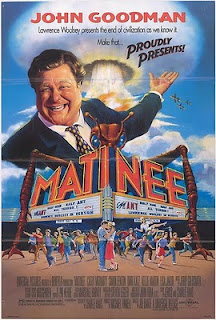
Academy of the Underrated: Matinee (1993)

Matinee Poster and Amazon link

Joe Dante is a director we haven’t heard from too much lately, and more’s the pity. Though he’s never ranked with the great auteurs, Dante is a wonderfully energetic filmmaker whose offbeat showmanship and love for the medium has enlivened many a project. After the wonderfully cartoon-like GREMLINS 2 failed at the box office for some strange reason, Dante went and made the best movie of his career, and a genuine overlooked classic of the 90s. MATINEE, recently back in print on DVD, is a tribute to a bygone era of low-budget moviemaking, but goes beyond nostalgia to reflect on why we like to be scared and why it’s a necessary preparation for life in a dangerous world. It’s also just charming as all get out, a slice-of-life taken at the weirdest possible time, when the years-long contrast between Cold War fears and B-movie atomic terrors reached the boiling point.

It’s October in 1962, and Gene Loomis (Simon Fenton), a military brat living (for the moment) in Key West, Florida, sees a trailer for a brand new monster movie from shock impresario Lawrence Woolsey (John Goodman.) MANT!, the thrilling true-to-life story of a half-man-half-ant monster, will not only have a special preview in Key West, with Woolsey debuting the new “Atomo-Vision” theatrical process, but Woolsey himself will appear. It’s a monster fan’s dream- but on the day he learns this, President Kennedy appears on television to announce that the Russians are building missile bases on Cuba and that the navy- Gene’s dad included- are being sent to blockade the island.

The show must go on. Woolsey, heading to town with his girlfriend/star Ruth Corday (Cathy Moriarty) is determined to make his monster picture the main event, and the kids are no less enthusiastic. Gene and his little brother Dennis (Jesse Lee) try to put their father’s absence out of their mind (he’s been gone before), and at school Gene finds himself drawn to the outspoken, beatnik-raised Sandra (Lisa Jakub), while his friend Stan (Omri Katz) manages to score a date with local beauty Sherry (Kellie Martin.) Unfortunately, Sherry’s ex-boyfriend, no-good greaser and terrible poet Harvey Starkweather (James Villemaire) is out of juvie and does his best to scare Stan away, while Gene- recognizing a local censor as a ringer for Woolsey to stir up controversy (and how could he not, since it’s Dick Miller)- worms his way behind the scenes of a premiere that’s as much stage show as movie. Everything builds up to one crazy Saturday afternoon, where MANT! premieres to a rambunctious crowd and panic is in the air.

There’s some debate over who deserves the most credit for this picture. Jerico Stone, the original scenarist, sued for screenplay credit, but was denied by the WGA. The guild’s arbitration process can be arcane and complex, and without access to the actual scripts I can’t really say how much of his work remains in the finished product. He did go on a bit of a letter writing campaign to just about any magazine that mentioned the film, saying Joe Dante was getting too much credit, which is possible. Far be it from me to ignore the plight of the oft-forgotten screenwriter.

Still, it’s hard not to see how, even if Dante didn’t conceive the film’s story, he was drawn to many of its elements. Woolsey is a riff on shock producer William Castle, who in the late fifties and early sixties experimented with all sorts of theatrical gimmicks, from floating skeleton puppets in HOUSE ON HAUNTED HILL to buzzing theater seats in THE TINGLER. GREMLINS 2’s “film break” sequence was a direct homage to Castle, which Dante had to fight the studio to include (his original plan included prop gremlins to be dangled in front of the projector, so audiences looking back would see the monsters in the theater.) I think it’s fair to hypothesize that Dante and Charlie Haas added at least some personal touch to Jerico’s original work. (It doesn’t help the writer’s case that he came off a little unhinged in his missives, apparently trying to ape Harlan Ellison.)

Whoever’s responsible, the narrative does elegantly keep a lot of balls in the air; the action is kind of slow up until the third act, but it’s the buildup of a farce, and the payoff works remarkably well considering all the separate elements in play. It helps that, as anecdotal as the action seems, there’s a clear thematic thread to all of it, all based around the idea of fear. In the film’s first ten minutes we go from the harmless fear of monster films and urban legends, to a game show on TV making light of a woman’s stereotypical fear of rats, to the very real threat of nuclear war. The boys at school are intimidated by the whole “talking to girls” problem, and no sooner does Stan overcome this than he is confronted by the much larger fear of Harvey beating him to a pulp. Harvey, then, tries to lift the wrong wallet and a threat of violence turns into a job offer. There’s a marked contrast between the threats that are real and the ones that are illusions, meant to soften us up a little.

By now most people know that John Goodman is a really good actor, but his performance as Woolsey is possibly his best work. He’s theatrical and showy, but somehow unpretentious- always about to give a knowing wink when he knows it’s safe to do so. It takes both charm and finesse to pull off a character like this, to justify the love and admiration Gene has for this schlock showman, even if his movies aren’t so good.

Speaking of which, the film’s second major triumph apart from Goodman’s performance is MANT! itself, an absolutely glorious parody of the 50s giant bug genre. (The filmmakers are cheating a bit in having a film like this come out in 1962, when the genre was well on the wane, but whatever.) The performances are wooden but sincere (Cathy Moriarty, a fine actress, does a great job being bad), much of the dialogue is lifted outright from actual giant bug epics, and the whole thing has the stiff-lipped sincerity that made the old B pictures look almost classy. (I particularly like the old scientist who, whenever he delivers an even slightly technical term like “accelerated”, stops to provide a grade-school-level synonym.) Interestingly, it doesn’t fall back on the easy laugh of an obviously fake monster- the Mant effects are kind of good, actually. They’re what the kids who saw the film would remember. Unfortunately, the DVD doesn’t include the complete MANT! footage which made its way onto laserdisc, but a quick search of tube-esque sites should bring that up. (There’s also a nicely vicious parody of dopey live-action kiddie movies of the era, featuring Naomi Watts and Archie Hahn in THE SHOOK-UP SHOPPING CART.)

The film is loaded with topical references, with the occasional easy laugh from kids in school being taught to get three servings of red meat a day and the like. This blends with Dante’s fondness for inside jokes, including more than a few references to FAMOUS MONSTERS OF FILMLAND- a young Dante once had an article published in the horror fanzine of note. Of course, it’s hard to tell the in-jokes from the material that’s actually genuinely important to the story, and this perhaps explains part of why this film is such a success. And I’d be remiss if I didn’t mention how good the kids are- it’s hard to find young actors and actresses that can hold their own with the likes of Goodman, Moriarty, Robert Picardo, et. al. Jerry Goldsmith’s score, orchestrated by Alexander Courage, adding unexpected gravitas to what is, after all, a low-budget comedy.

I’m still debating in my head whether this qualifies for Academy of the Underrated or not. The vast majority of critics liked it a lot, but the film quickly disappeared for lack of support by Universal, another project by Dante that went without an audience for no good reason whatsoever. (Ironically, mere months after this paean to the monster movie ran its course, JURASSIC PARK revitalized the genre and broke box office records. It was a good time to be a monster fan.) The film’s intermittent availability on home video and DVD hasn’t helped any, and I’m tempted, on the balance, to put it in this august category simply because it deserves the attention. It’s a bit of a cheat- normally this category is for movies that people genuinely didn’t like- but I’m willing to do it.

MATINEE is a movie lover’s movie, and it expresses the magic of the cinema and its effect on American culture in a wonderfully irreverent and unpretentious way. It offers the hope that our rituals of fright and cinematic armageddon can, perhaps, equip us to better deal with the real thing. In a few days in October, Gene Loomis undergoes a rite of passage, and discovers that the adult world is as ramshackle and uncertain as his own. It may not be CINEMA PARADISO, but it is far and away Joe Dante’s finest film, and a warm and humane work that is well worth discovering. Or rediscovering- it may be nostalgia on my part, but the film has aged beautifully.

Story by Jerico and Charlie Haas
Screenplay by Charlie Haas
(bear in mind the above caveats about disputed screen credits)
Directed by Joe Dante

Grade: A

Tuesday, March 16, 2010

Random Movie Report #74: Shanks

Shanks poster and IMPAwards link
The early Seventies were a time when major Hollywood studios granted an unprecedented level of creative freedom to filmmakers. We primarily remember this period for the early masterworks of filmmakers like Coppola, Altman, Scorcese, and so on. What fewer people know is that the studios’ greater willingness to experiment also resulted in some really weird shit. There were films backed by the likes of Paramount, Universal, et. al. that would not be backed or released at any time before or probably since, and as a nice reminder of this period, TCM’s “Underground” recently broadcast SHANKS, legendary horror guru William Castle’s last film as director and a vehicle for famous mime Marcel Marceau.

I have seen many weird films. I take it as a point of pride. So when I say SHANKS is one of the very weirdest films I have ever seen, take a minute to contemplate what that means. We are in freaky-deaky territory. Part comedy, part horror film, part silent movie homage, part showcase for mime choreography, SHANKS is a film that fell behind the desk of the movie industry and has collected dust for some time. It is not on DVD, and I’m not even sure there ever was a VHS release either. There are many reasons for this- it’s a slow, quiet movie with all sorts of problems, but there’s something jaw dropping about it too. It’s just singular enough to be worth seeing, and it goes so far outside the bounds of normal filmmaking that it’s hard to judge by normal criteria. I've got this tagged for the Academy of the Underrated, but the heading is for Random Movie Report because brother, they don't get any more random than this.

Marceau plays two roles, that of Malcom Shanks, a deaf-mute puppetteer living on welfare with his awful relatives, and Old Walker, a scientist experimenting with reanimation. He sees Shanks’ skills controlling marionettes and employs him to work at mastering a form of remote-control involving electrodes placed in dead bodies- first frogs, then chickens, then people. Walker dies after several weeks, but Shanks is unable to convey this to his horrible drunk brother (Philippe Clay) and horrible shrewish sister-in-law (Tsilla Chelton), who send him back to work to get more money. So Shanks works on re-animating his old companion, taking him for walks and making his movements almost lifelike. When his brother tries to shake up Walker for the money he’s promised, Shanks kills him with a radio-controlled chicken, then adds him to his puppet ensemble- along with the wife when she gets hit by a car. Things are going well until Celia (Cindy Einbacher), a little girl who’s friends with Shanks, insists on going on a picnic with him and his housemates, during which she discovers what he’s been up to. Somehow this doesn’t bother her too much, and he takes her to an impromptu birthday party at Walker’s place, but then, as commonly happened in the Seventies, a biker gang shows up.

Presented as a “grim fairy tale”, SHANKS seems to primarily have been conceived as a vehicle not just for Marceau’s own miming skills, but those of the people he revives. (Marceau served as choreographer on the film as well.) It’s a classic low-budget, in which a producer looks at what resources he has available at the time and bases a film around them. If you know a guy who has a prop plane, you make a movie with lots of flying sequences; if you know a mime, make a movie about corpses being raised and turned into life-size puppets. The film has a weird, creaky stylization to it, complete with silent-movie-style intertitles that make some interesting comments on the action.

One doesn’t expect learning how to control corpses via electrodes to be an easy task (God knows the aliens in PLAN 9 FROM OUTER SPACE had their problems with it), but a good portion of the action is taken up with Shanks mastering his craft on Walker and others, and well, there’s no avoiding it- this is really goddamn slow. Judicious editing could easily have cut a lot out of the film, but I imagine the problem was that doing that would have left Castle without enough for a feature. That said, there is a certain fascination in it too- the agility displayed by the performers is amazing, to be sure, and they’re all very convincingly awkward and manipulated. It’s a bit like watching the dancing in an Astaire/Rogers movie- it doesn’t advance the plot much, but it’s meant to be compelling in and of itself.

This is a film that by all rights should be utterly awful. Shanks’ relatives are so authentically nasty that they become painful to watch, up until the point where they die and become lovable automatons. Appropriately for an early-Seventies film, the moral compass of the picture is all over the place- the climactic captions try to paint this as a struggle between good and evil, but Shanks did kill his brother, and is making a living of sorts off this bizarre practice. But Marceau does make the character work as an outcast antihero, and I have a weakness for those.

It’s a weird enough movie that I was surprised to see the Paramount imprimatur on it, because I’m trying to imagine how the Hell you pitch something like this. Maybe Castle was using his good will from ROSEMARY’S BABY. But something this odd, this inconceivable, takes on a life of its own. I can’t help but think it’s valuable in and of itself, independent of any objective aesthetics; it’s such a singular production that it must be preserved and treasured because nothing like it will ever slither out of the studio machinery again. So, Paramount, give us a DVD, if not for commerce, then for the ages.

Written by Ranald Graham
Directed by William Castle

Grade: B-

Sunday, January 31, 2010

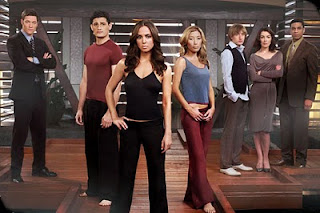
Academy of the Underrated, TV Version: Dollhouse

Dollhouse cast photo and Amazon link
So, to the sadness of some and the outright joy of others, the series DOLLHOUSE came to an end this Friday. Joss Whedon’s latest was a polarizing beast, to put it mildly, and while some of the issue seems to be that the geek favorite was due for a backlash, it was also a weird and uneven show. It was the mutant product of a deal between Fox and star Eliza Dushku that produced a show that would not have been greenlit otherwise, on a network that the showrunner had previously been badly burned by. Its cancellation was anticipated well before it aired, and its survival to a second (albeit brief) season was received with shock. On top of it all, there’s a whole host of gender politics and sexual issues invoked by the subject matter, which leads to fun times and accusations for all.

But what about the show itself? Well, I liked it. I liked LADY IN THE WATER too, so take anything I say with enough salt to kill a man, but I feel weirdly compelled to speak about what I think made this show worth watching. The premise was creepy, the tone jumped from 80s action series to cyberpunk mindfuck and back and forth without much warning, and arguably Ms. Dushku was in over her head, but just about every time the series seemed on the verge of total breakdown, something came along and prodded it back into engaging weirdness. I’m not sure what kind of piece I’m writing here, it’s got the bones of a review but there are various extratextual thingies I want to get into as well, but if you bear with me just a moment I’m sure we’ll have this sorted by the end.

So, the Dollhouse is a project put together by the Rossum corporation, home to all sorts of brain-breaking technology. Clients pay exorbitant amounts of money for the service of one of their “actives”, people programmed with a specific personality for the situation at hand. Many use it for a high class, highly specific brothel, others use it to hire bodyguards, negotiators, midwives (though that’s a weird story), surrogates for dead loved ones, etc. Dushku plays Echo, the most popular active, who has a habit of retaining bits of memories and skills from every imprinted personality she’s ever had, as well as flashes of her original self, who’s stored away on a hard drive as part of a contract signed when she needed to disappear for a few years.

The first few episodes in both seasons focused on individual jobs Echo took on, a “bottle show” approach that seemed to backfire on the show pretty quickly. On the one hand, it’s the obvious approach- the gimmick of the show is that the protagonist can become anyone, do anything, so throw them into some standard action show situations and have fun. Honestly, I did not hate these kinds of episodes, for the most part. I even have a soft spot for “Stage Fright”, the admittedly goofy as Hell installment in which Echo becomes a bodyguard for a pop star whose life has been threatened. It hit a weird nostalgia that I don’t even have for shows I never even watched, shows like KNIGHT RIDER and CHARLIE’S ANGELS where the point was to see which basic story concept got picked out of the pile each week (“Angels, I need you to go undercover... at Las Vegas' newest casino resort!”) I dunno. The basic problem was, Echo is usually tabula rasa without a specific personality, so there’s no character to get attached to, and while the second season established more of a baseline personality for her based on her accumulation of imprints, the bottle shows felt more like an anthology than anything else. And anthologies have not played well on TV for a while.

(As a side note, it’s worth investigating why that is. Seriously, we used to have THE TWILIGHT ZONE and PLAYHOUSE 90 and ALFRED HITCHCOCK PRESENTS but now every show has to have continuing characters and an ongoing storyline. What happened there? Changing the subject, sorry.)

In any case, the bottle shows did start to feel rather uninspired, and eventually the show got around to the more popular (critically, at least- commercially the show was dead in the water more or less the whole time) approach of episodes focused on the machinations of the Dollhouse itself. From the start you had the subplot of a former FBI man named Ballard (Tahmoh Penikett) obsessed with revealing this clandestine operation, and with Caroline, Echo’s original self, who apparently found out way too much about Rossum. And of course, the technology to reprogram people can be used for a lot more than just prostitution and temp jobs, and it’s suggested that the Dollhouse is basically a moneymaking machine and R&D house used in support of whatever Rossum really has planned.

This raises some very weird issues. In theory, all the actives have joined the program by choice. They serve 5 years or so on a contract, and are released back into their normal selves with a ton of money and whatever unpleasantness drove them there erased somehow. Clean criminal records, selective memory wiping to remove traumas, that sort of thing. But even if you were to overlook the coercion involved in getting some of the actives hired, the question is whether or not you can pre-emptively consent to indentured servitude, without any way of backing out in the middle if you change your mind. (In fact, since your mind is on ice, you can’t change it.)

So it’s uncomfortable, and that the show did not immediately come out and say that this was bad, bad, bad made some people argue that it was a glamourized prostitution fantasy. Not that the Dollhouse was ever unambiguously positive either- rather, its manager, Adelle DeWitt (Olivia Williams), about whom I will say more later, was a morally conflicted figure trying to justify the sleazier engagements by balancing it out with pro bono work.

Now, there’s a lot of additional stuff that comes up here, regarding Joss Whedon’s own reputation as either a feminist or not-really-a-feminist and whether sights like Eliza Dushku in bondage gear have any place in “feminist” work for whatever definition that has, and it’s all very inflammatory and impossible to discuss because it’s more polarized than a pair of 3-D glasses, and so on. I’m tempted to dismiss this with the old David Cronenberg adage of “an artist has no social responsibility whatsoever”, which may seem like an extreme statement but did you ever make VIDEODROME, but in this case I think it may be enough to say that the subtle wrongness of everything fit the material quite well. The Dollhouse has a pleasant veneer; it’s the appealing face of a company out to control your mind, after all. Every character is dealing with difficult and morally uncertain situations, so it makes sense that we’re made a little uncomfortable alongside them. And if it’s problematic, well, so’s any work worth discussing.

Cronenberg seems like an appropriate authority to appeal to here, because DOLLHOUSE evokes a lot of the themes and concepts that he’s dealt with as a filmmaker. You’ve got identity and transformation thereof, massive corporate conspiracies, sex and violence, and as we just talked about, moral ambiguity up the wazoo. I’m not sure if Whedon was specifically influenced by anything Cronenberg did, but I would wager money that at the very least he’s drawing on Philip K. Dick.

Of course, similarities aside, the show does trade a bit more on moral certainty in the end; the unaired DVD-exclusive episode “Epitaph One” (the result of some weirdness between Fox and the show over how many episodes were ordered) reveals that the Dollhouse tech is ultimately responsible for bringing about the end of civilization as we know it, Adelle’s attempts to keep her Dollhouse ethical put her at odds with Rossum, and the emotional toll all this takes on the characters is not ignored.

Still, the discomforting nature of the show was probably what, more than anything, doomed it commercially. The success of Whedon’s BUFFY THE VAMPIRE SLAYER (and most other genre shows) was partly due to fans’ identification and empathy for its main characters. He could and did put them through the emotional wringer, but there was still a certain safety in their friendships and our knowledge of them as fundamentally good people. While FIREFLY was a commercial failure, I’d argue that the reason it has such a fiercely devoted fanbase is because the crew it created is so damn likable, and even the ship itself took on a certain “safe haven” quality, even when invaded by bounty hunters and the like.

DOLLHOUSE doesn’t really offer that- every character is morally compromised on some level, the place’s Zen garden quality is a mask for the ugliness of what gets done, and even if this show had gotten good numbers, dark intense conspiracy thrillers really only work for a few years before they inevitably lose focus. (David Duchovny, early in the run of THE X-FILES, said it shouldn’t run for more than five seasons. He may have been right.) Heck, even BATTLESTAR GALACTICA had more of a comfort zone.

Eliza Dushku took a bit of criticism for her work as the lead. It’s funny- I remember that when she was on BUFFY, people liked her performance a lot, but she is apparently now a terrible actress who couldn’t carry an infomercial let alone a series. (This kind of hyperbole is intrinsic to fandom- I have pretty much heard the same about every DOCTOR WHO companion, everyone on TORCHWOOD, every Bond Girl since I started paying attention to Bond movies, etc.) Now, I do think she’s limited, and in the first aired episode there are a couple of very obvious, very stagey moments where she doesn’t quite convince. But if she got pushed out of her zone now and again, I think she held up most of the time. The overall ensemble fares better; in particular, Enver Gjokaj, playing the active Victor, steals the show on several occasions, and someone needs to cast him in something now because he is awesome.

And as long as this is getting, I want to talk about one more thing.

Adelle. Fucking. De Witt.

Olivia motherfucking Williams as Adelle motherfucking DeWitt

In retrospect I could just mention her and that would be all the defense this show needs. She is arguably one of the very best characters that Joss Whedon has created. Indeed, for those who say that he doesn’t *really* write strong women, well, there’s Adelle. True, she’s got issues. She’s got trade paperbacks. She is conflicted from the start, the pleasant face of the Dollhouse, the ruthless protector of it, and the jailer of a whole alphabet’s worth of men and women. But her moral journey is the show’s most compelling arc, and Olivia Williams plays it superbly. What I said about the show not having the most identifiable ensemble is true, but Adelle- I love Adelle.

Also, whoever is responsible for the character’s fashion needs, if not an Emmy, some sort of medal for distinguished service. I normally don’t notice these things, and Williams would look good wearing a potato sack, but not only is Adelle reliably fabulous, her wardrobe and hair reflect character and mood in the most wonderful way. Whether it’s the gentle look when she’s setting up deals with clients, or a black power suit when the gloves are off, she’s like a mature, morally conflicted Emma Peel.

The whole thing ended on an understandably rushed but still satisfying apocalyptic cyberpunk bash-up, which brought the characters’ various arcs to mostly satisfying conclusions. When the show was renewed for a second season, I took it as a gift, and apparently the showrunners did as well, and we got to have closure. The whole thing was a freak, a mutant that got away from Fox, Whedon, and everyone else and did some neat stuff in its short time. It won’t go down as a classic, but it’s one of the most idiosyncratic things I’ve seen on network TV in a while, and that should guarantee it a minor place in history.

In other words, Grade: B+.

Sunday, December 20, 2009

Academy of the Underrated: The Wizard of Speed and Time

Wizard poster and link to Mike Jittlov's Wizworld
This is a film that gets into the Academy by virtue of sheer obscurity. It’s possible that critics and audiences would have embraced this film had it been given more than a cursory release, but instead it’s remained underground due to distribution woes, not too hard to locate on VHS in the day but unreleased on DVD. (I’ve got a bootleg made off Blockbuster’s rental copy, but it’s seen better days.) Mike Jittlov’s unique autobiopic/special effects extravaganza really deserves a wider audience. It’s a legitimately weird and heartfelt picture, and for all its indulgent and amateurish qualities (which include a truckload of really dumb jokes), it’s the finest salute to geeky creativity I can name. It’s basically our ROCKY.

Set in Hollywood, 1977 (and possibly another dimension), the film follows Jittlov as himself, a struggling freelance special effects artist and filmmaker. His demo ends up at the desk of Harvey Bookman (Richard Kaye), a sleazy producer in charge of Hollywood Studios’ “Hollywood’s Greatest Effects” television special. After making a bet with Lucky Straeker (Steve Brodie), the director, that Jittlov can’t produce anything worth using, Bookman hires the filmmaker to produce a short film for the special, and then sets about trying to ensure that it never gets done. No studio space, no actors, no payment until it’s turned in (and perhaps not even then). Mike sells most of his personal belongings to start work with his friend and producer Brian Lucas (David Conrad), and create a musical short in which he stars as the Wizard of Speed and Time, a spirit of creativity who brings an entire studio to life in vivid stop-motion. Bookman and fate still throw plenty of curve balls his way, including two inept thugs (Gary Schwartz and Frank LaLoggia), various weather mishaps, and a general lack of support from the studio. Still, he keeps his spirits up, meets Cindy, a lovely young actress (Paige Moore), and uses all the special effects at his disposal to try and make movie history.

This is all kind of sort of based on reality. In 1979 Jittlov produced the original “Wizard of Speed and Time” short as a segment for a Disney-backed TV special called MAJOR EFFECTS. The show aired frequently on the Disney Channel (for which Jittlov would create the opening on-air short, with a giant Mickey Mouse satellite beaming down the signal- this appears briefly in the film along with the prop used), and Jittlov’s Wizard was one of many who worked to restore the powers of the titular superhero, Major Effects. As in the movie, the studio used no outside footage and treated it as a showcase for its own live-action effects productions, notably the upcoming epic THE BLACK HOLE. Similarly, the DOCTOR MAGIC pilot for which Mike is rejected is likely a reference to the ultimately underwhelming DR. STRANGE TV movie from around that time.

However real the details, the actual movie is a broad, farcical romp; the characters are comedy types, the laws of physics are bent on a whim, location shooting without a permit starts a citywide manhunt, and special effects are everywhere. Jittlov never met a transition or short shot he couldn’t spruce up with something, and his colorful handmade visual effects add life and energy to the proceedings. The picture simply flows in a different way from most normal movies, bouncing along and always throwing something new at us. It helps that Jittlov is really good at his craft; there’s a lot of impressive stuff here and I’m still not entirely clear on how all of it was done.

Some of the characterizations suffer for this; the thugs Bookman hires seem like knockoffs of Cheech Marin and one of the Mackenzie Brothers, while Cindy’s roommate is the archetypal “sassy black friend”. And to be sure, your tolerance for dumb jokes will be tested, frequently. I, however, love dumb jokes so that’s fine by me. And the actors are solidly game; a number of minor parts are filled out by veterans like Angelique Pettyjohn, superfan Forrest J. Ackerman, and AIRPLANE’s Stephen Stucker (his last role), and the leads are engaging.

One of the major problems of making a movie about yourself in which you are the misunderstood outsider standing up against the corrupt system (getting the girl in the process) is that the whole thing can end up seeming like an ego trip. That the film doesn’t collapse into this is kind of remarkable. Jittlov is so authentically oddball and gentle in his personality that he’s not just likable, he makes a good “type”, someone you can see as a stand-in for everyone who makes home movies or tries to bring a weird vision to life. It’s not so much about him as about the creative spirit.

One bit that may have contributed to Jittlov’s film not getting much circulation is its rather pointed criticism of the Hollywood union system. Jittlov gets rejected for DOCTOR MAGIC because it’s a signatory production, and he would have to join dozens of unions to cover all the work that he does. In a whirlwind sequence, he goes to them all and is swamped under a sea of dues, procedures, seniority restrictions, and redirections (William Z. Ryan plays the various union reps.) As you may know, I supported the WGA strike, and I think the creative unions have done a lot of good work in supporting talent, but there’s a point to be made that the special effects side of things has been weirdly affected by unionization. Effects crews are now massive armies, with little room for the artistry of a Jittlov, a Ray Harryhausen, or a Willis O’ Brien; there are still some big names, but the company masthead tends to overshadow the individual. It’s more complex than unions alone, I don’t doubt, but it’s an interesting issue that the film raises in its offbeat way.

The trailer for this film (which ran in front of the VHS release) says, “Five years in the making! Five days in the theaters!”And then we realize that whoever was in charge of distribution maybe did not do the best job. (This is always the pitfall of independent filmmaking- just because you’ve actually finished a movie doesn’t necessarily mean you’ll get to show it to anyone.) Sure enough, the film was gone from theaters before anyone knew it had even been out, and though it received a limited release on VHS and Laserdisc, it received no publicity there either, and I’m not sure if it’s ever been aired on television.

Mike Jittlov reportedly feels that he was cheated by the distributors, and has actually gone to the lengths of encouraging people to bootleg or download the picture, at one point contributing a DVD-quality rip to Bittorrent (that I cannot find at this stage.) There’s another high-quality rip out there, called the “Swordsman” torrent, but I’m having trouble getting that one due to my staggering incompetence with Bittorrent’s not-actually-difficult client software, so I’d check around. Jittlov, who went on to contribute effects to the film GHOST (actually playing the role of the “dark spirits” that drag some of the dead guys away), has remained active in fandom circles and maintains a website (linked above), and from all accounts is great with his fans. The rights to the picture may actually have reverted to him at some point- my understanding of the issue grows hazy here- but he’s understandably nervous about turning it over to anyone for wide distribution on DVD or other media.

So it’s worth keeping an eye out in the weirder corners of the Internet for this picture, though I still hold out the hope that Criterion or somesuch will offer Jittlov unlimited legal control, buckets of money, Swedish citizenship, whatever for the ability to finally give the film the deluxe edition treatment it deserves. But even if it just zips around the information superhighway, THE WIZARD OF SPEED AND TIME is a treat. It’s a great accomplishment for its filmmaker, and a wonderful gift to everyone who’s ever dreamed of making movie magic.

Written, Directed, Edited, and Effected by Mike Jittlov

Grade: B+

Friday, December 19, 2008

Academy of the Underrated: The Godfather Part III

Godfather III on DVD at Amazon.com
To coincide with the most recent release of the GODFATHER trilogy on DVD, all three films (the first two with restored prints) have been making the theatrical rounds. I missed the first film for nothing more or less than criminal personal negligence, but I caught II and III. I’m going to have to review the first two someday, but for now I’ll just take a look at the least-loved entry. THE GODFATHER PART III, is, to be sure, the least good of the three films, but when you consider that the first two are among the finest American films ever made, that’s not saying too much. The fact that it’s not up to this lofty standard means it gets a lot of flak, but in truth it holds up pretty well as an appropriately operatic finale to the story of Michael Corleone and the legacy he’s spent a lifetime trying to get away from. (Spoilers for the first two are below the cut, but seriously, you haven’t seen these films?)

The film takes place in 1979, after Michael Corleone (Al Pacino, natch) has moved back to New York and is continuing to try and become a respectable citizen. The first major sequence is a reception after Michael has been honored by no less than the Roman Catholic Church for his charity and humanitarian work, but in attendance is local enforcer Joey Zasa (Joe Mantegna), who’s been having run-ins with Michael’s bastard nephew Vincent Mancini (Andy Garcia), who’s inherited his father Sonny’s bad temper and masculine charms. All of this mobster business threatens to interfere with Michael’s attempt to finally make the Corleones legitimate; by paying off some of a deficit incurred by the Vatican Bank’s less-than-scrupulous accountant (Donal Donnelly), Michael will get their vote on a takeover of Immobiliare, the largest real estate company in the world, effectively transferring all his family’s holdings to this one clean business. When Michael calls the owners of his casinos to a meeting to formally dissolve their partnership, a brutal massacre takes place and he is forced to once again play the Mafia game to protect himself and his family. There’s further trouble brewing within the household, though, as Vincent has fallen in love with Michael’s own daughter Mary (Sofia Coppola.)

The plot dealing with Immobiliare and the Vatican is a rather intricate one, such that, having seen the film three times now, I’m still not entirely sure I get all of it. But it’s as fascinating as the elaborate ventures in the earlier films, showing corruption at the most rarefied heights of power and nicely playing into a brief but suspect chapter in the history of the Catholic Church. The idea is that Michael is essentially trying to wash his money clean, and atone for his many, many sins in the process. The film is the story of his attempt at redemption, and as one might imagine it does not go smoothly.

The weak link that’s been constantly attacked in regards to this film is Francis Ford Coppola’s decision to cast his own daughter Sofia as Mary. In his and her defense, the role was supposed to go to Winona Ryder, who bowed out for some reason at the last minute, and Sofia was the only person available on short notice. However, the poor girl just can’t act. She comes off as bored and wooden, and not nearly as sympathetic as the character is meant to be. This is a significant flaw, make no mistake. But it’s not quite the killer you’d expect, as the romance between Mary and Vincent (who does have a competent actor bringing him to life) doesn’t take up that much screen time. Coppola was also at a slight disadvantage in catching Al Pacino sometime after he decided that subtlety was a mug’s game; the chilling detachment of PART II’s Michael Corleone is replaced by a more bellicose personality, and the character this time is prone to diabetic fits which have the actor lurching about like the Frankenstein monster. That said, I don’t dislike his performance; if he goes over the top now and again, well, this is a bit of an opera. Literally, as Michael’s son Anthony (Franc D’Ambrosio) has grown up to become a singer about to make his operatic debut in a Sicilian production of CAVALLERIA RUSTICANA, the performance of which forms the film’s final act.

Once again we’re treated to some amazing locations and warm visuals, though obviously the period detail has been downplayed simply because there’s less of it. A rich bronze look defines much of the picture, taking place as it does in Michael’s autumn years. The picture has a slow pace, but it’s the slowness of old age, and there’s something oddly satisfying in the way the protagonist takes stock of his life and attempts to put things behind them, even when it doesn’t work. He confesses his sins, most particularly his ordering Fredo’s death, to Cardinal Lamberto (Raf Vallone), soon to be Pope John Paul I. He reflects on, and tells his children about his late wife Apollonia. Just as prominently he attempts to affect some kind of reconciliation with Kay (Diane Keaton), who has moved on with her life but never fully stopped loving him or being scared of him. Pacino and Keaton are at their best together, in a long interlude where they try to assess just where they are in regards to each other. Talia Shire returns as Connie, who in her later years has become a strangely dark figure who understands the family business better than ever. Veteran character actor Eli Wallach’s turn as the too-pleasant Don Altobello is especially memorable, and though it’s nearly unforgivable that the filmmakers failed to hire back Robert Duvall as Tom Hagen, and as odd a choice as it was to have the new lawyer be played by George Hamilton, he fits in better than you’d think.

Perhaps even moreso than the other films, THE GODFATHER PART III is a tragedy, and a good deal of my affection for it springs from how gloriously it all goes wrong in the end. There’s something strangely fitting about it, and though the film doesn’t quite get to the root of Michael’s moral failings, to the why of what he does, it’s a strong reminder of just how hard redemption can actually be. It’s difficult to not just recognize sin but turn away from it, and though Michael is always haunted by what he does he can never quite give it up. This is a worthy finale, and what mistakes it makes are not nearly as significant as what it gets right.

Written by Mario Puzo and Francis Ford Coppola
Directed by Francis Ford Coppola

Grade: B+

Friday, November 28, 2008

Academy of the Underrated: Doctor Who: The Movie

Doctor Who: The Movie on R2 DVD from Amazon
With DOCTOR WHO’s popularity now at an all time high, it’s interesting to look at a period when its hopes for the future seemed to rest on a long shot. The 1996 DOCTOR WHO television movie was an American co-production between Universal and the BBC for the Fox Network, and intended as a backdoor pilot for a potential new series. It was not a reboot, but a straight continuation of the classic show, and is still considered canon for whatever that’s worth. Obviously it was not the hit its producers wanted, and making the thing dependent on an American audience was probably a bad idea to start with, but despite falling into obscurity somewhat, the DOCTOR WHO TVM (as it’s sometimes referred to) has a lot to recommend it. It’s atmospheric, good-looking, and fun, and though the plot is twisty and coincidence-laden the whole production has too much charm to let that be a major problem. It’s gotten the reputation of being an “Americanization” of the concept but I think that’s being too harsh.

The Doctor (first seen in the guise of Sylvester McCoy) starts off being entrusted to take the remains of his old enemy, the Master, back to their home world of Gallifrey after his apparent execution on Skaro. (The arguments over why the Daleks would let the Doctor do anything or put the Master on trial to begin with echo widely throughout fandom, but let’s keep moving shall we?) However, the Master hasn’t so much died as turned into a slithering amorphous thing, and he manages to short out the TARDIS, which crash-lands in San Francisco on December 30th, 1999. The Doctor gets shot by a street gang as soon as he exits the TARDIS (insert your own social commentary), and Chang Lee (Yee Jee Tso), former Chinatown street gang member (former by virtue of his entire gang getting gunned down just prior) accompanies him to the hospital.

However, at the hospital, there’s a lot of confusion over a patient whose chest X-ray shows two hearts and seems to react very negatively to anesthetic, and in the confusion the Doctor dies. He regenerates into a younger body (Paul McGann) but with quite a few gaps in his memory, and he latches onto one face he remembers: Dr. Grace Holloway (Daphne Ashbrook), the heart surgeon who was in charge when he croaked. She thinks she’s dealing with a crazy man until he pulls a surgical probe out of his chest, and even then she’s not really convinced. In the meantime, the Master has possessed the body of an EMT (Eric Roberts), but his human form is not long for this world, so he cons and hypnotizes Chang Lee into helping him with a plan to use the Eye of Harmony, the TARDIS’ power source, to steal the Doctor’s body and all his remaining regenerations. The side effect? Having the Eye open during this procedure will eventually suck the entire planet through it, and wouldn’t you know, the deadline is midnight on New Year’s Eve.

So, yeah. Screenwriter Matthew Jacobs came up with a plotline that ultimately was too big for a 90 minute film, and a few details were sacrificed in trimming it down. There was an apparently an explanation for why the Master becomes a snake creature and how the Daleks were involved and so on, but the plot we see on screen is just a tad convoluted and relies a lot on coincidence. Some details get lost in the wash- the Doctor walks through a window and says he’s lost 20 pounds in 20 minutes both as a result of the Eye being open, but these elements of the Earth’s impending doom never come up again. There aren’t any plot holes of the “this really cannot happen given what we’ve seen so far” variety- the film doesn’t break its own laws as far as I can tell- but there’s an awful lot of handwaving involved.

The film also introduced a few controversial elements to the new WHO mix. The Doctor hints that he’s half-human, something that was intended to be a much bigger issue in executive producer Philip David Segal’s original series pitch- here it’s not even clear whether he’s serious, but the Master appears to think he is. It’s an element that might have been a problem had this gone to a series, but as such it’s just a weird quirk. Somewhat more controversial at the time was the Doctor’s romantic chemistry with Grace- up to that point he had been portrayed as mostly asexual (despite having a granddaughter), and though it never gets developed any further than a John Steed/Emma Peel type flirtation and a couple of good kisses, it was shocking at the time (as was the British press’ mistranslation of a phrase in the script, “Grace bonks the Doctor.”) The romance, plus a scene where the Master and Chang Lee in an ambulance pursue a motorcycle-riding Doctor and Grace, led to cries of “Americanization”, even though both the writer and director are British and the whole thing was shot in Vancouver. In the interim, though, the new series has taken the concepts of Doctor/companion romance and high speed action even farther, and though the TVM does some catering to American sensibilities, it doesn’t blot out the show’s roots.

Indeed, I remember that when this was broadcast, my biggest concern was whether they’d get the “feel” of DOCTOR WHO right. But from the very first scenes, where the Doctor relaxes in a charmingly steampunk TARDIS control room to an Eartha Kitt record, the atmosphere is dead on. Throughout the film maintains a great balance of whimsy and dread, with enough of the surreal to remind us that we’re still in the same universe as the old series. It helps that the dialogue is fairly snappy and clever even when the plot comes up short; there’s some very nice banter, and a spirit of good humor that makes the goofy moments more palatable.

The great tragedy of the TV movie’s poor ratings performance (in the US at least, where it was up against stiff May sweeps competition) is that this is as much as we’ve ever seen of Paul McGann as the Doctor (though not the last we heard, as he did several Big Finish audio productions afterwards.) As short on screen time as he is, McGann makes his mark pretty strongly; his Doctor is brighter than his immediate predecessors (McCoy had been a humorous Doctor to start but darkened near the end), capable of almost childlike wonder but possessing the intelligence and presence of a 900-year-old Time Lord. (The filmmakers also gave him the interesting ability to know a bit too much about everyone he meets.) Rumors often circulate among fans that McGann might appear in the future, possibly in a flashback to the offscreen Time War, but so far no dice. Eric Roberts’ version of the Master is high on the camp scale, but that seems to be the nature of the part. Daphne Ashbrook has a couple of shrill moments but is mostly charming, and Yee Jee Tso does pretty well; neither of these two were signed on in the event a series was ordered, but it’s interesting to think what they might have been like as companions.

More expensive than the average Fox Tuesday night movie, DOCTOR WHO has great production values and appealing visuals (with effects supervised by Tony Dow- THAT Tony Dow, yes). Director Geoffrey Sax composes all sorts of interesting shots, usually around themes of eyes and other circular patterns, and the use of colors- mostly blue and orangish-yellow- is striking. When the old series went off-air in 1989, it was still stuck in an increasingly outdated and stagey method of filming; low budgets and tight schedules meant fewer camera setups and fewer takes. During the long hiatus/cancellation, drama TV and its bastard cousin genre programming adopted a more cinematic style, and this film was really our first hint of what WHO would have to look like in the modern era. The TVM also benefits from a lush score by John Debney, John Sponslor, and Louis Febre; I have to confess I’m one of the few fans of the unusually superheroic rendition of
the classic theme.

DOCTOR WHO aired once on Fox, didn’t do well enough to merit a follow-up, and has since pretty much vanished in the US apart from a couple of cable airings. Universal still owns the film in part, whereas Warner Home Video handles the BBC’s WHO releases in this country, hence nobody’s made much effort to get this on R1 DVD. The project may have been doomed from the start; a DOCTOR WHO series made to the visual standards of US television in the mid-90s would be very expensive, what with the changing locations every week. After the production became a backdoor pilot instead of a proper series opener, Universal decided it would have to get a pretty big audience share to merit taking things any further (at this point they still had SLIDERS, a slightly cheaper spin on the whole “dimensional travel” concept), and of course it didn’t. Some have blamed the reliance on past continuity, spending so much time with McCoy’s Doctor instead of the proper star, etc., but really, this aired once and never again; there was no time for word of mouth to have an effect, positive or negative. The film received good ratings in the UK, and the BBC wisely decided that any future attempts at reviving WHO would be directed chiefly at that audience. Took them 9 years to try again, but I understand there was some sort of legal thing.

It’s interesting to look back on the DOCTOR WHO TV movie and see it as a taste of what was to come: faster and often looser storytelling, stylish visuals, a bit more action, and a finally-not-asexual Doctor. But I also love it for what it is, a high-spirited adventure about defying death, turning back time, and taking chances, all things that the good Doctor does regularly. It’s a shame this couldn’t be much more than a footnote in the show’s history, but at least it’s an entertaining one.

Written by Matthew Jacobs
Directed by Geoffrey Sax

Grade: A-

Saturday, August 09, 2008

Academy of the Underrated: Equilibrium

Order Equilibrium from Amazon here
This is one of those movies that passed me by for a while, and somehow I let myself ignore the good things I heard for many years. EQUILIBRIUM is two parts thoughtful dystopian sci-fi and one part Hong Kong gunplay film (though perhaps the ratio’s more like 3:2), and though THE MATRIX rode this kind of genre-blending to box office gold, this one kinda fell into a niche between its two target audiences. It’s got a cult audience, though, and I seem to fit into that very small shaded area on the Venn diagram of Gun Fu enthusiasts and admirers of Huxley. I liked EQUILIBRIUM quite a bit, and though it’s not developed enough to reach a level of true greatness, it’s surprisingly entertaining.

The film takes place some time after World War III, which the remnants of humanity decided was the product of mankind’s innate passions. A bunch of them have gotten together and reshaped civilization into a monochromatic authoritarian land where all manifestations of emotion are banned. Everyone takes regular drug injections to keep their mood stable, and the needlessly overnamed Tetragrammaton Council sends “clerics”- highly trained killers skilled in the art of “gun kata”- to arrest and usually kill people who insist on clinging to emotions and works of art from the old times. (Amusingly, the board of censorship regularly bans works by classing them “EC-10”, for emotional content, and I’m sure the resemblance to the MPAA ratings system is just a coincidence.)

Joseph Preston (Christian Bale) is a cleric, one of the best, but his faith is first shaken when he has to execute his longtime partner Errol Partridge (Sean Bean, dying even more quickly than usual this time around), who has been sneaking books of poetry on the side. Soon after, he accidentally misses his morning dose, and when he arrests an undrugged woman named Mary O’ Brien (Emily Watson), she gets him thinking what the point is of living without feeling. Preston starts missing dose after dose. He manages to sneak back a puppy from a resistance compound on the grounds that it might need to be tested for disease. Somehow his new partner (Taye Diggs) doesn’t seem to notice his behavior. Preston isn’t sure what he wants to do, but he does know there’s an organized underground out there somewhere.

The plot is very twisty; at any moment I expected a full-on LOGAN’S RUN scenario, with Preston being exposed as a “sense offender” and having to run to join the underground etc. Instead the film takes a more subtle approach, with Preston apparently able to conceal his emotions enough to genuinely see how he now relates to society. There are a couple of scenes where you think he’s going to pass the point of no return, but both times he’s kept back. It slows the action somewhat, but also keeps it unpredictable.

Speaking of action, much of the film’s cult reputation stems not from its intellectual ambition but from its characters’ kicking of asses and taking of names. The “gun kata” the clerics master is a particularly wild form of gunplay in which they generally stand still in the thick of fire while swiveling their guns into various positions to take advantage of optimum kill zones or something- basically it’s kung fu with pistols, and that’s awesome. Director (and writer) Kurt Wimmer doesn’t do the kind of quick-cut editing that so many other action directors fall prey to, and generally lets the action speak for itself. The fights are all visceral and just over-the-top enough to keep surprising you, and they’re a high point of the movie.

Which brings us to a weird problem. If you rent the film for the gun kata and general asskicking, you may bristle at sitting through the 66% or so of the film which deals with the philosophical problems of a world without emotion. And if you rent it for the heady intellectualism, you might bristle at the improbable kung fu sequences. It’s hard to be in quite the right frame of mind to appreciate a film which veers from high-octane action to slow contemplation. There’s a certain rhythm the picture has that does draw you in, but preconceptions can get in the way.

The tropes of dystopian fiction can get familiar if you’ve seen and/or read enough of them, and I don’t think EQUILIBRIUM can be accused of originality in this regard. You will recognize a piece here from FAHRENHEIT 451, another there from 1984 (though surveillance in this society is surprisingly low), traces of BRAVE NEW WORLD, hints of BRAZIL, a surprising amount of LOGAN’S RUN, etc. The film wears its influences on its sleeve, and to be fair I don’t think the movie is actually claiming any kind of novelty. It’s a pastiche, and the blend is just kind of lumpy.

Though parts of the film here and there are undeveloped- in particular, Emily Watson has something of a thankless and passive role- it’s a standout in a number of ways. It tells a nice dark story without getting bogged down in pretension, the performances are good, the action is thrilling, the cinematography is amazing, and on the whole it’s a nice little film that not enough people saw for some reason. I’d give it another look.

Written and directed by Kurt Wimmer
Grade: B+