Showing posts with label Comics Rambling. Show all posts

Sunday, May 16, 2010

Comics Rambling: The Ryan Choi Incident

Ryan Choi as the Atom
This is another rant, and if you’re following comics fandom online chances are you’ve read plenty about this already. I felt compelled to weigh in, but don’t worry, I’ve got a Godzilla review in the pipeline too.

You may be wondering what’s up with the “Chris Sims Was Right” label. Now, Chris Sims has been right about a lot of things- SPEED RACER, FINAL CRISIS, Jeff Dunham sucking, etc. Unfortunately, this is a more solemn vindication for the Invincible Super-Blogger. Recently Sims published a rare serious piece for Comics Alliance called “The Racial Politics of Regressive Storytelling.” It basically highlights a problem DC’s having with many of its returning Silver Age heroes displacing their modern replacements, who were more diverse, resulting in an unintended but notable “whitewashing” of the DC Universe, all the more notable because most of the characters getting replaced have been around for less than a decade.

This past Wednesday, as if to illustrate his point, DC published “Titans: Villains For Hire Special #1”, a one-shot meant to lead into a new series about a gang of, well, villains for hire led by super assassin Deathstroke. In this special, the new gang prove themselves by carrying out a contract on the All-New Atom, Ryan Choi, brutally murdering him and presenting him to their client in a matchbox coffin.

So yeah.

My reaction to this is biased by the fact that I really, really liked Ryan Choi. Gail Simone’s run on ALL-NEW ATOM was one of my favorite comics of the past decade- one of the few superhero books, along with the new BLUE BEETLE and INCREDIBLE HERCULES, to really “get it”. It was imaginative, original, and fun, full of wild ideas and likable characters. (We will for the moment overlook the series’ final arc, written by Rick Remender, which screwed things up spectacularly.) Its failure to succeed in the market kind of broke my heart, and I’ve been a bit more cynical about mainstream comics ever since.

This doesn’t help. But here’s the thing. I’ve disliked character deaths and retcons and other developments before. I still think Ted Kord got a raw deal, Maxwell Lord got it even worse, and so on. But on some basic level I can understand that those were creative decisions that I disagree with. My tastes are a minority in the comic market, for whatever reason, and I’ve accepted that DC and Marvel have to appeal to the wider audience. I didn’t like INFINITE CRISIS and was unwowed by BLACKEST NIGHT, but many people clearly loved them.

This time, however, I genuinely do not get what DC is doing. And I’m not sure they do either. Sure, whenever a comics company says, “We have a plan,” your best response is to nod politely and ignore them, but this decision seems utterly tone-deaf. Did they not get how this might come off? Did they really think it was that important to get cheap heat for an “amoral mercenaries” book when the very good SECRET SIX is still being published? Did they think we would be terribly interested in reading about the exploits of the people who just killed a charming, memorable minority character?

I’m not one to claim that artists need to be responsible and take care to send positive messages in their work, and sure, nobody’s ever going to have a perfect record on racial sensitivity. But having strong minority superhero characters in a shared comic book universe is a good thing. Superheroes are powerful identification figures for audiences, and if we can get a variety of them, in ethnicity as in other areas, so much the better. Ryan may have been a Chinese super-genius, but he transcended stereotype from the get-go, coming off as a well-rounded, believable guy with an enthusiasm for Science!, an easygoing and open-minded attitude, and a strong sense of humor. His ethnicity and bi-nationality affected who he was, but not in obvious ways- it was just his heritage. He was not a big seller, but he was making impressions in BATMAN: THE BRAVE AND THE BOLD and in the Johnny DC comics as well- logically, it would make sense to leave him be until someone could think of a good use for him.

And this is not the only decision DC’s made as of late which seems a little off. There’s the entirety of CRY FOR JUSTICE, in which beloved Silver Age characters- including Ray Palmer- turn all dark and gritty and Jack Bauer-esque while children get killed and the word “Justice!” is repeated approximately 100,000 times, and this is supposed to kick off a new era for the Justice League of America. There’s the Asian Cassandra Cain being kicked out of the Batgirl role in favor of plucky blonde Stephanie Brown, because they were going to put Barbara Gordon back in the role but decided against it at the last minute. There’s Wonder Woman being made a member of the Star Sapphire Corps, a group of scantily clad spacewomen who channel the power of love (they’re finally introducing a male member of the group, but he gets to wear something dignified.) There’s the black Firestorm being absorbed into his white predecessor (and his Asian girlfriend getting killed during BLACKEST NIGHT), there’s the Japanese Dr. Light still being overshadowed by her dead rapist supervillain predecessor whom someone apparently still thinks is an interesting character despite all evidence to the contrary, and on top of it all, there’s the fact that Hal Jordan helped save the day in BLACKEST NIGHT by becoming the White Lantern- which wouldn’t have been so bad in and of itself (the whole chromatic lantern thing was clearly building to it), but in the context of all this really becomes unfortunate.

(Man, when I total it up it’s really the people of Asian descent getting hit the hardest. Sorry, guys.)

As Sims himself had to make explicit, as does anyone tackling this, I don’t specifically believe that anyone in charge at DC has any particular racial prejudice. It’s not that they’re racist. They’re not. If anything, they in particular are having this problem because they tried to add some diversity with their legacy heroes, and they took a lot of heat for “tokenism” at the time (which I think they generally avoided by making the new characters pretty well-rounded.) They deserve a lot of credit for having made that push, but they seem to have decided that that approach isn’t working. “Brightest Day” has the feel of a quick-and-dirty reset, trying to go back to basics and not really thinking too much about what’s getting thrown out in the process.

Except I’m not sure that’s going to work either. Ryan Choi’s Atom didn’t sell many comics, but neither has Ray Palmer. “The Atom”, as a concept, doesn’t move a lot of books on its own, and the market as it is depends a lot on marquee value. This is a problem in and of itself, but it’s not one that will be solved by rushing back to the status quo of the Satellite Era.

Here’s what’s bugging me. As I’ve said before, I’m not happy with Ted Kord’s death. A lot of work has gone into casting it as a noble and essential sacrifice, but I think it goes against the merry prankster element of his character, I don’t like Max Lord as an irredeemable supervillain, and for various reasons I’d like to see him come back. But now I don’t think I do. Not now, anyway. Maybe not for five, ten years. Because the way things are working out now, any resurrection of Ted would put Jaime Reyes, the awesome new Blue Beetle, in danger. Maybe he’d be grotesquely killed, maybe rudely pushed aside, but whatever happens it would likely taint the joy of Ted’s return. So let’s hope that part of the status quo stays in place for now.

Part of this is DC’s old bugaboo, killing way too many characters way too often, most often to “raise the stakes” or establish how badass a villain is. But even just pushing these legacy characters out of sight is a waste. There needs to be room for the old and new, for variety.

In short, killing a likable if low-selling legacy hero who added diversity to the DCU for the sake of the comic book version of a series pilot was a bad move. DC really seems to be heading in the wrong direction- not just going retro, but actively paving over its recent past and cutting off avenues for future development. They’re still publishing some good books, and I’m not going to give them up entirely, but- they can do better than this. Seriously.

Saturday, January 12, 2008

Comics Rambling: Can You Feel A Brand New Day


I may be the last blogger on the Internet to comment about this, but it’s taken me a while to compose my thoughts. For the non-comics-readers on my blog, what’s happened is this: during the course of “One More Day”, a story arc spanning the major SPIDER-MAN titles, Peter Parker’s beloved Aunt May was at death’s door. Apparently spent for options, Peter sought out Mephisto, the Marvel Universe’s Satan-analogue (rather one of them), who offered a deal- Aunt May’s life in exchange for Peter’s marriage to Mary-Jane Parker. Peter agonized about this, until MJ persuaded him that their love would survive somehow, and the two of them agreed. Mephisto worked some kind of reality-altering mojo, and now he and MJ were never married- in fact they don’t seem to know each other yet. This leads us to “Brand New Day”, the first arc of the now thrice-monthly AMAZING SPIDER-MAN comic, and the first issue of this story arrived in comics shops Wednesday. And I decided to give it a look.

First, let me point out one thing: I did not actually read “One More Day” beyond its first issue. I consider myself a fan of John Michael Straczynski’s run on AMS, even the much-criticized “Sins Past” storyline, but this particular plot twist had been long-telegraphed, especially in interviews where Marvel Editor-In-Chief Joe Quesada would not shut up about how he hated Spider-man being married and how it apparently cut off so many storytelling opportunities. I’ll get to that later- the point is, I knew this was coming in some form or another, and I felt they were really dragging their feet on it. If you’re gonna piss off readers, do it quickly. Tom Petty was a liar; we do not want it done nice and slow. Anyways, I waited.

Now, I personally feel that this was a bad decision. I never felt there was any problem with Peter and Mary-Jane being married, in fact it was kind of sweet. Their relationship works. Moreover, the idea that their marriage cuts off story ideas is not entirely true; it’s true in that you can’t have Peter Parker having dating troubles or wondering which girl is right for him, but it’s also true that him not being married means you can’t have stories focusing on the trials of married life, which admittedly are harder to fit into the superhero genre. At worst it seems like a minor net loss against the multitude of stories that can be told involving the other sources of drama in the life of our favorite web-slinger, so why Quesada was so intent on changing this, I have no idea. On top of which, the method by which the marriage was removed is bizarre; I’ll give them credit for not killing Mary-Jane or causing some kind of bitter separation that would make it difficult to reunite them, but from a plot perspective the “Satan did it” angle causes many problems. Not only has the marriage been retconned out of existence, but apparently so has Spider-Man’s unmasking in the pages of CIVIL WAR and the death of Harry Osborn, among other things. It causes a lot of weird continuity wrinkles in relation to other books and events, which means that the writers of non-Spidey books are going to have their hands full.

That said, I gladly gave BRAND NEW DAY a try. For starters, I’m a fan of Dan Slott’s writing, and I didn’t feel like punishing him for Joe Quesada’s sins. For another, there is the character of “Jackpot”, New York City’s newest and most official superheroine, who is almost certainly our MJ benefitting from some weird side-effect of the deal. The character first was previewed in one of Marvel’s Free Comic Book Day offerings, also starring Spidey and written by Slott, and the concept is, for lack of a better word, adorable. MJ’s sparkling personality makes her a surprisingly good fit for the superhero role, and the couple’s inevitable (if also inevitably far-off) reunion should be nicely spiced up by her new role.

So, AMAZING SPIDER MAN #546. I was supposed to talk about that, wasn’t I? It’s good. Quite good. It’s bright, fun, and decidedly old-fashioned, the sort of thing Slott knows how to write well and which helps cleanse the palate of a long string of grim Spidey stories. Granted, our hero still has the fabled Parker bad luck, but here it translates to money troubles and girl troubles and the sort of thing that leans more to humor than melodrama. Peter Parker has been unemployed for a while and also not Spider-Man for some time either- he had hoped that putting his hero career on hold would let him make a normal life, but with that not working out, and with a mugger in a Spider-Man mask ruining his reputation, Parker gets pulled back in as he tries to find an apartment and a job. In the meantime his dear Aunt May has been working at a soup kitchen, and J. Jonah Jameson has his hands full trying to prevent a buyout of the Daily Bugle. It’s a good dense start, and a few back-up stories help justify the extra dollar on the price.

Is it worth the frankly-mind-boggling lengths that Marvel has gone to in order to set up this new status quo? Probably not. But what’s done is done, and it’s almost certain that the next EIC to come along, whenever that is, will push Spidey and MJ back together. And if not him/her, then the one after. In the meantime, the title’s making the best of a bad situation, and I’m viewing the whole event with a certain zen detachment. It’s not that I don’t have an opinion, this entire entry proves otherwise. But this too shall pass. Really, that’s the only way you can handle this sort of thing.

Monday, March 05, 2007

Comics Rambling: Civil War, Post-Mortem

There's a bumper crop of content sitting around my apartment, but I've decided to blog about something everybody else in the comics scene has already blogged about: Marvel's CIVIL WAR. The end came on February 21st, and the end was Not Good. I've written earlier that I was enjoying the series and intended to see it through to its conclusion, and so I did, and not only did the end not live up to expectations, it brought down my opinion of everything I'd read and overall managed to leave a very bad taste in my mouth.

So, the bad guys won. That's oversimplifying it- the Pro-Registration forces weren't really meant to be shown as the bad guys, even though they ended up in that light, and it's not like their position doesn't have any logical backing behind it. Were superpowered beings to exist in real life, we would probably feel better if they answered to some authority higher than their consciences, as they probably would not think in caption boxes or thought bubbles. But we, and by this "we" I mean "we the people reading CIVIL WAR", are fans of superhero comics, and as such we subscribe to the conventions thereof, including the idea that for the most part, these extraordinary people operate outside of the law to catch bad guys who themselves manage to evade the law's grasp. It's one of the founding principles of the genre, and so the Anti-Regs have our sympathy from the start. On top of this, the Pro-Registration forces promptly sacrifice whatever moral high ground by: 1) Creating an evil clone of Thor, 2) sending illegal heroes and villains alike to a high-tech Guantanamo Bay situated in the Negative Zone, and 3) hiring known supervillains to hunt down the rogue heroes. They were acting like villains themselves. So when Captain America decides that he's been wrong all this time and surrenders, and the former villains look hopefully into the sunset as their new utopia comes to pass, one gets a very bitter, queasy feeling.

It's worth noting how much this story comes to resemble Alan Moore and Dave Gibbons' resplendent WATCHMEN, rightly regarded as one of the best things comics have ever done. Those who have not read it should skip this paragraph. In said book, the "villain", Ozymandias, pulls off a horrific variation on the OUTER LIMITS "Architects of Fear" trick, staging an alien attack that really kills millions of people, thus tricking the world powers (who are on the brink of WWIII) into declaring peace so that they can stand united against the nonexistent menace. The book's heroes do the most good by failing to stop him, but for the lone holdout Rorschach, who dies rather than compromise his principles. In CIVIL WAR, the group acting most supervillainy is shown to have a utilitarian end, and they succeed for the moment, while the rogue idealist heroes fail- and it is suggested that this may be for the better. But somewhere in WATCHMEN's ambiguity and darkness, there is beauty and a sense of catharsis and closure. It manages this delicately, through depth of characterization and of imagery- the cynicism balanced against a sense of nostalgia. CIVIL WAR never manages this kind of balance- for all its grim seriousness, it's basically another beat-'em-up, and can't handle its own conceptual weight.

So, it's not really poignant or moving. Unfortunately, it's not really fun either. The first six issues passed by with nary a hint of irony, and while there are attempts in this final issue to bring in humor and fun and a sense of action, it just plain doesn't fit. I'm not sure if it's the context or just the writing in itself, but a sense of actual fun craziness is deeply lacking.

In the end, the story doesn't work because it doesn't make us FEEL enough of anything. (Except, maybe, disappointment at having spent over twenty dollars.) In a misguided attempt to be "balanced" when dealing with the issue at hand, the book ends with a finale that isn't quite triumphant, or tragic, or infuriating, or gentle, or funny. In the end it can't decide what it wants us to feel, regardless of what "side" we take; someone who views the Pro-Registration forces as heroes won't necessarily feel vindicated by the finale, in which the opposition gives up for rather contrived reasons and the moral justification for less-than-ethical actions is never explored. It's not so much that a work of art can't be ambiguous or complex or create conflicted perspectives among the audience, but it has to generate some kind of emotional impact.

It's a very cynical work, and not just in the "big event designed to get you to pay lots and lots of money" sense. On some level, the architects of this event seem not to trust the underpinnings of the genre on which Marvel Entertainment as a publisher depends. They seem determined to point out that there is something wrong with individual idealism and rogue adventurers at a time- and this is where it gets curious- when the superhero genre has gained more mainstream acceptance than it has in decades. Moviegoers flocked to see the latest adventures of Spider-Man, the X-Men, Superman, and Batman (and apparently Ghost Rider made some money against all odds.) HEROES, a show combining low-key powers and non-spandex clothing with comic-book melodrama and monologues, is a ratings smash. And superhero comics are continuing their slow crawl out of the hole they fell into in the mid-Nineties. The mainstream American audience in this post-9/11, post-Katrina, mid-Iraq-War world still has some need for the heroic ideal and the uncompromising moral paragon, to say nothing of us devoted fans.

DC, as much as I disagree with a lot of what they do, gets this- the changes of INFINITE CRISIS and beyond have all been targeted towards establishing a world where Heroes are Heroes, people who rise above their flaws. In CIVIL WAR we have Captain America, almost literally the embodiment of an ideal, throwing that ideal aside because the public doesn't agree with it; we have Iron Man and Mr. Fantastic succumbing to a grim utilitarianism, pursuing the least horrific of several projected bad outcomes. The moral tone of the world is dictated by a single grieving mother unable to see beyond her individual crusade, and (in FRONT LINE #11) a reporter who thinks Captain America doesn't represent his country anymore because he's not familiar with MySpace (I swear to GOD I am not making this up.) Maybe we're supposed to be unhappy with this, or maybe we're supposed to accept this as the Real World and discard ideals because we can't afford them. It doesn't work anyway.

That CIVIL WAR doesn't work may not be that much of a surprise. It's the sort of thing that's very tough to pull off, brilliant as it may sound on paper. But the execution is, in the long run, half-assed. At best, the book is a misguided attempt at relevance and a too-muted-to-register critique of modern America (the rest of the world doesn't get a look in during the entire series- particularly odd seeing as it was written by a Brit); at worst, one gets the vague sensation that the creators are giving the finger to those of us who slogged our way through all seven issues.

So, it was unpleasant. There is much good in the comic book world, though, and I plan to get to it soon. And remember, in five years' time things will be back to the old status quo anyway. I'm looking forward to that.

Friday, January 12, 2007

Comics Rambling: Penance, Deadbeat, & Head

The novel's finished (albeit in need of revision) and I've got more than a few items to cover. The comics world moves on a weekly basis, which isn't easy to keep up with. So, here are three recent-ish developments which I found of interest.

First, there's CIVIL WAR: FRONT LINE #10. As a result of being kicked around for allegedly causing the deaths of hundreds of people, mostly children (and probably several puppies) at Stamford, the hero once known as Speedball has finally snapped. Donning a suit of armor with spikes on the inside and outside (partly as self-punishment, partly because he now has to be in pain to use his powers, partly because he seems to kind of like it), he is now calling himself Penance, and, well, just look.

Needless to say, this is a spectacularly bad idea. Fortunately, it is also a hilariously bad one. That a previously lighthearted hero has been gritted up is nothing unusual for modern comics, but that he's been turned into a throwback from 1993 comes as a surprise. And what's more, in this issue at least, it's played completely straight, with some of the most hilariously grim narration I have ever read. Even the expression of the "tailor" in the last panel has a certain "oh, jeez" quality. Now, Penance is scheduled to appear in THUNDERBOLTS, written by Warren Ellis, who fortunately for us has a solid sense of irony; if anyone can make this emo antihero work, it'll be him. In the meantime, I'm finding this strangely satisfying- it renews my faith that in the midst of all-too-carefully calculated market-driven "events" and the respectable-but-joyless introspective arcs that epitomize superhero funny books, writers and editors can still give us spectacularly bad and ludicrous ideas. Penance is the modern Hypno Hustler, and it's good to know that things haven't changed that much. There's also the fun of wondering how he'll arrive at a crime scene without dying from blood loss or tetanus (unforunately, Marvel already has a character called Lockjaw.) To say nothing of how he goes to the bathroom.

From fictional absurdity we move to the real kind. There's a guy called Rick Olney who, in the midst of running conventions and trying to publish comics, has developed a habit of not paying anyone. In fact, nobody can confirm that anyone who did work for this man in any respect has been compensated. This has attracted the attention of several comics pros, from Gail Simone, who has started a thread on her discussion forum over at Comic Book Resources (the related threads are worth looking at, too), to Mark Waid, Kurt Busiek, Scott Shaw!, and others as this scandal develops. What makes this funny instead of just horrible is that Olney himself showed up on the main thread to try and defend himself- I've summarized his attempts over at Fandom Wank, suffice it to say, it's plainly obvious we're not dealing with a pro here. It's hard to say how this will turn out, since it seems like the man is in a position where he couldn't pay if forced, but at the very least his reputation is ruined.

And back to fun stuff. Comics from the "Big Two" don't often feature brand new super-characters- they're hard to sell, the companies prefer to focus on developing existing IP, and creators nowadays know that what they create won't be theirs, so the impetus is to save their good ideas for indie comics where they can more often claim ownership. But occasionally a good new concept shows up from a daring writer, and Gail Simone and THE ALL-NEW ATOM #7 is no exception. I give you the sensational new character find of '07- Head.

Head is the genius oracle of a microscopic alien race called "The Waiting", who have a lateral relationship to time and manifest this mostly by talking strangely. In his most recent escapade, Ryan Choi, the titular Atom, captured their oversized-to-them intellectual guru, who now lives with him and roommate Panda. Between his affection for television and his cries of "ORANGE SODA OR DEATH!" and "QQQQQQ!", Head is a fun and vaguely endearing figure who, while seemingly limited in his uses, may yet surprise us. Simone has a knack for exploring neat, weird ideas. Not enough people are reading the new ATOM, which needs to change swiftly- it's a solid dose of goofy fun and neat ideas, evoking a bit of the sense of wonder that comics used to go for more often. If that ever comes back into style, I'll definitely have more reason to keep up with the industry.

Saturday, September 23, 2006

Comics Rambling: Civil War at the Turning Point


After a monthlong delay, the fourth issue of CIVIL WAR, Marvel's newest mega-crossover event, finally hit stands last Wednesday. This was of particular significance to me since, having enjoyed the first two issues but not so much the third, I'd decided that issue #4 would be the tipping point, the one that would decide whether or not I would continue. As it happened, said issue has also been the most controversial to date, which is saying something since- well, I'll be nice and put all the Spoilers under the cut.

For those who haven't followed, CIVIL WAR started with a superhero/supervillain fight that, through circumstances noone could foresee, ended up taking out an entire suburban block, including an elementary school. In the wake of the tragedy, the public rallied behind support of a bill that required all superhumans to register their powers and intent to fight crime with the federal government, which would then regulate superhero vigilanteism. This polarized the superhero community, with Iron Man leading the heroes in support of the bill and Captain America leading the ones in opposition. When the bill actually passed, the pro-Reg side was effectively in charge of finding and capturing the Anti-Registration heroes. This leads to punching.

And so the focus of this issue was pretty much the punching. Thor showed up and dished out some serious punishment to the anti-Reg rebels, killing Goliath and smacking around many others. Only it wasn't Thor, it was a clone of Thor taken from his DNA, since the real Thor is still not around. Anyway, the shock over one of the heroes getting killed gave time for the rebels to escape and for the government types to regroup. Turns out the whole "Thor clone" project was known only to Tony Stark (Iron Man) and Reed Richards, and several people on their side are shocked by the revelation, including Sue Richards, who leaves her husband (and their children) in the hopes that this will jolt him out of his increasingly crazy "control the world with SCIENCE!" mindset. Meanwhile, another pro-Reg contingency plan is unveiled, as a group of supervillains are called in to help round up the rebels.

So, what is my verdict? It's complicated. I viewed issue #4 as an improvement over the murky, muddy violence of last issue (hint to colorists: just because a scene takes place near flames doesn't mean EVERYTHING has to be tinted red. Hint to writers: maybe don't set so many fight scenes near Abandoned Flame Factories,) and it packs a good visceral punch, but there are problems too. Goliath is black (or rather was) and though he's technically not the FIRST to die, the incident still has that "expendable minority death" smell to it. At an early point, writer Mark Millar claimed that the series wouldn't be about "big deaths", which made me feel good after the carnage of INFINITE CRISIS. However, he's since clarified that he means he won't have deaths of major A-list characters who are sure to be brought back to life, so the B-list corpses can still pile up. Pooey.

There's some fandom disdain for the Thor-clone, possibly because the very word "clone" has acquired a negative connotation from the infamous Spider-Man Clone Saga, a classic trainwreck of continuity that manages to encapsulate so much of what was wrong with 90s comics. (Incidentally, the link leads to 35 long and confusing essays- it's worth reading, but clear some time on your schedule and some space in your brain.) Me, I don't mind that so much, as it's a very comic-book-y plot development and the real Thor is scheduled to be back shortly. A broader complaint is just how much of a jerk Iron Man/Tony Stark is being written as, and how the main conflict between him and Captain America has been sort of shoehorned in to Marvel Universe continuity, where previous attempts at "Superhero Registration" have been attempted, shot full of holes, and even opposed by folks like Reed Richards who are now taking the pro side. Comics continuity is a hard thing to maintain, and I think that generally it should be flexible with very little sweating-the-details (Hell, I want resurrections and retcons a-plenty if they're for things I like), but a lot of complaints seem to center on character motivation. Iron Man still has his own book, but his ruthless ends-justify-the-means approach in this series is making it harder for him to be a sympathetic hero. The bad things heroes do have a tendency to live on with them and tarnish their image; look no further than Hank Pym, who once hit his wife Janet while under the delusion that he was a supervillain and, though reformed many times, is now still referred to as a wife beater (and hasn't headlined his own book for quite some time.) Stark has some moments of reflection and regret in this issue, but Marvel's walking a very fine editorial line here.

The critical reception for CIVIL WAR might have been better if Millar, Quesada, etc. had not at some point made the claim that the book would take a balanced, evenhanded view of the whole "Superhero Registration" issue. If superheroes were real, there would indeed be many compelling arguments to having the government keep tabs on them and make sure they don't act as vigilantes. At the same time, we, the readers, as superhero fans, want the characters to continue to operate in the same legal gray area that they always do and to be bold individuals not fighting for the system but for the abstract cause of Justice. It's close to a key precept of the genre; there are some government-backed superheroes, but not that many, and even they don't spend time getting warrants. One can see how the issue might indeed be painted in an ambiguous way, but unfortunately, the actions of the pro-Registration side have continually conspired to paint them as fascist tools. They use unethical methods to achieve an end that may itself be ethical, but they've lost our sympathy already so it doesn't matter. So the complexities of the issue are lost in the carnage. (I come across as vaguely pro-Reg in this paragraph, but I'm also familiar with some good non-metatextual arguments against, so I remain ambivalent.)

It occurs to me I haven't gotten to any sort of point yet. Sorry about that. Basically, my opinion is that while I am enjoying the series and intend to finish it, I think it should have been set outside the actual Marvel continuity. It doesn't quite fit with what's happened in the past and how these characters have acted, and the ramifications for the future are, at best, messy. You've got the New Warriors, one of the increasingly rare "fun" teams, not only being killed off, but in such a way that they're currently remembered as blundering idiots who are partly responsible for the deaths of hundreds of children. This is the sort of thing that would have worked if it weren't the "real" New Warriors, or if Millar had been able to invent some totally original supers team whose sole purpose was to screw up and get some bystanders good and dead. (Alan Moore's legendary WATCHMEN, originally intended to feature a group of heroes DC had acquired from the defunct Charlton company, worked better when DC decided it might want to use those characters again afterwards and Moore created his own cast of heroes.)

One of the problems with the Big Annual Crossover Event is that, in addition to being a story, it has to "set up" events for other titles to play with and "alter the status quo" in some form or another, which often results in contrivances and digressions which only serve to make the main title read less elegantly. CIVIL WAR, on its own, is a fun enough diversion, well written, well drawn, with a couple of interesting points raised. However, I pity the poor bastards who will have to clean up after it.

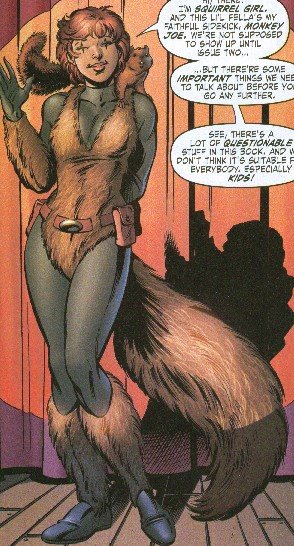
And me? I'm with Squirrel Girl.

Wednesday, August 30, 2006

Happy Belated Kirby Day


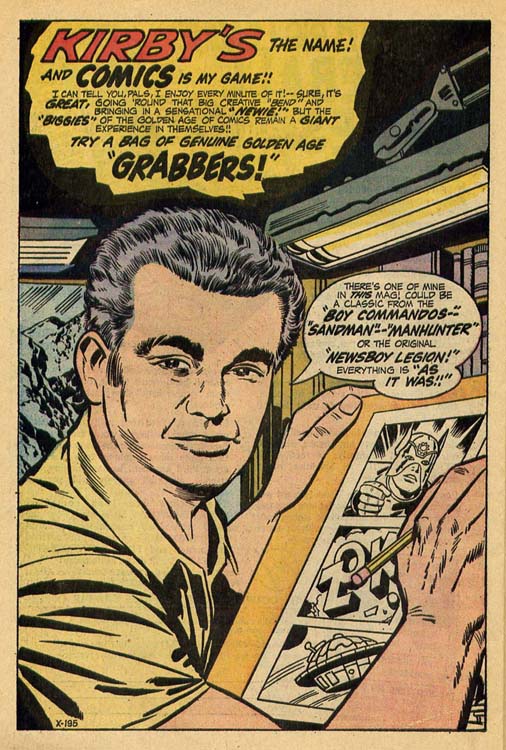
I feel somewhat shamed for missing the chance to join in various Jack Kirby tributes taking place across the comics blogosphere on what would have been his 89th birthday. (That was Monday, BTW.) But it's still the same week, so maybe I can kick in a belated tribute.

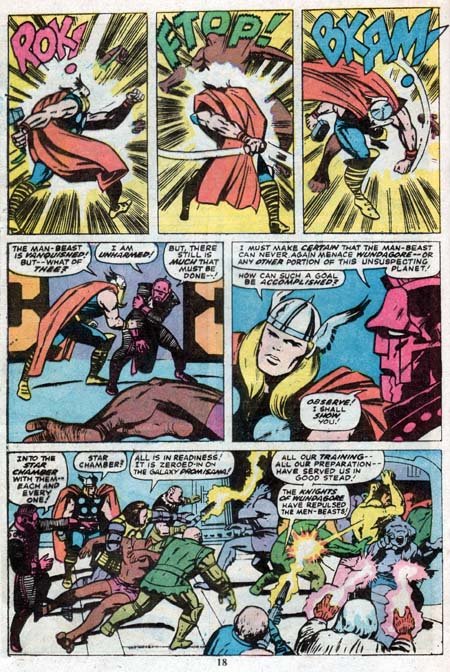
Jack Kirby was arguably the finest artist in the comics medium, certainly the best I've ever come across. Modern artists can achieve more photorealistic work, with more sophisticated shading, but this sometimes takes away from the flow between panels, and since comics don't rely on newsstands or five-and-dime stores for sales anymore, they can run late if an artist needs to take some extra time. Kirby seemingly never missed a deadline, and turned out thousands upon thousands of pages solely by virtue of sitting down at his drawing board and staying there for as long as it took.

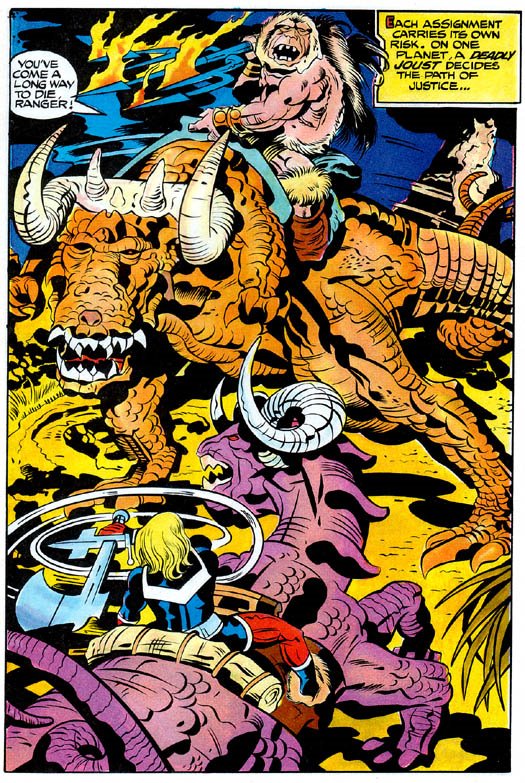
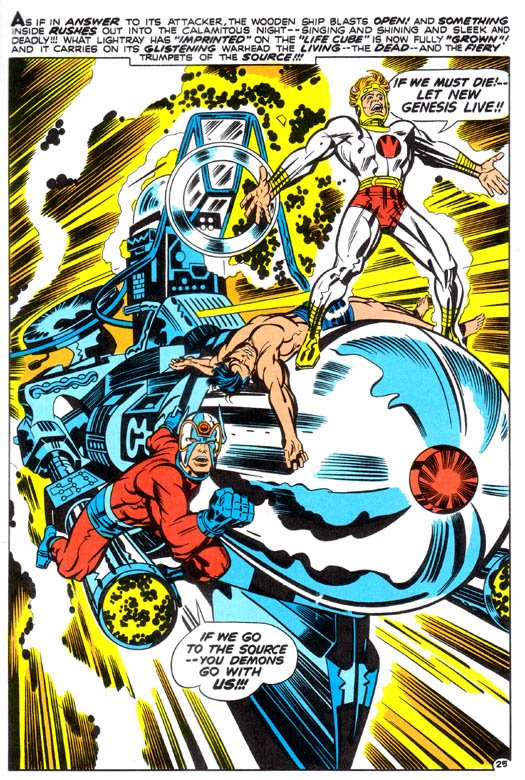
More importantly, his art strikes the perfect balance between beauty and storytelling. His action scenes leap at the reader using a combination of skewed angles and perspective tricks that became a favored technique of the genre (which has always struggled to depict action and movement in a medium that is by nature static.) As if that wasn't enough, his art is often just plain beautiful to look at. Working at Marvel in the sixties, Kirby's style became more abstract, his figures blockier, his lines more angular. The results are unique; characters have recognizable proportions and believable poses, but seem stronger, more vibrant, and just a wee bit weirder. Kirby was also fond of strange and vaguely expressionistic effects, photo collage, gadgets that were several orders of magnitude more elaborate than they needed to be, and "Kirby Krackle", a nifty effect whereby "cosmic energy" and pillars of smoke and similar things were represented by wild, fractal-esque patterns of solid dots (sometimes called, natch, Kirby Dots.) A certain joy of drawing comes forth in every page, as well as the ingenuity of a mind that just plain sees the world in a different way.

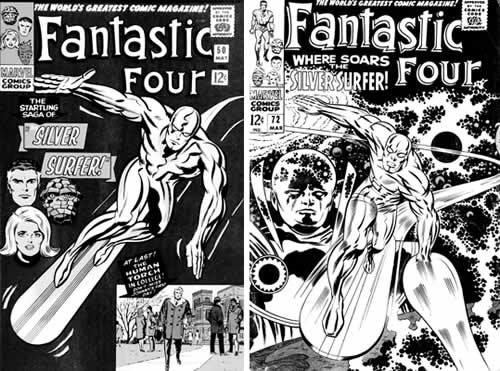
Kirby also wrote, and created more ideas and characters than could possibly be listed. It's still not quite clear about the exact extent of his collaboration with Stan Lee when the two worked together in the Sixties; the general consensus seems to be that Lee, who got the official writing credit, came up with the basic idea for each issue and wrote the final dialogue, and Kirby worked out the beats of the story in between. Certain characters, like the Silver Surfer, are uncontestedly his. When Kirby left Marvel, he began to work as both plotter and penciler, leading us to what is my personal favorite bit of his body of work- the Fourth World.

The Fourth World was an umbrella name for 4 separate titles written and drawn by Kirby for DC: NEW GODS, THE FOREVER PEOPLE, MISTER MIRACLE, and for various reasons, a run on SUPERMAN'S PAL, JIMMY OLSEN that took the title from light fantasy-comedy to high action insanity. Together the four books told the story of a conflict between the super powered "Gods" of New Genesis and Apokolips, a war in the Heavens coming to Earth as Apokolips' leader searched for an equation in people's minds that would allow him to control all living thought. Ramping up the "mythology" aspect of the superhero genre to previously unheard-of levels, Kirby's Fourth World project was cut down early (MISTER MIRACLE, the most popular series, running only 18 issues), but it's since become a cult favorite and a major part of the DC Universe. And he didn't stop there. Kirby appreciated that one of the strengths of the superhero genre was its ability to contain a wide variety of bizarre and fantastic ideas, of which he had plenty. He embodied Death as a black man in multicolored armor flying on skis. He had an entire planet sitting in a man's basement, inhabited by classic movie monsters. A super escape artist battled a sedentary being called "The Lump" in the confines of his overactive mind. Superman fought a giant green Jimmy Olsen. Good times were had by all. Some day, I tell myself, I'm going to review each and every issue of the Fourth World cycle in order of publication. And then I will learn Arabic and begin training as a sushi chef.

I don't think I actually know enough about Kirby's work and life to do the best tribute. But I will say this- he was a master, never adequately compensated for all he did for American comics. Talent like that comes along once in a lifetime.


For additional info and pretty pictures, please visit the Jack Kirby Museum & Research Center online. Long live the King.

Wednesday, August 23, 2006

Comics Rambling: Death and Superheroes

Okay, I'm going to try something different now: theory. God knows that as an English major I have the basic qualifications, but knowing how to begin, end or for that matter middle these kinds of pieces is tough. I'd go for the "introduction, three body paragraphs, conclusion" approach, only that brings back some ugly memories.

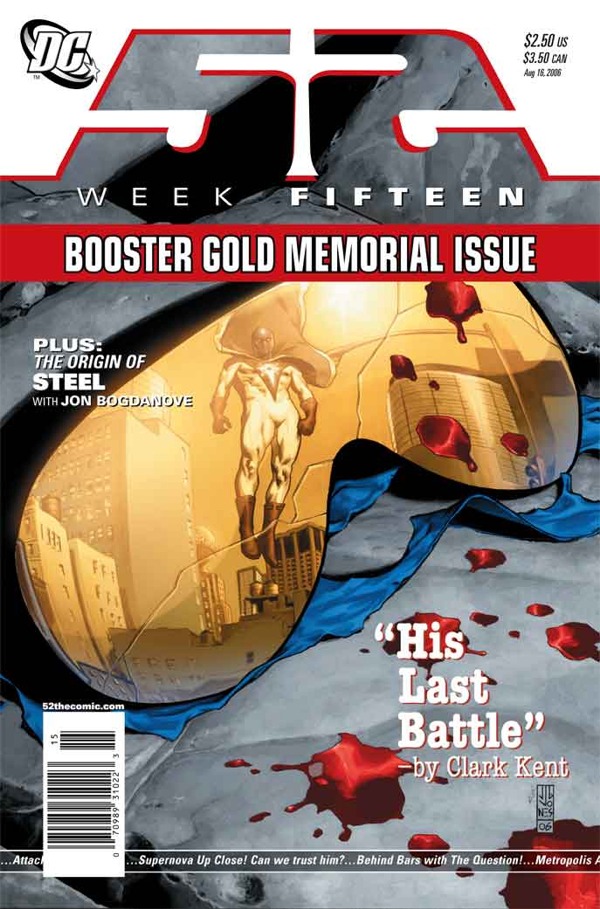
Anyway, this one's inspired by things what have happened recently in the comics world. In last week's issue of 52, the superhero known as Booster Gold met his untimely end. He's the latest in a surprisingly long line of recent casualties who gained much of their fame in the 1987-1992 Giffen/DeMatteis run on JUSTICE LEAGUE, known as the JLI or "Bwah-ha-ha" era when the title became a kind of light superhero comedy, adored by many (myself included) and loathed by others. But that's for another column. Instead I'm thinking about superhero death in general, its impermanence, why this one doesn't sit too well with me, and why it maybe happens more than it should from an aesthetic standpoint.

First off, it's strongly rumored that Booster may not quite be dead. One of his gimmicks is that he can travel in time, and the mysterious character "Supernova" might end up being him from another timeline or something. I haven't been following very closely, or at all. So his specific case isn't that significant.

That said, DC's just been piling it on. The INFINITE CRISIS series just before this was chock full of "B-list" characters (another note for a future piece- why I hate the hierarchy) getting gorily snuffed to add drama, and it was kicked off by the untimely snuffing of Ted Kord, the Blue Beetle. So maybe my problem is that there've been too many of the damn things. The good thing about DC and Marvel's comics "universes" is that they're full of interesting and colorful characters. Everybody knows Superman, Batman, Spider-Man, the X-Men, etc., but the real fun of reading superhero comics comes when you encounter unusual figures like Bouncing Boy, Danny the Street, or the Starjammers, and realizing that all these obscure persons have their own rich history. The more "housecleaning" that gets done and the more heroes and villains consigned to oblivion, the less fantastic the universe is. Granted, it'd take many more deaths than those in IC to really diminish the variety in DC's stable, but you gotta be careful.

That said, there's another problem that comes when you kill off a superhero, which is that that character's fans don't like it. This happens in all serialized media to some degree or another, but when you're dealing with a continuity that has been in place since 1938, things get heated. Julius Schwartz, longtime DC editor, once remarked that "every character is somebody's favorite" (or words to that effect); Booster Gold isn't one-eighth as popular as Batman, but he has his fans, and so do Pantha, Wildebeest, and Namorita, to name a few recent casualties. And this is to say nothing of non-super supporting cast members like Sue Dibny and Dr. Moira MacTaggert, also departed and sorely missed. So, you piss off some readers, in exchange for adding dramatic import and nice weepy moments to a story. Finally, perhaps most obviously, killing off a character cuts off any future "in-continuity" stories for that character, and future writers will have to deal with an altered roster.

For the time being, anyway. Superhero comic book universes tend to be wild, magical places with all sorts of super-advanced technology and cosmos-altering spells. This gives writers and editors plenty of opportunities to bring back characters they like or need, though the explanations can range from the contrived (the person we saw die was a clone/robot/impostor) to the hugely elaborate (don't ask me to explain how Superman came back.) Occasionally it's done right. Usually the best ones are the simplest and most low-key; elemental hero Metamorpho came back into existence as a side-effect of a "gene bomb" launched by alien invaders that mucked with everyone else's superpowers; it took all of a page of the INVASION! crossover and was handled with a certain level of humor. Oliver Queen, the Green Arrow, just sort of came back. When a hero returns, there's exultation from their fanbase, accompanied by complaints from some corners that superhero deaths ought to be permanent and that these resurrections undermine the drama of the original deaths. (Such complaints rarely surface with regard to supervillain resurrections, as it's generally in-genre for bad guys to come back with the most trifling of explanations.)

I can see the logic of that, but I can't agree with it. The drama of a character's death comes from the way the moment itself is executed, not whether it "sticks", the same with any other dramatic moment in a story. THE LORD OF THE RINGS, THE CHRONICLES OF NARNIA, and BUFFY: THE VAMPIRE SLAYER all contain at least one instance of a hero coming back to life after being killed, which doesn't make the death scenes any less impressive. There's only a problem when the resurrection itself is poorly done or doesn't fit the logic of the story/setting. On the one hand, a character coming back to life can be a silly contrivance to force a happy ending, on the other, it's also a trope found in more than one religion and can be argued as a mythic element derived from the cycle of the seasons.

So, with a certain revolving-door system in place, are superhero deaths worth complaining about at all? The short answer is that this is the Internet and that continuity errors in FUTURAMA episodes are worth complaining about, but to be slightly less flip, there are some bad things about an overly bloody run of comics. There's almost always a waiting period between a character's death and resurrection, its length being that between the time of death and the time someone convinces the current editor that said character is worth reviving and has a decent pitch. You'll notice that editors and writers never say in the immediate aftermath of a death that said character is going to be back in X months; the illusion of change is important to maintain, and unless the return has already been plotted as part of the same story arc (as with the death and return of Superman), there's a minimum grace period which, to fans of the character, is annoying at best. In almost all cases, the people killing said characters aren't the ones who created them in the first place; they have a kind of temporary stewardship of a portion of the company's intellectual property, and they don't have the kind of aesthetic authority to insist that a death should be permanent. Insisting that any significant change introduced by a writer or editor can't be reversed would put good writers at the mercy of bad ones, and vice versa. Not that Dan Didio, Joe Quesada, Brian Bendis, Geoff Johns, or anyone else with a lot of creative influence is insisting on such authority, but it's something I hear a lot from the fanbase.

Got sidetracked there, sorry. Anyway, even if character death is impermanent, it does temporarily deprive fans of a favorite hero or ally, and given the degree to which we are encouraged to see ourselves in these larger than life spandex models, it can be particularly disheartening to see our chosen avatar bite the bullet. Which is not to say that superhero deaths shouldn't happen, but they could be rarer. Currently, it seems that every summer crossover event mandates at least one significant death, and usually more than that; these deaths, to me, seem to be a bit contrived. I'd prefer it if these deaths were limited to the organic, natural outcomes of a character's story; how we expect a figure to meet his/her end, be it heroically or otherwise. Booster Gold's final sacrifice was tainted a bit by the appearance that he was doing it solely to be remembered, Blue Beetle's by the fact that he didn't really accomplish anything- he didn't save the world or beat the bad guy, just left a nasty stain on the floor.

Really, in fiction as a whole, a character who's been established, been given a rich history (of the sort all of DC and Marvel's characters inevitably accumulate over decades), had time to connect with the audience, shouldn't just be cannon fodder. Their death should say something about them. Which I don't think happens when their head is punched off at the start of a fight scene.

So, that's my essay. Cutting and insightful, or incoherent babble? You make the call!

Sunday, June 04, 2006

Comics: Top 10 DC Characters

So, The Great Curve challenged folks to name the Top 50 DC characters, and many bloggers offered up Top 10s, Top 50s, etc. I may be late to the meme-wagon, but it's a fun little experiment. These are my favorites, not meant to reflect popularity or influence or anything quantifiable like that- just the ones what I like.

1. Ted Kord, the Blue Beetle. Around the late 80s and early 90s my brother was into comics, and I picked up on the habit by osmosis. When he left for college I inherited the surviving collection, which included a huge number of issues of the Giffen/DeMatteis JUSTICE LEAGUE run. Ted Kord's Beetle- a geeky gadgeteer with a love of practical jokes and an occasional weight problem- was the heart and soul of the team, reflecting the series' lighthearted, sitcom-ish vibe. He is, perhaps, the most down-to-Earth and identifiable superhero that ever there was, at least to me. I could see myself in him. His recent death in COUNTDOWN TO INFINITE CRISIS was a disappointment to me- I figured he was the one superhero who deserved to retire peacefully, maybe find a girl, pass on the mantle and live happily ever after. Then again, it's not like he's not going to come back.

2. Maxwell Lord. If Ted was the heart of the JL team, Maxwell Lord was the lynchpin. A sleazy deal-maker with just enough charisma to mask his lack of scruples, Lord not only became important to the basic concept of that book- providing the League with UN backing and trying to boost their public status- he was also a surprisingly complex and ambiguous figure. He was scummy, a bastard, willing to overlook ethics when he felt he needed to- but he wasn't all bad. As the series progressed he went in for a lot of self-examination, developing a conscience in fits and starts and willing to make sacrifices for the team. A lot of this was undone in the aforementioned COUNTDOWN, where he became a wholly evil black ops leader who had apparently been manipulating the League from the start to try and curb superhuman activity, and who was willing to execute good ol' Ted when he got in his way. For his troubles his neck was snapped by Wonder Woman. This is what retcons are for.

3. Amanda Waller. Max Lord's counterpart- a loud, tough, decidedly uncultured leader who is, in her way, highly principled and self-sacrificing, devoted entirely to the team. That team was at first the SUICIDE SQUAD as written by John Ostrander, a "Dirty Dozen"-style outfit consisting mostly of supervillains hoping for reduced sentences by doing the US government's dirty work. Waller is a unique figure in many ways- off-hand, one of the few overweight, not-terribly-attractive* black women I can think of in superhero comics (though one could argue it's a bit of a classic stereotype in itself)- and remains one of the best supporting characters in comics.

4. Oracle (Barbara Gordon.) She's a beautiful, brainy computer geek with glasses, red hair, and (presumably) an MLS degree. The leader of the BIRDS OF PREY, the former Batgirl, now wheelchair-bound, gathers information on superheroes, supervillains, the underworld and just about anything else and sends her operatives to dispense justice. The ultimate comic geek fantasy girl- and not a bad role model to boot.

5. Darkseid. Jack Kirby's "Fourth World" books were years ahead of their time, emphasizing the mythology of the superhero genre instead of crimefighting, and giving the DC Universe one of its best villains. With a stony visage and the solemn tones of a god (which he sort of is), Darkseid is one of those people who can plot the domination of the entire universe and mean it. He's convincing (and deadpan) enough in his villainy that no matter how many times Superman beats him up, he doesn't lose any of his menace.

6. Ralph Dibny (the Elongated Man) and Sue Dibny. The Nick and Nora Charles of the superhero set- super-snoops with a coy sense of humor, fitting nicely into JUSTICE LEAGUE EUROPE and countless obscure back-up stories. Ralph was, in his own words, "the stretchy guy who[m] nobody takes seriously", while Sue- lacking powers of her own, but with keen investigative skills- never acted like anything less than an equal to the superheroes she spent time with. Killed in 2004's IDENTITY CRISIS, Sue is already due for a resurrection (52 hints at the possibility of one, but I won't believe it until it happens)- the story ended up having little to do with her or anything she did, and it was a bit like seeing Daphne Moon or Diane Chambers fall prey to an axe murderer.

7. Superman. Say what you will- that he's a bit dull, a Boy Scout, a flag-waver- he's still the first, and the brightest, boldest, most iconic superhero ever. He's what we wish we could be, the powerful man who looks out for the little guy, a god with a sense of humility and humanity, a guy who's just out to do good, period. Every kid in the world knows him. And though there are challenges to writing good stories about a superpowerful alien in human form, it's always worth it when it works.

8. Bizarro. Him am worst villain ever! Him am unfunny, uninteresting looking and him way of speaking am absolutely not infectious! He backwards logic totally easy to understand and easy to write. Him am not also idea behind Bizarro World, least interesting place in the universe! Him only this high on the list because Bizarro-speak cannot ever get annoying!

9. Harley Quinn. Though created for the BATMAN animated series, the Joker's squeaky-voiced moll quickly found her way into the comics universe proper. And why not? The cutest and funniest of femme fatales, Harley's childlike goofiness masks her skill with violence and dirty tricks- still, she's best off paired with a more level-headed evildoer, as in Bruce Timm and Paul Dini's hilarious three-issue HARLEY & IVY miniseries (which I think has yet to be collected.)

10. Big Barda. Another Kirby Fourth World creation, the lover and soon-enough wife of escape artist Mister Miracle, and former leader of Apokolips' Female Furies. In some ways, Barda is the strongest of the DC Universe's female characters, both physically and psychologically; despite once being on the "bad" side, her morality has never been in question, nor has her willingness to kick whatever asses need kicking in the name of good. Kirby modeled the character on his own wife Roz, making the character a pillar of strength and the relationship between her and Miracle a portrait of absolute love.

*Your tastes may vary, of course.

So many just barely missed the cut. My apologies to Fire, Ice, Guy Gardner, Salaak, Black Canary, Zinda, Mary Marvel, Orion, the Forever People, the Goddamned Batman, and yes, Space Cabby.