Showing posts with label Books. Show all posts

Tuesday, March 25, 2014

The Bookshelf: The Beach House by James Patterson & Peter De Jonge


When I was given this book, I saw an opportunity to take a look at modern thriller fiction, which is something I don't normally pay much attention to. James Patterson is one of those writers whose books you see everywhere, and he makes no secret of relying on co-authors to deliver the apparent hundreds of titles expected of him per year. Far be it from me to look down on popular fiction; there is an art to a good page-turner, to making the reader feel they just have to see what happens next. The Beach House isn't a complete letdown on this front, to be sure, but it's a toothless experience, a conspiracy thriller which avoids visceral bite in favor of vague class-awareness posturing.

Wednesday, June 13, 2012

RIP Ray Bradbury


There's not a lot I can say about Ray Bradbury that others haven't, but I feel compelled to talk anyway. He was a hero of mine, and probably is my single favorite writer. In truth he's a great example for anyone who writes, who wants to write, who thinks of the whole writing thing.

Saturday, December 31, 2011

The Bookshelf: The Forever War by Joe Haldeman

Forever War cover and Amazon link

I try to keep abreast of all the classics of science fiction literature, but it gets difficult sometimes. Joe Haldeman's The Forever War came out when the genre was going through a lot of changes in response to the times and to new literary trends, and it's certainly a product of that era. But it also manages a timeless feel, defying the traditional jingoistic slant of military sci-fi with a story that shows the real horrors of war, horrors psychological as well as visceral. Though a grim and intense read, it's also a very heartfelt human story.

Wednesday, December 14, 2011

The Bookshelf: The Flying Eyes by J. Hunter Holly

The Flying Eyes cover and Amazon link


I am a simple kind of man. If I see a book on the shelf with the title "The Flying Eyes", you know damn well I am going to purchase that book. I may not know if it's good or bad, or the author, or when it was written, but I just have to dive in. This is an obscure volume- the version I purchased doesn't even have a copyright date or much information of any kind, but it was apparently originally published in 1962 or 1963 (depending on which source you believe), and J. Hunter Holly is the pen name of Joan Carol Holly. It's a terse, effective, albeit supremely goofy novella, and its retro B-movie premise is accompanied by an appropriately cinematic tone. It works surprisingly well.

Thursday, March 31, 2011

The Bookshelf: The Death of WCW by R. D. Reynolds and Bryan Alvarez

Death of WCW cover and Amazon link
As of late I’ve become a bit of a mark for pro wrestling. It’s more of a performance sport than anything else (albeit without a formal judging system), and I enjoy the theatrics and the over the top clash of larger than life personalities. WWE’s Wrestlemania XXVII is this Sunday, so it’s as good a time as any to do something wrasslin’ related on the site.

I actually bought this book a while ago and devoured it quickly; I remember the heyday of the Monday Night Wars between then-WWF’s Raw and WCW’s Nitro. Like a lot of people I watched both, but drifted away, and was surprised to hear that the whole business ended in 2001 when World Championship Wrestling was bought by the WWF and effectively dissolved. From the minds behind Figure Four Weekly and Wrestlecrap.com, The Death of WCW details precisely how the Ted Turner-owned promotion, which for a time outdrew the WWF by a wide margin, not only fell behind but slowly and surely ran itself into the ground. It’s a fascinating look at the inner workings of a business that often isn’t taken very seriously, but which can have as much at stake as a movie studio.

The book runs in chronological order and effectively covers the company’s entire lifespan, starting from its beginnings in the late Eighties. As Vince McMahon’s New York-based WWF went national with Hulk Hogan at the forefront, Ted Turner bought the ailing Jim Crockett Promotions, part of the prestigious-by-wrestling-standards National Wrestling Alliance, and turned into a nationwide competitor. WCW struggled to find its feet for many years, but used Turner’s millions to nab Hogan and debut TNT Monday Nitro against Raw. Aggressive booking and poaching of WWF stars Scott Hall and Kevin Nash, combined with an angle that saw the two waging a proxy war on the WCW, helped propel the promotion into the lead, with a key moment being Hogan’s turn to the dark side at a summer pay-per-view, joining with Hall and Nash to create the New World Order.

So what went wrong? Well, according to the book, a number of things. Manager Eric Bischoff had created a plotline and an approach to wrestling on TV that worked, and so saw no need to change things for years. The New World Order continued to dominate the WCW without the good guys scoring substantial victories (a crucial match between Hogan and perennial babyface Sting at the Starrcade 1997 PPV ended in a messy, unsatisfying finish), and new talent was consistently kept low on the card while the focus remained on familiar and aging stars like Hogan, Ric Flair, and Randy Savage. In the meantime, the WWF rallied, with the rise of the raunchy and very 90s “Attitude” era and the ascent of new stars like Stone Cold Steve Austin (ironically a WCW castoff) and the Rock. When Raw started beating Nitro in the ratings again, Bischoff panicked, and WCW’s programming became increasingly erratic in an effort to be unpredictable. Increasingly confusing booking continued with other managers and with the teamup of Bischoff and former WWF writer Vince Russo, and business went into an outright freefall.

The book takes a very methodical approach to unravelling the WCW collapse, going through individual shows and pay-per-views with ratings, gate revenues, and buyrates for each. There’s a real sense of the momentum of storylines as they unfold (the book can’t cover every plot that was going, but the crucial “main event” angles are followed closely), and there’s a sense of genuine excitement as the Hall/Nash “Outsiders” plot becomes the nWo. The book also gets across the sense in later years of that very storyline starting to stall out, extended well beyond its time. Even as the mammoth Bill Goldberg begins his ascent to company icon status, Reynolds and Alvarez point out a few missteps made in his push (including piping in “Goldberg” chants when the cameras showed audiences with their mouths closed, and having his victory over Hulk Hogan appear on free TV instead of pay-per-view in order to boost Nitro’s ratings). It can be hard to keep track of all this, as individual wrestlers and staff come and go, but the writers have a strong sense of the company’s momentum.

As well-written as the book is, it does suffer from an apparent lack of editing. At times the writing lapses into a crude, unprofessional voice, as with the observation that during an on-air tribute of sorts to the newly villainous Hogan by the nWo, “[i]t looked for al the world like he [Bischoff] was either going to propose to the Hulkster or blow him mid-ring. Maybe both.” Though, to be fair, this informal style does produce some funny observations now and again, including the assertion that regularly throwing wrestlers into swimming pools could have saved the company. And at times the writers do attribute motives and reasoning to some people’s actions without any actual way of knowing what was going through their heads (though this is not unheard of in nonfiction writing.) The book assumes some familiarity with pro wrestling terms and concepts, not really explaining things like matches being in “negative star range” or what a buyrate is; most of this you can pick up from context or the internet, but it could have been more accessible.

Despite this the book is endlessly rereadable; it’s a thrilling and extremely informative account of a time when wrestling was at its hottest, and there’s both the amusement factor of watching a company do everything wrong, and sadness at what ended up being lost. I genuinely enjoy WWE’s current product more often than not, for all its faults, but it’s clear that losing its closest competitor was the worst thing that could happen to it. The pro wrestling business has stagnated since, and while nobody’s nostalgic for the days of the KISS Demon and World Heavyweight Champion David Arquette, it still feels like the business is missing something. If you’re at all interested in pro wrestling and how it really works, this is a must-read.

Grade: A-

Sunday, October 31, 2010

Monsterthon: The Bookshelf: Dracula by Bram Stoker

Dracula and his ladies- plus an Amazon link

I’ve made two unsuccessful attempts at reading DRACULA before. Both times I seem to recall enjoying it, but some other assignment or event compelled me to put it aside for long enough that I figured I probably ought to start all over again. This Halloween season I resolved that I would finally make it all the way through this classic of horror literature, and so I can complete Monsterthon by paying tribute to one of monsterdom’s elder statesmen.

The story, told entirely in correspondence and diary entries, begins with Johnathan Harker, a London real estate clerk, heading to Transylvania to finalize some sale documents with the mysterious Count Dracula, who is planning to buy the Carfax estate in England. As days pass, Johnathan works out that the Count is keeping him a prisoner, and that he is more than just an elderly aristocrat. He manages to escape, but in the time it takes him to get back to England, Dracula has already arrived on a ship whose crew were wiped out under mysterious circumstances. The Count sets his sights on Lucy Westenra, a friend of Johnathan’s fiancee Mina, and begins luring her out sleepwalking and feeding on her blood. Lucy’s betrothed Lord Arthur Goldamring, as well as asylum director Dr. Seward and Mina herself, notice a change in Lucy’s condition, and Seward summons his friend Professor Van Helsing, an elderly gentleman with some knowledge of things beyond the realm of known science. Van Helsing is too late to save Lucy from dying, but helps her friends to release her from the curse of vampirism that follows; afterwards, knowing Count Dracula’s intentions, they must protect Mina from becoming another of his brides.

An interesting thing about this book is that Dracula himself is barely in it. He gets a lot of “page time” during the early scenes in Transylvania, but in England he becomes mostly an external force, working through visions and animal guises, as well as through his slave Renfield, a fly-eating madman. Part of the reason for this is that the heroes are careful to avoid directly confronting the Count, who at night is basically too powerful for mortals to face and live. He is powerless during the day (though not actually burned by sunlight as would become the standard), but makes sure to appear rarely during such times. Though Bram Stoker famously based the character in part on Vlad Tepes (aka Vlad the Impaler), the references are more direct in the book than in any adaptation I’ve seen, with the possible exception of Francis Ford Coppola’s film- Van Helsing hypothesizes that Dracula was once a great leader who for whatever reason made a pact with dark magical forces and was turned into a prince of the undead. The physical description of the Count is very much like that of Vlad, and the explicity aristocratic background blurs and offsets some of the anti-Semitic origins of much vampire lore. The Count’s air of nobility makes him a fascinating character even though we rarely see him.

Perhaps the other thing that stood out to me when reading this book was how nice everyone is to each other; the heroes at times seem like embodiments of Christian virtue, ever patient in times of stress, ever faithful in the face of Satanic evil, and always seeking to treat each other well. This fits the style of much contemporary literature, and of course these are mostly affluent-or-better people raised to conduct themselves in a certain way, but as we’re reading their own thoughts in diary form, they come across as just plain decent folk. It can feel, at times, a little too cosy or twee; in particular Van Helsing’s broken English and folksy manner can be a little much over 300+ pages. That said, it does come off as sincere, and it creates a strong contrast between the elemental conflict of good and evil that is the book’s story. I don’t doubt this is what helped it resonate with audiences at the time and beyond; we’re not just scared of the monster but genuinely engaged with the protagonists, and this adds power later on when the story goes into a truly epic climactic pursuit.

Even though I was going through it the third time around, there’s definitely a wonderful touching sadness to Lucy’s fate, and while I’m not sure whether readers at the time were expecting her to live or die, most of us have been spoiled by film adaptations in the meantime. She’s as sympathetic a character as Mina, and doesn’t really deserve her fate- despite the much-talked-about undertones of Victorian sexuality in the book, there’s no sense that she’s being punished for any particular sin, just an innocent who wandered out onto the wrong moor.

There’s a lot of preparation and anticipation in the book, which makes it move slowly at times. This is primarily an artifact of the Victorian style of literature, though if H.G. Wells was largely able to cut through the crap Stoker doesn’t have much of an excuse. But there is tension, and emotion, and some genuine eeriness in the best passages. It’s easy to see how the book made the impact it did, and crystallized our perception of the vampire in popular culture. Not quite a masterpiece, but still a great page-turner.

Grade: A-

P.S. If anyone knows who the above image is by, I'll be sure to credit it. I can't quite read the signature at this resolution.

Happy Halloween!

Wednesday, June 02, 2010

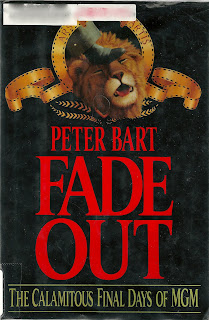
The Bookshelf: Fade Out: The Calamitous Final Days of MGM by Peter Bart

Scanned book cover and Amazon link
As of late I’ve been getting very heavy into movie history. I’ve become totally fascinated with the process of how the sausage is made, down to the soulless number crunching and dealing between studios and parent companies that make modern film possible. At the local library I found a book that's actually become more relevant since I finished reading it. (I scanned the cover since I couldn't find a good image online.)

If you follow movie news, you may have heard that Guillermo del Toro recently dropped out of the director’s slot for the planned live action film(s) of J. R. R. Tolkien’s THE HOBBIT, due to delays in production. The project looked ready to go for a while, but then MGM, who are financing the production, announced that they were in deep financial trouble again and had to delay any check writing until they could raise more capital. The part that actually surprised me was that they still existed.

The irony of this is that a long time ago, Metro-Goldwyn-Mayer was the dominant player in the old-time studio system. They owned the most theaters, had the most stars on contract, and their style was excess- they could produce epics like GONE WITH THE WIND, THE WIZARD OF OZ, both the silent and sound versions of BEN HUR, and so on. Peter Bart’s FADE OUT is an up-close memoir of the studio in decline, focused on an attempt in the eighties to revive production that fell apart for various reasons. There are some issues I have with the way it tells its story, and the limited scope will leave you with a few questions, but it has some fascinating material, and to a certain extent, the problems it was having then are very close to the problems it’s having now. Bart, who worked with Frank Yablans as he tried to right things through an ambitious slate of pictures, argues that MGM/UA suffered from a combination of bad picks, missed opportunities, and perhaps most damningly, a top-level inability to commit to the expense and uncertainty of being a film studio.

Bart chooses an odd alternating pattern to tell the book’s story, focusing on the eighties and his own time at the studio, but sometimes jumping back to the very beginning of Nevada entrepeneur Kirk Kerkorian’s reign as owner of the company. This gets a little disorienting, but suffice it to say, Kerkorian, who made his fortune chartering flights to Vegas for gamblers, bought a studio that was already teetering due to several expensive flops in the sixties. Jim Aubrey, brought in to cut costs and streamline the studio (including the sale and at times outright disposal of old props, sets, etc.), had a hard time finding hits, and started the trend of squeezing MGM’s budgets to a point where their output really slowed down as a result. Kerkorian, meanwhile, focused on leveraging the MGM brand, particularly with the new MGM Grand Hotel in Las Vegas.

A few more bosses later, and Peter Yablans entered with a directive to actually try and jump start MGM’s film lineup. And to be fair, he really did try. The studio had just acquired United Artists (deep in hock because of the HEAVEN’S GATE debacle) to become MGM/UA, and UA had the Rocky and James Bond movies to help things out. Here, it mostly seems to be bad luck and wrong guesses that hurt; the studio pushed RED DAWN and 2010 as major blockbusters, but both did only middling business. The book also describes an interesting project called ROAD SHOW, about a modern day cattle rancher who, fed up with corrupt truckers, decides to get his herd to market the old fashioned way, with a horse-led cattle drive across the modernized Midwest. From Bart’s account it was difficult to get much conflict beyond the basic premise, and the premise itself isn’t the most plausible, but you can almost imagine a film like this working. Two directors came and went and the picture got quite close to production, which no doubt cost a lot, as did schedule delays on the unexpectedly elaborate MRS. SOFFEL, wherein Peter Bart personally visited director Gillian Armstrong in an attempt to curb her increasing perfectionism.

Overall, the larger problem seems to be that they still weren’t producing, at least not enough. Though each film is a risk and most movies take a little while to earn back costs (if they do at all), studios rely on producing a full slate each year and having a steady stream of income to offset both production costs and the basic costs of having a business. (This is a simplification based mostly on my playing THE MOVIES a lot, but it’ll have to do.) Kerkorian’s own lack of interest in the movie end of the game- he was always more a Vegas man than a Hollywood one- probably didn’t help. Bart doesn’t go out of his way to cast aspersions on Kerkorian, but by implication he comes off as a little too disinterested.

A key moment in the whole story seems to have been MGM’s deal with Ted Turner in 1986. Turner originally tried to buy the studio outright, but this put him a little too far in the red, so Kerkorian agreed to buy back key elements of MGM (including the brand). However, this still left Turner with the classic movie library that he would leverage so well for better or worse, and MGM’s studio facilities ended up with Lorimar, a television company. (Though this may not have been a big loss since those facilities hadn’t been used for much in a while.)

My one major complaint with the book, apart from the flashbacks and flashforwards, is that it ends kind of abruptly. We get a lot of detail on RAIN MAN, which was a nice unexpected hit, but after a couple of failed deals to sell the studio, the book just ends with Kerkorian back to writing the checks himself. Obviously this has everything to do with when the book was written, but it makes the subtitle “The Calamitous Final Days of MGM” sort of misleading. For the next decade and a half MGM continued to exist as a kind of shadowy almost-studio, occasionally popping up to release a movie or declare financial trouble. Kerkorian did eventually sell to another private group (thusfar, MGM seems to be the only historic studio that wasn’t gobbled up completely by a major multinational, though this is hardly a better fate), but since they don’t even handle their own DVD releases anymore, you can see why I thought they had actually died at some point.

Obviously Bart couldn’t cover events taking place in the future, and I had to piece this together from discussions concerning the recent HOBBIT troubles. So I think the book still works pretty well overall, illustrating some of the unique challenges of the movie business and making it clear just how unpredictable it can be. I hope that something, somewhere, happens to keep the MGM legend alive, but that may just be because I do want THE HOBBIT and the next Bond movie to actually get made. And Hell, we all love that lion.

Grade: B+

Wednesday, March 24, 2010

The Bookshelf: Boneshaker by Cherie Priest

Boneshaker cover and Amazon link
I heard about BONESHAKER when the author, Cherie Priest, was interviewed on WAR ROCKET AJAX- that was some time ago, and I had a devil of a time tracking the damn thing down; in fact I’d say I spent more time trying to find it than reading it actually took. Even though the book runs some 400 pages, they go by fast. Even though it takes place against an elaborate alt-history steampunk backdrop, in which an attempt to build a better mining machine turned the population of downtown Seattle into flesheating zombies, the story is rather ingeniously boiled down to a mother and son searching for answers and for each other amongst the ghosts of the past.

The book takes place in the late 19th century, in the midst of a prolonged U.S. Civil War (though that doesn’t have a lot to do with the story.) About a decade-and-a-half earlier, the Alaska gold rush sparked a contest for devices that could dig under ice, and one intrepid inventor got a little too creative with the Boneshaker, a giant steam-powered drill. A premature test tore through most of downtown Seattle, before digging into the ground far enough to release a toxic gas known as the Blight. What does the Blight do? Well, it turns people into shambling flesheaters called “rotters”. Flash forward, and downtown has been walled off, with everyone living outside trying to keep too much of the Blight from getting into their air and water.

Briar, the late scientist’s widow, has been raising her son Zeke alone and keeping her head down. Zeke’s a teenager now, and he wants to know more about his father and what happened way back then, and with his mother silent and ashamed on the subject, he gets himself a gas mask and heads through a drainage pipe under the wall. No sooner does Briar find out about this than she goes after him, but an earthquake collapses the pipe, meaning she has to hitch a ride via airship. (Oh yeah, there are airships.) Inside the wall, there are still rotters waiting to devour human flesh, but also people living underground, trying to pump the Blight from the air and living in fear of the domineering Dr. Mitternicht.

That a story with this many ideas in it doesn’t go completely off the rails is a testament to how disciplined Priest is as a writer. The story is told more or less entirely through the eyes of Briar and Zeke, alternating between their points of view as they work their way in parallel through the ruined city. The alternation creates a lot of great cliffhanger moments, and the action flows at a natural (albeit breakneck) pace. Subplots are kept to a minimum; they exist but they don’t intrude too much on the main story.

At the same time, Priest has obviously put a lot of work into the setting, to the extent that there are probably other stories to be told in it. As I said, I’m not entirely sure what the Civil War angle contributes to the story, but I may have missed a detail there. As for the main story elements - airships, zombies, toxic zombie-creating gas - they’re blended very well. The rotters don’t completely dominate the action - it’s not a zombie book per se, or at least exclusively - but rather they show up every so often to tear through the streets and threaten everyone’s lives. These passages are particularly well-written, with the creatures described almost as a single boiling mass, sweeping through fragile buildings, up ladders, anywhere they can find purchase. We get some airship combat as well, which is briefly confusing but that may have been because I took a break between chapters, and the way the Blight is handled is very effective. Basically a kind of necrotic mustard gas from deep in the bowels of the Earth, it irritates the skin at first, and is even abused as a drug by some of the inhabitants of the city, even the ones outside the wall. Gas masks and clothing that doesn’t expose any skin are essential, and the constant attention given to details like mask filters and the seals outside safe zones drives home the reality of the threat.

None of this would work if the characters didn’t, and Briar and Zeke are both well-drawn. Briar is an interesting choice for a protagonist, being the working single mother of a teenaged boy, and she comes off as capable without being immediately exceptional- for years she’s just wanted to keep her head down, but her son forces her into an extraordinary situation. Zeke has an energetic nervousness I like, and there are a number of interesting supporting figures, including Dr. Mitternicht, about whom I can say little because what happens with him is fairly clever (and what you’re thinking is not it.)

Warren Ellis calls this Priest’s “breakthrough” book, and that somehow seems right to me even though I haven’t read any of her other ones yet. BONESHAKER is imaginative and wild and full of neat things, but it’s also tautly written and carefully constructed. Even if you’re not a fan of steampunk or zombies or alternate history, this is a fun read which puts all those elements in service of a believable human story. I hope more people discover this book, and I’ll have to give Cherie Priest’s other works a look.

Grade: A-

Saturday, October 31, 2009

The Club Parnassus Halloween Shindig

I love Halloween, and each year I try to do something nice and Halloween-y here at the club. Honestly, I got caught unprepared this year, so what you'll be seeing now is the result of some random scrambling for material. Hope you enjoy it.

To start things off, let's have another entry in opening credits sequence theater, with the simple but powerful start to John Carpenter's HALLOWEEN. This one's mostly about the music; the swift pace of the theme song sets up a momentum that carries through the film's first scenes.


And for those in our audience who are planning to complete major Jewish rites of passage on this day, a word on what you can expect, from Tracy Jordan and an intrepid Sims 2 player:


A good scary story is always appropriate, and Kevin Church and Paul Horn are offering us a particularly spooky webcomic for the holiday, known as Copy Protection.

For something text-only, pretty much all of the works of H.P. Lovecraft have been made available for free online. One of his best stories is Dreams in the Witch House, at least in my opinion, and you can go from there to everywhere on HPLovecraft.com, and wade through all his material, losing sanity as you go.

And finally, for audiophiles wanting to take a listen to probably the most famous radio drama ever, Orson Welles' Mercury Theatre production of The War of the Worlds is frequently revived by local public radio stations, and if you want to listen to it now, head on over to the Internet Archive for a free and legal download.

Hope this is all enough to make your Halloween a teeny bit more awesome. Have fun out there!

Wednesday, April 29, 2009

The Bookshelf: The Wages of Fear by Georges Arnaud

Wages of Fear cover and Amazon link
For a while I was convinced that I wouldn’t ever find an English copy of WAGES OF FEAR (the book) outside of a rare books dealer or a library’s special collections. Still, I would look, and at one library my inquistiveness unexpectedly paid off. The copy seems to date from the early 50s and I’m surprised it’s still in circulation, but I’m not going to argue. Instead let’s just enjoy a classic thriller, one which inspired two equally-brilliant film adaptations yet has somehow disappeared from the US book trade.

The book takes place in Guatemala (and somehow neither movie mentioned this), in Las Piedras, a town dominated by an American oil company. An explosion at one of their derricks leaves the company with a fire to put out quickly, and doing so requires that a quantity of volatile nitroglycerine (the only kind worth having) be hauled with great delicacy across 200 miles of treacherous jungle roads. The company puts out a call that is answered by four desperate men; all foreigners, hiding from crime or debt, hoping to buy their way out of the poverty-ridden hellhole. The focus of the book settles on Gerard, a Frenchman and former smuggler with ambitions of buying a boat, and Johnny, a twitchy Romanian fleeing a death sentence.

The book is short and tersely written, despite a few meditations on fear and its effects on people, how it both helps and hinders us. (The translation by Norman Dale is smooth enough, with a few clunky passages.) This is at heart a page turner, one to be blazed through in a few days at the most. It’s a form of novel that’s been tragically sidelined by modern publishing- nowadays even the trashiest of books is a disappointment if it doesn’t make it to 300 pages. In fact, I find it almost ironic that both film versions of this seemed to devote more attention to developing the characters. Speaking of the films, I can now definitely say that the original French version (which I need to get to reviewing sometime, if only to complete the triptych) is closer to this, but both took some interesting liberties.

The lack of space devoted to character development is sometimes to the book’s detriment, but the exploration of the relationship between Gerard and Johnny is quite well done. Gerard resents Johnny’s cowardice, but an inevitable comraderie develops. Where Arnaud really excels is in the attention to detail; according to the book jacket, he was taken prisoner in WWII, escaped to Latin America, and worked at a number of odd jobs, truck driving being one of them. The mechanics of moving a truck across bad roads as delicately as possible are, understandably, a huge part of the story, and with his own experience as an aid to research, Arnaud makes every step of the journey seem authentic. It’s the sort of thing that I have to seethe with envy at, because it would take me a solid six years buried in technical manuals to even begin to fabricate something as plausible.

At heart, THE WAGES OF FEAR is a good read, overshadowed by the cinematic genius it inspired but a compelling book nonetheless. It’s a damn shame that it’s been allowed to drift out of print; I’ll regret having to return this copy, that’s for sure, and you know what Amazon resellers are like. So keep your eyes peeled, or if you feel so inclined, start boning up on your French.

Grade: A-

Sunday, December 28, 2008

The Bookshelf: Nation by Terry Pratchett

Nation at Amazon.com
It is nearly impossible to talk about Terry Pratchett’s recent work without mentioning the author’s ongoing struggle with Alzheimer’s; it’s a senseless and tragic thing which threatens to take a charming and talented person away from us. Of course, the author has been keen to remind everyone that he’s still alive and fighting and that we should perhaps wait a while before composing eulogies. Still, Terry Pratchett’s NATION (which I have to continually remind myself is NOT called Terry Nation’s PRATCHETT) is itself a novel dealing with senseless tragedy and our attempts at making sense of said situations, and getting by afterwards. Though billed as a young adult novel, it feels aimed at a broader range of readers, and it’s an engaging and provocative story which raises a lot of challenging questions no matter the age of the reader. The skill with which Pratchett handles what can be inflammatory, unpleasant, or even just familiar subject matter is remarkable.

The majority of the book centers around Mau, a boy from an island community who has just completed part of his rite of passage to become a man. (His precise age is never set down, but I’m going to say he’s a teenager because that seems to fit.) However, on his way home, he lives through and becomes the sole survivor of a massive tidal wave that destroys the society of Nation and everyone he knew. The boy’s hopes of completing the rites of manhood are dashed, and his faith in the gods who allowed this to happen are almost totally destroyed, but a voice in his head tells him to go through the proper rituals to bury his kinsmen at sea and begin re-founding Nation all by himself. He’s not alone for long, though, because the wave carries with it a ship, and the sole survivor of the wreck is Daphne (or Ermintrude, as she hates being called), youngest heir to the throne of Britain who was being transported there to fulfill some contractual business best left aside for now. She’s about his age but that’s all they have in common, and they have to try and communicate as survivors of nearby islands, and a few unsavory characters, drift in.

Response to tragedy has been an increasingly popular theme of fiction in recent years, for obvious reasons. I’m not sure things are worse now than they’ve ever been, but between sudden natural disasters and endless wars it’s gotten to be a bit much. Inevitably, how you can reconcile a belief in a benevolent deity or deities with the objective existence of death and calamity is a big question for many of us. Pratchett himself is an atheist, and no stranger to criticism of religion, so once I worked out that this was going to be a main theme I did not hold out much hope for an answer that was not, “You can’t, God either does not exist or is a right bastard.” Which, in brief, I’ve heard already.

What we get is a little more complicated. Mau falls out with the gods pretty quickly, but other characters we meet hold on to their faith, and the events that take place are open to interpretation. It’s provocative whatever position you come at it from, and Pratchett doesn’t seem interested in presenting an answer so much as prodding the reader and throwing the issue out there.

Nor is religion the only subject on the table. I’m not even sure if it’s the main one. I think it’s more about how we cope with disaster. This involves faith and the loss of same, but equally important are the social structures that are broken and torn, needing to be repaired but inevitably being changed in the process. As the official man of Nation, Mau has to make sure that people are fed and cared for, that beer gets made, that women have a place to stay, and that the god anchors are in their proper place even if Mau doesn’t believe they’re important, because others do. We essentially see a new culture born from the ashes of an old one, and that’s interesting.

It helps that Pratchett writes this all with his usual deft comic touch. The subject matter is grim, and not trivialized, but the tragedy is so quick and the need for the survivors to get to surviving so urgent that we don’t dwell on it any more than we need to. The tone instead is very matter-of-fact, and no doubt the author had to keep the pace brisk for the YA market (though young adult fiction can get a LOT more depressing than this, believe you me.)

The one part of the book that doesn’t fit at all is a plot device brought up early, forgotten for most of the novel, and raised again near the end without much urgency. There’s apparently some kind of virus sweeping Britain, and the Royal Family all caught it and died quite suddenly, and there’s an esoteric clause stating that the new monarch needs to be coronated within a certain amount of time or the entire country gets turned over to France or something, and this leads to Daphne (who is not the new monarch, but is the daughter of him, I think) being on the boat that runs way too far aground. It’s not a bad plotline, but it’s a lot more than is necessary to get her into the story, and though there’s a thematic link, it seems like a concept best explored in another book altogether. Also, though it’s not usually expected that an author give every character’s age, it would have prevented me from somehow imagining Daphne as being in her early 20s and Mau as around 10, and thus being more weirded out than I should have been when faint romantic elements started cropping up.

I enjoyed NATION quite a bit, and it’s a book that holds up well in the memory. It’s a book about tragedy that is not at all depressing, because it’s also about the aftermath and how those left behind have to pick things up and move on. It raises questions and encourages the reader to consider multiple answers. Pratchett tackles some big issues here, and then turns around and asks us what we think. I appreciate that.

Grade: A-

Monday, December 15, 2008

The Bookshelf: Dragons of Winter Night by Margaret Weis and Tracy Hickman

Link to Dragons of Winter Night at Amazon.com
And I’m out. Life is too short to read books that you don’t enjoy, and at some point around the middle DRAGONS OF WINTER NIGHT started to feel like work. I had been looking forward to this second volume in the DRAGONLANCE saga, on the grounds that the middle installment is usually where things get really interesting, plus the dead-of-winter angle seemed appealing and seasonally appropriate. But instead this is where Margaret Weis and Tracy Hickman’s game fiction turned bestselling trilogy goes off the rails, losing the clichéd charm of the first installment in a morass of bad plotting and downright uninspired writing. It’s not without its good moments, but to get to those you have to wade through a lot of stuff that’s just not interesting.

My first difficulty comes with describing the plot. Our heroic adventure group have taken refuge with a group of people fleeing from the Dragon Highlords who now control Krynn. They’re sent on a quest to find the port city of Tarsis so the refugees can hopefully find some safe haven, but when they get there it’s been landlocked for centuries, and an attack by the Highlords splits them up. Laurana, an elvish girl who’s in love with Tanis (he’s obsessed with some evil warrior woman who shows up eventually) joins Sturm, Flint, and Tas in search of one of the fabled Dragonlances, weapons that can actually slay the flying menaces, while the rest of the group goes after an orb to control dragons in the midst of a haunted elven city. I think. Eventually the first group comes across a dragonorb too, and there’s some business with Sturm’s old order of knights suffering from political infighting, and there are elves and humans in conflict over who gets to keep one of the dragonorbs, and gnomes get involved somehow.

If these books were in fact drawn from a D&D campaign, this was obviously the point where the Dungeon Master made the mistake of splitting up the party and had to handle separate plotlines in the vain hope that they would intersect again. The alternative, of course, is that Weis and Hickman planned this storyline, which would be unthinkable but then again I saw the PIRATES OF THE CARIBBEAN sequels. The point is, this is not good plotting. The second installment of any trilogy always faces a challenge because it has to bridge two other works and thus often lacks its own beginning and end, and you often end up with lots of parallel action for some odd reason, but there’s parallel action and there’s whatever the Hell this is. I can no longer recall how anything in this book fit together, and was halfway tempted to steal someone else’s plot summary. And I understood THE AVENGERS.

This might be forgivable if this mess of loosely connected setpieces were consistently fun. There are some bits I like. The haunted city portion ends in a bit of a cheat, but it’s pretty damn moody before that. The action is generally good, and I liked the final battle. But we also have to wade through a lot of tedious political bickering, none of which reaches a level of sophistication beyond junior high debate and serves no purpose other than to reiterate the high fantasy cliché that diplomacy and debate are completely worthless.

My great failing in reviewing the previous book in this series is that I somehow managed not to pick up that it is a HUGE Mormon allegory, from the golden plates to the white Native American types. Strictly speaking I don’t object to fantasy being used as religious symbolism, but in this new context it was impossible to ignore a scene between Caramon and bar-wench-turned-warrior Tika which seems to exist solely for the purpose of establishing that he will not sleep with her until they can be in a committed relationship, essentially an abstinence message made incredibly ill-fitting by the fact that everything prior has established them as lustful stoats who could not be pried apart with a crowbar. It was what made them entertaining. Speaking of poorly wedged-in morals, an inordinate amount of focus is spent on Tas, the halfling who can’t help taking other people’s things because his culture has no concept of ownership and is absolutely not a thief. This itself is worth remarking upon for an entirely different reason, namely that his third-person-limited voice is cloying and twee, a forced roguish tone that quickly wears out its welcome. Between him, the comic tinker gnomes and the return of Fizban, the book stretches the reader’s tolerance for cutesy comic relief to the breaking point.

While we’re on the subject of characters, it’s weird how quickly the focus shifts away from Tanis, our protagonist from last time, and in fact he’s not even present for the book’s climax. Raistlin, also an interesting character, drifts to the sidelines as well. Goldmoon and Riverwind are also marginalised despite their prominence in the first book, but I actually didn’t mind that.

The prose is as workmanlike as ever, getting the job done and painting a few vivid pictures, which is why the book fails to slip from mediocre to outright bad. I do have to fault it for downplaying and often forgetting the whole “winter” thing- there’s the occasional mention of snow and/or ice, but it’s so sparse that if this were a film you wouldn’t be able to see the actors’ breath. Conveying season is a subtle thing, but if you put “winter” in your title you should indulge in a little overdescription.

I was perhaps forgiving of DRAGONS OF AUTUMN TWILIGHT’s flaws because I was convinced this was going somewhere. About midway through DRAGONS OF WINTER NIGHT I decided that if this was going anywhere it was sure taking its sweet time, and at this point my only real interest was in seeing the “state of play” for the DRAGONLANCE setting, which is something I could get on Wikipedia while reading a much better book. There is simply nothing sufficiently earth-shaking here- nothing that changes the game or raises the stakes or makes me think this is going to go in some very unusual direction. It’s just more running around, without the basic dungeon crawl coherence of the first novel. This is not quite a book to be hurled across the room with great force, but I was tempted.

Grade: C

Monday, December 08, 2008

The Bookshelf: House of Leaves

Link to House of Leaves on Amazon
HOUSE OF LEAVES is a book I heard about in figurative whispers, which is the inevitable result of not following book chatter very closely (probably not a good idea for an aspiring writer), but it had the effect of making the work more tantalizing. This is a horror book, of sorts, but it’s also a dense and metatextual and deconstructive assembly of a story that witnesses madness, and so it has an appeal as a real-world version of the Necronomicon (that isn’t some crappy New Age cash-in.) Appropriately enough it took a while for me to track down a copy, though I’m sure real forbidden books of cosmic horror cannot be found in paperback at Borders. Though Mark J. Danielewski’s debut novel has not had the kind of insidious effect on me that it has on some readers (that altar to Tsathoggua was there when I moved in, honestly), but it’s a beautifully crafted and compelling book with only a few niggling flaws.

The book is a multilayered affair, presenting itself as a manuscript by a man named Johnny Truant, consisting of his footnotes on a text by a man named Zampanò, who died in the apartment that Johnny later leased because L.A. residents can’t afford to shun ominous and foul places when the rent is low enough. Zampanò, in turn, was writing a huge critical work on The Navidson Document, a widely-circulated film purporting to be a documentary on a haunted house. Well, sort of haunted. Instead of having ghosts, the house has a series of rooms that should not exist, reached through a door that should lead outside. This foreign space is barren and offers no clues as to its origins, purpose, or true nature. Needless to say, Will Navidson, father of the household and veteran photographer who’s been in many dangerous situations (and started making this film because he was trying to do a documentary on his family) insists on exploring, and bringing in others to explore, while mother Karen tries to be supportive but is not-so-secretly wondering what the neighborhood is like in Timbuktu.

Zampanò covers the ominous developments in the most scholarly manner possible, though his notes start to show signs of obsession as the mystery deepens. Johnny, in turn, uses his footnotes to detail his story on how working with this text is starting to drive him insane. This is one of those books wherein the arrangement of text, footnotes, etc. is key to the overall effect, and it can be very disorienting and maze-like in itself. That of course is the point- arguably this is a book meant to be re-read and skimmed and looked at piecemeal in addition to (if not instead of) a straight beginning-to-end reading. A number of typographical distinctions become important- as an example the word house is always written in pale blue. (There’s another word that always gets written in red and crossed out, but revealing it may be some kind of spoiler.)

HOUSE OF LEAVES is pretty much at the extreme minimalist end of the horror spectrum- it never even so much as defines the outline of any creeping monster waiting on the other side of the door, and our characters instead face the more existential threat of pure oblivion. Not explaining things and indeed insisting that the reality is inexplicable seems to be a popular trend in the genre, and it definitely has its benefits. At the same time I kind of miss when horror writers would come up with bizarre names and vague shapes for their terrors- something like what Lovecraft does is about my speed, and his work is no less nihilistic for it. In some ways the horror of HOUSE OF LEAVES is one of sensory deprivation- you start to imagine what might be the root of all this, but you receive so little that your imagination is essentially feeding on itself. This doesn’t make it a bad book at all, but you should it know that it’s one that asks more effort than usual on the part of its reader.

If there is really one obstacle to my getting really heavily into this book and its enigmas, it’s Johnny Truant. There are points relatively early in the narrative where his footnotes get longer and closer together as he tells you his story, and I started to outright dread seeing his font pop up. Truant’s story is the kind you’ve probably heard. He lives in Los Angeles, works at a tattoo parlor, drinks, experiments with drugs and has a friend with access to the kinds of pharmaceuticals that would make Hunter S. Thompson turn in early because he’s really got a lot to do tomorrow, he had a traumatic childhood, he has a lot of casual sex with attractive women but is in a courtly kind of love with a stripper who's named Thumper because she’s got a bunny tattooed near the entrance to what she calls “The Happiest Place on Earth”, there are late night car rides with people who should not be driving, etc. It’s very much a hardboiled L.A. narrative of the kind you get in indie films and one-man-shows and comic books, and though Johnny freely admits he’s adopting a “tough guy” voice it gets to be a little much anyway.

Having such a consciously “colorful” element to the book gets in the way of the pure existential horror, as do frequent attempts to tie the madness of the house and its alien hallways to specific psychological issues on the part of the people who explore it. Is this a true cosmic trap for the unwary or just an extension of individual drama? Strangely, Zampanò’s scholarly tone does not intrude on the same level, though it’s arguably just as deliberate a voice and it has the kind of dryness that you would imagine is not conducive to spine-tingling suspense. That Danielewski pulls this off is actually pretty damn remarkable.

The book’s presentation as a found object continues to the inclusion of pictures, a half-finished index, and various appendices, and the narrative itself becomes increasingly uncertain as one expects from postmodernist fiction. How effective this is for you, I suppose depends on how much stock you put in Derrida. It’s worth noting, though, that some cheaper printings apparently leave out some key textual distinctions (coloration mostly); I think I’ve got the right version linked up above, but you may want to double-check.

So HOUSE OF LEAVES has yet to haunt my dreams, though those of a geekish persuasion may simply conclude that I made my SAN roll. Still it’s quite cool and though the text takes some work, it’s worth the effort for the dedicated reader. It’s obviously more effective if your tastes run towards existentialist minimalism (or minimalist existentialism), but from any philosophical perspective this is a wonderfully intricate book with many, many surprises.

Grade: A-

Monday, November 17, 2008

The Bookshelf: Dragons of Autumn Twilight by Margaret Weis and Tracy Hickman


For no particular reason I’ve taken an interest in some of the fantasy settings for DUNGEONS AND DRAGONS and its various permutations. The differences between them are often subtle and incredibly geekish, but the DRAGONLANCE saga caught my attention as a unique blend of creativity and marketing. The original trilogy of books that I’m reading- DRAGONS OF AUTUMN TWILIGHT, DRAGONS OF WINTER NIGHT, and DRAGONS OF SPRING DAWNING, all by Margaret Weis and Tracy Hickman- were tied in with a series of modules released for the game around the same time in the mid-eighties, detailing a very linear, story-driven campaign based on one that Weis, Hickman, and others had run earlier.

So DRAGONS OF AUTUMN TWILIGHT is essentially the professionally published and bestselling equivalent of someone’s online game fiction, and yet it’s not bad. I’ve mentioned in the past that I don’t like how the fantasy genre is dominated by Extruded Fantasy Product that always revolves around a diverse group of characters from every corner of the author’s fantasy world going on a quest which takes them to every other corner of the author’s fantasy world in order to collect plot tokens and defeat the Supreme Evil, but in retrospect I don’t really hate the form itself. Only a handful of authors have ever done anything genuinely great with it, but a good EFP can be fun reading, and DRAGONS OF AUTUMN TWILIGHT works on that level. It’s surprisingly fast paced, given its length, ably juggles a good cast list, and though it has more than its fair share of silly moments they don’t drag the whole thing down too much.

It begins, appropriately enough, in an Inn, where a woman named Goldmoon, in possession of a staff with magical healing properties, is hiding from her tribe with her lover Riverwind, whom she tried to save from execution. Needless to say, dark forces are after her and the magical artifact her boyfriend obtained from a lost city under mysterious circumstances, and she falls in with a group of seasoned adventurers who have been looking for information on the old gods of Krynn, gods forgotten after a great cataclysm but still at work in the land. The staff is obviously connected to them somehow (healing magic was lost when they went out of fashion), and the disappearance of a couple of constellations from the sky portends a new cataclysm on the way. So our band of adventurers- Tanis, our somewhat moody half-elven protagonist; Caramon, a rough and tumble swordsman; Raistlin, his sickly wizard brother cursed by his studies; Flint, your requisite gruff dwarf; Tasslehoff Burrfoot, a kender (essentially kleptomaniac hobbits); Sturm, formerly a knight of Solamnia, and our two sort-of-Native-American-but-she’s-blonde-somehow refugees- set off up north to find the lost city wherein Riverwind first stumbled across the magic item in hopes of discovering more about what’s going on. And yes, there are dragons.

Stories like this are hard to review, because while the plot structure is pure Joseph Campbell by way of J.R.R. Tolkien, it’s the details which make every story stand out. The setting here is quite elaborate, with its old gods and new theocrats, lost orders, dragon-like humanoids who turn to stone when killed, primitive “gully” dwarves, and a number of details that just sort of lurk in the background. There are also, as you may have noticed, more than a few characters to keep track of; they’re very distinct and broadly drawn, so it’s not hard to remember who is who, but it’s still a big cast and they get kind of scattered at times. (This is why Dungeon Masters try not to split the party.)

The plot rambles along in a way that one might expect from something adapted from an RPG campaign; it’s episodic, but each episode is strongly connected. One distinguishing element of the story for better and for worse is a certain level of silliness. Take for example the gully dwarves, a friendly group of underground dwellers our heroes meet on their journey through the lost city. They are primitive, childlike, and most importantly, stupid. They can’t count above “two”, they speak in pidgin babytalk, and they’re so lacking in apparent common sense that it seems hard to believe they exist as a civilization. Obviously, this is fantasy, and the dwarves are funny at times, but they wear on the nerves a bit, as does Fizban, an overly comic wizard who can never remember how to cast spells.

Closest to damningly, though, and I regret having to spoil anything so I’ll try to be vague but skip over this paragraph if you insist anyway, in rather quick succession we see two characters seemingly killed decidedly dead only to come back the next chapter. The very next chapter. Now, I am all in favor of resurrecting a fictional character if it’s at all necessary or entertaining, but if you’re going to do this you should at least have a suitable period of anticipation wherein we think the character might actually be gone. Gandalf at least had the decency to wait an entire book before his reemergence.

Some of the silliness extends to the characters. Tasslehoff’s ever-so-whimsical compulsion to take things seems like a contrivance because the authors were afraid to make any of the heroes morally ambiguous, and frankly all the main character notes get pounded on repeatedly without a lot of variation over 400 pages. Goldmoon loves Riverwind, Tanis is conflicted about his heritage, Caramon has the hots for a fetching barmaid, Sturm used to be a knight, and Raistlin is bitter. They’re never quite three dimensional, though they’re not without charm.

I can’t say I dislike this book, though, even if it does feel rather inconsequential for the first act of an epic trilogy. It’s got a lot of neat ideas, and even if they don’t all congeal they still give you the feeling that this is a genuine fantasy world and not just a marketing ploy. But the real sign that this book worked for me was that I picked up the sequel without any thought. Weis and Hickman have hooked me, for better or worse.

Grade: B

Wednesday, October 15, 2008

The Bookshelf: Season of Peril by Michales Warwick Joy

Buy Season of Peril from Amazon here
SEASON OF PERIL
, by Michales Warwick Joy, is a book I picked up at a science fiction convention in Columbia, Missouri in either 2004 or 2005, and have now just gotten around to reading. For me, that’s good turnaround time. It was published by Tigress Press, a small Columbia publisher, so it’s probably not gotten a lot of exposure on shelves. But more people really do need to know about this one; it’s an intense swords-and-sorcery actioner that harkens back to the days of Robert E. Howard and Fritz Leiber, back when fantasy books didn’t have to have a map in front. Lean, suspenseful, and surprising, this is a page turner that anyone interested in fantasy literature should pick up, because it’s the sort of thing the genre ought to do more often.

There’s something stalking the streets of the Walled City; some horrific creature killing people in brutal ways. Margar, formerly employed by the city’s Prince to drive out a cult of wizards, is enlisted to catch the thing or things responsible. A disastrous hunt one night reveals that there’s more than one of these strange monsters about, and Margar teams up with a professional monster hunter, among other people, to try and put an end to the menace. It all has something to do with the caverns under the city, and why it was built in the first place, and why nobody can enter or leave...

The “monster story” is more common than you’d think in fantasy, and the basic premise works well for the genre; it’s an obvious hook familiar from countless B-movies, and provides excuses for scares and brutal violence. Joy delivers this quite effectively, with sharp writing that conveys the immediacy of the action in a way that’s surprisingly easy to follow. (This is always something I have a hard time with as reader and writer, so to see it done so well is a real surprise.) Of course, extending this premise beyond a short story requires a lot to be lurking beneath the surface, and you should be prepared for some truly outrageous plot twists. In some ways this is a work of two halves, and the transition from one to another is disconcerting at first. Somehow the author ties it all together; a lot of thinking has gone into this backstory.

Still, the premise is accessible enough that in 265 pages we still have room for quite a bit of character development. Margar is the sort of figure you would expect to see in a modern cop drama; scarred, weary, and uncertain about his future after a life of service. He values the friendships he makes even as he’s suspicious of everyone. The other characters are well drawn in the brief space that we know them, though Okogawa suffers a bit from so obviously being from “Fantasy Japan” despite the rest of the book’s lack of geographic and ethnic parallels. The relationships of the characters are believable and develop in interesting ways; there are always more secrets to be revealed, seemingly for everyone.

I actually find myself at a loss for words simply because the book is this good. There isn’t much to harp on, and so much of what makes it work is simply in being well-written, in exhibiting the kind of economy and momentum you’d see in a good horror movie. The brevity of the work probably made it a tough sell for publishers, but stretching it out any further would have ruined things. Even the tone is right; it’s dark, and the action can get very gory indeed, but we don’t become bogged down in the grimness. The story’s denouement drags a little, mainly because there’s a lot to tie up, but even though this clearly isn’t the kind of Extruded Fantasy Product where you have to commit to three or more books to get the whole story (not that there’s anything- well, too much of anything wrong with that), it leaves the door open for similar adventures.

In short, SEASON OF PERIL is a book you should read. I’d meant to get around to it for a while, and it more than delivered on my expectations. Maybe if we get more word of mouth going on this thing it’ll find the audience it deserves. I hope all twelve of you bear that in mind.

Grade: A-

Tuesday, September 30, 2008

Opening Credits Sequence Theatre: Fahrenheit 451

In honor of Banned Books Week and the fact that I've not managed that many posts this month, I bring you the opening of the Francois Truffaut adaptation of Ray Bradbury's oft-challenged FAHRENHEIT 451.

In Caxtillan. Because that's the only version anyone posted. (Universal, you have Hulu. Just sayin'.)


It's an approach that in retrospect seems obvious- the movie takes place in a world where books are banned, so instead of text credits, let's have them be spoken. But it was no doubt a bit of a shock at the time, and probably hard to arrange with the unions. And Truffaut kept to the "textless world" approach pretty consistently.

Me, I've been reading MOBY DICK- I can't find it on any list but I'm sure it's been banned somewhere. Really, just read a book this week. Anything that gets read widely enough gets challenged at some point, it's the Circle of Censorship.

Wednesday, September 17, 2008

Another Meme: 5 Characters

Yes, yet another meme! This one was just too appealing. It works as follows:

1. By posting in the comments section of the last person to do this, I am given a letter.

2. I name five characters whose names begin with this letter.

3. I write down my thoughts on them.

4. If you want to participate, post a comment to that effect and I will give you a letter.

Anyway, I got “Y”. Because we like you.

1. Yossarian- It’s interesting. As flawed as the Mike Nichols adaptation of CATCH 22 was (too much righteous anger, not enough black humor), the casting of Alan Arkin as Yossarian was so perfect that it’s hard to imagine anyone else while reading.

It’s actually been a while since I did read the book, but I think it’s an accomplishment that Heller created a character who acted as a “viewpoint” for the reader without making him a cipher. He has his own mission (being found crazy so he won’t have to fly more missions) and can be as tenacious about it as the other characters are about their obsessions, but maybe since his motivation is pure survival, we can empathize.

2. Yellowjacket- Okay, so this was an unhinged alter ego of Hank Pym (formerly Ant-Man, later Giant-Man, Goliath, and probably others) who somehow surfaced in the guy’s mind and got him in big trouble. Mainly for hitting his wife Janet, in what I guess was an attempt to touch on the issue of spousal abuse in that classic heavy handed way that Seventies comics do. (I say this with love. Partly.)

And boy, the writers have never let him forget it. Even though Hank and Jan eventually reconciled, references to this incident keep creeping up over and over and over again- in fact, in the ultra-extreme “Ultimates” universe, Hank beats Jan on a regular basis. (One of many reasons I avoid the “Ultimate” titles.) Now, in the real world, spousal abuse is generally a chronic problem and it’s usually not a good idea for a battered spouse to trust that his or her partner has reformed. However, in the real world, wife beaters are not supervillains and it’s hard to take this as a serious parallel to domestic abuse. (In fact, I’m not even sure that was the original intent of the writers.)

In any case it’s more or less ruined Hank Pym as a viable heroic figure in most of Marvel’s comics. Not that he was that compelling a figure to start with, but now he’s mostly written as a dour martinet, and not much fun. Short of retconning the whole Yellowjacket story out of existence, I can’t think of any way to get writers to stop picking at this scab. Fortunately, the kid-friendly Marvel Adventures line has given us appearances by a young, not-yet-disgraced Dr. Pym.

3. Yellowbelly- Okay, there isn’t much to say about a one-note character who appeared in an exceedingly short SCTV sketch. Except that I remembered this guy’s song for YEARS.

Yellow, Yellowbelly, where you gonna run to now?

4. Yoda- who doesn’t love Yoda? It’s still amazing to think that back in 1980, with a strained schedule and production budget, the makers of the sequel to what was then the biggest movie of all time were effectively replacing Alec Guinness with a piece of sculpted foam rubber.

And. They. Sold. It.

Frank Oz and Irvin Kershner managed to have a puppet not only pass as an alien creature, but handle the film’s most challenging metaphysical dialogue and carry entire scenes. A small green puppet. Who wasn’t even Kermit.

Interesting fact- of all the minor pieces of STAR WARS trivia that tie-in books and comics and action figure packages have explained in insane detail, Yoda’s species and past remain a mystery. George Lucas has discouraged the release of anything that would explain too much about the mysterious little guy; where he comes from, whether he always looked like that, why he talks like he does, none of this revealed has been. Sorry. It’s catchy.

5. Yorgi. Another John Candy creation for SCTV, and sort of a one-joke character, but a memorable one. One episode featured as its premise the idea that the Soviets had hacked into SCTV’s signal, and started broadcasting CCCP1 programming. The most memorable show was “Hey Yorgi”, featuring the title character, a lovable Russian man who roams the countryside helping people for the good of all the motherland.

“Hey, Yorgi, he’s coming to your town...” Damn, I’m doing it again.

Tuesday, August 26, 2008

The Empire Strikes Back Fallacy: An Introduction

Posters from IMPAwards.com, as per usual
A recent announcement by Warner Bros. and DC got me thinking. Based on the success of THE DARK KNIGHT and the underperformance of SUPERMAN RETURNS, they’re going to try and apply the dark tones of the former to a kind of revamp of the Superman franchise. (They never actually said the word “reboot”, and there’s no word on whether or not Bryan Singer will still be involved.) I’m saddened by this in a way, as I think SUPERMAN RETURNS was utterly magnificent, but that’s on the record already. Instead I’d like to point out a concept I’ve been developing over time, looking at genre fiction, fandom, and media in general.

Now bear with me on this...
I call it The Empire Strikes Back Fallacy. Let’s break it down logically:

1. THE EMPIRE STRIKES BACK is the best/most well regarded of the STAR WARS films.

Granted, this is partly a matter of opinion, but the general consensus holds it up as the highest. It’s got the best RottenTomatoes score, the highest IMDB rating, and fans always think of it as the best.

2. THE EMPIRE STRIKES BACK is the darkest of the STAR WARS films.

In regards to the original trilogy, this is close to objective fact, and though maybe REVENGE OF THE SITH is a little darker, it’s dark in a different way (and, in any case, the best/most well regarded of the prequel trilogy.)

3. Therefore, the darker a work is (or from the creator’s perspective, the darker we can make it), the better.

You see this put into play in most serial fiction, usually movie series but also in television and comics. Writers and directors love to talk about how this newest installment of the series is “the darkest yet” and how they’re ratcheting up the peril and the danger. Part of this seems to be for show- you always want to tell your audience that our heroes are in more danger now than they’ve ever been- but a lot of times they seem to believe it.

And the thing about it is, it almost seems true. A darker story is one with higher stakes, one where you can kill characters and hand the bad guys victories and genuinely make the audience uncertain how things will turn out. That’s got to be better than watching invincible protagonists inevitably triumph over their foes, right? You’re writing drama, why not make the drama as dramatic as possible?

Indeed, I would add a supporting argument to this fallacy, known as the STAR TREK: VOYAGER element. This spinoff of the popular franchise was particularly poorly regarded, because it had a fairly dramatic premise (a spaceship marooned far from home) but was plagued by cozy familiarity and lack of actual suspense. Just about everything got solved by the end of an episode, the main characters had script immunity up the wazoo, and things like food supply or keeping the ship working or everyone not going crazy seemed never to crop up. Nobody fought, even though a portion of the crew were actually members of a rebel faction in conflict with the Federation. They just forgot about it. It was a bit weak.

So why is this a fallacy? The first answer is that it doesn’t always work. SPIDER-MAN 3 attempted to take the series in a particularly grim direction, and though I enjoyed the film quite a bit (not sure about the grade I gave it, but I’ll have to see it again), generally people thought it had gone too far with the so-called “emo” material. (And I’ll take them at their word that it was emo, since I have a hard time recognizing it.) The attempts at bleakening things in the PIRATES OF THE CARRIBEAN sequels never felt quite right either, though obviously they did boffo business.

Not even video games are safe.

Most famously, BUFFY THE VAMPIRE SLAYER had a really controversial sixth season in which just about everything bad happened to every character you could name. Buffy, back from the dead, suffered a near-suicidal ennui leading to a profoundly dysfunctional relationship with not-really-reformed vampire Spike, culminating in his attempting to rape her. Xander, fearful of his future, left Anya at the altar. Dawn struggled with kleptomania for some reason. Willow struggled with a perhaps-overly-literal addiction to magic, and went over to the dark side completely when her girlfriend Tara was murdered. A lot of fans were turned off by the sheer grimness and high melodrama, and much of the publicity for season seven emphasized that they were lightening up and going back to basics. I enjoyed season six, but they definitely went overboard. When you pile too much angst and horror on viewers, you risk making them feel detached- they don’t trust the storyteller anymore and they don’t want to risk being jerked around further.

This woman's husband was missing, presumed dead, and she didn't even brood.
There are also counterexamples. The TV series THE AVENGERS actually started in a dark place, with Dr. David Keel seeking vengeance for the death of his fiancee at the hands of drug runners, and working with a shadowy operative named John Steed to accomplish it. In following seasons, Steed, now the star, had a prickly relationship with partner Cathy Gale, and there was a lot of intrigue and distrust. However, what everyone remembers are the episodes in which Steed and the unflappable Emma Peel battle diabolical masterminds with bizarre schemes for money, power, and sometimes world domination. The main characters never seem like they’re in any true danger, and there’s so much humor and innuendo it makes James Bond look like one of Smiley’s people. Much of it is incredibly inconsequential in dramatic terms, but it’s undeniably fine television. More recently, and again on British TV, the reborn DOCTOR WHO is an upbeat, energetic, and joyful sci-fi adventure series which, though not averse to doing dark episodes, is never really bleak. Tragic things happen, but in carefully measured intervals.

But specific examples notwithstanding, what makes The Empire Strikes Back Fallacy a fallacy is that it’s too easy. It’s not really a great challenge to make a story darker, just as it’s not much of a challenge to make a story lighter. What is a challenge is finding the right tone for the story you are telling, and every television show, film series, book series, comic book, etc., has its own range. Moreover, you can’t be the darkest you can be all the time for the same reason that a rollercoaster can’t always go downhill; there have to be peaks and valleys, a rhythm that the audience can enter into. The reason that the ultra-dark BATTLESTAR GALACTICA is watchable and not an endless death march is because it has its up moments, as well as developments that aren’t so much “up” or “down” as they are just plain bizarre. Without those breaks in the tension, you wouldn't feel it when they really jam the knife in.

I’m not sure a “darker” Superman can’t work, but when you think about it SUPERMAN RETURNS was already a down movement from previous entries in the series, with a grimmer look, macabre humor, and Superman feeling alienated from the people he has sworn to protect. It’s possible to go darker, but it’s also a risk, and whoever ends up in charge of this is going to have to look closely at the precise tone they want. You can’t make a Superman film that feels like THE DARK KNIGHT and expect much of a positive response, after all.

It’s tempting to try and press as far as you can and spam the tragedy button in the fighting game that is dramatic writing, but eventually the audience will learn how to block. (Witness the backlash against Joss Whedon’s tendency to break up anything that looks like a happy relationship- I love the guy, but honestly, we can see it coming.) You must vary your attacks, and weave your moves together into a compelling and unpredictable pattern. I don’t think I can stretch that metaphor any further, but to conclude: THE EMPIRE STRIKES BACK is a great film NOT because it’s dark, but because that darkness helps throw the overall bright adventurous idealism of the STAR WARS series into relief, and ultimately affirm its values even after testing them. The darkness is there to advance the story and not for its own sake, and the true lesson to take is not that darker is better, but that the audience responds best when their guard is down.

Next week, I’ll use differential equations to explain why comparisons to video games do not work as film criticism. Unless I’m distracted by something shiny.

Thursday, July 31, 2008

And Now...

My impression of the latest rant from Orson Scott Card:

Wednesday, April 23, 2008

The Bookshelf: The Eyre Affair by Jasper Fforde


I’m a bibliophile and a sucker for anything resembling metafiction, so for me the hook of the Thursday Next series didn’t even need the line or the sinker. People entering books, and the characters within being living people with their own lives and routines- you really can’t miss. And though THE EYRE AFFAIR, Jasper Fforde’s first book in the series, has a lot of weird cruft around it and an inconsistent tone, it still manages to deliver; the premise, once fully explored, is ingenious, and is worth a lot of the oddness of the buildup.

THE EYRE AFFAIR is an alternate history novel, set in Great Britain around 1985, and just where things started diverging is hard to pin down. The Crimean War has been going off-and-on endlessly, while technology is several decades ahead- the government keeps tight tabs on time travel, and cloned dodos are popular pets. Thursday Next, a somewhat-cynical Crimea vet, works for the Literary Detectives division of Britain’s Special Operations Network, and starts out being put on the case of the theft of an original manuscript of Dickens’ MARTIN CHUZZLEWIT. The prime suspect is Acheron Hades, master thief, assassin, smuggler, and all around baddie (and with a name like that, who can blame him?) and a disastrous attempt to nab him results in two agents dead and Thursday in hospital, her reputation in tatters. More importantly, though the incident leaves Hades apparently dead, Next receives a vision telling her that he is alive and still in possession of the manuscript. The reason the old book is so important is that Next’s uncle has invented a “prose portal” capable of bringing people into, and out of, a piece of writing, and if you happen to have the original manuscript of something you can effect a change in all copies of it. Hades knows about the portal, and intends to hold a beloved work of Victorian literature for ransom. People in this world take their books seriously enough for this to be a problem, and though Next is officially off the case, she’s not going to let that stop her.

THE EYRE AFFAIR is Fforde’s first published novel, and though it is not about the struggle of a young writer to get his first novel written, it has many other traits of a first book, chief among them a surplus of ideas. We have alternate history, high tech espionage, literary whimsy, grim drama, and the occasional bit of supernatural business all sharing the stage and crowding each other just a bit. It’s all a bit much, and suffers from a certain conceptual incoherence- genre-bending is all well and good but the main thrust of the book threatens to get lost. Indeed, it’s quite a long time before the actual title starts to mean anything.

My major problem with the book being as muddled as it is is that it ultimately means the tone bounces about a lot as well. The prose portal is a thing of whimsy and delight, but most of the book is written in this very stone-faced spy thriller mood, and though there is plenty of humor (most amusingly the treatment of anti-Stratfordian theorists as Jehova’s Witnesses) it doesn’t quite blend with Thursday Next’s bitter memories of the Crimean War and the way in which her brother’s reputation was shattered. Given her attitude it makes sense that a pall hangs over things, but then you have Next’s dealings with the all-powerful Goliath corporation and its frontman, who happens to be named Jack Schitt and who is your classic over-the-top corporate bastard straight out of a 90s action film. And somehow, in all this, we pay visits to a branch of SpecOps devoting to keeping tabs on vampires and werewolves, which does play into the plot at one point but in other scenes seems as random as the space alien interlude in MONTY PYTHON’S LIFE OF BRIAN, only it’s not a joke.

Now, I don’t want to give the impression that this book is by any means bad. It’s well-written, though the impact of the first person narrative is diluted somewhat by a large number of cutaways. The character of Thursday Next is very well-drawn, and Fforde must be given credit for avoiding the obvious Mary Sue traps that this narrative throws in his path. Thursday is smart, brave, haunted by her past, etc., but all this is just low-key enough to work. All in all, I definitely kept going through the slower bits, and there’s a twist near the end which, though foreshadowed throughout, is a true corker.

THE EYRE AFFAIR is a bit of an odd beast, but it works as an action adventure story despite all the excess baggage. Fforde’s already made this into a series of at least four, with bestseller list appearances and critical blurbs out the wazoo, so obviously a lot of people liked this book even more than I did, but then, a solid hook and a good protagonist can excuse a number of sins. A good read, with qualification.

Grade: B-


Purchase THE EYRE AFFAIR by clicking on the image above, or check the "My Recommendations" sidebar to see if it's still up.