Wednesday, October 21, 2009

In Theaters: Where the Wild Things Are

Where the Wild Things Are poster and IMPAwards link
A lot of the buzz about WHERE THE WILD THINGS ARE is focused not on whether or not it’s a good film, but whether it’s a good film for children. The adaptation of Maurice Sendak’s legendary picture book is much darker and less glossy than anyone expects a children’s film to be, and it’s debatable whether it’s a kids’ movie at all. It’s scary in places, sad in others, and has a rough handmade look that allegedly speaks more to hipsters than anyone else. It’s been asked whether this isn’t really a film for people in their late 20s with fond memories of a book from their childhoods, and arguably by belonging to that group, I myself am biased.

I don’t care. This film is a treasure. It is dark, at times anyway, and sad at times, and more introspective than one would be led to expect, but these are not flaws. They’re not virtues either. They’re qualities, they’re what the film is, and in presenting those qualities in the context of a fully-formed story, WHERE THE WILD THINGS ARE is a triumph. It’s a powerful, imaginative, sweet, beautifully made story of a child’s imagination and the amazing places he goes in it, and what he learns from it. Director Spike Jonze flaunts just about every convention established in the past decade or so of children’s fantasy filmmaking to deliver a work that is earthy, raw, and as real as the monsters we always knew existed.

Max (Max Records, and yes, that is the actor’s actual name) is a wild kid. He likes to put on a wolf suit, chase the dog around, throw snowballs at his older sister’s friends, and generally get into trouble. He lives with his mother (Catherine Keener), who is divorced and dating, and though the two clearly love each other, sometimes Max is just too much to handle. One night, when she’s trying to entertain a boyfriend, he throws a tantrum and runs away from home, and into a boat, and he takes the boat across the sea until he reaches the land of the Wild Things.

He finds the strange beasts in disarray, with Carol (voiced by James Gandolfini), the sometimes leader, in a destructive tantrum. Convincing the Things that he’s a mighty king who can make everything great and keep them from being sad, Max is crowned the ruler of the land, and lets the Wild Rumpus start. He meets the ornery Alexander (Paul Dano), reliable Douglas (Chris Cooper), sweet KW (Lauren Ambrose), the hole-digging Ira (Forrest Whitaker), downer Judith (Catherine O’ Hara), and the silent Bull. Carol shows Max a project he wants to do, a giant fort for them all to live in, and Max convinces the Wild Things to get started on the ultimate treehouse/fort/castle/city, hewn together from sticks and rocks. Tensions arise between the Things, however, when it’s clear that not even their king can make everything perfect.

The unstated implication is that the Wild Things represent much of what’s going on in Max’s head, and that their conflicts reflect his own disturbances. But to sum up the whole thing as a psychological metaphor doesn’t quite do justice to the messy reality of the Wild Things; they seem like real beings with a life all their own, that just happens to mirror what Max is going through.

There’s a tendency for children’s films to look a certain way and feel a certain way; they have to be bright and colorful and have a kind of sheen to them. Jonze renders THINGS almost entirely in earth tones, and while I normally view this kind of subdued monochromaticism as a visual cliché, in this genre it’s an outright novelty. The warm colors, the plainly real locations, and the close-up camera work seem designed to confound our idea of how effects-heavy fantasies are supposed to look, and it makes the illusion almost imperceptible.

This also extends to the Things, who are a triumph of suit acting, CGI facial animation, and voice acting, with some puppetry to assist. The Jim Henson Creature Shop was heavily involved in turning Sendak’s drawings into three dimensional beings, and that outfit’s trademark attention to personality and physicality shines through. It’s hard to say where “special effects” stop and acting and direction begin; the entire work is all of a piece.

And we cannot but love the creatures. As mentioned above, they may stand in for shards of Max’s personality, but they’re no less three-dimensional for it. Gandolfini’s Carol is both a father figure and a lost child, alternately a gentle soul and the most dangerous of the beasts; whatever he is, he’s almost instantly lovable, and thinking about some of the more wrenching moments makes my eyes just a little misty. Yes, there’s a bit more angst than we’re used to, and we may think of that sort of thing outside a child’s conception, but Max isn’t every child, and the conflicts the beasts have seem natural.

The entire film feels organic, just like the tree-branch structures they build; there’s a certain structural logic underneath all the rough bits, but the roughness has the reality of the stories kids themselves dream up (as Max does in an early scene.) Every scene is the most important one at that particular time, and we don’t have the reassurance of knowing that things will work according to a screenwriter’s schematic.

Inevitably it would take a lot of invention and elaboration to turn Sendak’s simple picture book into a full-length feature, and it’s not quite the same story. But independent of fidelity to the source, or whatever the proper demographic is, or whether it’s just self-indulgence, this is an astonishing film. It is a work of visual and visceral art, and in the end, as someone who loves film, that’s the important thing. Sad, cathartic, a powerful howl to clear the air, WHERE THE WILD THINGS is unforgettable.

(P.S. I must apologize for being unable to credit the suit performers, who are not listed on the film’s IMDB page despite having their names in the end cast roll. They are as important as the voice actors when it comes to bringing the Wild Things to life.)

Based on the book by Maurice Sendak
Screenplay by Spike Jonze & Dave Eggers
Directed by Spike Jonze

Grade: A

Frasierquest 1.4: I Hate Frasier Crane

Martin, Niles, and Daphne prepare for carnage.
Frasier: Must he stare at me all day?
Martin: I don't know, I'll ask him. Eddie, must you? (Pause) Apparently, he must.

“I Hate Frasier Crane” is the kind of episode that signifies a series has landed; all the main characters have been set up and their basic relationships established, we know the situation, it’s time to introduce an outside element. This is the first show to deal with Frasier as a public figure, and the inevitable downsides of celebrity (even local celebrity). Of course, it leads back to Frasier’s relationship with his father, but that’s almost a subplot. The main event is as much about Frasier’s difficulty with criticism, and the realization that when you’re big, not everyone will like you.

Niles, out of the purest intentions to be sure, shows Frasier a column by Seattle newspaper gadfly Derek Mann, in which the titular four words are uttered. Delivering a long-winded albeit witty response on the air, Frasier prompts Mann to deliver a more detailed criticism, followed by a challenge over the phone to a fight outside the Café Nervosa. Frasier thinks it’s just talking tough, but Martin is disappointed when he learns that his son doesn’t plan to follow through.

Frasier having a showbusiness feud is a concept that would pop up now and again, and it’s a good story model. He’s a character who responds well to a nemesis, because of his penchant to over-dramatize everything in his life, and when it’s a public feud he just gets angrier. There’s also an angle of wounded anger in Frasier’s response to Mann’s criticism- he’s a therapist, someone who helps people, and who would object to that? Frasier is not used to this level of vitriol (which I can only assume means he never spent much time in academic publishing.) It’s amost certain that if he had let this matter lie, Derek Mann would have moved on to something else and things would quickly have been forgotten. As is often the case, Frasier brings this on himself.

But we still kinda root for him, not in the least because Derek Mann comes off as a bullying figure. Voiced via telephone by veteran Hollywood tough guy Joe Mantegna, and described as being so large “you could show a movie on his back”, Mann picks on Frasier precisely because he gets a reaction (and it’s good for circulation, no doubt.) Martin’s disappointment in Frasier not wanting to fight is linked back to his backing out of a similiar confrontation with bully Billy Creezel (great name, by the way) years ago, and Niles wonders what the Crane boys do to attract such attention as he buffs his nails.

This episode also contains a bunch of interesting side bits. We’re introduced to Martin’s hobby, which is trying to solve a grisly murder case from his time back on the force. This would actually end up paying off next season as the focus of the episode “Retirement is Murder”, and popped up occasionally in between. The scene which introduces this also lets Daphne show off her psychic ability, which seems eerily dead-on; one of the nice things about being a sitcom is that you never have to resolve the issue of whether or not someone has supernatural powers, it’s just a way to show that it’s a funny old world we live in. Another first is Roz and Niles’ on-screen meeting, though Roz says they’ve met before and Niles can’t remember when. The dislike between them is particularly pronounced in the early years, but it’s had some interesting variations.

The climax at the Café Nervosa is wonderfully satisfying, and I’m not even entirely sure why; Frasier gets to stand up for himself while being saved by a traditional sitcom plot device. Perhaps it’s just the scene itself, which has some great bits, but there’s a genuine feeling that things are just working. The cast is comfortable, the writing and direction are smooth, and wacky antics are free to ensue. Perhaps Frasier should have realized from the start that sometimes when people make fun of you, it’s because you’re doing something right.

Guest Callers: Judith Ivey as Lorraine, Joe Mantegna as Derek Mann

Written by Christopher Lloyd (not the one you’re thinking of)
Directed by David Lee
Aired October 7, 1993

Frasier: As some of you may know, yesterday I was mentioned in Derek Mann's "Mann About Town" column. He said, and I quote, "I Hate Frasier Crane"..."I Hate Frasier Crane". What trenchant criticism. Move aside Voltaire, step back in the shadows H.L. Mencken, there's a new kid in town. One can only wonder how many hours Derek Mann sat in the glow of his computer screen before his trembling fingers sprang to life and pecked out this chef d'oeuvre: "I... *hate*... Frasier Crane". A lesser critic would've wasted our time by presenting a well thought-out point-by-point constructive critique of this show. But no-ho-ho, not our Mr. Mann. So, dear listeners, when Mr. Mann's column arrives on your doorstep, read it, enjoy it, but above all, treasure it. For one day, this man will be joining the Pantheon of the Immortals. And if we're lucky, it will be one day soon.

(Full quote from TV.com)

Monday, October 19, 2009

In Theaters: Zombieland

Zombieland poster
You’ll get no argument from me that zombie films are overdone. Over the past five or six years the subgenre had a nice revival, and the concept has been explored in just about every way it can be. These things come in cycles, and inevitably the end of the cycle is comedy. Sure, we’ve already had SHAUN OF THE DEAD, but ZOMBIELAND manages to find its own niche; it’s more raucous, but just about as good natured, which plays on the tropes of zombie films without undermining them. Developed from what was originally an idea for a TV series, ZOMBIELAND is slight but charming, blending its humor with some solid action and an interesting view on social isolation and its ups and downs in the face of the apocalypse.

Jesse Eisenberg is our protagonist, a mostly-nameless youth who was living an isolated, geeky life when a strain of mad cow disease managed to turn most of the population of the world into flesh-eating monsters. He’s got a list of rules for surviving “Zombieland”, which often pop up in the background as he engages in them, from “Cardio” to “the Double Tap” (always take an extra shot at a downed zombie) to “Travel Light.” Which means he doesn’t make attachments, at least not until he runs into a more seasoned ass-kicker played by Woody Harrelson. Not willing to give their names, they identify each other as Columbus (Eisenberg) and Tallahassee (Harrelson) after their respective destinations, but they’re heading in an Easternly direction for the moment, so Columbus hitches a ride in Tallahassee’s car. They meet up with, and are twice outfoxed by two grifters, the lovely Wichita (Emma Stone) and her little sister Little Rock (Abigail Breslin), who are heading to a California amusement park on the hopeful theory that it’s the one area in the country that’s definitely zombie-free. Along the way, they stop over in Los Angeles, Columbus tries to put the unsmooth moves on Wichita, and various and sundry other things happen.

If one problem plagues this film, it’s that the characters lack an obvious goal. They’re in a position where they can survive the zombies indefinitely, and their destinations are more whims than anything else. Columbus finds out early on that his family probably isn’t still alive, what with Columbus, Ohio having burned to the ground and all, and after that he’s just along for the company.

But then, the real conflict here is with the personal hang-ups of the characters. They’ve all got baggage that prevents them from connecting with each other, but they find common ground in violence and cheap thrills, and suddenly you realize that this is one of those zombie films where the zombies are just there to highlight real-world business, in this case isolation and mistrust. All of which makes this sound much more serious and much less of a lark than it actually is; this is meant to be a fun movie, despite the horrific collapse of civilization in its earliest scenes. If the underlying character issues sometimes get overlooked because of this, well, sometimes you have to do that.

On the fundamentals, the picture works surprisingly well. The action is more clear and coherent than in a lot of serious action/horror movies, and despite the jokey tone there’s a genuine sense of danger at times. There’s some too-obvious CGI, but then, it’s a low-budget movie. (Lower than it looks, actually.)

Of course it all stands or falls on the cast, and I gotta say they hit a homer with this. The chemistry that the leads establish is superb, and a good thing too, since they’re virtually the only people who talk in the movie. (There’s a famous cameo that likely has been ruined by now, but if not, stop whatever you’re doing and see the film before someone else can spoil it for you. Suffice it to say it is brilliant both in conception and execution.) In particular, this looks like a breakout film for Eisenberg and Stone, who have up until now managed not to attract much attention. Both of them take roles that are, in theory, very flat, and manage to give them life.

The film has to struggle to set up a climax (albeit one that works pretty well.) There are times when the mechanics of the plot are contrived, but it’s easy to brush off these objections when the core of this film is so perversely sweet. At heart it’s about people learning to open up and rely on each other, a theme that the film pretty much spells out at the end. There are so many horrible zombie movies that it’s easy to forget the appeal of a good one, but ZOMBIELAND feels fresh and inspired. The walking dead may yet have a few more strolls in them.

Written by Rhett Reese and Paul Wernick
Directed by Ruben Fleischer

Grade: B+

Friday, October 16, 2009

Frasierquest 1.3: Dinner at Eight

Niles and Daphne's first meeting
Niles: When Frasier told me he'd hired an Englishwoman, I pictured someone a little more... not quite so... you're Daphne?

Yeah, I’ve been looking forward to this one.

In fandom parlance, I’m a Niles/Daphne ‘shipper. The long-unrequited love of a foppish, geeky psychiatrist for a batty English beauty was what made me a regular watcher when the show hit syndication in 1997, and though the meeting of the OTP is barely a part of this episode, seeing how it began never gets old.

“Dinner at Eight” is really about Martin and his sons, and it’s the episode which brings the inherent culture clash to the forefront. In the first two episodes, Frasier’s issues with his father are mostly about having his private space invaded; here, we take a closer look at what makes them inherently different. It’s also arguably the episode where Niles starts to take his place in the ensemble, playing off other characters as well as his brother; much of the fun of reviewing early episodes is seeing these little incremental milestones, as the show continues to build its identity.

Again we have a fairly simple plot; Frasier and Niles, feeling newly perplexed by their father’s lack of refinement, resolve to take him out to an expensive dinner at Le Cigar Volant (the restaurant’s first mention on the show.) However, a last-minute loss of their reservation means they instead end up joining dad at the Timber Mill, a steakhouse that clips off the ties of patrons who dare to wear them and asks them to select their cuts from the “beef trolley.”

It’s worth pointing out that the actual dinner is the episode’s climax; everything up until then is the seemingly uneventful buildup. The central conflict is basically kept on the back burner until, finally, Martin gets fed up with the snobbish, catty attitude his sons display at the steakhouse, which causes them to realize that they’ve been wrong to try and push class onto their father when they’re suffering a deficit themselves. The episode isn’t slow for the lack of plot; there’s enough banter between the characters to pull us along, mainly because we’re still getting to know them.

Back to Niles and Daphne for a moment. The whole idea of Niles having a crush on Frasier’s new live-in guest was basically conceived as a running gag; it was funny to see a stuffy upper class twit be struck dumb with affection for, basically, the help. It’s easy to see the comedy value, as Niles isn’t even sure WHAT he feels about Daphne. He loves his wife, in a bizarre kind of way (“Just the other day I kissed her for no reason!”), but in this episode Daphne just seems to have a hold on him- he can’t even bear to tell her that one of her psychic readings is wrong. It’s funny, but it’s also very sweet and cute, and this unintended upshot of their interplay is what gave it life beyond a joke.

The episode teases an appearance by Maris, and her dropping out of the dinner date is a nice early indication of just how moody the character is. (It feels weird to refer to her as a character, but there’s rarely any better term. Outside force? Plot element?) Equally revealing is Martin’s total non-surprise when Maris drops out; it’s a nice bit of history between him and Niles. Similarly, this is the first time where Martin, trying to lay down the law, invokes the memory of Frasier and Niles’ mother. Hester Crane actually appeared on an episode of CHEERS, as an overprotective, cold woman who threatened to kill Diane if she insisted on marrying Frasier, but this show recasts her more benevolently, as a model both for Frasier and Niles’ refinement and for the tolerance of unrefinement that they seem to lack. Here, and later, it’s a powerful weapon.

By now, the show’s first three episodes have specifically focused on the conflict betwene Frasier and his father; since this was the basic premise that the creators built the series around, it makes sense that they’d make sure to hammer it down early so as to establish itself to the audience. It avoids repeating the first two episodes by making it a three-sided conflict, and adding a few fun bits on the side. FRASIER is not yet the ensemble piece it would become, but you can see it’s starting to get there.

Guest Caller: Patti LuPone as Pam

Written by Chuck Ranberg and Anne Flett
Directed by James Burrows

Aired September 30, 1993

Niles: In the middle of dressing for the evening, she suddenly slumped down on the edge of the bed in her half-slip and sighed. Of course, I knew then and there that dinner was not to be.

Thursday, October 15, 2009

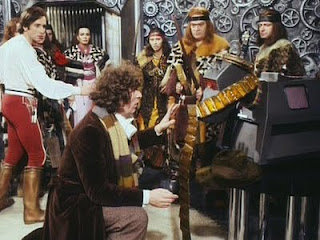
Random Who Report: The Invasion of Time (1978)

Invasion of Time still and Amazon link
As I said when I started this feature, I’ve got a weakness for Gallifrey. I still think the show lost something when it was written out, and it’s hard to articulate just why. Its inhabitants are stuffy, the show’s production budget could never quite get the whole “super advanced space Rome” thing right, and the conventional wisdom holds that outside of THE DEADLY ASSASSIN, there are no really good stories set there.

THE INVASION OF TIME doesn’t quite disprove points one and two, but I’m willing to make the case that this is a better story than it gets credit for. The story, by “David Agnew” (a common pseudonym- Anthony Read and Graham Williams get the real credit), was a last minute replacement for a hideously expensive script involving cat people, and it has a certain loopy twistiness to it that’s hard not to enjoy. It’s a season finale, and on the old series, “season finale” doesn’t mean “epic blowout” so much as “we have no money left”, but despite being cheaper than usual, THE INVASION OF TIME has a nice atmosphere and gets quite a bit of entertainment value out of a supposedly bland concept.

After a meeting with some mysterious alien beings on board their spaceship, the Doctor decides, seemingly under their influence, to return to Gallifrey and assume the title of Lord President, which he won in DEADLY ASSASSIN’s emergency election and promptly forgot about. Taking the crown in a solemn, almost mystical ceremony, the Doctor is wounded by interfacing with the Matrix- the Gallifreyan repository of all knowledge- and goes into an even stranger state, exiling companion Leela (Louise Jameson) to the wilderness outside the main Citadel, and apparently opening the way for Gallifrey’s invasion by the still-enigmatic Vardans. The Doctor may be playing some kind of bluff, but then, the aliens have a game of their own.

There are more than a few reversals and surprises here, so I’m not sure how much to spoil off the bat. The Doctor himself is keeping us in the dark for over half the story, and though this wouldn’t be the only time, it’s rare for the show to even imply that he’s on the side of the baddies. We of course know this can’t be true, but Tom Baker does a good job selling the idea of the Doctor’s untrustworthiness. The story gains a certain energy from us never knowing what’s going on, which overcomes one of the common issues with six parters; the story rarely lags, because it’s always going someplace different. The structure isn’t exactly rock solid as a result, but it holds together.

The major stumbling block for this story, and the reason it doesn’t quite enjoy the reputation it should, is that even for DOCTOR WHO, the special effects were cheaper than cheap. The sets for Gallifrey- partly retained from DEADLY ASSASSIN- are impressive enough, but the President’s Office is apparently decorated with tire rims, the Vardans are represented for most of the story by shimmering pieces of foil, and a climactic chase through the TARDIS interior seems to have been mostly shot in an abandoned factory of some kind. Along with the cheap sets, our suspension of disbelief is sometimes tested by characters making asides to the camera, a sign of a sort of lazy self-awareness setting in.

Despite these limitations, the story speaks more to the ancient-yet-new mystery that Gallifrey is supposed to represent than most others. The sets and costumes still have a unique aesthetic quality, and the introduction of the “savages”- people who broke with the Time Lords and live in the Gallifreyan wilds outside their domed city- also reveals a fair bit about the civilization, without rendering it mundane. The Doctor’s coronation as Lord President is a wonderfully dramatic ceremony, conducted almost like a church service complete with organ music. (Topping it off, access to the Matrix is granted by a halo-like crown.)

We’ve also got some good character work, both from the regulars and the guests. The Doctor has always shunned authority, so when the story compels him to take it on, it’s an interesting exploration. This is also Leela’s last story, and Louise Jameson gets several great moments; the method by which she leaves seems sort of contrived, but she manages to sell it. Hilary Ryan also does a charming turn as Rodan, a Time Lord techie who serves almost as a sort of proto-Romana (though disappointingly, she destroys no Japanese cities in the course of the story.) We also have John Arnatt as the nicely crotchety Borusa, and Milton Johns as the slimy Castellan Kelner, who ingratiates himself to whoever is running Gallifrey at the moment.

As goofy as this story sometimes is, and as often as it seems that we have to use our imagination to figure out what the people making this really wanted it to look like, THE INVASION OF TIME has an incredible amount of charm. It knows it’s sort of a slapdash last-minute affair, and so tries to keep things fast and energetic to pave over any potential story holes or thematic inconsistencies. In that sense it shares a lot with some of the new series’ more madcap episodes, the ones that make serious fans grumble but pull massive approval figures regardless. Which just goes to show that Gallifrey wasn’t that stuffy a place after all.

Written by David Agnew (meaning Anthony Read & Graham Williams)
Produced by Graham Williams
Directed by Gerald Blake

Grade: A-

Sunday, October 11, 2009

Frasierquest 1.2: Space Quest

Martin interrupts Frasier's readingFrasier: Thanks, Niles. You’re a good brother and a credit to the psychiatric profession.

Niles: You’re a good brother too.

The only Frasier episode to share its title with a graphic adventure game, “Space Quest” is sort of the second half of the story told in the pilot. Frasier now has “my father, Mary Poppins, and the Hound from Hell” all living in his apartment, and he has to adjust to the reality that we so far only saw in the end credits last time. It’s actually, as the title suggests, kind of abstract; the entire plot boils down to “Frasier wants to find some peace and quiet to read a book”, the sort of thing you’d see in a silent movie comedy, but the meat of the episode is in the disruption Frasier sees to his routine- something an Aspie like myself can appreciate.

The episode takes place the day after “The Good Son”, with Frasier waking up to realize that hiring Daphne wasn’t a dream. With another new person in the house, and Martin finally settling in, Frasier finds his morning ablutions disrupted by pre-read newspapers and high-fat breakfasts, to say nothing of having to keep his robe firmly cinched. After going to work and trying to use his radio show to host a symposium on “intrusion”, Frasier tries to reclaim some personal space by finding somewhere to sit alone and get some reading done. Fate has other plans. He can’t do it at his booth because sportscaster Bob “Bulldog” Briscoe (Dan Butler, making his series debut) needs it because the transmitter failed at his regular spot, he can’t read in the park because it starts raining, and anywhere else he constantly gets interrupted by people he knows. Inevitably, he has to confront Martin about getting some peace and quiet in his own home.

In some ways this episode is the one that establishes the status quo as the status quo- all the characters are in place, and are free to bounce off each other. Daphne is bright and cheery, sometimes too much for Frasier’s temperament, while Martin, though not nearly as grouchy as he was, having made peace with his own disruption, just naturally has a way of getting on his son’s nerves. It’s interesting to see how John Mahoney plays the character differently already, establishing the Martin Crane we’ll see in the rest of the series. Eddie, of course, continues to stare, and Roz’s fun-loving personality gets fleshed out a little more via a phone conversation. Strangely enough, Niles is only seen at the Café Nervosa, Martin and Daphne only at home, and Roz only at the station- the characters aren’t quite in a moving-around phase yet, except for Frasier himself. There’s still a certain simplicity to the setup this way, and again it’s the foundation for future shakeups.

Frasier’s talk with his dad- introduced with the superb subtitle “Just a Couple of White Guys Sittin’ Around Talkin’”- is like a lighter, comical version of the argument in “The Good Son”. Frasier realizes that getting to be closer to his father will be work, and that everyone’s going to have to make a few compromises. It falls to the end credits gag to actually bring the story to its proper resolution, an interesting use of the format.

Overall this episode isn’t quite as memorable as the pilot, but it finishes the job, as it were. The second episode of a series is now usually the “first normal” episode, and “Space Quest” does a good job of setting the rhythm of Frasier’s world and the difficulties he’s going to encounter within it. We all like to have our little spheres of quiet and control in our lives, and it can be a struggle to get them; very few sitcoms address concepts like this, and it’s part of what makes FRASIER so fascinating.

Guest Caller: Christopher Reeve as Leonard

Written by Sy Dukane & Denise Moss
Directed by James Burrows
Aired September 23, 1993

Bulldog: Okay, where’s my Cosell tape? Someone stole my Cosell tape! THIS STINKS! THIS IS TOTAL B.S.! THIS IS- oh, here it is.

Friday, October 09, 2009

In Theaters: Whip It

Whip It poster and IMPAwards link Motivated by what is now an unhealthy attraction to Zoë Bell, I went into WHIP IT expecting the light, fun story of a young beauty pageant queen becoming a roller derby superstar; I was hoping to see some lovely ladies, some mild violence, and a general asskicking attitude. Part of the movie is like that. However, a much larger portion of the movie is the rote, lifeless story of teenage rebellion against blander-than-life parents. (There’s also a third, smaller portion that made me want to buy a gun, but we’ll get to that.) Drew Barrymore’s directorial debut is plagued by a failure to realize what its strengths are; it tries to do too much, and a game cast can only pull this confused material so far. Indie-film darling Elliot Page is Bliss, a 17-year-old pageant champion and high school student, who works at a diner in the deadish-ended town of Bolin. She and her friend Pash (ARRESTED DEVELOPMENT’s Alia Shawkat) get wind of a roller derby in nearby Austin (well, it’s in bus distance anyway), and Bliss is dazzled by the sight of strong punk women rolling around the ring and throwing the occasional punch. Encouraged by star Maggie Mayhem (Kristen Wiig), Bliss tries out for the last-place Hurl Scouts, and her small size and speed make her a natural “jammer”- the person who has to pass all the other girls on the track to start scoring points. Dubbed Babe Ruthless, she hangs out with the much older scouts- Mayhem, Smashley Simpson (Barrymore), Rosa Sparks (Eve), Bloody Holly (Bell), and the Manson Sisters (Kristen Adolfi and Rachel Piplica)- as they start actually following their coach’s calls (coach played by Andrew Wilson) and winning a few games. Naturally there’s a rival team, the top ranked Holy Rollers, headed by the diva-esque Iron Maven (Juliette Lewis.) Honestly, if that were the entire movie, it would be great. A little cheesy and conventional, sure, but still good times. Unfortunately, there’s also a lot of business with Bliss’ parents, especially her mother, former beauty queen Brooke (Marcia Gay Harden). (Her father, played by Daniel Stern, isn’t nearly as strict, but he’s also the definition of henpecked.) Brooke doesn’t know about Bliss’ adventures (she thinks she’s taking an SAT Prep course), and obviously wouldn’t approve if she did. And then there’s Oliver (Landon Pigg), a charming hipster who’s in a small band and becomes Bliss’ first love. Shauna Cross wrote the screenplay for this, based on her novel, and I hope there were significant changes along the way because otherwise she wrote one trite book. (Maybe her prose is really good.) The picture follows indie-film conventions to a fault, and while being predictable isn’t a fatal flaw, if we’re going to expect every wrinkle in the plot as it approaches we should at least enjoy the ride. The scenes of Bliss living her button-downed life simply aren’t entertaining; the direction is flat, the characters aren’t developed much, and there’s a fundamental lack of focus. It’s not quite the messy reality of Bolin life (I assume), it’s not quite a cartoon exaggeration for emotional effect, it’s just sort of boilerplate. And then there are the scenes with Oliver, which honestly seem like they were forced in when one of the producers decided they needed more hipster cred. We get the obscure references, the rare vinyl collections, and romantic “hijinks” that are far too spontaneous to be spontaneous. The indie-love material borders on self-parody, climaxing in a pool sequence that has the participants holding their breath longer than Shelley Winters in THE POSEIDON ADVENTURE. Too much of this picture is just faux-quirky, and it feels prepackaged. The picture does briefly come alive when Bliss becomes Babe Ruthless and the Hurl Scouts are out in force. Barrymore actually directs the sports sequences pretty well, and more importantly, these characters are fun. We want to know more about them. We get to find out a bit about Maggie, and Wiig does a great job with a weightier role than she’s usually given, and Bell and Eve and Barrymore are charming even if they don’t get much development. At times, Lewis’ character’s bitchiness seems arbitrary, but it does work out in the end. But I wanted to see more, to know more, to have more fun and less guiltily navigating around the fun. (And I must point out that Bell is criminally underused.) The roller derby scenes, and the wild times surrounding them, feel cut short compared to the more JUNO-esque material. (And as much of a backlash as that film has gotten, it at least had a story that went in interesting directions.) The performances are uniformly good, there are some laughs, and the climax is genuinely exciting. Somewhere, perhaps only in the realm of the imagination, there is an alternate edit of this film, one in which the Hurl Scouts dominate the action and the business with Bliss’ mother wanting her to be in beauty pageants is just a subplot. There is so much raw material here for a really energetic and fun movie, and some outtakes during the end credits give us a hint of what might have been, and it makes one wonder why the filmmakers didn’t realize what the good parts of their own movie were. Screenplay by Shauna Cross based on her novel Directed by Drew Barrymore Grade: C