Showing posts with label Games. Show all posts
Monday, June 30, 2014
The Tabletop: How D&D Fifth Edition Can Be Truly Modular (Or Something Like That)
I've been looking at the previews for the fifth edition of Dungeons and Dragons, and was worried that I was starting to get truly edition-warriory about the whole thing. The more and more the gaming press and the developers themselves treat Fourth Edition as the redheaded stepchild of the family, the more I've been inclined to see it as a misunderstood masterpiece, the Community to Pathfinder's Big Bang Theory. I've been increasingly skeptical of every single teaser being released, and while there is some material here that bears watching, it was the newer, more lethal monster entries that pushed me beyond skepticism, past dismissal, and into some weird academic thinkspace.
Tuesday, June 04, 2013
The Tabletop: On the Oncoming Demise of Dungeons and Dragons 4th Edition
As time goes by and columns like this come out, it's becoming more and more obvious that the next edition of Dungeons and Dragons, called "D&D Next", will in fact be the first edition designed entirely by fear. While previous revisions to the rules set were done in the spirit of expanding, modernizing and generally improving the performance of a system that, by virtue of being the most widely played RPG in the world, had its quirks and eccentricities put to the test, this is an edition in full retreat, an effective apology on behalf of Wizards of the Coast for trying too hard to do something innovative and interesting with the system last time.
Saturday, September 17, 2011
The Tabletop: Space 1889: Red Sands

I've long been in love with Space: 1889, the RPG that captured the spirit of Victorian science fiction long before anyone knew what "steampunk" was. The setting is one of my absolute favorites, thick with romance, mystery, wonder, and morally ambiguous colonialism. The system I'm not quite as devoted to (though I don't think it's bad), and while Heliograph Incorporated has been doing the Lord's work keeping the original game in print, Space: 1889: Red Sands, a setting book for Savage Worlds, has the promise of updating the classic world with a more modern, streamlined rules set. The two prove to be a good match, and while the book has a few shortcomings and doesn't quite capture all the things that made me love the original game, it's a good translation of the setting with some new elements that open up gameplay quite a lot.
The setting is based on the premise that Thomas Edison invented a form of space travel in 1870, with ether propellers taking ships to the planets of the inner solar system, which happened to be mostly inhabited. Earth's major colonial powers took advantage of the opportunity to expand their empires, setting up bases on the new worlds and making the Great Game of political intrigue even more complicated. While the original game limited PCs to human adventurers, and generally presumed they'd be loyal subjects of the British Empire (with options for anarchists and criminals), Red Sands gives us the opportunity to play noble or savage Martians and Venusian lizard men (no Selenites, though, but I'll get to that later.)
The thing tying all characters together is that they're all members of the British Association's Explorer's Society. It's a group dedicated to discovery, advancing knowledge, and also saving the civilized worlds from the predations of evil secret societies. This is where some of the new stuff comes in- a mysterious cult called the Brotherhood of Luxor has arisen, and while the Explorer's Society doesn't know a lot about it, they know they're up to no good.
The conflict between the Explorer's Society and Brotherhood of Luxor does two things. First, it sets up the Red Sands campaign, a serialized adventure taking up a chapter, which takes the players all over the inner planets fighting a sinister conspiracy. It also alleviates one element of the setting that people may have a problem with- nowadays we generally view old-school imperialism as a Bad Thing, what with our valuing self-determination and not treating other peoples as disadvantaged savages and so on. Frank Chadwick's original game showed some understanding of the messy complexities of the British Empire and Victorian values, but it was hard to really push against those things, and characters were locked in a "colonizer" role by default. Now the characters are not only not necessarily the colonizers, they're not necessarily fighting for the Empire or Queen Vic- they're united by a more palatable, more universal love of adventure and dislike of diabolical masterminds.
The campaign itself is fairly interesting, mirroring the serialized adventures in other Savage Worlds setting books. It has a darker, grittier tone than most of the published material for the original game, and it may be worth double checking the lethality of some elements, but it's a compelling story and likely won't require a GM to do any more tweaking than he or she wants to. There are also a number of shorter, self-contained "Savage Tales" plot hooks, and a nice random adventure generator system to spark ideas.
There's a good amount of setting information, though space concerns mean you may want to turn to some of Heliograph's reprints to pick up on details. However, there are problems I do have with Red Sands' presentation of the setting. As the name implies, the central campaign- and so much of the material- is very Mars-centric, and this is a problem the original game had in terms of the supplements it put out before the line was canceled. More on the lizard men and dinosaurs of Venus would have been welcome, and there's very little information on the moon; the insectoid Selenites aren't even statted up anywhere. Only one of the Savage Tales plots takes place on the moon, and that doesn't involve the Selenites, rather dealing with the vanished Vulcan culture. I had hoped at first that Pinnacle planned to deal more with the other worlds in future books, but I've not heard much on that front. So if you really want to explore all the Many Worlds you may have to do a few conversions yourself.
Though Space: 1889's original rules system was a little clunky and unfocused, I am glad that the Savage Worlds conversion preserves something of its funky, fiddly Invention system that lets you create everything from a more efficient ether propeller to a goddamn lightning cannon, as well as rules for building your own ether flyer (which any good group should do, in my humble opinion.) Converting characters over should be no problem, and of course Savage Worlds was designed for pulpy action-adventure so it fits the setting quite well.
I'm not entirely satisfied with the book, but this may be because I'm applying high standards to the treatment of one of my favorite settings ever. It's definitely focused a bit more on savage adventure than on the wonder of discovery, but the latter isn't shortchanged. I do think the emphasis on Mars represents a missed opportunity to correct the same imbalance in the original line, which was discontinued before it could begin to focus elsewhere. And I'm still nonplussed about the Selenites (they should be in the errata or something.) Still, I can't argue against this being a successful translation of the setting to a new system, and not only is the change in mechanics is for the better, but Red Sands opens up the setting and adds quite a few new possibilities for adventure. It's good enough that I want to see more.
Grade: B+
(Note: this review or something like it should be up on RPG.net later. Since this site gets less traffic I figure I'd give you a sneak preview.)
Tuesday, August 30, 2011
Random Movie Report #95: Dungeons & Dragons: Wrath of the Dragon God
A long time ago, there was a movie version of Dungeons & Dragons, and it was pretty terrible. As I wrote at length for the Agony Booth back when they still did text recaps, it was a dull, unimaginative quest through clunky exposition with the only reward being watching Jeremy Irons devour every last scrap of the set. Somehow it did well enough to merit a direct-to-video sequel, and astonishingly, not only is it not terrible, not only is it actually kind of fun and in keeping with the spirit of the game, but it's actually good. Dungeons & Dragons: Wrath of the Dragon God doesn't try to be much more than a cheesy sword & sorcery picture, the sort of thing that Syfy airs regularly, but it tries hard within that framework. With only a tenuous connection to its predecessor it manages to do just about everything better.
The hero of the film is Berek (Mark Dymond), a former adventurer who discovers that an ancient dragon god is slumbering beneath a local mountain, waiting to be released. Doing some research, his magic-user wife Melora (Clemency Burton-Hill) discovers that an undead villain named Damodar (Bruce Payne, returning from the original) has located a magic orb which can be used to release the dragon- and that he intends to do so, in hopes that he can rule over what's left of the world when his scaly partner is done with it. Melora is struck ill by her divinations, and Berek gathers a band of adventurers- a barbarian (Ellie Chidzley), a thief (Tim Stern), a cleric (Steven Elder), and an elven wizard (Lucy Gaskell)- to travel to an ancient ruin and track down Damodar before he can unleash evil on the kingdom.
All of this is really just a prelude for the action, and rushed through efficiently as a result. If a few details get lost in the process, it's not a big deal because it's easy to follow the "bad guy wants to do bad thing, heroes must stop him" thread. This is, on balance, a good thing; unlike its predecessor, the picture delivers what it promises, packing plenty of action and incident into its running time. The key to low-budget filmmaking is the efficient use of resources, and while you can see the corners that have been cut now and again, they manage a few impressive CGI monsters and good-enough-for-cable production values.
A real effort to be true to the game has been made here, which is impressive considering that Dungeons & Dragons doesn't even have a fixed setting or characters (the makers of the Monopoly movie would be wise to take note). We have your standard adventuring party, not defined much beyond their class stereotypes but likable nonetheless, lairs and tombs filled with traps and treasure, a few familiar monsters, and even a plot point hinging on the differences between "arcane" and "divine" magic. Fortunately the emphasis is not on the grognardy details but on the general "band of heroes in a dangerous land" territory that should be familiar to anyone- sure, the nerds will get the most satisfaction from it, but it's not exactly impenetrable.
Despite all the in-jokes and a generally unpretentious tone, Wrath of the Dragon God does manage a genuine sense of danger and drama. One of the party is killed about midway through, making it look like all of them are at risk, and the dungeoneering is played parallel to Melora and the mage council's attempts to get in touch with the elder gods who imprisoned the dragon in the first place; we're constantly reminded of her encroaching curse, which threatens to turn her into an undead abomination like Damodar. She's a nice character, well-played, and it's not clear if she's going to make it.
So against all odds, despite specifically not aiming much higher than B-movie fare, Wrath of the Dragon God genuinely works. It captures some of the hack-and-slash feel of the tabletop game without getting bogged down in geek minutiae, and it has just enough heart and regard for its characters to make one want to see how it turns out. In a just world this would have gotten the theatrical release, but then again, it makes for a perfect TV matinee.
Written by Robert Kimmel, Gerry Lively, and Brian Rudnick
Directed by Gerry Lively
Grade: B
Friday, April 10, 2009
Dave Arneson, 1947-2009

I was hoping to get back to regular reviews at some point, but for now, another formless text piece. Not a rant this time, but another memoriam. Dave Arneson, the co-creator of DUNGEONS & DRAGONS, passed away recently at the age of 61, over a year after the passing of his collaborator, E. Gary Gygax. Arneson wasn’t quite as well known or prolific as Gygax, and so doen’t quite get the credit he deserves. So I figure he deserves a tribute at least as long as Gygax got, even if I’m now finding myself rummaging for something new to say.
I’m fuzzy on the early history of D&D’s development, but I do know that Arneson was the creator of Blackmoor, a fantasy setting that actually predated the game. He’d been working with miniature wargaming and introducing fantasy elements, and Blackmoor was the world he had the games take place in. The desire for a more codified rules set than existed at the time led him to team up with Gygax, who had been involved in the CHAINMAIL medieval miniatures game, and together they developed D&D based on the structure of one of Arneson’s Blackmoor scenarios. It formed the background for the earliest D&D games, but the world wasn’t presented in much detail until it was published as a third-party campaign setting in 2004.
Arneson parted ways with Gygax and TSR near the end of the 70s, (though he briefly returned to author a few Blackmoor modules when Gygax temporarily took control of the company) and was kept out of the copyright for ADVANCED DUNGEONS & DRAGONS by virtue of Gygax writing the whole thing. At one point Arneson was involved in a lawsuit against TSR regarding ownership of the DUNGEONS & DRAGONS trademark, but this was resolved when WotC took over (hence the third edition going back to D&D.) Despite these troubles Arneson never seemed bitter about his experience, and continued running games and working with game design in various forms until shortly before his death.
Arneson’s death came at the end of a long battle with cancer, and far too soon for anyone. But he leaves behind a great legacy- a game that spawned a medium, a game that encourages the imagination, and something very fun for the nerdier set, i.e. people like me. He didn’t get quite enough credit for it, but he’s not going entirely unsung. I hope I’ve done justice to him in my small way, and if it’s not too sappy, I’d like to imagine he’s just now started on his greatest adventure. Or, at the very least, that he and Gary are finally collaborating again.

Rest in peace, Mr. Arneson. We won’t forget you.
Monday, November 17, 2008
The Bookshelf: Dragons of Autumn Twilight by Margaret Weis and Tracy Hickman

For no particular reason I’ve taken an interest in some of the fantasy settings for DUNGEONS AND DRAGONS and its various permutations. The differences between them are often subtle and incredibly geekish, but the DRAGONLANCE saga caught my attention as a unique blend of creativity and marketing. The original trilogy of books that I’m reading- DRAGONS OF AUTUMN TWILIGHT, DRAGONS OF WINTER NIGHT, and DRAGONS OF SPRING DAWNING, all by Margaret Weis and Tracy Hickman- were tied in with a series of modules released for the game around the same time in the mid-eighties, detailing a very linear, story-driven campaign based on one that Weis, Hickman, and others had run earlier.
So DRAGONS OF AUTUMN TWILIGHT is essentially the professionally published and bestselling equivalent of someone’s online game fiction, and yet it’s not bad. I’ve mentioned in the past that I don’t like how the fantasy genre is dominated by Extruded Fantasy Product that always revolves around a diverse group of characters from every corner of the author’s fantasy world going on a quest which takes them to every other corner of the author’s fantasy world in order to collect plot tokens and defeat the Supreme Evil, but in retrospect I don’t really hate the form itself. Only a handful of authors have ever done anything genuinely great with it, but a good EFP can be fun reading, and DRAGONS OF AUTUMN TWILIGHT works on that level. It’s surprisingly fast paced, given its length, ably juggles a good cast list, and though it has more than its fair share of silly moments they don’t drag the whole thing down too much.
It begins, appropriately enough, in an Inn, where a woman named Goldmoon, in possession of a staff with magical healing properties, is hiding from her tribe with her lover Riverwind, whom she tried to save from execution. Needless to say, dark forces are after her and the magical artifact her boyfriend obtained from a lost city under mysterious circumstances, and she falls in with a group of seasoned adventurers who have been looking for information on the old gods of Krynn, gods forgotten after a great cataclysm but still at work in the land. The staff is obviously connected to them somehow (healing magic was lost when they went out of fashion), and the disappearance of a couple of constellations from the sky portends a new cataclysm on the way. So our band of adventurers- Tanis, our somewhat moody half-elven protagonist; Caramon, a rough and tumble swordsman; Raistlin, his sickly wizard brother cursed by his studies; Flint, your requisite gruff dwarf; Tasslehoff Burrfoot, a kender (essentially kleptomaniac hobbits); Sturm, formerly a knight of Solamnia, and our two sort-of-Native-American-but-she’s-blonde-somehow refugees- set off up north to find the lost city wherein Riverwind first stumbled across the magic item in hopes of discovering more about what’s going on. And yes, there are dragons.
Stories like this are hard to review, because while the plot structure is pure Joseph Campbell by way of J.R.R. Tolkien, it’s the details which make every story stand out. The setting here is quite elaborate, with its old gods and new theocrats, lost orders, dragon-like humanoids who turn to stone when killed, primitive “gully” dwarves, and a number of details that just sort of lurk in the background. There are also, as you may have noticed, more than a few characters to keep track of; they’re very distinct and broadly drawn, so it’s not hard to remember who is who, but it’s still a big cast and they get kind of scattered at times. (This is why Dungeon Masters try not to split the party.)
The plot rambles along in a way that one might expect from something adapted from an RPG campaign; it’s episodic, but each episode is strongly connected. One distinguishing element of the story for better and for worse is a certain level of silliness. Take for example the gully dwarves, a friendly group of underground dwellers our heroes meet on their journey through the lost city. They are primitive, childlike, and most importantly, stupid. They can’t count above “two”, they speak in pidgin babytalk, and they’re so lacking in apparent common sense that it seems hard to believe they exist as a civilization. Obviously, this is fantasy, and the dwarves are funny at times, but they wear on the nerves a bit, as does Fizban, an overly comic wizard who can never remember how to cast spells.
Closest to damningly, though, and I regret having to spoil anything so I’ll try to be vague but skip over this paragraph if you insist anyway, in rather quick succession we see two characters seemingly killed decidedly dead only to come back the next chapter. The very next chapter. Now, I am all in favor of resurrecting a fictional character if it’s at all necessary or entertaining, but if you’re going to do this you should at least have a suitable period of anticipation wherein we think the character might actually be gone. Gandalf at least had the decency to wait an entire book before his reemergence.
Some of the silliness extends to the characters. Tasslehoff’s ever-so-whimsical compulsion to take things seems like a contrivance because the authors were afraid to make any of the heroes morally ambiguous, and frankly all the main character notes get pounded on repeatedly without a lot of variation over 400 pages. Goldmoon loves Riverwind, Tanis is conflicted about his heritage, Caramon has the hots for a fetching barmaid, Sturm used to be a knight, and Raistlin is bitter. They’re never quite three dimensional, though they’re not without charm.
I can’t say I dislike this book, though, even if it does feel rather inconsequential for the first act of an epic trilogy. It’s got a lot of neat ideas, and even if they don’t all congeal they still give you the feeling that this is a genuine fantasy world and not just a marketing ploy. But the real sign that this book worked for me was that I picked up the sequel without any thought. Weis and Hickman have hooked me, for better or worse.
Grade: B
Monday, October 06, 2008
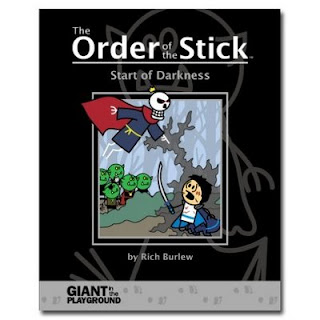
The Comics Page #18: Order of the Stick: Start of Darkness

It’s common for a webcomic to move from simple gag strips to intricate dramatic plotlines that require we suddenly care about the characters. What’s rare is for a strip to do this without completely falling apart. ORDER OF THE STICK, written and drawn (after a fashion) by Rich Burlew, has managed to achieve a careful balance between jokes about DUNGEONS AND DRAGONS rules, character banter, and genuine plot, resulting in what may be one of the best webcomics currently going. To be fair, it got into plot business reasonably early, and has never abandoned its metatextual roots, so it may not be a shift so much as a predetermined blend. Giant In The Playground has released a few trade compilations of the webcomic, but START OF DARKNESS is one of two print-only prequels delving into the surprisingly layered backstory of a stick figure fantasy comic. THE ORIGIN OF PCs deals with the origins of the actual Order, while this delves into the series’ overarching villains: Xykon the lich, Redcloak the goblin priest, and their pet, a fearsome monster lurking perpetually in the darkness. Burlew recommends reading NO CURE FOR THE PALADIN BLUES, the second compiled volume, before this one because this spoils some of the backstory, and that story begins roundabout here if you’re curious. For those already up to speed, START OF DARKNESS marks a change of tone but still shows off what the strip does well, blending sharp comedy writing with solid comics storytelling and a genuine interest in its characters.
We first meet Xykon as a young boy, one who has suddenly developed mystic powers, which he uses to re-animate his dead dog, kill and re-animate his family, and basically to set out to become the most powerful and most evil spellcaster that ever there was. Meanwhile, an entire clan of goblins is slain by the Paladins of the Sapphire Guard, and a survivor, an acolyte of the Dark One (the goblins’ default deity), inherits the Crimson Mantle of the High Priest, and with it knowledge of a great plan to wreak revenge on the “civilized” races that have plagued them since their birth. Taking his younger brother with him, he meets up with Xykon and a partnership is born. Naming himself Redcloak (because Xykon doesn’t have the patience to learn his real name), he persuades the not-yet-undead sorcerer to aid him in taking control of a mystic gate that could give them both the power to rule the world. Things do not go as planned.
The moral dimensions of this story are apparent from very early on, with the ostensibly (and, by the game rules which the strip follows to the letter, objectively) good paladins massacring an entire village of goblins. Further complication is added in the backstory, which implies that the goblins, orcs, bugbears, and hobgoblins of the world were created solely to be killed for experience points by patrons of the good gods (the Dark One having ascended to his position from among the goblin race.) Anyone who’s read a good amount of fantasy has no doubt come across this sort of inversion before- heck, play a Horde character in WORLD OF WARCRAFT and you’ll encounter it. But Burlew doesn’t simply let us off the hook by putting us firmly on Redcloak’s side, either. His quest for justice for the goblins starts to turn into one for vengeance, and Xykon’s growing corrupting influence helps to drag it down even further. Xykon himself is Just Plain Evil, without any redeeming qualities, but he’s still well-rounded; he’s got a short attention span, no head for strategy, and a determination to enjoy life and undeath through causing the suffering of others.
Through this, it’s still funny, and the interesting thing is how broad the humor is allowed to be without obstructing the serious business. The simple artwork makes it easy for us to accept a D&D-esque fantasy world with diners, action figures, and taco joints. Burlew also likes to break the fourth wall a lot, which is particularly fun if you’ve been reading OOTS for a while.
Burlew uses more or less the same page format that is employed for most of the strip, but while the online strip is in full color, this prequel is mostly in black and white (presumably to save on printing costs, but he gets some good gags out of it too.) The art, as mentioned, consists of stick figures in a fairly simplistic 2-D environment, but is surprisingly expressive and carefully rendered.
This is a good fast read, one which depends on familiarity with the strip but not too much. (The main strip’s still free anyway, so why complain?) Obviously it’s a dark chapter, with inevitable tragedy by the end of it all, but at the same time it opens up a lot of possibilities as to where the story will go in the end. For fans of the online strip it’s a must-buy, for everyone else, start reading those archives.
Grade: A-
Wednesday, August 27, 2008
In the Picture Business

I’ve been meaning to put this up for a bit. Late last year I purchased the computer game THE MOVIES from Lionhead Studios. It’s a sim game of sorts wherein you run a movie studio, from the twenties to the present and beyond. The game part is fun enough, though difficult, but the game is also a machinima tool; you can use the “Advanced Movie Maker” feature, either in the Standard game or a low-maintenance Sandbox mode, to plot out movies scene by scene, cast “actors” from your studios, set plots and set elements and juggle all sorts of things. You don’t have total control of everything the actors can do, but you can modify quite a bit, and the STUNTS AND EFFECTS expansion offers more options.
This isn’t a game review, though. Lionhead runs THE MOVIES ONLINE, which allows you to upload your films and have them reviewed, and I’ve used them as an outlet for the work of Global Film Company. My present movies are up there, but there’s limited space, so I started uploading the overflow to Youtube and, when TMO briefly went kablooey, to The Movies Underground, an alternative site. Included after the jump is a taste of what I’ve been doing, courtesy the Tube of You:
TO THE DEPTHS OF SPACE! (1930)- Space explorer Tara Flame journeys to Alpha Centauri to rescue a missing scientist. This is an expanded version of a film I made in the standard game, which had a brutally troubled production (including frequent tantrums by its director) and took a couple of years to finish, but ended up being a success and a nice metafiction story. The sequel is up at TMO, and I will be adding more adventures to the Tara Flame saga.
REPTILE WOMEN OF MARS (1953)- Another retro sci-fi-er, made in the standard game so it’s sort of compressed. This one still needs a little work.
THRILLKILLER JOHN (1955)- Anyone who watches this one, please tell me if you understood what was going on or if I should add subtitles. I’m genuinely curious.
ROAD TO DYSTOPIA (1972)- My tribute to seventies Dystopian science fiction.
If you want to try this yourself, here are the product links for the game and its expansion, for PC and Mac.
Lionhead’s got all its resources tied up in FABLE 2 so we may not see another expansion (which is a shame, since there aren’t many options for fantasy or historical epics), but there are plenty of modders working to add content on their own: the Director’s Cut Modding Foundry is where I’ve found my material so far. See you in the pictures.
Tuesday, August 26, 2008
The Empire Strikes Back Fallacy: An Introduction

A recent announcement by Warner Bros. and DC got me thinking. Based on the success of THE DARK KNIGHT and the underperformance of SUPERMAN RETURNS, they’re going to try and apply the dark tones of the former to a kind of revamp of the Superman franchise. (They never actually said the word “reboot”, and there’s no word on whether or not Bryan Singer will still be involved.) I’m saddened by this in a way, as I think SUPERMAN RETURNS was utterly magnificent, but that’s on the record already. Instead I’d like to point out a concept I’ve been developing over time, looking at genre fiction, fandom, and media in general.

I call it The Empire Strikes Back Fallacy. Let’s break it down logically:
1. THE EMPIRE STRIKES BACK is the best/most well regarded of the STAR WARS films.
Granted, this is partly a matter of opinion, but the general consensus holds it up as the highest. It’s got the best RottenTomatoes score, the highest IMDB rating, and fans always think of it as the best.
2. THE EMPIRE STRIKES BACK is the darkest of the STAR WARS films.
In regards to the original trilogy, this is close to objective fact, and though maybe REVENGE OF THE SITH is a little darker, it’s dark in a different way (and, in any case, the best/most well regarded of the prequel trilogy.)
3. Therefore, the darker a work is (or from the creator’s perspective, the darker we can make it), the better.
You see this put into play in most serial fiction, usually movie series but also in television and comics. Writers and directors love to talk about how this newest installment of the series is “the darkest yet” and how they’re ratcheting up the peril and the danger. Part of this seems to be for show- you always want to tell your audience that our heroes are in more danger now than they’ve ever been- but a lot of times they seem to believe it.
And the thing about it is, it almost seems true. A darker story is one with higher stakes, one where you can kill characters and hand the bad guys victories and genuinely make the audience uncertain how things will turn out. That’s got to be better than watching invincible protagonists inevitably triumph over their foes, right? You’re writing drama, why not make the drama as dramatic as possible?
Indeed, I would add a supporting argument to this fallacy, known as the STAR TREK: VOYAGER element. This spinoff of the popular franchise was particularly poorly regarded, because it had a fairly dramatic premise (a spaceship marooned far from home) but was plagued by cozy familiarity and lack of actual suspense. Just about everything got solved by the end of an episode, the main characters had script immunity up the wazoo, and things like food supply or keeping the ship working or everyone not going crazy seemed never to crop up. Nobody fought, even though a portion of the crew were actually members of a rebel faction in conflict with the Federation. They just forgot about it. It was a bit weak.
So why is this a fallacy? The first answer is that it doesn’t always work. SPIDER-MAN 3 attempted to take the series in a particularly grim direction, and though I enjoyed the film quite a bit (not sure about the grade I gave it, but I’ll have to see it again), generally people thought it had gone too far with the so-called “emo” material. (And I’ll take them at their word that it was emo, since I have a hard time recognizing it.) The attempts at bleakening things in the PIRATES OF THE CARRIBEAN sequels never felt quite right either, though obviously they did boffo business.

Most famously, BUFFY THE VAMPIRE SLAYER had a really controversial sixth season in which just about everything bad happened to every character you could name. Buffy, back from the dead, suffered a near-suicidal ennui leading to a profoundly dysfunctional relationship with not-really-reformed vampire Spike, culminating in his attempting to rape her. Xander, fearful of his future, left Anya at the altar. Dawn struggled with kleptomania for some reason. Willow struggled with a perhaps-overly-literal addiction to magic, and went over to the dark side completely when her girlfriend Tara was murdered. A lot of fans were turned off by the sheer grimness and high melodrama, and much of the publicity for season seven emphasized that they were lightening up and going back to basics. I enjoyed season six, but they definitely went overboard. When you pile too much angst and horror on viewers, you risk making them feel detached- they don’t trust the storyteller anymore and they don’t want to risk being jerked around further.

There are also counterexamples. The TV series THE AVENGERS actually started in a dark place, with Dr. David Keel seeking vengeance for the death of his fiancee at the hands of drug runners, and working with a shadowy operative named John Steed to accomplish it. In following seasons, Steed, now the star, had a prickly relationship with partner Cathy Gale, and there was a lot of intrigue and distrust. However, what everyone remembers are the episodes in which Steed and the unflappable Emma Peel battle diabolical masterminds with bizarre schemes for money, power, and sometimes world domination. The main characters never seem like they’re in any true danger, and there’s so much humor and innuendo it makes James Bond look like one of Smiley’s people. Much of it is incredibly inconsequential in dramatic terms, but it’s undeniably fine television. More recently, and again on British TV, the reborn DOCTOR WHO is an upbeat, energetic, and joyful sci-fi adventure series which, though not averse to doing dark episodes, is never really bleak. Tragic things happen, but in carefully measured intervals.
But specific examples notwithstanding, what makes The Empire Strikes Back Fallacy a fallacy is that it’s too easy. It’s not really a great challenge to make a story darker, just as it’s not much of a challenge to make a story lighter. What is a challenge is finding the right tone for the story you are telling, and every television show, film series, book series, comic book, etc., has its own range. Moreover, you can’t be the darkest you can be all the time for the same reason that a rollercoaster can’t always go downhill; there have to be peaks and valleys, a rhythm that the audience can enter into. The reason that the ultra-dark BATTLESTAR GALACTICA is watchable and not an endless death march is because it has its up moments, as well as developments that aren’t so much “up” or “down” as they are just plain bizarre. Without those breaks in the tension, you wouldn't feel it when they really jam the knife in.
I’m not sure a “darker” Superman can’t work, but when you think about it SUPERMAN RETURNS was already a down movement from previous entries in the series, with a grimmer look, macabre humor, and Superman feeling alienated from the people he has sworn to protect. It’s possible to go darker, but it’s also a risk, and whoever ends up in charge of this is going to have to look closely at the precise tone they want. You can’t make a Superman film that feels like THE DARK KNIGHT and expect much of a positive response, after all.
It’s tempting to try and press as far as you can and spam the tragedy button in the fighting game that is dramatic writing, but eventually the audience will learn how to block. (Witness the backlash against Joss Whedon’s tendency to break up anything that looks like a happy relationship- I love the guy, but honestly, we can see it coming.) You must vary your attacks, and weave your moves together into a compelling and unpredictable pattern. I don’t think I can stretch that metaphor any further, but to conclude: THE EMPIRE STRIKES BACK is a great film NOT because it’s dark, but because that darkness helps throw the overall bright adventurous idealism of the STAR WARS series into relief, and ultimately affirm its values even after testing them. The darkness is there to advance the story and not for its own sake, and the true lesson to take is not that darker is better, but that the audience responds best when their guard is down.
Next week, I’ll use differential equations to explain why comparisons to video games do not work as film criticism. Unless I’m distracted by something shiny.
Saturday, March 08, 2008
The Tabletop: Promethean: The Created

This review, like the other I've posted here, was first put up over at RPG.net. You can buy the book by clicking the above image.
PROMETHEAN has been a long time coming. White Wolf has tackled vampires, werewolves, ghosts, and mummies, among other supernatural beings, and in this twisted version of the Universal horror movie line up it was inevitable that the Frankenstein monster would get a look in. PROMETHEAN: THE CREATED, one of the more recent entries in the new World of Darkness line of games (all requiring use of the WORLD OF DARKNESS core book), is a bit broader than that, expanding on the “artificial life” premise to incorporate golems, muses, mummies (again, though their last incarnation was in the old WoD so it’s not really overlap), and shamans (shamen?). It’s a strong game, one with a few odd quirks here and there but a great central conceit, putting the players in the role of tormented creations in search of a soul.
A Promethean is a resurrected corpse, gifted with life by the mysterious alchemical fire of Pyros. Their history stretches back to five individual acts of creation: the killing and resurrection of Osiris by Isis, Pygmalion’s construction of Galatea (not through sculpture, as the myth says, but through the assembly of particularly good-looking body parts), the resurrection of Tammuz over in the Babylon region, the strange birth of the shaman Ulgan in Siberia, and of course Victor Frankenstein’s unusual experiments with lightning. These five experiments created five unique Prometheans, gifted with the Pyros, and they in turn created many descendants, each retaining the distinct characteristics of his/her lineage. Thus, we have the Wretched (or Frankensteins), the Galateids (or Muses), the Tammuz (or Golems), the Osirans (or Nepri), and the Ulgan (or Riven). The Frankensteins are ramshackle assemblies of body parts given life by lightning (and tied to the element of fire), the Galateids (tied to air) are beautiful and social creatures whose inherent otherness nonetheless creates problems, the Osirans (connected to water) are priests of the god of the dead intent on mastering their condition through knowledge, the Golems are born slaves whose strength comes from the earth itself, and the Ulgans are mystics, tied to the spirit world despite their own lack of a soul. Most Prometheans- including the PCs, one presumes- are on a quest to become human, an achievement they know to be possible but only after a long journey of self-actualization and mastery of the forces that rage within them, including the morally questionable act of creating another Promethean.
Of course, being a hideous supernatural monster always seems to come with perks, and through mastery of their Pyros, Prometheans can attain various “Transmutations”, powers reflective of their natures- this can range from detecting electricity to temporarily animating the dead. Starting characters start out with three dots’ worth of Transmutations, and the ones you select are based on your Refinement, a weird kind of template regarding your current emphasis in your quest for humanity as expressed by alchemical elements (the Refinement of Gold is about learning to understand humanity, the Refinement of Copper is about understanding yourself in relation to the world, the Refinement of Iron is about strengthening the body, etc.) You can change Refinement, but you have to roleplay the shift in philosophy and it usually takes a bit of time.
Character creation is mostly run by the guidelines of the WoD core book, except that in this case you’re not creating a human who is changed by the supernatural but someone who is a supernatural being to start with. The WoD Morality trait is replaced by Humanity, a 10-point scale which shows how well you understand (or at least can imitate the behavior of) the mortal world around you. Monstrous behaviors (like throwing little girls into ponds and the like) reduce your Humanity and make it harder to resist the Torments of being an inhuman creature. Promethean characters also have Pyros which they can spend to power Transmutations, and Azoth, a form of purified Pyros which functions as the strength of the fire contained within you. Having lots of it makes it easier to spend Pyros and ultimately attain humanity, but also makes the mortals who meet you more unsettled and can attract Pandorans, misbegotten creatures who feed on the Pyros.
This is probably getting confusing. There’s a lot to absorb with this game, which is typical of World of Darkness stuff- it’s a matter of becoming used to the specific terminology of each little subculture. Unfortunately we’re not quite done yet- there are plenty of capital words to follow. It does get a bit simpler, though.
There are three mechanics which reflect the difficulty of being a Promethean in a mortal world. Prometheans can generally give the illusion of a normal appearance, but something about their soulless nature causes Disquiet in humans- mortals have to roll a test of Resolve and Composure, against the Promethean’s Azoth, and failure places them in the first stage of Disquiet, initially suffering strange dreams about this odd person in their lives, moving on to dark fantasies, paranoia, and finally destructive action. Disquiet can also spread from person to person, turning entire communities against the Prometheans and causing everyone to break out the pitchforks and torches. This is perfectly in tune with all kinds of “artificial life” stories, from A.I. to EDWARD SCISSORHANDS, and the mechanics leave a lot of room for interpretation. Then there’s the psychological pressure on the Promethean, represented by Torment. Various conditions and occurrences (including being damaged by fire, which is especially dangerous to a Promethean- fire BAD, if you will) trigger an unopposed Humanity roll, failure throwing the Promethean into a state of rage and temporarily smothering his or her humanity. Frankensteins get vengeful and violent, Muses take on a stalkerly attitude, Osirans become detached and almost sociopathic, Golems go on mindless destructive rampages, and Ulgans become dominated by the spirits they contact. This has some good potential, though obviously Storytellers have to be delicate about guiding PC behavior. Finally there’s Wasteland, the corrupting effect Prometheans’ Pyros has on the world around them. When a Promethean spends longer than a day anywhere, the Pyros starts to degrade and twist things for a mile around, and over a period of months the landscape develops in a way relates to the Promethean’s lineage (and the element connected with it.) A Wasteland can also spread if things get too bad in the center area, and there seems to be no upper limit on how big they can get. Now, I like the basic idea of the landscape where Prometheans live changing to look like something out of a James Whale movie, but at times the effect seems a bit severe, especially when the land starts spreading Disquiet and perhaps subtly prodding mortals in the area to do something about the taint. It makes sense for Prometheans to be under pressure to keep moving, but it also seems like these rules would make it difficult to run an urban campaign (and lower the value of the Lair merit.) Wasteland stages run from one to five, but for some reason the description of effects by lineage only goes from stages two to four. Wasteland probably isn’t too bad in practice since it does spread on a monthly basis, but it seems like it could have been limited and simplified a bit. It just seems weird to me that you could theoretically create a Wasteland the size of Rhode Island by staying in a shack for long enough, especially in an overall setting where humanity is largely ignorant of the supernatural forces that surround them.
Both the Wasteland and Torment rules have a weird addition that also seems to force a certain style too much. A party of Prometheans is, most properly, a branded “throng”, in which the characters make an alchemical connection in order to help each other. Being part of a throng with Prometheans of other lineages makes Torment easier to resist and slows the spread of Wasteland- however, having one of the same Lineage as you makes these problems worse. Encouraging diverse parties is one thing, but I’m not sure why the designers went out of their way to discourage there being two Ulgans, two Golems, etc. in a given group. I think it’s at least possible that players can come up with interesting variations on the basic archetype behind each Lineage (say, one Galateid with a naive Pollyanna attitude who fancies herself an actual Muse, and another who more cynicaly manipulates her good looks and unearthly charm to get what she can from the mortal word before it turns on her), and that two characters of the same type can be played in different and entertaining ways. The carrot makes sense, the stick is unnecessary.
Fortunately, despite all the things the system sets against Prometheans, the rules also provide a lot of support for guiding their progress towards humanity. There are rules for the creation of new Prometheans (or Pandorans if something goes wrong), and the journey of each Promethean is laid out as a series of milestones which the Storyteller specifically determines based on the character and what vision the player has for him or her. It’s about understanding humanity on intellectual and emotional levels, and basically becoming a well-rounded (though not necessarily well-adjusted) individual. Personal development is really the theme of this game, which is an interesting one.
Of course, there are enemies, and not just humans suffering Disquiet. The chief antagonists are actually the Pandorans- corrupted vessels of the divine fire, lacking any sense of humanity from the start and often completely mindless. Pandorans feed off the Vitriol that Prometheans accumulate as they refine themselves, and are attracted to the natural Azothic radiance that all Prometheans exude. Pandorans get created when a Promethean tries to make another one of his or her kind and fails spectacularly, and can also reproduce by division when exposed to an excess of Azoth. They are divided into five mockeries of the Lineages; the Ishtari, the anti-Tammuz, lurk deep in the earth and enjoy capturing their victims and feeding on them at leisure, the Renders, a twisting of the Ulgan creation ritual of being pulled apart by spirits, actually do the ripping and tearing themselves. Sebek, the Osiris mockeries, are savage crocodile-like creatures lurking in the water. The Silent mock the Galateans through stealth and mutilation of their prey; the Torch-born, born of fire like the Wretched, seek to burn their victims to death. Most of these things are mindless, but some, the Sublimati, are born as intelligent as human beings or Prometheans. There are also Centimani, Prometheans who follow the “Refinement” of Flux, embracing the chaotic forces within them and abandoning any search for humanity. There are also clones, mindless psuedo-Prometheans created by unethical scientists (are there any other kind in a White Wolf game?), and some vague hooks for a new, barely understood Nuclear Promethean born from an accident either in Los Alamos, Bikini Atoll, or the USSR.
The book closes out with an introductory adventure- any potential players might want to skip this paragraph, but basically, a human alchemist summons the characters together and promises to help make a dose of aqua vitae which will help one of them on their journey towards humanity. They have to gather a few symbolic ingredients, and there’s some intrigue involving other Prometheans, and some business with Pandorans as well. It’s kind of slight, and didn’t really stand out to me that much, but some GMs might find it a decent campaign starter.
The book is well produced, with an above-average bit of fiction scattered through a few separate sections like a magazine article, and attractive black and white art. The arrangement is sometimes a little weird- the detailed listings of the Refinements come before those of the Lineages, which are more likely what you’d want to know first. Character creation involves looking back and forth between this book and the WoD core, which is annoying since I’ve only got the latter on PDF, but such is the nature of the line.
Appropriately enough, PROMETHEAN has entered this world a little rough around the edges. The writers as much as admit that this game is harder to run than most because of the level of character involvement required; you could argue the same for many of the World of Darkness games, but this suffers the curse of being new and not having had any default play models evolve yet. But there’s a lot of potential here, and the system seems to back it up. The game captures the tropes of isolation, rejection, and need to connect with humanity that underlie not only the Frankenstein story but many other myths of artificial life, and they’re able to make what seems like narrow subject matter offer a real range of possibilities. The rules will need some tweaking, I think, but if you’re interested in the subject matter (or the burning question of what would happen if the Frankenstein Monster, Imhotep, and Kira from XANADU rented an apartment together), this is definitely worth taking a look at.
Grade: B+
Wednesday, March 05, 2008
E. Gary Gygax, 1938-2008
You know, if I make a habit of tributes to recently deceased creators, this is going to become one very maudlin blog very quickly. This year has gotten pretty cruel only three months in. But this one I have to do.
When E. Gary Gygax created DUNGEONS AND DRAGONS together with friend Dave Arneson, he probably didn’t know just what he was doing. D&D was actually released first as a rules supplement to the pair’s miniatures wargame CHAINMAIL, suggesting rules for taking individual figures and using them to represent heroic adventurers exploring caves and forbidden labyrinths full of monsters and treasure. It sold like hotcakes and was quickly published as a stand-alone game, and with that, the entire hobby and medium of the role playing game was created. D&D wasn’t the first RPG I ever played, but when I discovered what these games were it was one of the first I had to have. It was the touchstone, the center of this weird new world, and I’ve followed it from that bright red box to the game it is today, and the one that’s just on the horizon. Gygax had tapped into something big- the desire to identify with the heroes of fiction and myth and to put oneself in their shoes- and placed it in an appealingly straightforward package. However complex the rules may become, the appeal is direct and visceral; fighting orcs and ogres, dodging traps, casting spells, and swiping vast hoards of gold and maybe finding a magic sword or two.

It’s all so wonderfully geeky, and for a brief period in my life I thought this was something to be a bit embarassed about. But let’s face it, fun is fun and there’s no point in being ashamed of a hobby that encourages creativity, imagination, and getting together with friends. Despite being almost perpetually a niche hobby that gets mainstream attention sporadically and rarely flatteringly, the industry that D&D started has survived increasingly intense competition from video games offering the same heroic thrills with less math and more pictures, and seems unlikely to ever truly die. And there’s a unique value to what RPGs do which goes beyond the trappings of genre- at heart, a roleplaying game is one where you can try anything, where the only limit is how generous your game (or dungeon) master is. Any situation not specifically covered by a rule can be winged, and competition takes a backseat to just enjoying oneself.

Gary Gygax’s contribution to pop culture and the lives of young geeks everywhere is a remarkable one, and really the rest of us can only hope to have that kind of impact. It’s sad to see him go, but comforting to know that his legacy continues unabated.

Friday, November 02, 2007
The Tabletop: Battlestar Galactica- The Roleplaying Game

Roleplaying games. I play them, when I have a group, and I've reviewed them for RPG.net before. They're a unique hobby and medium, and the books are always a fun browse. So, I'm going to start posting game reviews up here, and fellow geeks can enjoy, and everyone else- well you can read them too, or just read the other articles. I said I'd been planning to expand the site's remit a bit. So, to start, the official licensed BATTLESTAR GALACTICA RPG. (The following review, minus this intro paragraph, appears on RPG.net here.)
Back before the new BATTLESTAR GALACTICA actually made its way to our screens, word got out that showrunner Ronald D. Moore, in the series bible no less, had proclaimed that “Our goal is nothing less than the reinvention of science fiction television.” How could we possibly have expected him to deliver on that? As much as the skepticism of sci-fi fans before the miniseries aired is derided now, with the show not just a cult phenom but a mainstream critical darling, comments like this (along with rumors of sexy female Cylons and the like) couldn’t help but make me skeptical, reacting the same way I would to the young guy who walks into a boxing club for the first time and proclaims he’s ready to take down the champ. (Granted, for this metaphor to work you have to assume I’ve been in a boxing club and not just seen them in movies.) Even when the show was on it took me a while to warm to it; it was dark and intense and grueling, not really my style. But around when I caught the second season finale (the one where they demolish the status quo about halfway in) I realized there was quite a lot going on, and quickly became wrapped up in the show’s unique blend of gritty drama, moral ambiguity, and pure mind-frackery. I remember hearing about the RPG a long while back, but was a bit surprised when I happened to see it on the shelf at the local big bookstore. I’m not entirely sure why I wrote all that, but consider it context.
The BATTLESTAR GALACTICA roleplaying game comes to us from Margaret Weis Productions, Ltd., the group behind the popular and award-winning SERENITY RPG from 2005. This isn’t quite as good a pedigree as it sounds, as the SERENITY game, while not bad, lacked a few things like explicit rules for starship combat (and, in early printings, a character sheet), and felt rushed to come out roughly around the same time as the movie. Seeing that this game uses the same system as SERENITY, which didn’t exactly blow me away the first time I saw it, made me seriously question the policy of every game company having one house system that they apply to everything by default. Still, I picked the book up, and I think it’s a success. It’s a solid system matched to setting material that gets the vibe of the series down right and offers many suggestions for expanding the game’s possibilities beyond standing behind Commander Adama as he does everything cool. There are a couple of areas where it doesn’t work so well and a few nitpicks, and it’s a bit pricier than I expected, but none of that really does much harm.
So, the premise. The Cylons, sentient robots who a while back rebelled against their human masters and left to find their own home, have come back with the intention of exterminating us all instead- and they generally do a good job of it, driving humanity from its home on the Twelve Colonies and sending a group of less than half a million survivors off in search of the fabled Thirteenth Colony, known as Earth. The Cylons, who have now evolved to the point where there are versions that are almost indistinguishable from humans and “resurrect” on death to pass their experiences along a nearly-infinite line of clones, are in hot pursuit of the capital ship Galactica and the fleet of civilian transports it both leads and defends. Resources are scarce, tensions are high, and nobody’s really entirely sure that Earth actually exists, let alone knows where it is. So, it’s up to the PCs to defend humanity, or screw the whole thing up, and also to deal with personal drama and the moral question of whether humanity is worthy of survival and so on. Full character write-ups are given for the main characters of the show (well, most of them- it’s a big ensemble), and the thing seems to be “set” at about the start of the series. (Practically, a licensed RPG inevitably lags behind any ongoing source material due to lead time and the approvals process and so on- I’m not exactly sure how long the lag for this game was, though they obviously don’t incorporate a lot of later series developments.)
Characters are defined by six attributes- Agility, Strength, Vitality, Alertness, Intelligence, and Willpower- a decent-sized selection of skills, some derived attributes, and finally general Traits that can have roleplay or mechanical effects. What really defines the Cortex system is that these are all defined by die type- the overall scale reaches from d2 to d12 and some combinations thereof. Human attributes range from d4 to d12+4 (for some characters) and skills start at d2 and go as far as d6, but specialties can go as high as d12+d4. You get points to spend in each category based on whether your character starts as a Recruit, Veteran, or Seasoned Veteran, each level respectively getting more points than the last. Interestingly enough, character generation also incorporates, as a roleplaying mechanic, the idea of a character’s “home colony”- since there are 12, and they all relate to star signs (Caprican, Sagittarian, etc.), you can use the stereotypes for each world to influence your character concept. It’s kinda neat and a nice kick for ideas- after reading that Aquarians had a reputation as storytellers, I latched on to the idea of a grizzled writer of pulpy adventure novels, trying to find a useful place in the middle of a genuine war. Point-buy is relatively easy since every attribute costs its maximum die value in points (6 points for d6 and so on), with skills being similar but kind of different due to specialties. Equipment is basically a matter of GM fiat, since the Colonial economy has more or less devolved to whatever’s on hand. Experience comes in the form of Advancement Points, which can be turned into Attribute Points, Trait Points, and Skill Points (albeit expensively.)
Traits where were I was most apprehensive about how well the game would emulate the source material; I remembered them from SERENITY as not always covering the various psychological quirks I wanted to give my characters, with the expectation that these things would be roleplayed out. Which is all well and good for that setting, but on BATTLESTAR GALACTICA characters don’t just have drama; their drama impacts on their ability to do their job, and it’s not just the obviously crazy people (see Baltar, Gaius) who have issues. Traits are divvied up into Assets and Complications, each rated with a die type, sometimes with that die coming into play on actual tasks, while other times it just represents the cost. Again comparing against SERENITY, there seemed to be just a few more psychological/roleplaying Complications, and most Traits have a variable cost representing degrees to which they work for or against you. This works pretty well, and I haven’t run into any problems yet. Well, one- there’s no “Dark, Potentially Life Destroying Secret”-type Complication, though I’m sure most BSG characters have at least one (and this ties into something I’ll get into later.) I’d still have preferred something like the Madness Meters in UNKNOWN ARMIES or even PENDRAGON’s Virtue/Flaw system, but this’ll do. Of course, there are also the more tangible Assets and Complications, like Two-Hand Fighting and Dull Senses and the like.
Anyway, so far, so good. The basic system is a beat-the-target-number affair- you roll your Attribute plus Skill/Specialty, plus any modifiers, and try to beat a target number. There are 8 categories of action to roll for, ranging from “Easy” (difficulty 3) to “Impossible” (difficulty 31), and each also has a number which, if rolled, represents an Extraordinary Success at said task. Most rolls involve a Skill, but “Attribute” rolls can involve two Attributes or one rolled twice. There are three of these that are actually common enough to have names- Endurance, Initiative, and Resistance. One wrinkle I like is that with opposed rolls, characters can actually roll different Attribute/Skill combos for the same task if they go about it a different way- the example is Starbuck, Tigh, and Boomer playing cards, and one trying to bluff, one trying to be cautious, and one looking for tells. There are Complex Tasks, which have much higher difficulties that you reach over a number of rounds of rolling. Plot Points are supposed to play a big role in overall play- every character starts with six, and they can be spent in play to add dice to an action, add to the total after an action (more expensively, of course), reduce damage, and manipulate the plot in small ways. As far as dice go, one PP gets you a d2, two a d4, and so on up- and each die has a “minimum bonus” equivalent to the points you spent, so if you spend 6 points for a d12 and roll a 1, you still get a 6 added to your total. That’s a good guard against one of the common frustrations of “add a die” mechanics. Judging from the play examples and online chatter, you’re supposed to spend these points frequently, and earn them equally frequently as well- you get them for various plot and roleplaying accomplishments, coming up with cool ideas, etc., as well as playing out your character’s complications.
Combat works mostly in terms of opposed rolls, as you’d expect, and there are a number of modifiers which cover most major situations. Damage is based both on the weapon and by how much you exceed the difficulty, and each character has an equal amount of both Stun and Wound points, both based on Willpower and Vitality plus any relevant Traits. When you run out of Wound Points you’re dying and have to make Endurance rolls to stay alive until treated. Looking at the damage most weapons do and the average number of Life Points characters have, this comes across as a reasonably lethal system- combat is dangerous enough to reflect the rough, gritty nature of the show, and while a lucky shot is unlikely to kill a character outright (especially with Plot Points in play), it’s going to be enough to make him or her think hard about getting out of the situation as soon as possible. It’s hard to say how well this works without having had the opportunity to actually playtest it, but on paper it looks good. We finally get a Starship Combat system in this book, and it works on much the same principles; Ranges are different (given rather counterintuitive names like “Skirmish”, “Capital”, “Short DRADIS”, and “Long DRADIS”), and there are rules for vehicle pursuit and operating a vehicle you’re not quite strong or quick enough for and so on, and it covers some common show situations like escaping from a missile that’s locked on to you (though not shooting it down, which happens a couple times in the miniseries.) One qualm I have is that the damage system for vehicle combat doesn’t really reflect damage to specific ship systems, like FTL drives and landing gear and so on, when in most sci-fi movies and shows, BSG included, that’s most of what happens- a gimbal fails, sensors are acting wacky, so you have to do X to fix the ship and can’t use that system until you do. The rules imply that the GM can roleplay or rule on specific effects, but it’s a bit unsatisfactory. On the other hand, there’s a very good sidebar about how to run the big battle scenes the show is known for- zoom in on the stuff your PCs are involved in, zoom out to show the players some of the major effects of the combat, etc. We get stats for most of the major ships in both the Colonial and Cylon fleets, including, of course, the Galactica itself (there are also some nice interior maps.)
The Game Mastering section combines general advice on running an RPG (involve the players, share the spotlight, that sort of thing) with specific talk on the themes pervading BSG, as well as campaign building and adventure building and all that fun stuff. There’s nothing here that’s terribly new but it’s all solid, and the writers definitely “get” most of the conflicts and ideas inherent in the series. This section also talks about the Cylons a bit, and what we know and don’t know about them. The final chapter contains a number of writeups for supporting characters, both specific and generic, and including the Cylons (numbers 6 and 8 are statted out, albeit without Traits.)
This brings me to the game’s one major omission. When I was thinking of characters I would like to make for this game, the concept of a Cylon infiltrator or sleeper agent came up. I expect this is not atypical thinking. Now, the game doesn’t say you can play a Cylon. It doesn’t say you can’t. It doesn’t say “well, maybe, that’s up to the GM”, or “look for this to be addressed in the BATTLESTAR GALACTICA GAMEMASTER’S GUIDE”, or anything. I find one mention of it that seems to imply it as a possibility, but they never say so explicitly. The idea seems either to have not occurred to the writers altogether, or (more likely) been dealt with somewhere that got cut for space reasons. To be sure, it’s something you can easily kitbash- the basic information on humanoid Cylons is on page 211, and there’s nothing really game-breaking about them except their tendency to come back from the dead with extreme regularity. Now, the timeframe the book covers may have something to do with this. In the early episodes the Cylons were mostly distant and mysterious, and it’s only relatively recently that we’ve actually seen more of their culture and interactions, but even then you have one major character who’s unwittingly a skinjob, and it should have been obvious to everyone involved that every single player group would have at least one guy asking to be Number Six (though come to think of it, the kind of guys who would ask to play that character are usually the people who should not be allowed to under any circumstances.) I really hope they get around to addressing this in supplemental material, because it’s a very curious thing not to mention.
This is an attractive looking book- I’m not sure about $45 attractive, but then again it’s been a while since I’ve bought a new corebook and maybe that’s just what they cost nowadays. As a nice touch, all the pages have these little “missing corner” borders to reflect the look of paper in the BSG universe, and the whole thing has a vague military notebook feel. The text also tries to emulate a kind of genre-appropriate tough-as-nails tone at times as well, but it’s sort of inconsistent about it and the colorful intros don’t mesh well with the straightforward gamespeak. There’s the rare goofy collision between the two, as with “When you need to know if you succeed for (sic) fail, the Cortex System stands tall.” The writing’s not bad but I think there are certain narrative voices that don’t go well with rules for roleplaying games. On the upside, the appendix supplies us with all sorts of military lingo, as well as a full wireless “alphabet” (Alpha Bravo Foxtrot, etc., and this is actually the first time I came across an explanation as to why this practice is used.) There’s a decent-looking character sheet as well, and a good-sized index.
The word that best describes the BATTLESTAR GALACTICA RPG is “solid”. It looks like it’ll work just fine for a campaign based on the show, or even the classic series if you’re so inclined. There’s a degree to which I wish it were as daring and dynamic and wild as the show itself, or at least had more of that spark. But I can’t let such a lofty standard demean the achievements of what is, as far as I can tell, a good RPG that most fans will have a positively grand time with. You could do a lot fracking worse.
Grade: B
Subscribe to:
Posts (Atom)