Showing posts with label Music. Show all posts
Thursday, February 28, 2013
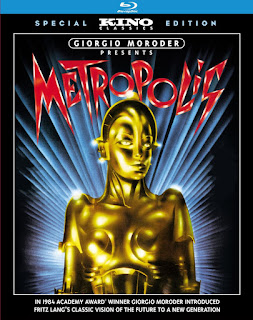
Academy of the Underrated: Giorgio Moroder's Metropolis (1984 release)
Now you may think that I've gone a little crazy. Everyone loves Metropolis, and what's more, I've already reviewed it! But this one needs some context. Composer and producer Giorgio Moroder released a partial restoration of this beloved silent film in 1984, at a time when the only other version was the bastardized US cut. To attract people to theaters, especially the kids who would normally have no interest in silent movies, he released it with a modern electronic rock score similar to the work he did for Scarface, Flashdance, etc., and featuring a number of familiar stars like Freddie Mercury, Pat Benatar, and Bonnie Tyler. Critics welcomed the new footage but scorned the music, and it's long been lambasted as an unnecessary modernizing touch on a timeless classic.
So I'm going to bat for it. I may be incredibly biased, since this was the way I first saw the film, but even then I knew the rock score was a sore point. But it works, and the reason it works is because the film itself is so timeless. It goes just as well with an electronic rock score as it does with its original orchestral accompaniment, and though it's been rendered a curiosity by the discovery of the complete version, it has its own aesthetic appeal.
Tuesday, November 20, 2012
My Favorite Movies: Phantom of the Paradise
When people talk about the great movie musicals, there's usually one glaring omission. Brian De Palma's Phantom of the Paradise is a cult classic that, while it's inspired a loyal fanbase, hasn't managed the pop culture prominence of similar offbeat rock musicals like The Rocky Horror Picture Show or Little Shop of Horrors. But it deserves better; while comparable to those classics, it's also unique. While De Palma has often gotten flak for imitating and ripping off his forebears, in Phantom he manages to synthesize several classic stories and images into a blistering satire of the music industry set to a truly killer song score. It's one of the most purely cinematic musicals ever made, not only original to the medium but dependent on its tricks. And at the core of all the craziness is something heartfelt.
Friday, August 19, 2011
In Theaters: Glee: The 3D Concert Movie
I think I’ve worked out why Glee: The 3D Concert Movie isn’t doing well. Though the show is still popular despite a backlash in some quarters, for a good portion of its audience it’s enough of a guilty pleasure that they wouldn’t want to be seen in public buying tickets to a film of a stage revue. I’m probably projecting my own self-consciousness here, though. Going to see this was like going to see one of the Human Centipede movies- I bought the ticket at an electronic kiosk and did my best to remain inconspicuous as I walked to the theater. I’m not a proud man but the film, in its earnest and celebratory embrace of Gleemania, just seems to invite brickbats. But if you’re still Gleek and proud, it’s actually a fun experience: inessential, but pleasant fanservice that, despite some uneven choices in presentation, contains a lot of fairly talented individuals giving good performances.
The film records a concert from the live tour the Glee cast did not too long ago, between seasons 2 and 3 (which hasn’t started airing yet.) The cast did this last season as well, and as the show’s popularity has grown, the concerts have attracted a large audience of loyal Gleeks. Between numbers we get interviews with the cast which seem to be at least half in character, as well as a lot of talking head spots with the fans. Rounding it out, we have in-depth profiles on three fans who fit the whole “be proud of not fitting in” ethos of the program- there’s a cheerleader who’s also a little person, a gay teen who recounts the rough road he had being outed, and a girl with Asperger’s who idolizes Brittany S. Pierce (which, let’s face it, is what more people should do.)
The whole “fan profile” thing is the film’s most ill-advised decision. It’s a little shameless in tying Glee to a message of empowerment and individuality and loving who you are, and it definitely feels at least a little like the show patting itself on the back. But the fans themselves are charming people, and on balance the segments focus more on them than on how the show changed their life (and even acknowledges it didn’t at all in one case.) It still feels a bit like padding though, and unnecessary padding given that this is obviously not the whole show (a number of sketches have been trimmed, including one featuring Jane Lynch as Sue Sylvester that popped up in previews, and the songs are also cut a bit from their full versions.)
What we see of the show works pretty well. The cast’s voices aren’t quite as processed as they are on air, and they all sound good. Heather Morris as Brittany pretty much steals the show, be it in her ultra-sexy Britney Spears number (which justifies the 3-D process in and of itself), her feature dancer status in other songs, or just contributing an awesome gesture or two in the background. That said, all the cast have gotten pretty good at working the crowd over two tours, and it’s fun to see them throw in little gestures or reactions to spice up the performance. I think 3-D may be a particularly good fit for concert pieces like this, especially with the number of dance numbers involved- it enhances the spectacle without getting in the way of anything, since the people on stage may as well be floating in space to begin with. Sadly, some cast members get the short shrift, notably Jenna Ushkowitz as Tina who has no on-screen solos.
Rounding out the affair are a few fun clips and vignettes, such as a very young “mini-Warbler” captured performing along at home, and Lea Michele as Rachel ruminating on the possibility that her idol Barbara Streisand may be in attendance. Nothing comes of this, but it’s a great bit of acting on her part, arguably the best she’s done Glee-wise. (It’s naturally followed by her standout rendition of “Don’t Rain on My Parade”.) Other parts feel like they don’t quite fit, like Gwyneth Paltrow’s appearance as Holly Holiday, as fun as she was on the show. It definitely kind of rushes to the ending, as though the filmmakers suddenly realized they shouldn’t let this run long, and I hope more shows up on the DVD release.
If you hate Glee, there’s obviously no reason whatsoever to see this. If you’re ambivalent, you probably won’t get too much out of it either. But for fans who didn’t actually catch the tour, it’s a nice substitute, and is worth catching while you can. The film is just over halfway through a limited two-week release and the box office obviously hasn’t been good enough for it to be held over, so if you want the full big-screen 3-D spectacle, get going. I had to push myself to see it, but in retrospect it’s better than I expected, and was a nice reminder of why I like this crazy thing to begin with. As obvious as the show’s “be proud of who you are!” message may seem, there are a lot of people who don’t actually hear that enough, and if nothing else the film does provide a little pop culture snapshot of an audience for whom that message was just what they needed. And there’s some fun singing and dancing. Nothing to be ashamed of.
Written by N/A
Directed by Kevin Tancharoen
Grade: B
Sunday, November 14, 2010
On the Duality of Glee (Sort of)

GLEE is a show that’s fun to watch, sometimes frustrating to follow, and hair-pullingly maddening to try and talk about on occasion. It’s a volatile show, often wildly inconsistent, and I don’t necessarily think that’s the worst thing. I admire that it’s a little out of control, that it’s big and brash and sometimes kind of smart and sometimes kind of dumb. It’s idealistic and joyful, but with enough dark comedy to keep it from sliding into HIGH SCHOOL MUSICAL territory. (And yes, I know I gave that a good review. I am large, I contain multitudes.) It can be incredibly self-indulgent, as in the various theme episodes where plot takes a backseat to exploring the repertoire of a popular artist, but dammit, the indulgence can be fun. And while the show doesn’t really need defending, what with a massive explosion in popularity midway during the first season, I think it may be worth taking a look at what makes it such a rollercoaster ride.
Now, there’s a popular theory that the show’s apparent lurches from restrained comedy to glitzy craziness stems mainly from a split between the show’s three creators/head writers: Ryan Murphy, Ian Brennan, and Brad Falchuk. There’s some truth to this, at least if the episodes they’re credited with are representative- Murphy’s done all the “theme” episodes, for one, Falchuk has some of the more dramatic ones, Brennan is sort of in the middle, etc. Of course, though this is subject to individual opinion, each has some of the best and worst of the show to their credit: Falchuk has the superb “Dream On” and the less effective “Throwdown”, Brennan wrote the forgettable “Hairography” but the amazing “The Rhodes Not Taken”, and Murphy, of course, is responsible for highly criticized installments like “Wheels” and “The Rocky Horror Glee Show” but also the pretty amazing “Mattress” (and I have a certain fondness for “The Power of Madonna.”) I think the Three Writers approach explains some of the show’s shiftiness, but not all, especially since American TV writing is almost inherently collaborative and I’m sure everyone has worked on everyone else’s credited scripts.
Instead, I’ve constructed a little thesis of my own. GLEE is basically a game of duality- highs and lows, comedy and tragedy, sophisticated satire and big dumb spectacle. I think this is mostly by design. There’s a basic contrast from the start of the series, between the ideals of togetherness and joy through art that Will Shuster envisions his Glee club as representing, and the messier dark parts of reality, like the fact that he hooked its lead male singer by threatening to frame him for pot possession. I think it’s this tension which serves as the show’s key dramatic engine; while the external conflict may be Sue trying to destroy the club or a new competitor or random personal drama for the students, it usually comes down to whether the ideal or the cynical reality carries the day, and sometimes it’s one, sometimes the other, and just as often a mix of both.
Let’s take one of my favorite episodes, “The Rhodes Not Taken”, as an example. This was the first episode I saw and the one that got me hooked; a lot of that had to do with the utterly astounding duet between guest star Kristin Chenoweth as April and Lea Michele as Rachel, both singing “Maybe This Time” from CABARET. The latter did good, the former pretty much blew the roof off. Anyway, the plot revolves around Rachel ditching the club to play the lead in the school’s production of the aforementioned musical, leaving New Directions without someone to handle the big diva numbers. Will Shuster (Matthew Morrison) gets in touch with April Rhodes, who was a major glee club diva back when he was in high school- and upon finding out that she leads the life of an alcholic squatter, offers her a position at the school and on the club. It’s a heartfelt gesture and a second chance, but April soon starts getting her fellow clubbers drunk (and teaching them how to shoplift), and it’s obvious that this just isn’t going to work out. She’s broken and Will can’t fix her, as much as he wants to. Rachel, in turn, finds that her dream of leaping straight to stage stardom isn’t going to work, mainly because the director is a creepy, ego-destroying douchebag. There’s reconciliation at the end- Rachel rejoins the gang, and April accepts that she can’t go on like this and decides to strike towards Branson. A couple of dreams get dashed, but hope springs eternal.
This constant give and take extends to the characters as well, which gets us to the heart of much of the criticism the show has had, namely that ostensibly identifiable and sympathetic characters like Will, Rachel, and Kurt (Chris Colfer) often do very unsympathetic things, often enough that we start to wonder whether we should root for them at all. I don’t doubt that the shades of gray we’re given with each character are deliberate; it works both ways, as the ultra-villainous Sue Sylvester (Jane Lynch) has shown her soft side on occasion, and even Will’s much hated ex-wife, who faked a pregnancy to try and keep him with her, has been allowed a moment of grace or two. In general, the characters each have a light and dark side. Rachel and Kurt are very vulnerable in the overall school hierarchy, one being a dowdy do-gooder, the other the only openly gay student thusfar, but they can both be manipulative and cruel when grasping for their respective desires.
Will is a more complex little pirate; in trying to court the lovely and neurotic Emma (Jayma Mays) or teach his kids, he just doesn’t seem to know where the line is, and while this has had him move into some very ugly territory as of late, I can’t drop my sympathies completely because I realize how messed up he is. He went right from school to marriage; this is the first time he’s been on his own in years, and I think his short sighted and self-serving behavior stems from not being experienced in really dealing with other people. He wants to be kind and generous and often is, but he doesn’t understand when his actions can cause harm.
As far as I’m concerned this is interesting characterization, if not always perfectly modulated; the show seems mostly story-driven, and to serve the needs of a given week’s plot the characters sometimes have to swing from one extreme to another quickly. This is something that the show does have to work on, to make the shifts less jarring and maybe make their bad moments easier to understand, and therefore forgive.
Now, if there’s a part of the show I will class as an outright guilty pleasure, it’s the gimmick episodes. When the show first started, music rights were hard to secure, but as it became popular, artists and publishers have been very forthcoming with their catalogues, which has resulted in the show itself growing more music heavy. The gimmick episodes- “The Power of Madonna”, the Gaga-themed “Theatricality”, “Britney/Brittany”, and “The Rocky Horror Glee Show”- have almost all had fairly thin and often self-contained storylines, and while I’m not sure most of them are objectively good television, I more or less enjoyed them all. It comes down to the music- the cast are, by and large, quite good performers, and while neither the songs nor arrangements are original, there’s an enthusiasm and reckless goofiness that I just can’t reject. There’s an extent to which a musical is carried by its songs, and while the show shouldn’t indulge itself too often, it’s an indulgence I like to share in.
I may be wandering off point, but I think on the whole, what makes the show so maddeningly inconsistent is also what makes it so damn compelling. If it’s not entirely in control of itself, it may be because it’s doing something no other show right now is really trying. It’s trying to mix cheery music and dark comedy, flawed characters with big ideals, and really obvious thematic statements with the occasional moment of nuance. It may yet mature into something a bit more stable, but I have to say I’m enjoying the volatility. Its worst episodes still usually have some moments of cuteness, humor, or just plain awesome music to recommend them, and at its best, it reaches heights of joy and depths of despair that I’m just not seeing anywhere else.
I’d recommend it, but the show doesn’t really need my thumbs-up now, does it? Still, I think fans and non-fans can all agree on one thing: Heather Morris is some kind of a ninja.
Friday, October 31, 2008
Move Your Dead Bones!
So as not to go into one of my favorite holidays on a wholly negative note, I give you a nice bit of Halloween dance party fun- the music video for "Move Your Dead Bones" from the DVD for the DTV feature BEYOND RE-ANIMATOR (which was better than I expected- I really need to review it some time.)
To the producers of this film: Why is this song not available for download on iTunes or a similar service? Or even just free? It's a catchy number and nice publicity for the film, you're missing out.
To everyone else, Happy Halloween!
To the producers of this film: Why is this song not available for download on iTunes or a similar service? Or even just free? It's a catchy number and nice publicity for the film, you're missing out.
To everyone else, Happy Halloween!
Tuesday, October 14, 2008
Stage Review: The Rocky Horror Show
I don’t get to the theatre very often, for whatever reason, but on hearing from a friend about a new production of THE ROCKY HORROR SHOW over at the Off Center Theatre (in Crown Center), I decided to take it in. I’ve seen the film several times, of course, but never the original stage show, and this thirty-fifth anniversary revival of Richard O’Brien’s cult horror musical is a nice seasonal selection. I have to say, with absolutely no credentials as a theater critic whatsoever, that it’s a good production. It’s got the intimacy the show needs, is well paced, and you can drink in the theater, which is a positive for any performance but fits this in particular.The plot is as it always was. Brad Majors (ASSHOLE!- and also, Evan White) gets engaged to his best girl Janet Weiss (SLUT!- er, Katie Karel), and the two head out to meet their ex-tutor Dr. Everett Scott (Noah Whitmore.) However, they get a flat tire and seek help at the castle of Dr. Frank N. Furter (Doogin Brown), a sweet transvestite mad scientist who is about to unveil his latest creation, the beach blonde muscleman Rocky (Brian Shortess). Brad and Janet find themselves tempted by forbidden fruit, and though Frank is eager to help them along to corruption, he’s insanely jealous when it comes to his new toy.
As you can imagine, any production of ROCKY HORROR nowadays has to contend with the fact that much of its potential audience knows the film and its audience participation ritual by heart, and there’s a good chance they’ll play along with the stage version. Director Steven Eubank has chosen to head them off at the pass by throwing a few ringers into the audience and having them lead the commentary, even eliciting responses from the main cast. It’s as funny as it’s always been, and a few topical jokes have been thrown in. With that integrated into the action, the show starts to play more with the fourth wall- in particular, Vanessa Severo plays Magenta as an increasingly bored actress who at one point reads her lines off her hand.
The program indicates that the music has been futzed about with a bit by Eubank and musical director Daniel Doss, and again, having not seen the stage show before I’m not sure how much is different there. In comparison to the film, the songs are more consistently up-tempo, which sometimes works and sometimes doesn’t- “I’m Going Home”, “Once In A While” and “Science Fiction Double Feature” really work better slow (or at least without such noticeable percussion.) That said, the music is consistently good and there’s some enthusiastic dancing.
The show is very nearly stolen by Bill Pelletier as the Narrator, who plays along with the vulgarity and cat-calling more than you’d expect him to; indeed, he arguably sets the tone for the show. As Frank, Doogin Brown is as enthusiastic and overdramatic as he needs to be, though not as sexually overpowering as one would hope. As mentioned before, Vanessa Severo’s performance is twistedly inspired, and Price Messick gives Riff Raff a nice Peter Lorre vibe. Katie Kalahurka is a nicely bouncy and bratty Columbia, and Brad and Janet are as broad and dorky as they should be. Brian Shortress doesn’t make a huge impression as Rocky, but he can dance better than his screen counterpart.
The Off Center Theatre has a very small stage, so there’s not much room for decoration, but the creative team does its best. The burlesque elements outweigh the cheesy horror film elements somewhat, and I would say that bits of the costume and set design look too much like the film, but there are some nice touches. The costumes for the climactic floor show are particularly inspired.
Overall it’s a fun show, much zippier than the movie, though this comes at the expense of some of the story’s weird pathos. (Then again, my take on Frank N. Furter as tragic hero may not be the consensus reading.) It runs through the second of November, so catch it if you’re in town.
Grade: B+
Wednesday, April 30, 2008
Madonna: Hard Candy

I’m a Madonna fan. I’m not entirely sure how this came about, and of course I realized this just before SWEPT AWAY and AMERICAN LIFE. Despite all the bad press I held on to an admiration to this woman, an artist with a strong voice, good songs, a unique sexual allure, and a way of coming out on the bright side of most controversies. Madge’s reputation recovered slightly with the superb CONFESSIONS ON A DANCE FLOOR, but between jokes about her age and the Kabbalah thing I gather she has to establish her mainstream credibility yet again (or just work harder to maintain it). And so we have HARD CANDY, a less fizzy, more spiky pop confection that actually marks Madonna’s last work for Warner Bros., though I’m not sure where she’s supposed to be going next. It’s an extensive collaboration with Timbaland, Justin Timberlake, and about ten million producers, and Kanye West shows up at some point also. Despite the behind-the-scenes army involved here it’s still very much her show, and a tight, solid piece of work.
The big single from this that kicked up a lot of positive buzz was “4 Minutes”, featuring both Timberlake and Timbaland, but it’s the opening track, “Candy Shop”, that establishes the feel of the album. It’s got a driving, insistent beat, and lyrics that are actually more sexual than she’s been in the last few albums- I think there are bits of it that make “Justify My Love” look subtle. Like CONFESSIONS, this is a dance album- in fact I’m fairly sure I heard the phrase “dance floor” more times here than there. I think there’s one song that doesn’t mention it. A certain sameyness is risked, which isn’t necessarily bad, but at this early stage it’s harder to single out specific tracks. “She’s Not Me”, in which the singer faces the dilemma of her ex not only having a new lover but said lover having copied her style completely, stands out- it reminds me of Kirsty Maccoll’s “Treachery” for some reason, and it’s got a nice edge. It’s bookended by the more wistful “Miles Away” and the more upbeat “Incredible” (which does go on a bit, though it’s not bad.) I also liked “Dance 2Night” for its casual beat and egalitarean lyrics. The closest thing to a weak track here would be “Spanish Lesson”, if only because it’s a bit of a retread, but it’s fun in a way that recalls her early work, and not just “La Isla Bonita.” The last two tracks do mark a change of pace, being slower and more surreal- it’s a nice capper.
Madonna’s voice hasn’t lost any of its distinctiveness, and she uses the blunt texture of it to good effect. The rhythm is excellent, and the beat even borrows a bit of influence from modern R&B, blending that with the modern disco of CONFESSIONS and MUSIC. There are touches of 80s pop in there as well- overall it’s eclectic but surprisingly of a piece.
I think I don’t like this album quite as much as I did CONFESSIONS ON A DANCE FLOOR, but that may be a question of how my tastes run- it was more of a rich retro feast, this is more modern and sharp. And I have to point out that for better and worse this is mostly a first impressions review, but my impression is definitely positive. Okay, the cover design is kind of sloppy and I’m sure I have that font in Appleworks, but whatever. The point is, this is good music. Madonna may have to fight more these days to stay relevant, but when she’s up against the wall it seems to do her good. I’m glad she’s feeling punchy.
Grade: B+
Getcher Hard Candy
Sunday, March 16, 2008
Random Movie Report #44: High School Musical

I was curious. HIGH SCHOOL MUSICAL was a surprise smash hit for the Disney Channel and has become a major tween phenomenon. Hearing about this, I wanted to know whether it was any good. Was it the kind of kiddie entertainment that parents gladly watch alongside the youngins, or the kind they barely tolerate? Was it SESAME STREET or BARNEY? (Okay, it’s aimed at a slightly older audience but you get the idea.) So I eventually rented it, and eventually watched it, and have come to the decision that it’s kinda good. Not great, but I can see what the appeal is and have to admire its spurts of cleverness. It’s nice to see the kids getting enthusiastic about music considering how bored the rest of us have become, and this appears to have been near the center of that explosion. So, let’s take a look.
The heroes of HIGH SCHOOL MUSICAL are Troy (Zac Efron), star basketball player for the Albuquerque East High Wildcats (their motto: “Get Your Head In The Game”, which makes for a good song but is not the most inspiring slogan- rejected ones presumably included “Try Not To Fall Asleep Out There” and “Yo, Neil Armstrong, Wanna Come Back to Planet Earth?”), and bookworm transfer student Gabriella (Vanessa Hudgens, about whose personal life I will say absolutely nothing, just watch me). The two share a karaoke duet at a New Year’s Eve party, and when they meet at the start of the next school year, it sparks memories and inspires them, after substantial hesitation, to sign up to audition for the school’s winter musical. This causes two problems (or three, depending on how you count it.) Firstly (and potentially secondly), both Troy and Gabriella’s respective cliques don’t approve of the star athlete and star pupil both becoming drama geeks. (The Wildcats in particular are worried that auditioning will distract Troy from the upcoming big game.) And it’s not like the drama stars- in this case, Sharpay (Ashley Tisdale) and her brother Ryan (Lucas Grabeel), who have headlined every drama production the school’s put on since kindergarten- are keen on having competition. Of course, in the midst of all this, Troy and Gabriella start to like each other, which causes no end of problems.
“Cliques” are an odd trope. Every high school-related thing made in the past twenty-five years or so has dealt with them, usually as a major focus. While I definitely remember cliques existing in high school, I don’t recall them being terribly rigid- the prom queen was on both the drill team (sort of like cheerleaders but not quite for some reason) and the school paper, while her boyfriend, a soccer player, took the same creative writing class I did and acted more skaterly than jockish. There was some division, but most of the time it took a backseat to the sheer soul-crushing grind of getting through the school year. So it’s always a bit weird for me to see characters in high school act totally defined by strictly codified and exclusive groups, all easily distinguishable by their mode of dress. Of course, this movie isn’t aimed at high school students so much as kids who will be going to high school later, and generally speaking it’s nice to stress the importance of not getting hung up on cliques before they start to become a problem. Not that having a good message gets this a free pass or anything, but it does lead to some fun scenes, the musical highlight easily being an elaborate production number in the school cafeteria wherein various students start confessing hidden desires based on Troy and Gabriella’s audition.
Ah, yes, the music. I was kinda worried when I started watching that it would be the kind of generic American Idol fare that anyone can warble. The songs are actually written by a few different teams, but they mesh pretty well, and though they’re teen bubblegum by nature they’re pretty good for it. The lyrics have their clever snatches, and alongside the aforementioned cafeteria number the closing song is appropriately big. The cast are strong singers, though for some reason the lip-synching is sometimes off.
I do have to say that even for a Disney Channel movie this is a remarkably good natured little film- the film extends empathy and sympathy not just to our two young lovers, or even their immediate friends, but to virtually everyone in the cast. The playing is broad and enthusiastic, especially by Tisdale who gets a brilliant post-credits gag. There are a few slow patches, and I was really disappointed that Kelsi, the pint-sized songwriter (ably played by Olesya Rulin), doesn’t get a lot to do. And I was wanting to see more of the actual musical, even though it’s a MacGuffin. What can I say, I loves me some metafiction.
It’s easy to see how HIGH SCHOOL MUSICAL appeals to its target age group, and it’s a job well done. For the rest of us, it’s not unpleasant either- it’s cute in its sincerity and surprisingly smart. I’m grateful that I liked it because a negative review would doubtless have unleashed a firestorm of tween rage the likes of which the world has never seen, and I’m not sure when I’ll try an experiment like this again, but it was worth it this time.
Written by Peter Barsocchini
Directed by Kenny Ortega
Grade: B
(As always, this film is available through the link in the image above.)
Thursday, January 31, 2008
A Day That Will Live In Infamy

And in honor of the occasion, and to help the m80 marketing firm promote the new AQUA TEEN HUNGER FORCE season 5 DVD (which I'll be receiving and reviewing shortly), a song:
I am not a member of the firm and insist on my editorial objectivity, but swag is swag.
Friday, January 18, 2008
In Theaters: Sweeney Todd, The Demon Barber of Fleet Street

Tim Burton’s film of Steven Sondheim’s SWEENEY TODD is the most fun I’ve had at a movie theater this holiday season (or rather just-past holiday season), which is a bit of an accomplishment. Holiday movies seem to divvy up into serious Oscar bait and agonizing attempts at family entertainment, so something as ghoulishly pleasant as this is a wonderful surprise. Sure, this film’s been hyped substantially, gotten great reviews and a Golden Globe or two, but I still wasn’t quite expecting to feel as enthusiastic, as downright giddy as the film made me. Sure, it’s a dark and sad tale of revenge and tragedy and cannibalism, but Sondheim’s original musical/operetta achieved a near-perfect mix of horror and gallows humor, and Burton and screenwriter John Logan appear to have gotten the recipe right as well.
Sweeney Todd (Johnny Depp), formerly known as Benjamin Barker, returns from London after a long exile, a sentence imposed on him by the less-than-honorable Judge Turpin (Alan Rickman), who levied a bogus charge on the man to get at his lovely young wife Lucy (Laura Michelle Kelly.) In the ensuing 15 years, Lucy has disappeared and her daughter Johanna (Jayne Wisener) has become Turpin’s ward/prisoner. Sweeney, planning a gruesome revenge, rents a room from Mrs. Lovett (Helena Bonham Carter), a frazzled woman who sells, by her own admission, the worst meat pies in London. Anthony Hope (Jamie Campbell Bower), a sailor who rescued Sweeney at sea, happens by Johanna’s window and instantly falls in love with her, and tries to come up with a plan to rescue the girl from Turpin and his weaselly accomplice Beadle Bamford (Timothy Spall). In the midst of this, Sweeney ends up killing a rival who intends to blackmail him, and decides he can cut quite a few throats on his way to the judge’s. Mrs. Lovett, pondering what to do with the body, works out that Sweeney’s victims will make an excellent supply of fresh meat, and so a truly diabolical partnership is formed.
Sondheim’s musical was not the first take on the material (which may or may not be based on a true story) by far, but it’s become the most well-recognized, not to mention just plain beloved as musical theatre. Burton was stepping on sacred ground here, and the casting of Depp and Carter- two very distinguished non-singers- was cause for concern. But there’s method to the madness, and Burton seems to know what he’s doing. Both the acting and singing are cinematic, not theatrical; the characters communicate in hushes and pleas, giving things time to build. Neither Depp’s nor Carter’s singing voices are unpleasant, though they’re not really professional either (the latter seems to underplay and even gloss over some of the darker jokes in her lyrics, and to be sure the “Little Priest” number could have been much grander.) The pitch of the film is very precise, not realistic but not stagey either, blending genuine Victorian dinginess with a more artificial Grand Guignol look and feel to create an atmosphere that’s heavy on dread, but still has room for laughs. It’s a very rich mood and it creates an air of genuine uncertainty, even while the laws of revenge melodrama dictate that certain things fall into place.
I was supposed to be talking about the film in relation to the stage musical, wasn’t I? Well, it’s a lot more faithful than I expected; anyone who’s seen the original will notice obvious omissions like “The Ballad of Sweeney Todd” itself (a shame, that) and other numbers, but the plot unfolds pretty much as I remember it, perhaps across a few more locations to avoid being stagebound. Most of the same themes are covered, from revenge to family to forms of love both cancerous and benign. What changes there are have been made to make the story more immediate and visceral, which actually helps recapture the sense of intimacy lost when moving from stage to screen. The acting is all around splendid- Depp’s singing has a certain rock-star quality to it, Helena Bonham Carter manages both to fill out Mrs. Lovett’s costume nicely and add a twisted maternal brooding to the character- she’s competing with the memory of Angela Lansbury’s performance among fans (and with the memory of a particularly good high school performance by Ms. Wendi Butterworth for me), but she makes the part her own. Sacha Baron Cohen has a wonderful and brief role as a rival barber, and Anthony Stewart Head pops up for all of three seconds, regretfully not to sing. The one really wrong thing with the film is that the romance between Anthony and Joanna isn’t allowed to develop very much and seems rote as a result. It’s a minor sacrifice, but the young actors do what they can to compensate, and the subplot still serves its purpose in the larger story.
Tim Burton may not have made a film as excellent as this since ED WOOD back in 1994; then as now, he weds his skill at creating great visuals and a strong mood to a solid narrative and a great script. This is an amazing spectacle, full of grit and gore and song and laughter and tears. From the ingenious opening credits to the final tableau, the film remains utterly committed to a twisted and beautiful vision, not forgetting to entertain us in the process. It does right by Sondheim while working quite well on its own level, and it’s easily one of the year’s best films.
Based on the musical by Stephen Sondheim and Hugh Wheeler
Adaptation by Christopher Bond
Screenplay by John Logan
Directed by Tim Burton
Grade: A
Monday, November 12, 2007
Dethklok: The Dethalbum
I’m a bit late reviewing this record, and I’ll tell you why. The Dethalbum ended up selling much better than Adult Swim anticipated: due to a printing error the Deluxe Edition (which, for a true Dethklok fan, is the only version worth getting) sold out extremely quickly, and it was in fact nearly a month before I could find it on the shelves. The funny part about all of this is that I am not what anyone would call a metal fan; I don’t dislike the genre, I’m even sort of interested in it, but I’ve never embraced it. I am, however, a big fan of Adult Swim’s METALOCALYPSE, a genuinely captivating animated series about the death metal band Dethklok, who control millions of fanatical followers and seek to make the entire world a metal world, while at the same time being intensely stupid. The music on the show, done by showrunner Brendon Small (the creator of the semi-autobiographical HOME MOVIES), is consistently good even when it strays into genre, so I was looking forward to a soundtrack album- I didn’t quite expect them to do a proper metal record, though. And that’s the triumph of the Dethalbum- it’s genuinely good heavy metal music despite also being a lampoon of the genre.Dethklok, metafictionally, consists of lead guitar Skwisgaar Skwigell (taller than a tree), rhythm guitar Toki Wartooth (not a bumble bee), bass William Murderface (Murderface Murderface), Pickles the Drummer (doodily doo), and frontman Nathan Explosion. In truth, Brendon Small performs all vocals, guitars, and keyboards, while Gene Hoglan drums. All this, of course, is possible through the miracle of modern mixing technology, but honestly you’d never guess it if you didn’t look at the liner notes. I have no idea how Small does it so I’ll just assume he’s some kind of bizarre super-genius.
Anyhow, the music. My theory on why rock-and-roll had been for so long losing pop culture ground to R&B (though there’s been a turnaround recently), is that rock was full of very earnestly intelligent and thoughtful bands who eschewed any pop-like qualities to perform sophisticated and mostly serious material. Even metal itself seems a less lively scene than it used to- backlash to the “hair bands” of the 80s has resulted in groups of intensely nondescript people wearing black T-shirts and well-cropped goatees. You see, rock (and I count metal alongside it, at least for purposes of this argument), has an inherently “willing to be stupid” quality about it- it can be smart, as long as it’s dumb at the same time. It is inherently music that, to quote the “Trashmen Tests” developed over at the late and lamented Quarter Bin, is loud at any volume, dumb, and annoying to parents. It has to be transgressive, and it can’t be transgressive if it can double as easy listening.
Enter the Dethalbum to show us the way. This is an entire album of calculated idiocy backed by genuinely brilliant production. Songs have titles like “Murmaider”, “Bloodrocuted”, and “Briefcase Full of Guts”, and yet have lyrics that are clever and funny in sometimes subtle ways. (The joke on “The Lost Vikings” is so subtle I had to go back and re-read the words.) It’s smart, but not in any guarded or pretentious way. At other times, as with the songs “Hatredcopter” and “Face Fisted”, the point is to deliberately ratchet up the stupidity.
Make no mistake, though, this is not an album that it in any way denigrates The Metal. A parody this good can obviously only be done with a solid grounding in the genre, and it’s also just plain good music- unlike, say, Spinal Tap, which set out to suck just enough to still be listenable, Dethklok sets out to be good just enough to still be funny. The actual music is good, with some great high-speed guitar riffs and, to quote the liner notes, “insane drumming”- in particular the opening of “Go into the Water”, featured prominently in the show’s first season finale, is downright beautiful in its way.
The deluxe edition of the CD features a second disc with some more songs from the show and a final track, the inexplicably funny “Dethklok Gets in Tune”, as well as a video for “Bloodrocuted” and, best of all, the entire first episode of the new season. If I have to complain about the album in any way, it’s to say that some of the funnier and more inventive non-metal songs heard in the show aren’t included- from Toki’s upbeat underwater number (sung as he’s hovering in a tank of liquid oxygen) to a song by Dr. Rockso, the Rock’N’Roll clown and a sharp lampoon of David Lee Roth (or maybe just hair bands in general), there’s a lot of stuff I would have liked to have. But then, that would make this less of a metal album, so maybe those will be released separately or in another album or something. It’s a tiny flaw overall.
I’m not actually going to give the Dethalbum a letter grade, because I don’t know nearly enough about the genre of music it inhabits to compare it to anything similar. I do know that I enjoy it a lot and should find plenty of opportunity to listen to it in the future, whenever I feel my eardrums have had it too easy (I write a lot with just ambient noise in the background. Bastards are lazing about already.) It’s a great reminder that first and foremost this popular music is all about having fun and not taking yourself too seriously, and I think the real message is that you can be smart so long as you’re also stupid. I think that’s valuable advice for all of us.
Thursday, October 18, 2007
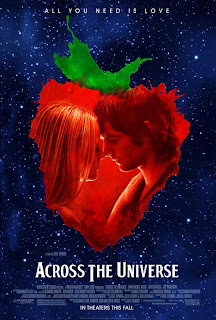
In Theaters: Across the Universe

ACROSS THE UNIVERSE is a rare achievement in film as visual and musical art, one that made me wonder why other films don’t look as good. Needless to say, anything this good to look at is automatically suspect as regards actual substance. So let’s get to that right away. Is there a plot? Pretty much. Is it any good? I’d say so. Any depth to the characters? More than you’d think. In truth, the film, despite being a celebration of the dewey-eyed idealism of the Sixties, is fairly intelligent in dealing with the themes of revolution and doomed struggles against the state that this sort of thing entails. A rare modern musical specifically crafted for the screen, the film uses the music of the Beatles to examine the social context which influenced and was influenced by the group, and to keep things entertaining wraps it all up in a love story.
The film is the story of Jude (Jim Sturgess), a Liverpool dockworker who takes a ship to America to track down his father, the janitor at an Ivy League school. There, Jude meets and becomes friends with Max (Joe Anderson), a bored and aimless student who focuses more on campus hijinks than education. During a visit to Max’s home, he meets his sister Lucy (Evan Rachel Wood), and is somewhat attracted to her, but her heart belongs to her high-school sweetie, now off in Vietnam. He is killed in action, though, and a heartbroken Lucy runs off to New York to join Max (who has dropped out of college) and Jude (who at this point is an illegal alien), both living in a squalid apartment with aspring singer Sadie (Dana Fuchs, who is indeed sexy). Other characters also move in, like JoJo (Martin Luther McCoy), a black guitarist who moves to the city after a race riot, and Prudence (T. V. Carpio), an at-first deeply closeted lesbian from Ohio. Right now you’re probably having RENT flashbacks, and yes, the ensemble is very deliberately diverse and bohemian. This is, as the geekier among us like to say, a feature, not a bug. The point is, Jude and Lucy fall in love, and they and everyone else get swept up in the turmoil of the decade, a journey into uncertainty that begins when Max is drafted.
Needless to say, the songs are the star attraction here. Beatles covers are always tricky because the originals have such legendary status; it’s much like staging Shakespeare (which director Julie Taymor has also done.) The singing ability of the cast varies, but as with MOULIN ROUGE character is emphasized as much as sheer skill, and there’s nobody really bad in the mix. More importantly, the songs are placed in new contexts and given different emphasis, which is the point of a cover to start with, and it’s really this which the film derives most of its effect from. I’ll get into some of the cooler twists in a bit, but I particularly liked how “I Want You (She’s So Heavy)”, easily my least favorite Beatles song, was turned from stoned makeout music into a dance number for square-jawed military recruiters. I kinda like it now. Outside the songs, nearly everyone is named after someone in a Beatles song, and there are several songs not sung but referenced in the dialogue.
Thinking on it, the timeframe of the movie seems very closely keyed to the actual career of the Beatles, basically encompassing most of the Sixties and trailing off at about the same time the counterculture did. We start with pop love songs and move into psychedelic experimentation and social commentary- the songs themselves are way out of chronological order, mind you, but there’s still a general sense of exploring the same themes and ideas that the group was. Jude becomes an artist in the midst of all the chaos, and the question of what role his art plays in the revolution is a big one. “Strawberry Fields Forever” shows Jude working juxtaposed against scenes of destruction and death in Vietnam, his work speaking to the horror but also seeming to evade it, escaping somewhere where there’s nothing to get hung about. “Helter Skelter”, ostensibly about a relationship if you pay attention to the lyrics, is made political, sung by Sadie in front of footage of protests and riots, and of course I don’t think anyone’s considered that song non-political since Manson. The numbers get nastier and more confrontational as time rolls on- but there’s still a devotion to the basic idealism of the counterculture, no matter what happened to it.
The film’s visuals are truly surrealistic, combining psychedelia with the kind of modern artistic craziness that for some reason you mostly see in television commercials. It’s constantly beautiful, even when looking at fairly ugly things, and if it starts to look like a music video after a while (albeit one with unusually restrained editing), that’s not such a bad thing. It’s colorful, ostentatious, and not scared of looking silly at times. Taymor’s visual brazenness is the sort of thing I like to see in movies, and she also gets points for using a full color palette. God I sound like a crank.
The love story is the sort of thing that’s always required for this sort of movie and therefore the potential weak link, because it’s always a very idealized and simple kind of love story. Jude and Lucy have a giant blinking “Meant to Be” sign over their heads, and their romance is in some ways predictable. It is, however, rendered with more detail than usual, and some subtle playing by the leads helps. It feels natural even if it isn’t written as such. Similarly, there’s a certain cloying quirkiness to all the characters, but they manage to keep themselves likable and relatable (and there are some very amusing cameos). I do think some of the love songs are paced way too slow, though.
ACROSS THE UNIVERSE is a lot smarter than you’d think, and in reimagining and reinterpreting the music of the Beatles, it manages to address the same ideas they were struggling with so often. Jude, in some ways, is fighting the same fight they did- he’s trying to be an artist when both sides of the cultural conflict demanded soldiers, trying to explore something more complex and more universal than the conflicts of the day while recognizing their importance. This is a film with hidden layers, and one I expect will age very well.
Story by Julie Taymor, Dick Clement, & Ian La Frenais
Screenplay by Dick Clement & Ian La Frenais
Directed by Julie Taymor
Grade: A-
Friday, September 07, 2007
Random Movie Report #34: Rock and Roll High School

Sometimes the cure for blog burnout is right under your nose. I’d had this DVD at my apartment via Netflix for quite some time, never quite remembering why I ordered it, and finally made the time to watch it, and lo and behold, it was weird and goofy and funny and lively enough for me to want to write about it.
ROCK AND ROLL HIGH SCHOOL is a very bouncy little picture characterized by a very bouncy performance by P. J. Soles, an actress who should have made more movies than she did. A surprisingly clean high school comedy- for 1979, for Roger Corman’s New World Pictures, and for a movie involving the Ramones- the film gets by on great songs, incredibly dumb gags, and enthusiastic acting. It’s the sort of film that’s better than you’d think, despite seemingly making no attempt to be good. Which, you have to admit, is pretty punk rock for a PG movie.
Soles plays Riff Randel, a student at Vince Lombardi High School and a rabid Ramones fan. She’s actually written several songs for the band, and hopes to give them to the group at a concert they’ll be having in a few days. But a new principal (Mary Woronov, having way too much fun) has performed some scientifically dubious experiments on mice proving the deleterious effects of rock and roll, and is intent that this sort of thing be discouraged among her students. So, when Riff takes a few days off to camp out for tickets (not just for her but for the entire student body), she goes on the warpath. Meanwhile, football captain Tom Roberts (Vincent Van Patten) has been trouble getting a date, and goes to school entrepreneur Eaglebauer (Clint Howard), who promises Tom a date with his love, who happens to be Riff. But in the meantime he sets her up with Riff’s friend Kate Rambeau (Dey Young), who as it turns out has been pining for Tom for some time. The two start dating under the pretense that this is “practice”, and complications ensue, just in time for the big concert.
This is a wilder high school comedy than most, relying on broad and stupid jokes that are nonetheless kind of funny. (Perhaps this is the reason why the film went for a PG- they didn’t want to cut out the target audience.) The IMDB lists Jerry Zucker as an uncredited director, and it’s known that Joe Dante (of GREMLINS fame) stepped in to handle a couple of sequences when Allan Arkush suffered exhaustion and had to be hospitalized. Despite multiple hands the film has a coherent feel, albeit a deliberately sloppy one. The high-school level gags are creative enough to be pretty amusing despite themselves, especially some of the bits involving mice (which include a man in a giant-sized mouse costume designed by THE HOWLING’s Rob Bottin.) Enthusiastic work by the cast sells it, and veteran filmmaker Paul Bartel is particularly good.
But it all comes back to P.J. Soles. She is perfectly cast here, displaying an energy and enthusiasm that pretty much lights up every scene the character is in. Watching her performance in this film, I get the feeling that the only thing which kept her from being a star was her actual decision to start a family instead of continuing with the acting game. I can’t fault her for her choice, but we the viewers are poorer for it; she makes Riff Randel so damn lovable that it’s impossible not to root for her to get everything she wants. (She also may be the one female protagonist in a high school comedy who has more or less no romantic inclinations whatsoever- her heart belongs to Joey Ramone.) As good a job as everyone else does, Soles walks away with the movie.
The music in this film is a lovely call back to the days when rights to popular songs did not cost millions of dollars apiece and even low budget filmmakers could load their soundtracks with whatever worked best for the picture. Obviously all the Ramones stuff was a package deal (presented in fun musical numbers, including one where Riff fantasizes about the band being in her bedroom), but we also have Chuck Berry, Devo, Alice Cooper, Fleetwood Mac, Wings, the Velvet Underground, Brian Eno, and Brownsville Station, among others. Since this film is sort of a musical, all this is important, and that the film pretty much stops the story in several places so the Ramones can play would be annoying if it weren’t for the fact that it’s damn good music.
This film was made at what may have been the height of American exploitation cinema- home video had yet to take hold, and so films from places like New World could still be assured of getting a look-in at some kinds of theaters more-or-less nationwide, and though budgets were low, a given Corman-produced film would still have a good explosion or two, actual crowd scenes, more than five sets, etc. You had ambitious young talents on the payroll and earnest attempts at making something watchable.
ROCK AND ROLL HIGH SCHOOL is a movie for everyone: Ramones fans, musical fans, people who like watching mice explode, people who like dance numbers featuring schoolgirls in gym outfits, people who like Clint Howard, etc. It really ought to be more well-known as a movie; it was an early example of the kind of MAD Magazine humor that had been introduced in KENTUCKY FRIED MOVIE and would soon go mainstream in AIRPLANE!, it features a downright starmaking performance, and it may be the only PG-rated punk movie ever made. Fun for the whole family, really.
Story by Allan Arkush and Joe Dante
Screenplay by Richard Whitely & Russ Dvonch and Joseph McBride
Directed (mostly) by Allan Arkush
Grade: B+
Friday, February 16, 2007
The Bookshelf #2: Sgt. Pepper's Lonely Hearts Club Band

Used bookstores are the best kind, really. The books are cheaper, slightly aged (but seldom beyond the point of readability), and they carry the weirdest stuff sometimes. Case in point: SGT. PEPPER'S LONELY HEARTS CLUB BAND, a novelization of a bad musical with little dialogue to start with which began filming without a script. I had to have this, really, if only to see how they did it. And Henry Edwards, the film's screenwriter (as such), is the author, which adds a bit of curiosity value. And though I'm as much a Beatles fan as anyone, the misbegotten 70s musical is a nicely sacrilegious thrill, so spectacularly missing the point that it becomes amusing in itself, and I hoped for the same from the book.
I wasn't disappointed. Most novelizations are pretty flat affairs, not going far beyond what you can see on the screen (the original point of such books being to provide a sort of recollection of the film because home video wasn't available), and generally being written by people who would most likely rather be doing their own work but need a paycheck. This is a change. Edwards seems almost enthused about the project, and goes beyond the meager elements of the film to add all kinds of extra stuff. It's still not good, but it didn't make me want to hurl it across the room either.
The plot. Oh, yes, there is a plot. Sgt. Pepper's Lonely Hearts Club Band was a legendary band hailing from the town of Heartland, U.S.A., a magical small-town utopia of the sort beloved by early sitcoms and conservative politicians. They played throughout WW1 and WW2 and the 50s and brought happiness and joy to millions, right up until the point when Sgt. Pepper himself died. The legacy has now been passed to young Billy Shears, nicest of the nicest, and local boys Mark, Dave, and Bob Henderson. As soon as they start playing, they get an offer from Big Deal Records to come to LA and make an album, and are suddenly bigger than Jesus. While they're away (one can only assume they write home every day), Mean Mr. Mustard, a real estate agent under the command of the mysterious FVB, comes into Heartland, steals the magical instruments of the original Lonely Hearts Club Band, and buys up the town, turning it into a sleazy dump. He's also got his eye on Billy's girlfriend, the oh-so-lovely-and-perfect Strawberry Fields.
It's crazier and dumber than it sounds. Both movie and book take this really surreal approach to the story, so that Heartland isn't just a nice town, it's freaking PLEASANTVILLE, and everyone there is the bestest and nicest they can be, and no good ever comes from leaving it. La-La Land is corrupt and full of drugs and sex and no good ever comes from going there. The book is written in the present tense, full of short sentences written in brash prose. Exclamation points abound. I'll excerpt some of this.
"The crowd boogies in front of the bandstand. The brashy boys and the silly girls leap high into the air! When the band sings of love, the audience shouts back, 'We love you!' And they do! No music has ever made them so happy, has ever made them want to dance and sing, has ever made them feel that every single day will be sunny from this day on."
The prose is so similar to that of a children's book that one is shocked when references to sex and drugs pop up. In the meantime, Edwards manages to sneak in all sorts of goofy backstory that wasn't in the movie- we learn about the silly and brashy girls and boys (respectively) such as Peter and Mimi and Hans and Carrie, and Butcher Jack and Farmer Jasper and Teacher Ellen and Postman Hank. It's like a cross between Garrison Keillor's Lake Wobegon and those STAR WARS anthologies wherein every visible character in the films is given a backstory longer than ULYSSES. Even the incomprehensible robots that serve Mr. Mustard are given distinct personalities. This is what makes me think that Edwards actually put some effort into this gig, like he had all this detail worked out in his head but couldn't fit it into the script. Or maybe he had to fill 190 pages- at one point, he actually just starts listing famous pop stars and acts, and goes on for five pages in a litany that makes the Book of Numbers seem action-packed. There is actually one added detail in the whole thing that I sort of liked- in an obvious jab at the Church of Scientology, we learn that Mustard was recruited by FVB when he took a free personality quiz that classed him as a complete loser, and was offered the opportunity to make himself a winner by joining up. It becomes a running gag for FVB's other minions (I'd tell you what FVB is, but let's just say it's unbelievably stupid), and it's kinda funny. Obvious, but funny.
Oh, yeah, the songs- they're written out in verse, with distinct borders and their own typeface. I actually rushed through them since they lose something sans music, but it's nice to have an extra lyric sheet handy. Half of the dubious joy in watching the movie is seeing great songs mangled by the goofiest renditions imaginable, from George Burns' "Fixing A Hole" to Steve Martin's "Maxwell's Silver Hammer"- my personal favorite is the version of "Mean Mr. Mustard" performed by Mustard's incomprehensible robots. (There's actually a good performance or two mingled in there, and Peter Frampton and the Bee Gees make an okay cover band, but I'm getting off track.) Just seeing the lyrics doesn't have that same shock value.
Many things went wrong when making "Sgt. Pepper's Lonely Hearts Club Band" (or, more accurately, "Most of Sgt. Pepper plus most of Abbey Road plus some other songs") into a movie, but reading this I finally pinned down the big miscalculation. "Sgt. Pepper" the album came from the crazy idealistic neo-bohemian side of the counterculture of the late sixties, the side that believed war was best opposed by surrealism and the words "peace" and "love" flying over Terry Gilliam landscapes. It was about freedom and beauty and everyone both doing their own thing and connecting with each other, at least in theory. It was very much a leftish hippie kind of scene. This story, on the other hand, is vaguely fearful and conservative; it has at its center a small town that's utterly perfect in its isolation, that is best when nobody upsets the status quo, and the enemies are from the decadent and permissive world outside. It comes out of the weary cynicism of the late seventies, which would soon give way to the early eighties and "Morning in America." It's also completely un-British, and though the Beatles were undoubtedly influenced by American culture (even leaving out American jazz and rock), you can't read the lyrics of, say, "A Day in the Life" and not recognize it as something written by a Brit. The two just don't mix, and seeing the psychedelic Englishness of Lennon and McCartney and occasionally Harrison's lyrics sitting right alongside Edwards' Dick-and-Jane prose just highlights it.
Which is not to say that reading this book is an unpleasant experience. It's vaguely amusing, certainly friendly, and not any sort of challenge or slog. It is completely disposable and at the same time a unique cultural artifact, wonderful in its sheer wrongness. I can't recommend this book at all, but I bought it, I read it, and I think I'll keep it.
Grade: C-
Monday, January 22, 2007
Random Movie Report #17: Space is the Place
I feel vaguely unqualified to write this review. SPACE IS THE PLACE is a film about Sun Ra, cultural cynicism and the black experience in the early to mid 70s, and, obliquely and possibly unintentionally, the black separatist movement. My sum experience with all of these elements can actually be expressed as a negative number. But, hey, a good critic can analyze anything. And this isn't really the hardest film to follow. It's a sort of science fiction/fantasy/art film hybrid with a basic plot wrapped around songs by Sun Ra and his Arkestra, and extensive philosophical ramblings by the artist/character/cosmic god himself. Come to think of it, maybe this is the kind of movie I'm suited for.We open on a strange planet full of bizarre, multicolored, plasticine flora, through which Sun Ra- who spends more or less the entire film clad in Egyptian regalia- wanders, accompanied by servants with mirror faces. He observes that this strange and tranquil paradise would make a good second home for the black people of planet Earth, and decides to set out on a mission to take them there, using music as a power source. After a brief visit to Earth in 1943, where his strange atonal jazz causes a major disturbance in an integrated nightclub, he returns in the present (well, the 70s anyway), landing in a giant spaceship that looks like a pair of eyeballs and attracting mass attention with his message of a black exodus from the soon-to-be-destroyed planet Earth. As Sun Ra's music and his "Outer Spaceways Incorporated" Employment Agency attract attention, reporter Jimmy Fey (Christopher Brooks), a witness at the landing, falls under the corrupting influence of the Overseer (Ray Johnson), a debonair Satanic figure out to stop Sun Ra's holy mission. Throughout, we cut to Sun Ra and the Overseer playing the cosmic game of mankind's future, watching for the fates of various souls.
The storytelling in this movie is pretty fragmented, leaving the audience to infer a lot, but the basic premise isn't hard to grasp if you're willing to accept the surreal imagery. Originally conceived of as a concert film, SPACE IS THE PLACE is more a platform for the music and musings of Sun Ra than anything else; it's not quite an all-out musical, but it is, from all accounts, the essence of what his ideas were all about. In concerts and albums, Sun Ra portrayed himself as pretty much what he is in this movie, a cosmic god-figure sent to show people, specifically black people (sort of- I'll get to this later) the way towards peace and enlightenment. To him it was a kind of allegorical vessel for a general message of freedom, love, and transcendence through art. As much as this may have seemed outdated after the fall of the counterculture and the general cynicism of the early 70s, the imagery keeps it fresh, and the story takes this cynicism into account. There's something vaguely defeatist about the fact that "space is the place", that the only hope for humanity is to give up on a corrupted Earth. And of course, the idea of black people leaving Earth to find a new home has parallels with the then-current concept of black separatism, in which many African Americans flirted with the idea of returning to Africa as a way to finally free themselves of oppression (the movement seems to have peaked in the seventies, and though there was no mass exodus of blacks to Africa, it did revive an interest in African culture.) And here's where it gets really interesting.
In the film, Sun Ra is explicitly interested in getting black people off the Earth. Since said planet is about to be destroyed, this presumably does not portend good things for white folks like your humble reviewer. At some point, Ra (who wrote all his own dialogue) suggests that the way things are is an inversion of the natural order, and that the blacks should be on top. And yet, at the risk of spoiling things, among the people specifically shown getting into Sun Ra's spaceship at the end is a hispanic prostitute. There are white audience members at the climactic concert, and whites and blacks alike apply for jobs at Outer Spaceways Incorporated (the two white applicants we see coming in both leave, but they're not so much actively rejected as they just can't grasp Sun Ra's idea of cosmic employment.) The Overseer is black as well (though amongst his minions are two white NASA scientists-I think- who want to discover the secret of Sun Ra's power), and getting things really complicated now, Jimmy Fey tries to back out of going with Sun Ra, only for Ra to demand that the black part of Fey remain with him. (The non-black part is just as dark-skinned, though this may have been a budget issue.) Not to mention, the director and producer of this film are both white guys.
Digging around the net for some info on Sun Ra, I happened across a quote by him where he said that he used "blackness" and "darkness" as metaphors for something good existing in all people, and that seems to explain the racial element of this film, or at least clarify it slightly. To be appropriately "dark" is more a state of mind, of soul, of being oppressed or downtrodden and wanting salvation. In an odd way, this eschatological fable has parallels to the modern Christian concept of the Rapture; God collects the good people and takes them off of Earth, leaving the bad people and Satan himself to witness its destruction. It's less judgmental, though, and less hostile- we don't revel in the punishment of the doomed in a kind of 70s Afrocentric LEFT BEHIND. In general, it's not an aggressive movie. It's more serene, even lighthearted at times, resigned to things going bad in the world but hopeful of salvation.
I don't want to weigh the movie down too much. Made on the cheap and emulating in some ways the science fiction films of the 50s, SPACE IS THE PLACE is really sort of fun, also incorporating blaxploitation and just-plain-comic elements. And there's the music. It's arty jazz of an almost minimalist quality at times, with repetitive lyrics recited as much for the sound as their meaning. In short, it will drive some people up the walls. I'm told this isn't quite Sun Ra at his peak, but though I wasn't completely won over, I was made very curious. And I keep humming that damn "Outer Spaceways Incorporated" tune to myself. It's catchy. (Props are due to June Tyson, who provides many of the vocals.)
Overall, I was left wanting to know more about Sun Ra (who passed from this world in 1993), both his music and the persona he created. The film articulates a basic theme of art freeing the mind and soul in a way that I'd never quite seen before. Though not really compelling or dramatic as a narrative, and without much real emotional "oomph", the movie is intriguing and stimulating, and gets you thinking just a bit. If this seems like the kind of movie you'd enjoy, you're probably right.
Written by Sun Ra and Joshua Smith
Directed by John Coney
Grade: B
Friday, August 18, 2006
Tracey Ullman: Behind the Music
In what is apparently an attempt by my subconscious to squelch any last remaining claim to maleness on my part, I've decided to blog about the music career of Tracey Ullman. Not her lengthy career as brilliant comic actress and writer, but a much more ephemeral stint as pop singer which apparently lasted all of two years but managed to produce more obscure singles than I can count. I came across Tracey's first album in a record store in Kansas City. How, I can't quite recall- I'd never spent much time in the pop/rock section, and I'm only slightly more familiar now- but there it was, and Trace was looking, well, adorable. I'd seen a VH1 bit on her brief career, with some footage of her performing, and this seemed like such an odd, neat thing that I had to have it, cheesy hearts on the back cover and all. Hence the affair began.Tracey was already known as a comedian before starting her song career, and she apparently happened into it as a lark. (I think every celebrity in Britain who displays any singing talent must release at least one pop album by law. Not doing so is an offence punishable by not being invited on the chat shows quite as often.) With help from a number of industry veterans, most notably Croydon goddess Kirsty Maccoll, Tracey released her first album, "You Broke My Heart in 17 Places", and it was a hit. She also charted with several singles, by far the most successful being "They Don't Know", a cover of one of Maccoll's songs that hadn't quite broken out the first time around. (Interestingly, the B-side to that single was simply "The B-Side", a spoken comedy bit with Tracey doing the voices of several studio musicians, and which is quite funny.)
Tracey's style was almost purely retro, an homage to 60's girl groups. Most of her songs were covers from this era (or, like "They Don't Know", tributes thereto)- for a time I was under the impression that her career had been all covers, but it turns out there are a few originals here and there, at least two ("Candy" and "Thinking of Running Away") with lyrics by Tracey herself. Some of the more offbeat covers included "I Know What Boys Like" and "(I'm Always Touched By Your) Presence Dear", but her high, sweet little voice and the solid 80s-pop production lends every number a bouncy, sugary quality. It's pure bubblegum, and by those standards excellent.
To digress personally, I've always found Tracey's music a perfect mood-lifter. I don't know if it's her own charisma or the Motown-esque beats backing her, but I find it nigh-impossible to resist singing along and pounding my fist in the air during "Helpless" or "I Don't Want Our Loving To Die." I've also grown intensely found of "You Caught Me Out" (a rare original) and the ethereal "If I Had You." At this point it's obvious that I need to sign up for gender reassignment therapy, or maybe just watch a few Bond films to raise my testosterone levels. It would be cheaper.
Anyway, "You Broke My Heart..." came out in 1983, and in 1984 Tracey's follow-up record, "You Caught Me Out", was released. It didn't do nearly as well, with a couple of singles charting but nothing spectacular. Granted, I don't think the evidence indicates it was a bomb, either, and I suspect Tracey could easily have pressed forward, but she decided comedy was her true calling and soon moved to America to continue her career. Somehow, as a byproduct of this, the Simpsons were born.
Tracey's original albums are hard to find on CD, but her music has been released in several compilations, each one with a slightly different song list. I have no clue exactly how many songs she did, and haven't taken the time to count- there are seemingly endless obscure b-sides and singles floating around out there, an impressive output for so short a career. In America, the two discs to look for are "The Best of Tracey Ullman" with the above cover artwork, and "Tracey Ullman Takes On The Hits", a more recent CD. In the UK you can find "The Best Of... Tracey Ullman", a compilation by Stiff records, her original label, as well as CDs of her albums (including the 1985 best-of release "Forever"). You can also get her two albums on CD in Japan, apparently.
To conclude on another personal note, Tracey was pretty much my gateway to non-soundtrack music. At the time I picked it up, I had a few Cat Stevens albums, and had heard They Might Be Giants and Weird Al Yankovic, and that was practically it. But I listened to this, and was entertained. On an AOL board I frequented, I noted that I'd picked up Tracey's album, and a fellow poster recommended Kirsty Maccoll to me. I obliged, and slowly gained a larger appreciation of this thing called "popular" music as well as the whole "album" format. So I've got Ms. Ullman to thank for my not being completely hopeless when it comes to knowing Kylie from Madonna, the Beatles from Pink Floyd, and Devo from... whomever I could possibly mistake for Devo. And I heartily recommend her distinct brand of pop to anyone with a sweet tooth.
[Thanks to Totally Tracey Online for additional research info, and the Tralfaz Archives for the album cover image.]
Tuesday, June 20, 2006
101.11: The Metropolis Musical

I can't help but wonder if big-budget theatrical flops are the saddest of media failures. When an expensive movie bombs, chances are it will still have an excessive number of DVDs printed, it'll show up on pay cable a dozen or so times, and it will probably acquire some fans eventually. But the theatre is an exclusive sort of experience to start, limited by place and time and affected by changes in cast and direction and even audience. In global terms, not a lot of people get to actually see CATS or THE PRODUCERS or SPAMALOT in the truest of senses. A show that folds quickly can practically evaporate. We do get script books, and sometimes video recordings, and in the case of musicals, cast albums- and that's how I came to this- but they acquire a particularly special air of esoterica. Until I was given this double-LP set (my mother enjoys browsing Half Price Books), I wasn't even sure the musical version of METROPOLIS existed. I thought I had heard something about Brian Blessed being involved and it being somehow British, but that was it. Finding something like this makes you compelled to share it.
(One warning: The liner note/lyric sheet booklet that came with this once upon a time is missing a huge center section, and the sound mix is such that softer vocals and dialogue sometimes get drowned out. So I can't claim to have fully followed the entire show from start to finish.)
For those who don't know the movie, METROPOLIS is the story of a futuristic city where the idle rich live above in absolute splendor while, below the ground, the workers toil at the cruel machines that keep the city powered and functioning. It's about Maria, a young worker (well, she lives underground, but I don't think we've seen her at the machines in ANY version of the story) who preaches hope for the future, and Steven (Freder in the movie), the son of Metropolis' ruler (Fredersen in the movie, Freeman- and Brian Blessed- in the show), and how his meeting her sparks his compassion for the oppressed. The ruler, trying to put a stop to this, kidnaps Maria and has an inventor (Rotwang in the film, Warner in the show) create a robot double used to mislead the workers, ultimately sparking a cataclysmic revolution. The story changes a bit for the show here, and I'll get into that. Eventually.
The show starts in an interesting way, with Maria teaching the children of the workers about the things that exist on the surface, before they're cleared out of the machine room for the work shift to begin (cueing the song that's the title of this post- and the most blazingly catchy number in the show.) A worker is killed in the shift, cueing a number of interlocking laments.
The songs are good on the whole, but the writing is uneven- the lyrics at times veer towards the simplistic, with Freeman and several of the rich "elitists" professing an open contempt for the workers in a way that seems cartoonish. One doesn't exactly expect subtlety from musical theater, or indeed from the story of METROPOLIS, but there's something decidedly unimaginative about some of the writing. Emphasis on "some"- there are other pieces which are very clever, well-written and evocative. The music itself is very good.
And then there's the ending. In the film, as you recall, Maria and Freder are ultimately able to stop the violence on both sides, and Fredersen makes peace with the worker chief despite having been in on a plan to destroy them. It is, to our eyes, sentimental and a bit unrealistic. The writers here went for a more apocalyptic, "Eat the Rich" style finale in which Metropolis is utterly destroyed in the chaos, and Maria, Steven, some of the workers, and their children are the only survivors. It's vaguely more realistic, but depressingly cynical in its way, suggesting that there can't really be any peace without the complete destruction of the upper class- who, as mentioned, are shown as uniformly vile and bad people anyway. There aren't any words of mourning for the people killed in the cataclysm, and nobody stops to ponder that the elitists may have had children of their own. What was an attempt to be less naive comes across as instead being just a tad immature. But then I suppose it's hard to get a fully complex and ambiguous story from this material.
There's a CD of this, to which I've diligently linked, though the cost is just a bit insane even by music industry standards. I can't give a grade to this, having missed bits and pieces as explained above, but it's an interesting addition to the METROPOLIS legacy- and might make for a good revival if anyone wants to put up the money. (An Amazon review notes that a staging with a rewritten book may be on the way this year.)
Wednesday, May 10, 2006
Kirsty Maccoll- A Tribute

When it comes to music, I'm not half as well-travelled as I'd like to be. I've got a passing acquaintance with most of the major bands and have a vague idea of what's popular these days, but that's mostly based on heavy viewing of VH1 back when they showed BEHIND THE MUSIC 12 hours a day. Nonetheless, as the saying goes, I know what I like. And I like Kirsty Maccoll. Some credit goes to an online friend who recommended her to me after I'd picked up Tracey Ullman's first album (which is a matter for another post); I picked up Maccoll's "Best of" CD and was slowly hooked. This was in the summer of '01, already after her untimely death, and there was a certain bittersweetness (if that's a word) to discovering her less than a year after she'd passed on, made worse by the consensus that she was apparently a really cool, nice woman. But I'm no biographer, and this post is about her work, or rather the fraction of it I've experienced. Though Kirsty was never a big star, her career spanned twenty-some years, and as a "musician's musician" she did a lot of backing and collaborative work with people like Morrissey, the Pogues, and Evan Dando. The best word to describe her would be eclectic- she never really settled on one style.
The thing that really stands out about Kirsty Maccoll's work is that it's both very smart and very pretty, two qualities which don't seem to go together very often in music. I can't even begin to name all the indie or cult bands and artists who seem to offer great lyrics but sandpaper vocals, or can't resist the urge to be just plain depressing (not to impugn all artists with scratchy voices or bleak world views, but you get the idea.) Kirsty was a great songwriter, with vibrant, poetic lyrics, but also a good sense of humor and an ear for good instrumentation. Her voice was also unique, rich and soft but also hard and steady, a brick wrapped in velvet. You don't hear that kind of texture very often, and I prefer it to the American Idol/bel canto/diva approach that's become increasingly popular. But I don't want to turn this into a rant against how everything sucks now. Let's just say that Kirsty's talent was overlooked, and that artists could do worse than to learn some lessons from her, and move on to some album recommendations.
Galore: The Best of Kirsty Maccoll (1995)- A good starting point (it worked for me.) Shows off the breadth of her work, from girl-group tribute to country pastiche to Latin to pub rock to protest music. Also features her famous duet with Shane MacGowan on "Fairytale of New York", and another Pogues project with "Miss Otis Regrets."
Electric Landlady (1991)- Her first dollop with Latin music, which would become a major interest. Sort of a light album, not so much in terms of subject matter but in the airy, smooth arrangements and delicately pensive tone.
Titanic Days (1993)- Apparently hard to find nowadays, but worth hunting down- there are a lot of really great songs here, with a generally darker tone. The title track is a short epic about a thrilling but obviously doomed relationship, driving forward with reckless abandon (at least that's my interpretation, I'm frequently wrong about such things.) Very ambitious, possibly my favorite.
Tropical Brainstorm (2000) Kirsty's last album, reflecting the culmination of her Latin influence. Extremely lush and gorgeous sounding, with some clever blending of tracks and very unusual sampling (see if you can pick out the "Galaga" sound effects.) Hunt down the American release of this album (it has Kirsty's face on the cover)- it includes a few bonus tracks and a music video.
More information and a complete discography (plus lyrics, chords, etc.) can be found on KirstyMaccoll.com, the foremost fan site for the artist. Get to listening.
Subscribe to:
Posts (Atom)