Showing posts with label For Your Ears Only. Show all posts

Saturday, October 24, 2015

The Audio Locke & Key Is Potent Stuff, Worth Reopening a Blog For

 Free until Nov. 4!


American audio drama has been very slowly rebuilding itself ever since the massacre that was the coming of television, and over the past few years a critical mass has started to form. Locke & Key is an ambitious epic, a thirteen-hour-plus adaptation of Joe Hill & Gabriel Rodriguez’s graphic novel featuring a massive cast and co-produced for Audible by Audio Comics and Final Rune productions. I haven’t actually read the graphic novel, so I’m forced to judge this entirely on its own merits. It can best be described as an adult take on a YA fantasy concept, using magic and the supernatural to tell the story of a family haunted by bad decisions made in the past and by the ones they keep making. Parts of it are whimsical, other parts are very sad, and the overall effect is very powerful indeed. 

Friday, October 31, 2014

Halloween Monsterthon, For Your Ears Only Edition: The War of the Worlds

The War of the Worlds at the Internet Archive


Since the Monsterthon has unintentionally taken on a very alien character, it’s appropriate to use the holiday to commemorate the Halloween edition of the first alien invasion story of all time. The Mercury Theatre On The Air’s broadcast of The War of the Worlds is a thing of legend, a radio play that allegedly spooked an entire nation with its documentary realism. The furor over it helped catapult Orson Welles into the national spotlight and resulted in a lot of rules preventing radio and TV from ever being too convincing in the future. But setting all that aside, it’s just a damn good audio play, one of the great works of the medium.

Saturday, November 30, 2013

Doctor Who at 50: The Sword of Orion

CD cover and link to Big Finish

While the Big Finish Audios have frequently played with the boundaries of the traditional Doctor Who story, both in order to better serve the audio medium and experiment with storytelling in general, they're still aiming for the same basic giddy thrill that the TV show inspires. "The Sword of Orion" gives us a traditional Cyberman story, a siege by a relentless force of silver giants with overtones of cosmic war that are never fully defined. The story has a few rough patches, which might be explained by excessive adherence to tradition, but the results are suitably atmospheric, and it's good to see McGann's Doctor face off against some classic villains.

Saturday, November 16, 2013

Doctor Who at 50: Storm Warning

Storm Warning cover and Big Finish link

One sour note in Doctor Who's long history is that Paul McGann's star turn as the Eighth Doctor in the 1996 TV movie was essentially a one-off (at least until very recently)- when the show finally did return, it was nine years later and time for a new Doctor.  Even the film's harshest critics tended to have nothing but praise for McGann's performance, and it took the fellows at Big Finish to let us see (or hear) what he was capable of in the long term. Storm Warning marked McGann's debut with the BF audio series, and it's still one of the best jumping on points they have, an adventure that not only tells a thrilling story and introduces a new companion, but shows off just what a Doctor Who story can be without the constraints of a visual effects budget.

Monday, September 30, 2013

For Your Ears Only: Hordes of the Things


Thanks to the rise of nerd and gamer culture (and that can be a mixed blessing, believe you me), fantasy spoofs are pretty easy to find these days. They vary widely both in quality and in approaches to the material, but they all reflect the increasingly mainstream position the genre enjoys in pop culture. So it's interesting to uncover a relatively early attempt at lampooning high fantasy.

Hordes of the Things was broadcast in 1980, in a period of animated Tolkien adaptations, the early Dungeons & Dragons craze, Star Wars and its imitators, and perhaps most significantly, the highly popular, acclaimed science fiction comedy series The Hitchhiker's Guide to the Galaxy. Hordes is by no means a retread of Douglas Adams' masterpiece, but it's hard to imagine that BBC Radio didn't have it in mind when commissioning this four-part adventure from Andrew Marshall and John Lloyd. (And both were produced by Geoffrey Perkins.) It's not nearly as groundbreaking, but it is a decent collection of jokes deflating the seriousness and pomposity of the millions of epic adventures adorning bookstore shelves then and now.

Sunday, September 22, 2013

For Your Ears Only: Doctor Who: Excelis Dawns

Excelis Dawns cover
Available for download at BigFinish.com


The Doctor Who Big Finish audios most often aim to capture the feeling of the TV show, and that's just fine. In aping the episode structures and traditional story beats Who fans are familiar with, the audio dramas tend to explore the cinematic possibilities of the medium, seeking to convey action and thrills without visual aid, and they often succeed. But Excelis Dawns is a break from the cliffhanger approach. The first part of a three-story triptych covering the history of a planet over three eons and three different Doctors, this Fifth Doctor story takes a somewhat calmer approach, focusing on the audio debut of the previously book-only character Iris Wildthyme as well as the establishment of at least one character who will be key to the entire trilogy. (Hint: it's the familiar face in the armor.) It's not always successful but it does some interesting things with the format, and that's always worth paying attention to.

Friday, June 22, 2012

Live Tonight! An Evening of Audio Theater

Zombies! Dogs! Romance! Bigfoot!

At 7:30 Central Time (that's 8:30 eastern, etc.), the National Audio Theater Workshop for 2012 will present their end product, a 2-hour evening of radio theater, live from the West Plains Civic Center here in southern Missouri.

We will be on local radio, but for those not in the area, the National Audio Theater Festivals web page will be streaming it live as it happens. The link is not on their page right now as I post this, but it will be come showtime.

The work will feature the voice acting of such veterans as the Firesign Theatre's Phil Proctor and David Ossman, and audiobook luminary Barbara Rosenblatt, as well as amateur participants from all over the world. (Translation: one of them is from England.)

The plays:

  • "The Last Broadcast", a brutal horror epic featuring a zombie invasion at the doorstep of a local radio station.
  • "September, September", a touching romance between a teacher and an older man unsure of commitment.
  • "Workshop 101", written by the Workshop's freshman class- this year, the story of a struggling farmer, a wealthy developer, and a giant apelike creature named MoMo.
  • "On The Internet, Nobody Knows You're A Dog", a raucous comedy about a family and the dogs who secretly run their lives.
Tune in! Enjoy! Tell your friends! I'll be telling mine!

Saturday, March 10, 2012

RIP Peter Bergman


The Club Parnassus is sad to announce the passing of Peter Bergman, writer, voice artist, and founding member of the Firesign Theatre, at 72 from complications from leukemia.

The influence the Firesigns have had on American comedy and American audio theater is easy to understate. At the same time groups like the Beatles and Beach Boys (and Stones, baby, Stones!) were using multi-track editing to produce complex, genre-defining rock albums, the Firesign Theatre used the technology to turn their comedy albums into fully-formed audio plays, with complex soundscapes and all sorts of audio tricks. Their surrealistic humor was as much about constructing imaginative worlds as telling jokes, and they provided a unique view of much of the era's social upheaval. Bergman's sardonic voice was key to characters ranging from the gruff, show-stealing Lieutenant Bradshaw to teen deadbeat Mudhead, and on Duke of Madness Motors, the recently released DVD-ROM archives of the Firesigns' early Seventies radio shows, he's frequently the passionate hippie philosopher, calling for the end of pointless laws and hellish jobs and bland food, wrestling with a kind of New Age anarchism.

The Firesigns had mostly stopped producing original material for some years before this, but with this the group is likely truly done. He is dearly missed by his friends and partners, and by those of us who appreciated his unique perspective.

"I'm finished in politics because I don't have the votes, and I can't go into wrestling because I don't have a mask. Guess I'll just swim, swim, swim..."

Friday, June 24, 2011

Tonight Only! An Evening of Audio Theater!


This past week I've been at the National Audio Theater Festivals' 2011 Workshop, and tonight is performance night! Coming to you live from West Plains, Missouri, we bring you around 2 hours of original audio drama and comedy, featuring:

  • "Knocking on Heaven's Door", a stirring drama by comics legend J. M. DeMatteis, based on a script for a revived Twilight Zone which went unproduced when it went away again;
  • "The Son of West Branch, America's Great Humanitarian" by Dr. William Wayne Anderson, a historic recreation of vintage election propaganda for Herbert Hoover;
  • "Junk in the Trunk", a raucous comedy from this year's Freshman Class;
  • "TransMars Tango", an original science fiction adventure by comic writer Elaine Lee (of Stardust fame);
  • Music led by Dwight Frizzell, of the Kansas City Art Institute and KKFI's From Ark to Microchip;
  • Performances by The Firesign Theater's Philip Proctor, Audiobook star Robin Miles, Richard Fish, and yes, even yours truly.
The program begins at 7:30 Central Standard Time (that's 8:30 Eastern, 5:30 Pacific). If you're in West Plains you can either come in and watch us live, or follow on KKDY 102.5. Everyone else can listen along at the same time through a stream on KKDY's website or at NATF.org (a stream link should appear at 7:15.)

Listen and enjoy!

Wednesday, November 24, 2010

For Your Ears Only: Starstruck

Cover and link to Starstruck on Amazon MP3
I have some connection with the people behind Audio Comics, which makes its debut as an audio theatre company with STARSTRUCK, but I’m not terribly familiar with the source material. Elaine Lee wrote this based on a stage play dating back to the eighties (written by herself, Susan Norfleet, and Dale Place) which later became a comic series, and I do want to say, if there’s a stage play out there featuring the wild and ribald adventures of four female space rangers, why is this not performed as often as THE SOUND OF MUSIC? This is just what you need to get people going to the theatre again.

In any case, STARSTRUCK’s translation to the aural medium is superbly done. It’s a lush and charming sci-fi comedy which has a lot on its plate but somehow manages to avoid a spill into incoherence, which is probably a sign that it’s tighter than it seems. I don’t want to seem too effusive in my praise simply because I do know some of the people involved and have a little bias, but I genuinely enjoyed this and think it’ll be worth a listen for most people.

STARSTRUCK follows the crew of the Harpy, four female freedom fighters who are on a mission for the galactic federation when they get come across a curious object on radar. They’ve found another ship, a living ship apparently made from the remains of Galactic Girl Guides. Captain Galatia 9 (Tavia Gilbert) is outraged and decides to investigate, ultimately finding that the ship is owned by none other than her arch-nemesis, space pirate Verloona Ti (Denise Poirier) and her motley crew of pirates and ne’er-do-wells. They’ve got big plans for the multiverse, and it’s up to Galatia, liberated love droid Erotica Ann (Kristina Balbo), Brucilla the Muscle (Jennywren Sanders), and psychic Bronwyn of the Veil (Genevieve Casagrande) to stop whatever it is they’re trying to do, and complete their original mission to keep order on a planet with a kidnapped ruler.

With space opera we almost automatically expect a certain grandeur, opulence, and most importantly clutter. An audio play can’t have visual clutter and can’t risk too much audio clutter, so instead it has to throw wild and weird concepts and story twists at us to fully convey a vibrant sci-fi universe. As the summary hopefully indicates, STARSTRUCK has plenty to offer in this department. There are several story threads thrown up by the Harpy’s chance encounter with evil, and while I thought I was a bit lost at times, in the end everything is actually accounted for.

It really helps that this this is a traditional trashy space adventure in outre trappings; if you know enough of the conventions and clichés you’ll be able to get the general gist of what’s happening, as we move through discoveries, betrayals, revelations of diabolical plans, and so on and so forth up until the big showdown between space ranger and space pirate. What’s different are the trappings, drawing on various reaches of high and low culture, mixing retro sci-fi and fantasy with wry comedy, bohemian craziness, and a subtle dash of third-wave feminism.

Strong production values add to the atmosphere, with various sound effects and atmospheres setting the mood but getting out of the way when they need to. There’s some narration by Simon Vance which helps bridge transitions and give character backstory, but as sparse as it is it doesn’t feel out of place. The cast all do a good job, staying at a high level of energy from start to finish; they keep the momentum up by speaking fast and loud, and allowing themselves to go over the top without becoming shrill.

STARSTRUCK is being rolled out in a variety of audio formats and platforms; the link above is to the album on Amazon MP3, but the company site also offers it on CD and it’s being made available through other MP3 sellers as well (iTunes may be in the offing but no concrete word yet). At a little over two hours, it lasts long enough to scratch the space opera lover’s itch, and it should appeal to lovers of the offbeat in all genres. It’s a really strong debut for the company; a slick and professional production of an original and appealing work, that may well find the audience it deserves.

Stage play written by Elaine Lee, Susan Norfleet, and Dale Pace
Adapted for audio by Elaine Lee
Directed by William Dufris

Grade: A-

Sunday, November 29, 2009

Today! Today! Today!

Today's the day "You Have Five Minutes...", a radio theatre anthology containing one short play by yours truly, airs on KUNM in Albuquerque. For locals, that's 89.9 on your dial.

Everyone else, click HERE to listen to their online stream. The show starts at 6:05 Mountain Time, and will be archived for about two weeks.

Please, give it a listen if you have the time.

Monday, November 23, 2009

It's time for Blatant Self Promotion!

Despite this blog being mostly reviews, I still do creative writing, and a good deal of my recent work has been writing radio scripts. This past June, a very short work of mine was actually performed and recorded as part of a larger performance at the Filling Station in Albuquerque, NM, entitled "You Have Five Minutes", under the direction of Lance Roger Axt (friend of the blog) and Linda Lopez McAlister.

On Sunday, November 29, at 6:05 Mountain Time, KUNM in Albuquerque will broadcast the final edited show. The full schedule will feature plays by myself, Algernon D' Ammassa, Lance Roger Axt, Frederick Greenhalgh, and Butch D' Ambrosio. I'm still working on finding full program information, but my play is entitled "On the Outskirts."

Now, I know what you're thinking. "I don't live in Albuquerque! And neither do you!" Well, KUNM streams all its material live. Simply click Here at the appropriate time (I'll put a new thing up on the day in question, but still) and you can listen to their stream.

What is the appropriate time, you may ask? Well, you can probably figure it out, but just to be clear, it's 6:05 MT, which means 5:05 for those on the East Coast, 7:05 for us Midwesterners, and 8:05 for all you Eastern Timezoners. (Also 1:05 AM for the UK, 4:05 AM for Madagascar, and 9:05 AM for Irkutsk.)

This will actually be the first time I've heard this, so it'll be fun for everyone. It says they have shows up for 2 weeks after but I'll check and see if that includes us, and I've heard nothing about any permanent MP3 or whatever access but I'll keep you posted. (I'm still trying to find a way to get a copy of that comedy sketch I was in during the NATF 2007 show.)

But anyway, I hope you listen and enjoy. Back to business as usual.

Saturday, October 31, 2009

The Club Parnassus Halloween Shindig

I love Halloween, and each year I try to do something nice and Halloween-y here at the club. Honestly, I got caught unprepared this year, so what you'll be seeing now is the result of some random scrambling for material. Hope you enjoy it.

To start things off, let's have another entry in opening credits sequence theater, with the simple but powerful start to John Carpenter's HALLOWEEN. This one's mostly about the music; the swift pace of the theme song sets up a momentum that carries through the film's first scenes.


And for those in our audience who are planning to complete major Jewish rites of passage on this day, a word on what you can expect, from Tracy Jordan and an intrepid Sims 2 player:


A good scary story is always appropriate, and Kevin Church and Paul Horn are offering us a particularly spooky webcomic for the holiday, known as Copy Protection.

For something text-only, pretty much all of the works of H.P. Lovecraft have been made available for free online. One of his best stories is Dreams in the Witch House, at least in my opinion, and you can go from there to everywhere on HPLovecraft.com, and wade through all his material, losing sanity as you go.

And finally, for audiophiles wanting to take a listen to probably the most famous radio drama ever, Orson Welles' Mercury Theatre production of The War of the Worlds is frequently revived by local public radio stations, and if you want to listen to it now, head on over to the Internet Archive for a free and legal download.

Hope this is all enough to make your Halloween a teeny bit more awesome. Have fun out there!

Saturday, August 15, 2009

For Your Ears Only: NPR's Star Wars

Link to STAR WARS on CD from Amazon
The NPR adaptation of STAR WARS is a bit of a legend among audio theatre buffs, for reasons that aren’t too difficult to guess at; it’s a large-scale, professional adaptation of a beloved story, one that doesn’t seem at first glance to lend itself to an audio-only format, and in most people’s opinion, it worked. But the STAR WARS radio drama is more than just a translation of the story from one medium to another. Three times as long as the movie and then some, the radio mini-series takes time to expand on the characters and universe we all know and love, adding backstories and interstitial scenes that frame the story in an interesting context. It’s better when it’s introducing this new material than when it’s replaying familiar scenes, but the overall effect is pleasurable, like getting to know a friend in greater detail.

You probably know the basic story. Galactic war, rebels vs. empire, a young farmhand buys a couple of robots and meets a Jedi which leads to high adventure and princess-rescuing on an enemy battle station. But it’s actually not until three episodes in that we get to the action that we saw in the first minutes of the film. The first and second episodes are all backstory, the first revolving around Luke Skywalker (Mark Hamill again) and his friends on Tattooine, including Biggs Darklighter (Kale Browne), a pilot at the Imperial Academy who’s planning to jump ship for the Rebellion shortly. This is based on material that was actually shot for the movie but left on the cutting room floor, and it’s interesting to hear it play out (without having to search video sites.) The second episode gives us some of Princess Leia’s story, as the young Senator (played by Ann Sachs) witnesses the cruelty of the Empire firsthand and comes into possession of the plans for the dreaded Death Star.

As the familiar story unfolds, we’re treated to scenes like C-3PO (Anthony Daniels again) and R2 hiding from Stormtroopers in Mos Eisley, Han Solo (Perry King) meeting with Jabba the Hutt’s representative Heater (Joel Brooks) in a scene like that which was eventually completed for the Special Edition of the film, and most interestingly a lot more material set on the Death Star, with Grand Moff Tarkin (Keene Curtis) seeing himself as a potential challenger to the Emperor and Darth Vader (Brock Peters) now that he’s in command of the Empire’s main means of keeping order in the universe. It’s a neat bit of pageantry that foreshadows the villainous double-crosses that would drive the action of the next two installments.

I guess what I find most interesting about all this is that the universe of the first STAR WARS is so very simple. The sequels and prequels and various Expanded Universe stories would do a lot to flesh out the details and feel of Star Wars as a franchise, but the spin-offs which were built solely on the first movie seemed to rely more on its purer blend of fairy tale and space opera. The mental images conjured up by the radio play are iconic; the rugged gulches of Beggar’s Canyon where Luke and friends race T-16s, the pastoral peace of Alderaan, the oppressive machinery of the Death Star. It’s all rendered with high spirited performances and appropriately hammy dialogue (and it’s nice to remember a time when bad dialogue in Star Wars was part of the fun rather than something to be ashamed of.)

Things are a bit more scattershot when we’re replaying the action of the film. Given that this was, at the time of broadcast, still the highest grossing movie ever, and with Lucasfilm watching over the whole thing, the adaptation is faithful to a fault. A good example of this is Han Solo’s now infamous confrontation with small time bounty-hunter and eternal mook Greedo; in the play, as in the film, Greedo speaks an alien language, except on radio there are no subtitles, so Han has to give us leading lines like “Yes, Greedo, I was going somewhere...” to make sure we know what’s happening. When he shoots (presumably first, but don’t get me started), he has to exposit that he shot from under the table because that’s how it happened on screen. Some of the action sequences are adapted pretty smoothly, but there are times when the dialogue tries too hard to spell out the action, as when Luke swings with Leia across a chasm on the Death Star.

Now, I need to point out two things; one, the action sequences are never, ever incomprehensible or even terribly hard to follow. This is a big deal, because when you’re dealing only with auditory information it’s possible to lose track of the action more easily than if you’re looking at something. A bit of clumsiness on the dialogue’s part can be forgiven, because writer Daley was nice enough to err on the side of clarity. Just as importantly, the climactic action sequence, the Death Star attack, is executed terrifically, generating the same suspense as its cinematic counterpart. NPR ended up using most of the original film’s signature sound effects and, of course, John Williams’ music, and this helps drive home to fans that it is the same world after all.

With strong voice acting (listen closely for Adam Arkin as one of Luke’s friends), solid production values and unobtrusive narration, STAR WARS is a fun listening experience. It’s not quite as good as the film- it inevitably drags in a couple of places (and the story’s first act was pretty long to start with)- but it’s a great companion piece, letting us spend more time with the characters and learn a little more about everything. If you liked STAR WARS on film, you pretty much can’t go wrong. And anything that gets more people listening to quality audio theater is good by me.

Based on characters and situations by George Lucas
Written for radio by Brian Daley
Directed by John Madden

Grade: A-

Thursday, August 13, 2009

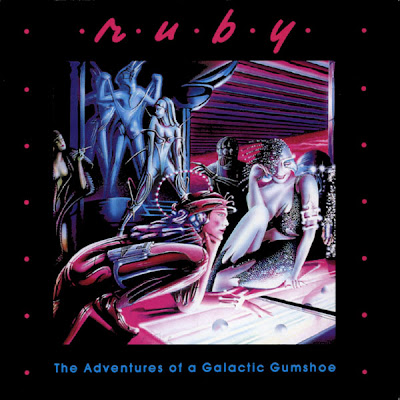
For Your Ears Only: Ruby: the Adventures of a Galactic Gumshoe

Ruby CD cover and Amazon link
A week’s vacation in Colorado was the perfect opportunity to catch up on some of my audio drama. I’d bought RUBY: THE ADVENTURES OF A GALACTIC GUMSHOE a couple of years ago, but only recently had the chance to listen to it. One of ZBS’s older productions, it’s outwardly your standard mix of sci-fi and film noir, but it throws in a hefty dose of postmodern reality-bending and off-kilter comedy. It’s the better of the two ZBS productions I’ve reviewed, more absorbing in its atmosphere and creative in its story, and while the actual plot can get kind of scattered, strong characterizations hold it together.

Laura Esterman plays Ruby, who is, as the title suggests, a galactic gumshoe (a good one, she is often inclined to say.) On the distant alien world of Summa Nulla, Ruby’s on an assignment trying to uncover what her employers believe is a conspiracy to manipulate the media. She’s sidetracked, however, when she runs across an android dressed like her and being chased by genetically engineered assassins called “Slimeys”. The android, Angel Lips (Robin Karfo), is a pleasure model who once belonged to lonely and crusty archaeologist T. J. Teru (Bill Raymond) , who has discovered a lost city beneath the planet’s jungle. Angel Lips, programmed with a degree of independence and inquisitiveness, goes off for repairs and ends up making a Digital Circus techie named And/Or (Tom Stewart) go completely crazy for her. The Slimeys are still on Ruby’s tail, and she decides to make rooting them out her priority, but there’s the question of mysterious signals being sent from somewhere, signals that may or may not have anything to do with the conspiracy she’s trying to hunt down. Ruby’s got her hands full, but she’s still got time to visit Casino City and head underground to play cosmic pinball with the pun-happy mole people.

As far as I can tell, people have been trying to mix film noir with sci-fi ever since the former was invented. To be sure, we’ve got the everpresent narration, which Esterman is quite good at delivering; the writing itself isn’t overdone, but is just vivid enough to evoke some powerful images. In fact I’d say the blend of sci-fi and detective conventions is just about right overall; you’ve got your set-ups, double crosses, and conspiracies, but also some genuinely interesting science fiction concepts and imagery. There’s a lot of light humor to ease things along, and it definitely helps the play’s metaphysical and philosophical discourses go down. As with the Jack Flanders play I reviewed, RUBY invokes the theme of consciousness altering reality at many points, along with other related ideas of mental expansion, questioning social paradigms, etc. It sounds dry, but it’s quite well integrated into the actual story; the closest it gets to just stating these ideas is in a number of segments featuring media darlings the Android Sisters (Ruth Maleczech and Valeria Vasilevski), but it feels nuanced and kind of tricky since we don’t know what their agenda is.

Ruby herself is what ties the whole surreal shebang together; as mentioned before, Esterman has the right voice and personality for the character, and she comes across strong from the start. The character has a good bit of texture; she sometimes makes wrong decisions, but she grows on the listener, and when she disappears from the story for a spell, she is sorely missed, as boldly as Teru tries to take up the slack.

RUBY has an odd structure, as it was originally aired as a series of three-minute drive-time radio segments. Listened to as a whole, it has a lot of overlapping exposition but still manages to pull forward substantially each time. The sound effects are strong throughout; the narration covers the bulk of the action, but the technicians never fail to convey a strong otherworldly atmosphere.

As mentioned above, there’s a part where the series drags a little, and it ends with a few things in the air, partly in accordance with its postmodernist bent but still slightly frustrating. Fortunately, RUBY was a success and there are currently 8 separate series featuring the stellar detective. It’s well worth listening to, delivering more than you’d expect and confounding expectations in a very pleasurable way.

Grade: A-

(I tried to get the name of the writer, but for the life of me couldn't make it out. Something Fulton, I think. If anyone wants to give me that info, I'd be grateful.)

Saturday, November 29, 2008

For Your Ears Only: Doctor Who: The Genocide Machine

Link to The Genocide Machine at Amazon.com
To wrap up Who week, I’ll take a look at one of the good Doctor’s adventures in another medium. During the period wherein the show was still canceled, an independent audio production company called Big Finish Productions obtained the license to make new DOCTOR WHO audio stories on CD. They’ve continued the Doctor’s audio adventures to this day, featuring a number of past Doctors and a few alternates. An early entry in Big Finish’s oeuvre, THE GENOCIDE MACHINE is quite fun, recalling traditional runarounds while taking advantage of the extra scope afforded by audio theatre.

The story takes place on the rainforest-laden world of Kar-Charrat, home to the greatest and most comprehensive library in the known universe, containing just about every piece of information in existence- and so hidden away, its location known only to “time-sensitives.” (No idea if Steven Moffat heard this before writing “Silence in the Library” and “Forest of the Dead” for the new series, but everyone’s just taking from Borges at this point.) The Doctor (Sylvester McCoy) has arrived with his companion Ace (Sophie Aldred) to return some overdue books, and is just in time to see Chief Librarian Elgin (Bruce Montague) unveil a new wetworks data storage system wherein all the information in the library is kept in a tank of water, and can be accessed at the touch of a button. In the meantime, a group of mercenaries investigating a ziggurat elsewhere in the jungle have been wiped out by robotic killers, leaving only one survivor (Louise Faulkner). It quickly becomes apparent that the Daleks have been lying in wait on this remote world, waiting for their chance to break into the library and access the data store (knowledge is power!), and the Doctor’s arrival has given them just the right opportunity. In the meantime, everyone’s hearing mysterious voices in the rain.

I genuinely think one of the great strengths of audio theatre as a medium is its ability to quickly invoke atmosphere and a sense of place. Setting this story in a rainforest, and making water and rain major elements, makes for a good level of intensity; we are instantly thrown into an alien environment, and the constant rain creates a nicely oppressive atmosphere during the outdoor scenes. The sound effects work is pretty sophisticated, handling a number of unusual elements.

Sylvester McCoy and Sophie Aldred are both in good form here, the latter getting some very good scenes when the Daleks try to use her as a way of infiltrating the library. As Bev Tarrant, Louise Faulkner actually sounds just a bit like Aldred which can be confusing, but she’s pretty convincing on her own. Bruce Montague’s delivery is more theatrical, and I actually briefly thought Michael Gough was playing Elgin, which I suppose is a compliment. You’d think the Dalek voices would get old in what is often a dialogue-heavy medium, but this isn’t a problem for whatever reason.

The story seems padded at times, though oddly enough this makes it easier to follow if your attention drifts. However there are still some good twists and turns, particularly involving the nature of the library and the Daleks’ attempts to access the wetworks database. There’s also a running gag involving a mostly-silent cataloguer (voiced by director Nicholas Briggs) that is arguably overplayed, but there are some good payoffs.

THE GENOCIDE MACHINE is part of an arc of Dalek stories collected under the “Dalek Empire” concept, but it works as a standalone. Tucker and Briggs and everyone else involved do a fine job and it’s a fairly sophisticated bit of audio theatre, accomplishing some interesting effects and handling a twisty plot without ever leaving the listener behind. I need to look at more of Big Finish’s stuff in the future; rest assured, they’re worth keeping an ear out for.

Grade: B+

Sunday, August 31, 2008

For Your Ears Only: three from Play It By Ear


Not too long ago (though perhaps longer than he expected), Lance Roger Axt, whom I met at last year’s National Audio Theatre Workshop sent me an e-mail telling me about a few more plays he and his group, Play It By Ear (duly listed on the blogroll to your left) have produced. He was kind enough to send me a few of ‘em, and I finally had a listen. Obviously I’m not an unbiased source, I know some of these people, but with that in mind, the three short plays I’ve been handed are all good listening.

First up is “The Field”, written by Elizabeth Martin and directed by Elizabeth Gottlieb and Nathan Dean. The longest of the plays, it’s a one-act centered around a house built near Lakota lands, where some tribal archaeologists have discovered the remains of a massacre. Needless to say this event may have supernatural repercussions, but the emphasis is on the conflict between the young couple who own the house; the husband is wary of the Lakota trying to reclaim the house he bought, but the wife thinks something genuinely strange is taking place. In some ways this play takes the familiar horror concept of “a house built on an Indian burial ground” and spins it into low-key drama. The portrayal of the Lakota is low-key and unsensationalized, though there’s really only one native character and not much time to develop him. It’s a solid story with a particularly good ending, and a strong atmosphere throughout. Not quite horror, more of a mystery. B+

“Matthew, Mark, Luke, and Chazz”, written and directed by Robert Grady, is the shortest piece and also the lightest, as its title suggests. It’s the story of the four authors of the Gospels, trying to work out just what they’re going to write. There’s substantial debate over whether to include material as provocative as Jesus’ “eye of a needle” speech (and whether a camel is really the best image), to say nothing of how many loaves and fishes there were. To complicate matters, John, now Chazz to avoid confusion with another local author putting together a Mithras story, has been spending much more time hyping up the Jesus story than actually writing it down, and the meeting between the four takes on the air of a dysfunctional story conference. It’s simple but exceedingly funny, with some terrific gags. A-

“The Love Song of...” by Lynn Rosen rounds out the trilogy, directed by Eileen Myers. Set in New York on a rainy day, it concerns a young woman and her mother going to the grandmother’s birthday party. There’s obviously more to it than that; the grandmother isn’t all there anymore, and there have been troubles between mother and father which slowly come out over the course of conversation. This one goes on for a bit longer than it needs to, and the mother fits a bit too well into the stereotypical Jewish matriarch mold, and while I’m sure there are Jewish mothers who are like that, she sometimes comes off more as a “type” than a character. The title is a reference to T. S. Eliot’s “Love Song of J. Alfred Prufrock”, which gets quoted extensively (perhaps too much- in the course of an audio drama, reciting someone else’s poetry can be a distraction from the present action.) Despite the obvious character beats and a bit of fat around the edges, I do like this in the end; the atmosphere is very strong, we get some more depth from the characters as the story progresses, and it resolves in a nicely ambiguous fashion. At a little under 20 minutes it’s an effective vignette, and even though I said it’s on the long side I would be interested to see if more time could be spent with these characters. B-

All of these productions (available here) were done in 2003 as part of the “We Have Ignition” series, featuring new writers and new talent, and in that respect they’re particularly successful; everyone comes across as knowing how to use the medium, how to tell a story in a short amount of time, and how to hold the listener’s attention. After five years I’m sure they’ve already developed even further, so keep your ears perked.

Sunday, September 30, 2007

For Your Ears Only: The Fantastic Voyages of Captain Jack Flanders: Tropical Hot Dog Night


You’re wondering why it’s been so long since my last radio theatre review, and the basic answer is that my new apartment has a very loud air conditioner, and the weather has only just now gotten mild enough for me to turn it off for a few hours at a time. Even then I can easily be distracted by reading things- I’m too visually centered to just stare at my sound system while it plays out (then again, those old-timey radios were cooler looking.) But I’m getting into the habit.

THE FANTASTIC VOYAGES OF CAPTAIN JACK FLANDERS: TROPICAL HOT DOG NIGHT is a production by the off-beat ZBS Foundation, and, as the long title might suggest, part of a series. I haven’t heard any of the others and basically picked the CD up at random, so I’m going in blind. It’s an odd, light kind of fantasy adventure, brought down a bit by structural problems and a bit of preciousness but ultimately enjoyable.

Captain Jack Flanders (Robert Lorick) is sailing a small yacht around the Florida Keys with his informal crewmates, Mojo (Dave Adams), Claudine (Pascale Poirier), and Dominique (Lindsey Ellison), when they come across the island of Key Milagro. By day it’s your typical small island community, but by night a strange mist descends from the swamps, sucking the color out of things, and making Claudine very ill. The crew escapes the island, but is intrigued by the mystery, and resolves to return, this time with friend Rose (Laura Roth) in tow. There are a lot of stories about Key Milagro, and somehow when the fog arrives it turns into a town out of a 40s Film Noir in glorious black and white...

I have to give credit to writer M. Fulton for going with a premise that, on the face of it, sounds like it needs visual representation, and managing to convey the idea and, in fact, have the characters describe what they see without making it too unnatural or contrived. Part of this may simply be the acting, which is enthusiastic and believable throughout; there’s a mood of everyone enjoying themselves to some degree. Sound effects are used sparingly but not too sparingly, and a jazzy score contributes to a laid back atmosphere.

Unfortunately, the way the story is built is at odds with the promise of its setup. The crew leaves the island at first before the fog can really take effect, and we don’t see what it does until well into the second half (and second disc) of the play. This leaves little time for the crew to get to the bottom of what’s happening, let alone solve it or even see if it needs to be solved. We do get an answer, but a lot of red herrings too, and a lot of things that aren’t followed up on. The answer we get is pretty vague, which on one hand seems to have been the point, but just a little more definition would be nice. After a while, there’s a certain lack of suspense; the story wanders astray, and we get some very over-hip public-radio moments like the characters quoting verses from the Captain Beefhart song from which the play’s title comes and discussing the nature of perception. There’s nothing wrong with being smart and quirky and casual, but it is all a little “inside”.

Without a strong structure, the production generally has to coast on charm and creativity, and make no mistake, there’s a lot of imagination on display. Producer and director Tom Lopez does a good job of keeping everything coherent; there were a couple of moments where I wasn’t clear on where a scene was taking place, but it wasn’t actually an impediment to understanding the story. And as said before, the acting is solid, with characters who are well defined and likable (though having two French Canadian women with slightly different voice registers on the crew does become confusing.)

This is a nice, pleasant listening experience which, though it could have gotten more out of its ideas, does at least have plenty to spare. It plays quite a bit with what’s possible in the medium, which is good (and inspiring as I’m trying to make a script of my own.) It is, needless to say, a much better radio drama than the one I started this feature with, and hopefully I’ll uncover more good’uns as I go through my haul from the workshop. Keep paying attention.

Grade: B+

Tuesday, July 24, 2007

For Your Ears Only: Night of the Living Dead


A little over a month back I attended the National Audio Theatre Workshop, hosted by the NATF, a group dedicated to advancing the seemingly moribund art of audio drama in America (in other countries, particularly those with national radio networks similar to the BBC, the medium still thrives, even though it’s overshadowed by television.) I’ve listened to quite a few of these things, mostly old time radio programs, but the Workshop store had a lot of clearance CDs of interesting stuff. Now is as good a time as any to start in on a new medium.

Not the best choice for an opening entry, though; Simon & Schuster’s “Audioworks” adaptation of NIGHT OF THE LIVING DEAD is a major disappointment, taking a story that, with skill and care, could have become a horrifying audio experience (note to self: find more synonyms for “audio.” “Aural” will provoke giggles) and instead clumsily shoehorns it into the medium, inexplicably camping it up in the process. It’s a very cheap, amateur production, the sort of thing you might expect to be cobbled together by fans or for a live Halloween show, not something produced and released by a major publisher (which may be why the whole Audioworks thing didn’t catch on so well.) As an interesting side note, the CD packaging claims this features “the original cast of the cult classic”, which as far as I can tell is completely not true at all.

The story is basically the same. A woman named Barbara visits the cemetery with her brother when they’re both attacked by a strange man; the brother is killed, and Barbara runs away, the man in pursuit, until she holes up in a farmhouse, where she slowly loses her mind as Ben, a more levelheaded survivor of this mysterious wave of mass murder, boards up the house to make it secure from the growing mob outside. They run into other survivors, a teenage couple and a young girl and her parents, and radio and TV announcements start to confirm what the title implied, that these murderers are the walking dead, risen from the grave to feed on the flesh of the living. Tensions rise and panic ensues as the small group tries to decide how to survive the night.

I knew I was in trouble when, after the opening narration (which isn’t too bad), we had the first exchange between Johnny and Barbara. Now, in the movie, neither performance is too realistic, and there are some endearingly cheesy moments before the horror really starts. But for the audio production we get performances which start at “cheesy” and quickly ratchet it up to “ludicrously shrill.” Johnny imbues every other line with sarcasm worthy of Comic Book Guy, and all the dialogue so heavily hints at the impending zombie apocalypse that “irony” just doesn’t seem a strong enough word. And this continues, from Ben’s inexplicable Southern accent to Harry Cooper’s trembling voice- it’s as if the director assumed that this being an audio production meant everyone had to play to the rafters to make up for not being seen. In the film, Barbara’s descent into madness is actually rather well-played; the audio Barbara goes into hilariously bad hysterics from the instant she gets into the farmhouse. George A. Romero is not a director known for subtlety, and I honestly thought I would never see the day in which I would call NIGHT’s performances understated, but here we are.

Not that the writing is any help. To be fair, the play runs only an hour, and so has to condense the film’s gradual buildup of information and paranoia. But this doesn’t really excuse the weirdly campy tone of the narration and much of the dialogue; nobody at any stage is taking the story very seriously, so there’s no reason we should either. I will admit there are a couple of clever lines, but the smirking tone of it all undercuts the story’s power to shock, and makes the production feel all the more amateurish. Worst of all is how the radio broadcasts are handled; in the film, we hear radio and tv reporters gradually uncovering information about the invasion, making the situation more and more horrific as we hear more. In the play, most of the information about the zombies is revealed in one long infodump by, of all people, the President of the United States, and since this was produced in 1988, that means a Reagan impersonation. Not only does this date the work more than anything in the movie, it adds further goofiness to what should be some of the most shocking and terrible revelations in the picture.

Then again, I’m thinking that even a deliberately campy NIGHT may have worked, if not for the sheer clumsiness exhibited in adapting this thing to audio. It’s a challenge, of course; zombies usually don’t talk, and the importance of shooting a ghoul in the head is kind of hard to convey without visual assistance. But for the most part the play doesn’t even try. Whenever we reach something resembling an “action” scene, the narration kicks in and describes everything while the voice actors and sound effects artists go off for a smoke. This is pretty much a textbook example of how you’re not supposed to use narration in an audio play; it needs to have a purpose beyond spackling over the stuff you can’t see. The sound effects are incredibly sparse, as well- a few gunshots and hammer noises, plus an odd echo effect when characters are outside. We don’t even get any zombie moans. Seriously, people, that should have been job number one; round up everyone you can, set up an omnidirectional mike or two, record moaning, season to taste. Sound technology was not this bad in the Eighties.

Honestly, I drifted out of this one as soon as I realized it wasn’t going anywhere interesting. The idea of doing NIGHT OF THE LIVING DEAD as an audio drama contains within it a lot of challenges, but a lot of potential as well- the use of broadcasts, the heated dialogue, the ever-growing cries of the undead. Done right it could be as intense as the Mercury Theatre’s WAR OF THE WORLDS. Instead we get the cheap and sloppy version. It’s a crushing disappointment, but then, the relative obscurity of this attempt means the door’s still open for someone else to try. I’m tempted to take a pass myself.

Grade: D+