Showing posts with label Kaiju. Show all posts

Monday, July 21, 2014

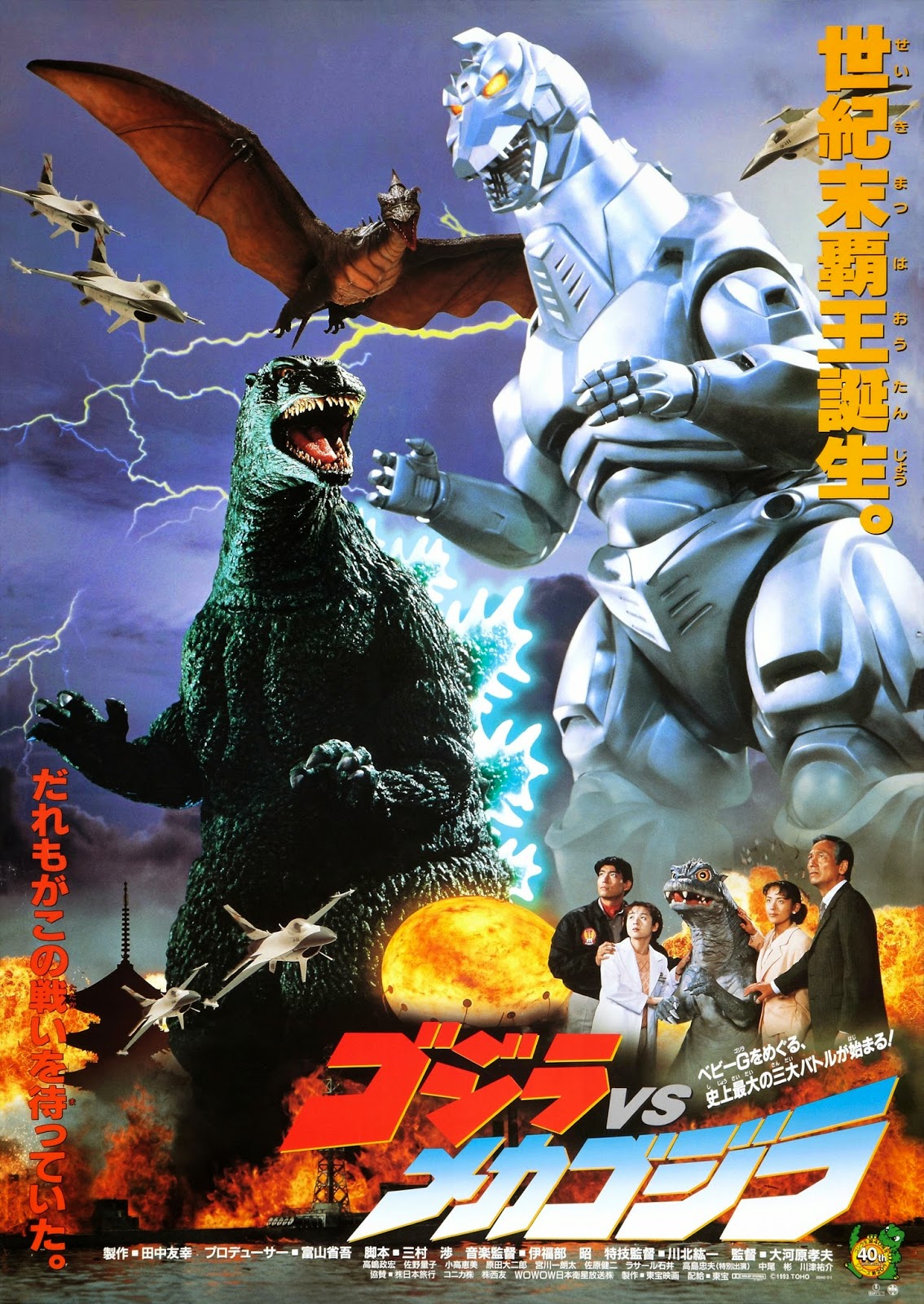
Random Movie Report: Godzilla vs. Mechagodzilla II

Godzilla vs. Mechagodzilla II poster
Poster via WrongSideoftheArt.com

It's easy to see why Godzilla vs. Mechagodzilla II is  a fan favorite. Not only is it probably the slickest and most technically accomplished of the Heisei Godzilla films, it's also the only film in the franchise to not only pit Godzilla against humanity, but to make humanity the villain. Sure, in the original Godzilla he's a kind of punishment for our use of nuclear weapons, and Godzilla vs. Hedorah is about manmade industrial pollution, but in stories like that the audience is expected to empathize with the humans struggling to overcome their own folly, because we are dealing with Major Problems that all of us must reckon with. Here, humanity just makes some bad decisions with the monsters as the injured parties, so we can finally stop pretending and cheer for some miniature cities to get squashed. Sometimes we just have it coming.

Monday, June 23, 2014

Random Movie Report: Godzilla and Mothra: The Battle For Earth

Japanese poster for Godzilla and Mothra: The Battle For Earth

The most commercially successful entry of the Heisei Godzilla series, Godzilla and Mothra: The Battle For Earth is also its weakest; not a bad movie, but less than the sum of its parts. Once again, Toho went to Godzilla's past and resurrected one of his most durable foes, reinventing the giant flying insect as a mystical Earth god(dess?) engaged in an eternal struggle to protect the planet. With Takao Okawara taking over the director's spot, the film feels a little unsteady, but does manage to introduce a few new things in amongst references to classic kaiju films and American blockbusters.

Saturday, May 31, 2014

Random Movie Report: Godzilla vs. King Ghidorah

Godzilla vs. King Ghidorah poster

In some ways Godzilla vs. King Ghidorah is a return to tradition for the series. After Godzilla vs. Biollante failed at the box office, Toho decided that their next Godzilla movie needed to pit the monster against a classic enemy with name recognition of his own; hence, four-time Godzilla opponent King Ghidorah returned to continue the pair's epic rivalry. But this is pretty much where tradition ends, as King Ghidorah is one of the most radical and unusual entries in the series, featuring geopolitical subtext, a downright loopy take on time travel, and a surprisingly long dearth of Godzilla himself. It's the Godzilla film that got mentioned on The McLaughlin Group, and watching it is like taking a trip back to a time when Japan seemed poised to conquer the world.

Friday, May 23, 2014

In Theaters: Godzilla (2014)

Godzilla poster

Godzilla is a film that feels well overdue. There was, of course, one past attempt at making an American take on the character, and while I'll always have a soft spot for it, the filmmakers basically dodged a lot of the inherent challenge by making their monster less grandiose, less powerful, and theoretically more plausible as a result. After that didn't quite work, Toho brought back the "proper" Godzilla for a series of films that, while sometimes good, never had much of a reason for being other than reasserting tradition. Godzilla has been dormant for ten years, falling out of favor even in his native Japan, and so making a true, traditional Godzilla film for American audiences used to seeing him as a camp figure seemed like a long shot.

Gareth Edwards, director of Monsters, is at the helm for what turns out to be a slow, methodical burn of a monster movie. Godzilla eases the audience into the concept of a giant radioactive dinosaur who fights other giant radioactive monsters, knocking over skyscrapers in the process. People have complained that the King of the Monsters doesn't get enough screentime, and to be sure there's a lot of teasing involved, but the payoff is worth it. It's both a fantastic reintroduction to the kaiju eiga genre, and a film about reckoning with forces greater than ourselves.

Wednesday, July 17, 2013

In Theaters: Pacific Rim

Pacific Rim movie poster

Pacific Rim is a rare kind of spectacle. A Westernized fusion of kaiju eiga and mecha shows, not based on any existing IP, Guillermo del Toro's latest feels like some kind of weird nerd indulgence, something that shouldn't have gotten through the Hollywood assembly line but for a few vague resemblances to the Transformers series. The movie is a toybox, packed full of nifty sights and sounds and concepts, but what really makes it sing is that del Toro and co-writer Travis Beacham not only take their concept seriously and sincerely, but make sure there's a heart beating at its center. A film this dense and chaotic may be easy to write off as a jumble of special effects, but on closer examination it's a lot more finely crafted than that.

Tuesday, February 26, 2013

Random Movie Report: Godzilla vs. Megalon

Poster and Amazon link

Every series has its nadir, and after a few years of falling budgets and a lack of interest, something had to give for Godzilla and company. Godzilla vs. Megalon is doubly an embarrassment for Toho, being not only its worst entry in the Godzilla series, but also one of its most widely seen abroad. It's arguable that this junky, cheaply made drag is responsible for most of the English-speaking world's perception of Godzilla films as campy trash. The poor thing never really had a chance, and while its ubiquity gives it a certain nostalgic charm for those of us (un)fortunate enough to have seen it as children, said charm wears off pretty quickly.

Tuesday, February 19, 2013

Random Movie Report: Godzilla vs. Gigan

DVD cover and Amazon link

Following the heady surrealism of Godzilla vs. Hedorah, Toho decided they needed to get back to tradition and make a movie that was just about giant monsters destroying cities and beating each other up. So seasoned kaiju director Jun Fukuda took the helm for Godzilla vs. Gigan, a big sci-fi brawl in which Godzilla and a friend face down space monsters like they did in the Sixties. But the Japanese film industry was a darker and less friendly place for such things, and Godzilla vs. Gigan suffers some of the worst effects of Toho's austerity. Cheapness leads to shortcuts, which blend with a few significant story problems to make a film that really is only for the fans. It has a few neat and quirky ideas, though, and introduces one of the franchise's most memorable villains.

Saturday, March 31, 2012

Random Movie Report #102: King Kong Escapes

DVD cover and Amazon link


A curious chapter in the Toho kaiju saga as well as its title character's filmography, King Kong Escapes is a film that languished in obscurity for many years, not even getting an American video release until the DVD era. It's definitely a lesser effort for Kong and for Toho, but it's not without its ridiculous charms either. Since it's apparently my lot to cover every SFX film Toho made in this period, well, here we are.

Wednesday, February 29, 2012

Random Movie Report #100: Destroy All Monsters

Destroy All Monsters Blu Ray Cover and Amazon Link

This is what I've been building up to. Though I've long since stopped numbering features, I figured the 100th installment of Random Movie Report ought to be something especially neat, hence, the Godzilla film to end all Godzilla films. (Granted, this undermines the concept of randomness, but never mind.) Destroy All Monsters took forever to get a proper DVD release in this country, but though I've had the DVD since Christmas, I decided I had to build up to it. It deserves it.


Friday, February 24, 2012

Random Movie Report #99: Son of Godzilla


The second of Godzilla's tropical adventures ends up being one of the series' weirdest installments. Son of Godzilla, as the title implies, is a continuation of the great monster movie tradition of having inexplicable offspring, a tradition going back to Kong himself (though maybe it started with the Grendel family.) As a result this was the most kid-friendly monster epic Toho had produced up to that point, and so an omen of things to come. It's a fun, loosely put together affair which has a few obvious weak points- including the worst Godzilla suit in the series- but is cute and playful enough to make up for them.

Friday, January 27, 2012

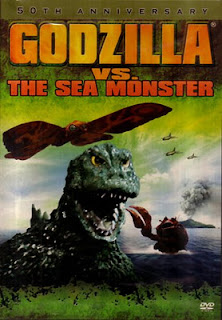
Random Movie Report #98: Godzilla vs. The Sea Monster

Godzilla vs. The Sea Monster DVD cover and Amazon link


After Monster Zero, Ishiro Honda took a break from the Godzilla series, and the series itself took a vacation. In one of those great stories of Tinseltown, a script originally intended for King Kong was instead messengered over to Godzilla's people, deals were struck, and Godzilla traded Tokyo for the South Seas. It was a move that allowed Toho to save a little money on miniature city sets, and Godzilla vs. The Sea Monster, under the direction of Jun Fukuda, turned out to be a really neat change of pace. It's a jaunty, colorful romp in which four Japanese guys get mixed up with island natives, international terrorists, a giant dinosaur, a giant moth, and one very angry shrimp.

Tuesday, October 25, 2011

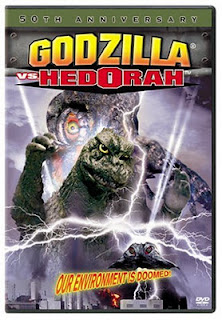
Monsterthon: Godzilla vs. Hedorah

Godzilla vs. Hedorah DVD cover and Amazon link

Let's jump ahead to something more horrific. Godzilla vs. Hedorah, once released in the US as Godzilla vs. the Smog Monster, came at a dark time for the Godzilla franchise, with the passing of Eiji Tsubaraya and the general collapse of the Japanese film industry, which had an especially harsh impact on the budgets of kaiju and other effects-driven movies. Intended to kick off a new generation of Godzilla movies, with a new director and new, more kid-friendly attitude, Godzilla vs. Hedorah ended up being a strange, surrealistic experience. It is, frankly, insane, defying any expectation of what a Godzilla movie should be and playing by a set of rules it just made up. There's never been a Godzilla film like it before or since, and the results are goofy, atmospheric, and kinda creepy.

Saturday, October 22, 2011

Monsterthon: Mothra Vs. Godzilla

DVD cover and Amazon link


Godzilla's bout with King Kong was a major box office draw, really giving birth to the Godzilla series proper by showing he was no passing fad. But for his next fight he needed another lofty opponent, and so Toho called up its second-biggest draw to give us Mothra vs. Godzilla. This particular entry is a fan favorite, showing Godzilla at his meanest and most relentless, Mothra at her bravest and most selfless, and still treating the whole affair with some degree of seriousness. Though it's not my favorite of the period, Mothra vs. Godzilla does what it sets out to do and makes us believe without reservation in an epic life-or-death struggle between a radioactive dinosaur and a giant bug.

Monday, October 17, 2011

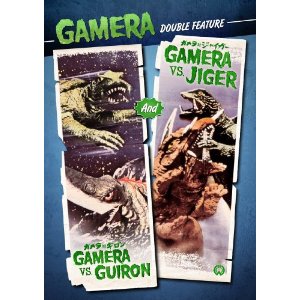
Monsterthon: Gamera vs. Guiron

DVD cover and Amazon link

Gamera vs. Guiron is a movie I've seen many times via Mystery Science Theater 3000, so I was looking forward to seeing the full and proper version of it. Surprisingly it's not that different an experience, even in Japanese- the film doesn't seem like it was altered much for American release, and it's short enough that it didn't need to be cut down too much in order to be riffed on. Like the film before it, it's a slight, microbudgeted affair, but seems to wear it a little better. You really have to treat it as a kids' movie, and it appeals to a child's sense of wonder even if it is goofy as all get-out.

Friday, October 07, 2011

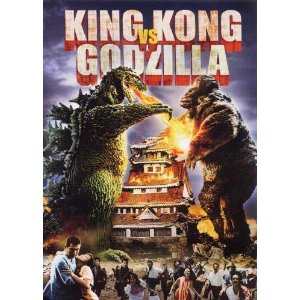
Monsterthon 2011: King Kong vs. Godzilla

Link to King Kong vs. Godzilla on Amazon.com

This October is gonna be another month of monsters, and I'm going to concentrate on our friends the kaiju. They're not often scary, though they are awesome, and I may throw in some traditional horror stuff as time permits.

King Kong vs. Godzilla is a tough film to review because, like the original Godzilla, it exists in two versions, but with a much larger gap in quality between them. What's more, the "proper" version of the movie, the original Japanese release, is going to be inaccessible to most readers of this blog; there is no legal English-language release of it, nor is there likely to be anytime soon owing to complicated legal issues. This is the 21st century, though, so… well, I'll let you do the searching.

In any case, this is a lot of fun. Godzilla returned after a 7-year hiatus to battle the original icon of giant movie monsters in a big splashy color Tohoscope production to commemorate the studio's thirtieth anniversary, and not only did the filmmakers deliver the spectacle, they packed in a sly, satiric attitude and some jabs at the world of advertising and publicity. While Godzilla's original rampage was deadly serious business, and the follow-up a straightforward sci-fi thriller, King Kong vs. Godzilla shows Ishiro Honda, Eiji Tsubaraya, and company loosening up and having a little fun with their larger-than-life superstars.

Tuesday, August 23, 2011

Random Movie Report #94: Gamera Vs. Viras

DVD cover and Amazon link

Inspired by the nigh-miraculous release of the Gamera episodes of Mystery Science Theater 3000 recently, I've decided to restart my look at the giant turtle's original hits. Gamera vs. Viras avoided the gaze of the Satellite of Love, but it's worth noting for the shift it marks in the series. This is when the goofiness really started to set in, and though it's weird to talk about the Gamera movies of all things getting "more childish", the filmmakers have toned down the darker parts of earlier movies. Not that this is a problem; the film's only major flaw comes down to cheapness rather than kiddie appeal. That flaws kind of a big one, but there's still some fun to be had here.

The movie starts off with a bang as Gamera, flying through space as is his wont, destroys a spaceship from the Viras system which is preparing to invade Earth. Now realizing that Earth is protected, Viras sends another ship, with orders to target Gamera and see how he can be disposed of. The ship manages to snare Gamera and, after probing his mind, realizes his great weakness is that he is the friend to Earth's children. And so the aliens kidnap two boy scouts, Masao (Toru Takatsuka) and Jim (Kurl Crane), and inform Gamera via telepathy that they will kill the children if he doesn't obey them. While Masao and Jim explore the alien ship and try to evade their captors, the aliens plant a mind control device on Gamera, forcing him to go back to his old city-destroying ways.

While there is an actual enemy monster Gamera ends up fighting, the film deviates from the formula a little by not focusing on him until the final battle. Before then, the emphasis is on the Viras spaceship and its attempts to kill or control Gamera, and the kids' attempts to stop the aliens. The aliens and their ship owe a lot to the same colorful, jazzy 60s aesthetic that pervaded Toho's Invasion of Astro-Monster, and the film never steps into outright horror the way the previous installment threatened to. You never get the sense that the kids are truly in danger, and they have a surprising amount of autonomy so long as they don't threaten the ship or its inhabitants. This isn't a bad thing, but it's a bit of kiddie movie logic that you have to accept.

Unfortunately, the series' low budget was felt rather strongly in this film, and it struggles to reach a proper feature length. Seemingly ten to twenty minutes are spent on the spaceship's mind-probe of Gamera, which translates into a lengthy montage of the monster's exploits from three previous movies. It's kaiju action, and I shouldn't complain, but it's clearly padding. It gets worse, though, when Gamera goes on his alien-ordered rampage, which consists entirely of stock footage from the first and second films, the first still in glorious black and white with only traces of color tinting. It's really shameless, even in comparison to what some 70s kaiju films would end up doing to save money.

While all this very nearly ruins the picture, it's saved by a nice atmosphere and an entertaining finish. The climax hinges on a particularly contrived bit of kiddie movie logic, but then, this is a kiddie movie. The main event is a good one- though Viras the monster doesn't have as many tricks as Gamera's other foes, he can still pack a wallop, and there's some truly disturbing kaiju violence, including one particular scene that Gamera by all rights shouldn't survive. But then, he is Gamera.

Gamera vs. Viras (sometimes circulated under the title Destroy All Planets) is a weaker entry than its predecessors, but still delivers some quality entertainment. The film takes the series on a turn towards the stars and towards bright, fun adventure, and it's hard to find much fault with that approach, at least as it relates to a giant jet-powered turtle who breathes fire. I think we can all agree that that's really neat.

Written by Nisan Takahashi
Directed by Noriaki Yuasa

Grade: B-
Monday, February 28, 2011

Random Movie Report #87: Gamera vs. Gyaos

Link to the Double Feature DVD on Amazon

After a short experiment with entirely grown-up characters, the Gamera series veered back sharply into kiddie territory. This isn’t necessarily a bad thing, though, and one of the things I realized going over GAMERA VS. GYAOS is that the series, however derivative, managed to be pretty fresh. Some of its approaches to the giant monster battle genre were appropriated by the Godzilla series in the following decade, and while this entry contains more than its fair share of borrowings, it manages not to feel like a retread. Instead, it gives the giant flying turtle his definitive adversary, and comes off as an effective spectacle done on the cheap.

A series of earthquakes and volcanic eruptions rocks the Pacific Rim, and the eruption of Mt. Fuji lures Gamera back to Japan. The upheaval also results in a green glow emitting from a mountain near a remote village in northern Japan, where a development company is trying to build an expressway over the objections (and demands for money) of the townsfolk. A mysterious ray from the glowing mountain destroys a survey helicopter, and eventually an inquisitive boy named Eiichi (Naoyuki Abe) discovers (and names) the culprit: Gyaos, a supersonic, prehistoric flying monster with traits of bird, lizard, and vampire bat. Gamera comes along to save the day, but finds himself vulnerable to the creature’s supersonic beams, which cleanly cut through just about anything they come in contact with. The military tries to develop its own ways of combating the creature, focusing on its aversion to bright light, which is ultimately revealed as a vulnerability to the sun’s rays. Of course, knowing its weakness is one thing; taking advantage is another.

You can see a formula for the series already emerging; a new monster appears, Gamera challenges it but is wounded, and the humans work out a weakness and set up elaborate plans to try and defeat it, which inevitably must serve only to delay or inconvenience the monster until Gamera’s ready for a rematch. It’s not a bad formula, to be sure, and it’s one thing that the Godzilla series would adopt now and again.

It is, for one thing, an opportunity to show off the new monster. Gyaos has become Gamera’s signature adversary, chosen to headline the revival of the series in 1995, and in a series filled with weird monsters, he still stands out. The sleek, sinister, cartoonish design of the creature is inspired, and there’s something nicely horrific in his habit of eating people alive and emerging at night to feed. The “sonic beam” is also an interesting effect, splitting cars and helicopters in twain with a surgeon’s precision. The series tradition of brightly colored goriness continues apace as well, Gyaos bleeding bright pink and having the ability to regrow severed limbs.

The monster’s nocturnal dining habits mean this is a moodier film than you’d expect, with nice visuals of dark wooded mountains. The cinematography for this picture actually won an award, and it does help the film carry its low production values. The picture simply has a dark atmosphere that is unusual in a kids’ kaiju movie.

Of some note is the subplot involving the developers, though only some. It’s actually framed in an interesting way, with the developers determined to finish the highway but the villagers determined to get the best price they can for their homes, and having the project foreman Tsutsumi (Kojiro Hongo) be the dashing male lead almost gives the story a pro-big-business slant. As much as this plot gets buried by the whole giant bat monster business, it does get a resolution eventually, one that’s expectedly pro-niceness and pro-compromise and so on. As plainly for kids as the series was, it’s interesting to see the various attempts at social comment that pop up.

GAMERA VS. GYAOS more or less does what it says on the tin, but is distinctive enough to be memorable. As derivative as the Gamera series can be, it’s also unique, and Gyaos is another strange entry in a wonderfully weird rogue’s gallery. Shout! Factory has again given this film better treatment than it’s ever had in the English speaking world, and the picture holds up stronger for it. This is a series I’m glad I have the opportunity to revisit.

Written by Nisan Takahashi
Directed by Noriaki Yuasa

Grade: B

Sunday, January 30, 2011

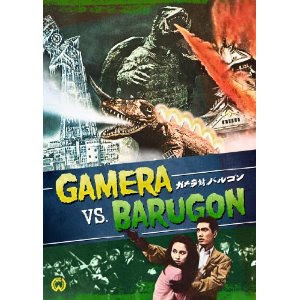
Random Movie Report #85: Gamera vs. Barugon

Gamera vs. Barugon DVD cover and Amazon link
The Gamera series has always been under appreciated, the poor cousin to the more lavish Godzilla films of the same period (even though their success ended up influencing Toho’s series.) However, the Shout! Factory DVD releases of the classic films are making them look quite a bit better. Viewed in widescreen with quality transfers, they’re not quite as ratty or cheap as they seemed, and GAMERA VS. BARUGON in particular stands out. An unusually dark, serious, and annoying-little-kid-free entry in the series, the first sequel and first full-color monster bout for the jet-powered turtle is a romp which can stand up with some of Toho’s better kaiju epics.

When last we left Gamera, he had been lured into a rocket and fired off to Mars (seriously.) A meteor strikes his capsule, releasing him, and he flies back to Earth, making short work of a dam and heading to a volcano to recharge his flame-powered batteries. Meanwhile, an air pilot named Keisuke (Kojiro Hongo) quits his job to join with a group of men who are planning to retrieve a valuable opal from an area around New Guinea, where Keisuke’s now-disabled brother Ichiro (Akira Natsuki) hid it during the war. Ignoring the warnings of the natives, who insist that the area is cursed, Keisuke, sailor Kawajiri (Yuzo Hayakawa), and criminal Onodera (Koji Fujiyama) recover the strange egg-shaped jewel, only for Onodera to double-cross his friends and run off, keeping the jewel for himself. Kawajiri is killed by a scorpion’s sting, and Keisuke is injured in a cave-in. He is nursed back to health by the natives and a Japanese doctor, none of whom are happy to learn that the jewel has been taken; an oddly light-skinned native, Karen (Kyoko Enami), volunteers to go to Japan with him to try and recover it.

The reason for this is that the jewel is actually the egg of a monster named Barugon, and when Onodera lets it be exposed to the light of an infrared lamp on the voyage back home, it hatches, blowing up the ship and releasing a giant reptilian beast on Osaka. Barugon has quite the diverse arsenal of abilities, with freezing breath, a giant tongue, and a devastating rainbow beam it can project over great distances. Gamera is attracted by the energy the new monster gives off, and the two quickly start to battle it out, but our newly-heroic turtle is frozen and pushed onto his back. It looks like it’s up to the Japanese military, Karen, and a newly repentant Keisuke to find a way of defeating Barugon once and for all.

This is the only film in the original Gamera series not to have any child protagonist, and the tone overall is much darker and more adult than the rest of the series, even the first. I hate to join the “darker is better” crowd, but in this case the approach yields good results; the central story is very strong and I really like the theme of redemption. Keisuke’s venture seems harmless enough at first, but between greed and disrespect for native traditions it’s a venture that’s bound to yield bad results. It helps that Onodera is a genuinely scummy character, at one point leaving Keisuke’s brother and his wife to die helplessly in the path of Barugon’s rampage. Director Shigeo Tanaka brings a nice sordid atmosphere to the human scenes, and Hongo is particularly good at showing his character’s remorse. Chuji Kinoshita’s score also adds to the vaguely oppressive atmosphere.

The downside to such an approach is that Gamera himself does not get a lot of focus; indeed, the fact that he’s basically the good guy goes unremarked-upon. Still, the film doesn’t skimp on monster action, and while some of the effects are a little threadbare, VFX director Noriaki Yuasa does create some imaginative setpieces. It’s genuinely interesting to see the monsters do battle in a frozen cityscape, and Barugon is a wonderfully strange first foe for the equally eccentric jet-powered turtle to confront. The addition of color allows for an interesting trend in the series to surface; Gamera’s battles are a lot bloodier than those of Godzilla or other Toho monsters from around this time, but Yuasa keeps things kid-friendly by giving the monsters bright dishwasher-soap-colored blood.

For whatever reason Daiei decided not to stick with the “mature” approach for the rest of the Gamera movies, leaving this as an unusual but effective change of pace. It’s weirdly touching, and the human story gives us just enough of a connection for the monster action to work that much better. GAMERA VS. BARUGON is probably the best of the original series, and it’s great to see it finally get its due.

Written by Nisan Takahasi
DIrected by Shigeo Tanaka

Grade: B+

Thursday, October 28, 2010

Monsterthon: The Comics Page #26: Essential Godzilla

Essential Godzilla cover and Amazon linkI promised you monster comics and I will deliver. Godzilla has been in a number of comics over the years, and his first American appearances were with Marvel starting in 1977. Marvel not only bought the license from Toho for a couple of years, but actually brought Godzilla into the Marvel universe for that time, having him face S.H.I.E.L.D., Hercules, the Fantastic Four, even the amazing Spider-Man at one point. Four years ago the Essentials collection of this series was released, but the cost of licensing meant that it had only one print run, meaning it’s probably a little hard to find, but if you’re a Godzilla fan and can tolerate some off-model art, it’s pretty fun.

The story of the comic, such as it is, is that Godzilla, at some point after his initial rampage, ended up trapped in an ice floe just off the coast of Alaska. A warm winter and warmer spring end up setting him free, and the international spy group S.H.I.E.L.D. is the one organization with the manpower and artillery required to combat the great beast as he rampages across America for the first time. The group’s #1 hero Nick Fury is elsewhere for most of the comic’s run, so it falls to the bowler-hatted, cigar-chomping Dum Dum Dugan to lead a multiethnic crew (including an elderly scientist who survived Godzilla’s first rampage, and his grandson who thinks Godzilla’s not that bad) and a small army against the king of the monsters. Godzilla also runs up against the mutant hordes of the monster breeder Dr. Demonicus, a group of super-monsters from space, a giant robot named Red Ronin, and even some cowboys.

Old school Godzilla fans will probably be taken aback by some of the liberties taken with the monster’s design; it’s nothing as radical as in that one film that I and only I like, but it’s still distinctly different from anything we saw in the movies. Herb Trimpe, who pencilled most of the series, came up with an interesting, slightly dinosaur-like variant on the classic look, with a much larger head than normal and gem-like eyes. He’s bright green and the fire he breathes is orange instead of the traditional blue, but both of those don’t really matter in an Essentials volume for obvious reasons. Overall the art is pretty solid- it closely follows the Marvel house style of the period, with some nice splash page work and even a little aping of Kirby when Godzilla meets Devil Dinosaur (long story.)

You won’t be seeing any of Godzilla’s Toho buddies like Rodan or Mothra in the series; Toho treated all these characters as separate licenses (a practice continued for the Dark Horse comics, though apparently not any of the video games), and so the big scaly hero has to fight a host of original creations. Some are more memorable than others, though the giant ape-like Yetrigan and the aforementioned Red Ronin are nice additions. The writers do put Godzilla in some very interesting situations, most notably in a multi-issue arc where he’s hit by Dr. Hank Pym’s reducing gas, initially shrinking him down to rat size as he explores Manhattan from the ground up, then slowly returning him to normal size. The occasional story like this, that would only really work in comics given the limitations of late 70s special effects, helps break up the more traditional monster action. There are also some nice, though characteristically overwrought, human vignettes, such as one about the plight of a compulsive gambler on the one day Godzilla decides to visit Las Vegas.

The main attraction is really Godzilla mingling with the big names of the Marvelverse. The hotheaded Col. Duggan is a great foil for him, always frustrated when his plans fail, and an early battle with B-list supergroup The Champions (which includes two former X-Men) at the Golden Gate Bridge is a highlight. Technically, Godzilla’s adventures in the Marvelverse are still canon, although licensing issues prevent his resurfacing (a later story implied that Doctor Demonicus successfully mutated him into a non-infringing beast that was easily dispatched, but we all know Godzilla’s toughter than that.) As I’ve said before there’s a nice comraderie and distinctive atmosphere to Marvel’s stuff in the 70s, and adding a celebrity monster was a nice touch.

Godzilla’s time with Marvel was brief, but it was a really solid run; goofy, strange, but never failing to deliver the requisite destruction and mindless violence you can always count on the character to deliver. The art is quirky, the stories creative if ridiculous, the prose borderline Claremontian- it’s the Bronze Age in all its gaudy glory. The people who will love this should know who they are.

Written by Doug Moench
Pencils by Herb Trimpe and Tom Sutton
Inks by Way Too Many People To Name

Grade: B+

Thursday, October 14, 2010

Monsterthon: Random Movie Report #79: Gamera the Giant Monster

Gamera DVD cover and Amazon link
The first picture was a dead giveaway, wasn’t it? Gamera has appeared at the club before, but just this past year, Shout! Factory began releasing the original Gamera films on R1 DVD. After years of languishing in poor transfers on budget titles destined to clog the shelves at Half Price Books, the king of monster turtles is finally getting the treatment he deserves. Though obviously conceived as a cash-in on Toho’s kaiju epics, specifically the Godzilla series, the Gamera films quickly found their own vibe and charm. The first film isn’t quite as charmingly absurd as later entries would be, but it’s still pretty entertaining and is a good introduction to this uniquely friendly beast.

The film opens in the Arctic, with a Russian bomber attempting to slip past America’s DEW system. It’s intercepted and shot down, unfortunately triggering its nuclear payload, which melts an ancient glacier and unleashes Gamera, a giant prehistoric turtle worshipped as a god by the local Inuits. The giant monster causes some local destruction before apparently disappearing from sight; shortly after, people in Japan start catching sight of a strange UFO, and local kid Toshio (Yoshiro Uchida) is rescued from a crumbling lighthouse by the monster. Sure, Gamera caused it to start crumbling in the first place, but Toshio is convinced the monster is the reincarnation of a beloved pet turtle he was forced to set free. In due time Gamera- who can not only breathe fire, but fly by tucking all his limbs into his shell and spinning on flame jets like an elaborate firework- sets about destroying the Japanese mainland. Scientists and generals are helpless to find a way to destroy the creature, and Toshio tries to persuade them that Gamera isn’t bad, just misunderstood. Eventually, a supremely goofy plan is hatched.

One of the major reasons Gamera stood out from a number of attempted Godzilla rivals is that Daiei studios directly went after the child audience. While Toho’s star was slowly transforming into a more sympathetic and kid-friendly character (1965, the year this was released, saw Godzilla doing his first fight for good in GHIDORAH, THE THREE HEADED MONSTER), Gamera’s titled that way from the start. Sure, in this movie he’s mostly wrecking buildings and setting cities on fire, but the film takes care not to make his rampage too scary or too realistic. I think it also helps that there’s something almost human (or at least cartoonish) about Gamera’s look; he’s got large expressive eyes and a rounded shape that makes him look kind of jolly. In no time whatsoever (well, one or two movies) he would become the friend of children and battle really evil monsters, but solo he comes off as less aggressive than simply out of his element.

Daiei never had a lot of money to spend on these movies, but while the effects are a bit on the cardboard side, they’re well-shot and large-scale enough to get the mood across. Gamera, at least, is convincing and well-designed. I, like many other people, still don’t know just why the filmmakers decided to make him jet-powered, but it’s honestly an inspired touch of whimsy, similar to something Nintendo auteur Shigeru Miyamoto might have come up with 20 years later. (I am not entirely sure what tense that was.)

The human action is sadly a little boring, a common flaw with minor monster pics from this era. It’s not bad, but the fact that I can’t really recall any of the characters besides the kid and older scientist (Eiji Funakoshi) does not speak well. A slight disappointment on the DVD front is that this relese doesn’t include the more widely-seen American cut released as GAMMERA THE INVINCIBLE; the rights to those and other English dubs of the original Gamera series are still held by other parties, and have only been available on the aforementioned budget discs.

The first GAMERA epic isn’t really spectacular, but it is one of the few really solid non-Toho kaiju epics from this period. A lot of it is down to Gamera himself, a unique and charming creation one can’t help but like. The film’s story and production values are just strong enough to provide a decent platform for the super turtle’s talents, and launch him off to a surprisingly lengthy and durable career.

Written by Nisan Takahashi
Directed by Noriaki Yuasa

Grade: B