Showing posts with label The Comics Page. Show all posts
Wednesday, January 04, 2012
The Comics Page: Lightrunner
The boom in original graphic novels in the 1980s gave us a lot of material that's since sunken into obscurity, be it through low print runs, poor distribution, or simple physical decay. I found Lightrunner in an antiques store some years ago, hardbound with some nice foil embroidery. It was a labor of love for its creators, a full color science fiction epic, and if it's not exactly original, the enthusiasm of it is charming.
Thursday, October 13, 2011
The Comics Page: Dungeons & Dragons: Shadowplague
I'm not going to be the first person singing the praises of the new Dungeons & Dragons comic, but it's worth adding to the chorus. John Rogers (of Blue Beetle and Leverage fame) and Andrea DiVito have managed to be the first people to successfully translate the tabletop fantasy game into a fun action comic. Shadowplague is a nice hardbound collection of the first major arc, and if you, like me, have been having trouble following the monthly issues, it's a great way to catch up.
Thursday, October 28, 2010
Monsterthon: The Comics Page #26: Essential Godzilla
I promised you monster comics and I will deliver. Godzilla has been in a number of comics over the years, and his first American appearances were with Marvel starting in 1977. Marvel not only bought the license from Toho for a couple of years, but actually brought Godzilla into the Marvel universe for that time, having him face S.H.I.E.L.D., Hercules, the Fantastic Four, even the amazing Spider-Man at one point. Four years ago the Essentials collection of this series was released, but the cost of licensing meant that it had only one print run, meaning it’s probably a little hard to find, but if you’re a Godzilla fan and can tolerate some off-model art, it’s pretty fun.The story of the comic, such as it is, is that Godzilla, at some point after his initial rampage, ended up trapped in an ice floe just off the coast of Alaska. A warm winter and warmer spring end up setting him free, and the international spy group S.H.I.E.L.D. is the one organization with the manpower and artillery required to combat the great beast as he rampages across America for the first time. The group’s #1 hero Nick Fury is elsewhere for most of the comic’s run, so it falls to the bowler-hatted, cigar-chomping Dum Dum Dugan to lead a multiethnic crew (including an elderly scientist who survived Godzilla’s first rampage, and his grandson who thinks Godzilla’s not that bad) and a small army against the king of the monsters. Godzilla also runs up against the mutant hordes of the monster breeder Dr. Demonicus, a group of super-monsters from space, a giant robot named Red Ronin, and even some cowboys.
Old school Godzilla fans will probably be taken aback by some of the liberties taken with the monster’s design; it’s nothing as radical as in that one film that I and only I like, but it’s still distinctly different from anything we saw in the movies. Herb Trimpe, who pencilled most of the series, came up with an interesting, slightly dinosaur-like variant on the classic look, with a much larger head than normal and gem-like eyes. He’s bright green and the fire he breathes is orange instead of the traditional blue, but both of those don’t really matter in an Essentials volume for obvious reasons. Overall the art is pretty solid- it closely follows the Marvel house style of the period, with some nice splash page work and even a little aping of Kirby when Godzilla meets Devil Dinosaur (long story.)
You won’t be seeing any of Godzilla’s Toho buddies like Rodan or Mothra in the series; Toho treated all these characters as separate licenses (a practice continued for the Dark Horse comics, though apparently not any of the video games), and so the big scaly hero has to fight a host of original creations. Some are more memorable than others, though the giant ape-like Yetrigan and the aforementioned Red Ronin are nice additions. The writers do put Godzilla in some very interesting situations, most notably in a multi-issue arc where he’s hit by Dr. Hank Pym’s reducing gas, initially shrinking him down to rat size as he explores Manhattan from the ground up, then slowly returning him to normal size. The occasional story like this, that would only really work in comics given the limitations of late 70s special effects, helps break up the more traditional monster action. There are also some nice, though characteristically overwrought, human vignettes, such as one about the plight of a compulsive gambler on the one day Godzilla decides to visit Las Vegas.
The main attraction is really Godzilla mingling with the big names of the Marvelverse. The hotheaded Col. Duggan is a great foil for him, always frustrated when his plans fail, and an early battle with B-list supergroup The Champions (which includes two former X-Men) at the Golden Gate Bridge is a highlight. Technically, Godzilla’s adventures in the Marvelverse are still canon, although licensing issues prevent his resurfacing (a later story implied that Doctor Demonicus successfully mutated him into a non-infringing beast that was easily dispatched, but we all know Godzilla’s toughter than that.) As I’ve said before there’s a nice comraderie and distinctive atmosphere to Marvel’s stuff in the 70s, and adding a celebrity monster was a nice touch.
Godzilla’s time with Marvel was brief, but it was a really solid run; goofy, strange, but never failing to deliver the requisite destruction and mindless violence you can always count on the character to deliver. The art is quirky, the stories creative if ridiculous, the prose borderline Claremontian- it’s the Bronze Age in all its gaudy glory. The people who will love this should know who they are.
Written by Doug Moench
Pencils by Herb Trimpe and Tom Sutton
Inks by Way Too Many People To Name
Grade: B+
Monday, April 05, 2010
The Comics Page #25: The Wonder Woman Chronicles, Vol. 1

I’d been waiting a long time for DC to give Wonder Woman the CHRONICLES treatment. The character’s original Golden Age stories, written by William Moulton Marston (under the not-quite-a-psuedonym Charles Moulston) and illustrated by Harry G. Peter, are the subject now of a lot of disdain and misunderstanding, most of it down to the creator’s fondness for bondage and how thinly this was disguised in early renderings. Comicdom’s first female superhero has a lot of baggage attached to her, but in my view it’s the unusual and problematic aspects of the character’s history that make her enduring. Contrary to Jules Pfeiffer’s assertion that Wonder Woman felt like a corporate attempt at a lady superhero, the early Wonder Woman stories have the feel of authentic fantasy to them. They’re the singular vision of someone who had a genuinely unusual way of looking at the world, and though the stories collected here are hardly masterpieces, there’s an energy and enthusiasm to them that gives this collection more than just historical value.
Diana is the princess of Paradise Island, a mystical Mediterranean realm that is home to the Amazons, a society of warrior women sworn, thanks to past treachery, never to consort with the male of the species. This poses a problem when American pilot Steve Trevor crash lands on the island in an attempt to stop Axis saboteurs; nursing him to health, Diana falls for him and wishes to accompany him back to “man’s world”. Her mother Hippolyta initially forbids it, but when Diana secretly wins a contest to become champion of the Amazons for this important task, she is given leave to travel to the outside world as Wonder Woman, superpowered defender of righteousness. Through an unlikely coincidence Wondy also ends up taking the identity and nurse’s credentials of Diana Prince, and in her secret identity she becomes privy to many ofthe problems Trevor faces wrestling with Nazis and fifth columnists. Inevitably these problems require the intervention of a superstrong woman with a magic lasso and bracers that can deflect bullets; in a pinch, Wonder Woman calls upon her rotund friend Etta Candy and the girls of a local academy to run interference.
From the start, WONDER WOMAN blends ancient fantasy, science fiction (the Amazons have much advanced technology, most notably a telepathic communicator), and anti-fascist action, the results having the feel of contemporary serials and pulp adventure. If there’s one thing that I dislike about the subsequent Iron Age reboot, it’s that it focused on the Greek myth element to the minimalization of these other aspects, in the name of thematic coherence; what we get here may be a little bit slapdash, but it also feels organic and original.
Now, for the most part, the weirdness that many remark on with the old school WW stories is restrained in this volume; I have a feeling Marston wanted to make sure the character was a mainstream comics success, and so for a start sticks mostly to reasonably straightforward stories involving Axis spies in weird environments. A story set at the circus, and another in the wild west, are marred in modern eyes by old school Golden Age racism, though both have odd enough plotlines that they’re memorable otherwise. There’s also an interesting trip into Superman-esque social commentary in a story where Wonder Woman confronts a cartel driving up the price of milk, which turns out to be another Nazi plot to weaken America’s youth by depriving them of healthy teeth and bones. What I’ve seen in various comms has led me to believe that Marston eventually threw in some weirder adversaries, but for the first few issues it’s all WWII stuff.
Harry G. Peter’s art has the crudeness common to Golden Age illustration, a problem with the early comics industry being a blotter hungry for ink. Quality control pretty much gave way completely to having 64 pages done in time no matter what, but though there are some odd expressions and muscle contortions here and there, the art has a pleasingly rounded, almost classical look. It’s pleasant, though Wondy herself has a tendency to look a little stoned.
The major criticism one sees of these early stories is that Marston’s interest in bondage colors the action more than it should. You’ve got the lasso, which Wonder Woman uses to put bad guys under her power, you’ve got several sequences in which she herself is captured, her magic bracers are the reminders of a brief period in which the Amazons were enslaved due to Hippolyta’s carelessness, etc. For some this taints the feminist ideals of the character, but I honestly don’t see it as that great of a conflict. Bondage and fetishism in general are not incompatible with a belief in female equality, or even the female supremacy that Marston apparently espoused. The bondage elements- muted enough that anything sexual would easily go over the heads of the children reading- make the story a bit stranger than your traditional girl-power narrative, but I’m almost inclined to put that in the plus column. It makes the subtext something that’s genuinely transgressive, both then and now (albeit for different reasons.)
The flip side of Marston’s slightly demented dream is the presence of a lot of downright whimsical elements. The concept of Wonder Woman being helped by an entire sorority is downright charming, and though Etta Candy is the target of many, many, many fat jokes, this somehow does not prevent her from kicking ass when called upon to do so. She’s actually a lot more tolerable than most sidekicks of the era, mainly because once the jokes are over she can actually do things. Then there are the giant kangaroos of Paradise Island, the purple healing ray, and of course, the invisible plane, which would be explained at some point in the Silver Age but here is just another incongruous example of Amazon technology. Marston was willing to put in some things that didn’t immediately make sense, or couldn’t be explained by the story’s main conceit, and I think that’s the mark of true fantastic worldbuilding.
I can’t help but think that something was lost when Wonder Woman’s backstory was cleaned up and reshaped; some of the changes were welcome (Etta Candy is now a government agent without any obvious chocolate addiction), and arguably the whole thing was necessary, but a certain subversive magic runs through the original stories in all their goofiness. In fact, looking at the old stories suggests why so many writers since Marston have struggled with the character. It may just be that you have to be a little crazy, a little willing to embrace fantastic whimsy and AVENGERS-esque sexual undertones (Emma Peel, not Janet van Dyne), to do Wonder Woman justice. Maybe that’s why I’ve enjoyed Gail Simone’s run so much, and though J. Michael Strayczinski is a talented comic writer I’m not sure he has the right touch. I hope he proves me wrong. In the meantime, it’s good to have the classics in an affordable collection, and I eagerly await future volumes.
Grade: B+
Friday, July 17, 2009
The Comics Page #24: Blackest Night #1

I’m not entirely sure reviewing BLACKEST NIGHT #1 is a good idea. The event is just starting up (albeit after an irritatingly prolonged runup) and just the first part doesn’t offer as much to chew on as the full series will once it’s finished (in theory.) Also, I usually review things on which I have a strong opinion, and that’s just the thing- at this stage, I am very fervently of the impression that BLACKEST NIGHT #1 is undoubtedly, unquestionably, without question, a comic book.
Seriously, this thing has been polarizing. And it’s surprising, because it’s so... adequate. The art is nice. The dialogue is solid. The pace isn’t too bad. The story makes sense. It’s not a spectacular misfire, but that’s because it doesn’t try anything. It is, thusfar, what you would expect from Geoff Johns writing what’s effectively DC ZOMBIES without the humor.
So, you’ll notice that in the past few years, the casualty rate in the DC universe has gotten a little ridiculous. Second-stringers, supporting cast members, even what is technically the original Superman, all piled up like firewood. Of course, there have been a lot of resurrections too, from Hal Jordan to Barry Allen to Conner Kent and Ice. Most of the issue is just going through the casualty rate, as explained through the inner monologues of various characters on a national day of remembrance for fallen superheroes and the ones who’ve come back.
But all is about to change. You see, a few competitors to the Green Lantern Corps- the willpower-driven space police force, have sprung up- you’ve got, let me see if I can recall this, the fear-driven Yellow Lanterns or Sinestro Corps, the hope-driven Blue Lanterns, the rage-vomiting Red Lanterns (and that’s not a metaphor), the love-driven Star Sapphire Corps who are sorta pinkish and all hot chicks for some reason, there are Orange dudes who represent greed, Indigo is compassion which seems to overlap a bit... anyway, motivated by some unseen force and aided somehow by Black Hand digging up Bruce Wayne’s grave, a bunch of Black power rings appear, slip themselves on the fingers of various corpses and turn them into superpowered zombies whose basic mission is to kill everyone.
I’m starting to move towards the side that says this isn’t very good.
Now, that’s not fair. This story has potential, and it’s a follow-up to the extremely well-done SINESTRO CORPS WAR, which was much better than anyone expected. And who knows? This could go somewhere. Most of this issue is exposition, and in theory it’s not a bad idea to fill everyone in on the state of play. Granted, if your plot requires this much backstory you may want to prune it down a bit, but the exposition is handled relatively painlessly. And it’s not all that happens. We see the zombies start to rise, we find out that the JLA has been keeping the bodies of supervillains in a giant morgue and there is no way that could possibly backfire, and there is a major death.
Skip the next two paragraphs if you don’t want to be spoiled.
So, Hawkman and Hawkgirl, who we thought maybe died in FINAL CRISIS but didn’t because editorial said so I think, are lounging about somewhere and talking about how they always seem to die just after they admit their feelings for each other (which is kind of weird since I have it on good word that they were married in the Silver Age). Needless to say, Hawkgirl is on the very cusp of telling Hawkman he loves him, when- they are attacked and murdered by the zombies of Ralph and Sue Dibny.
This is supposed to be very shocking. It’s something that Johns likes to do a lot, have a gruesome death at what should be a happy occasion, as when he had Nazi supervillains murder an entire family reunion picnic in JUSTICE SOCIETY OF AMERICA #3 (which, coincidentally, was the third and last issue of the series that I read.) And though I’ve complained about this kind of Romero-esque carnage in superhero comics before, here I was not offended. I was not shocked. The killing is telegraphed for several pages, drawn out for a few more, and is so in line with every horrible ironic death in the DC Universe that it completely fails to register. It’s a bad scene, not because it’ll destroy your childhood or anything, but because it just kind of sucks.
The major difference between this and MARVEL ZOMBIES, apart from being in-continuity, is that, as far as I can tell, this has no sense of humor whatsoever. The concept is ludicrous, but Johns handles it with utter solemnity, which is something that bugs me about him as a writer- he comes across as afraid of the genre’s sillier side, and tries to shore up its serious nature with blood and entrails and sad ironic deaths. Where the SINESTRO CORPS event was an exciting action adventure, this is marking itself as dark and grim from the start, and though this can be made to work, this is not an inspiring direction. It’s not bad, but...
You know what? I just noticed that in one of the big splash panels, one of the Black Lanterns is Ch’p. The cartoon squirrel Green Lantern who used to antagonize Salaak and got run over by a car for not being serious enough.
That does it. This is not a good comic. It’s not horrible, but there’s just nothing in it that leaps out at me. There is nothing that says, “This is a great comic story that will thrill you at every turn.” There is nothing that says, “This will make you weep, first with sadness, then with joy.” There is nothing that says, “You will gladly pay $4 for this every month.” I can see others finding something that interests them, but I’m not sure why the praise thusfar is so effusive. Even if you’re a big Geoff Johns fan- and the man has done good work, do not get me wrong- this is pretty average for him. The art by Ivan Reis and Oclair Albert is pretty solid, but again I don’t see how it stands out from the pack.
It is a superhero comic that kicks off a big event, and, well, that’s it. Not the worst thing in the world, but I see no reason to stick with it.
Grade: C
Tuesday, May 12, 2009
The Comics Page #23: DC Showcase Presents Ambush Bug

Comedy superhero books have an unfortunate habit of not lasting very long, so those of us who appreciate the genre tend to treasure the ones that come down the pike. To call Ambush Bug a superhero would maybe be inaccurate, and he’s only briefly a supervillain, but he’s the DC Universe’s silliest resident and primary deconstructionist, and while his current miniseries languishes in publishing limbo just shy of its final issue, it’s as good a time as any to enjoy DC’s comprehensive showcase collection of his earlier misadventures. Created by Keith Giffen, and given dialogue by Robert Loren Fleming, Ambush Bug can be seen here quickly evolving from a mildly interesting supervillain concept to a character whose very existence seems to threaten the tenuous nature of comic book continuity itself.
Ambush Bug first popped up in DC COMICS PRESENTS in the early 80s, during a bit of a doldrums for the company. The Bronze Age was slowly moving towards a close and a bunch of characters and concepts were on the verge of being retconned by CRISIS ON INFINITE EARTHS, and in this bleh period the green suited bug first pops up to menace Superman and the then-new Doom Patrol, murdering a Metropolis D.A. just to establish his villainy and popping around town thanks to a miniature robot bug teleportation network (and that idea makes a lot more sense in context.) He gets away and causes trouble later for the Legion of Substitute Heroes and Supergirl (who he thinks is Superman, just looking a bit different) before starting to work as an independent hero type and slowly drifting out of normal continuity as we know it, into a succession of miniseries and specials.
Ambush Bug’s actual origin story involves a suit sent from a doomed planet in a rocket that was later bitten by a radioactive spider, before ending up in the hands of Irvin Schwab, who was raised by a solid-state television set. Or maybe not- later he insists that his secret origin is just that, secret, and you aren’t ever gonna hear it. Whatever he is, wherever he comes from, the Bug can go anywhere he pleases, and with his loyal sidekick Cheeks, the Toy Wonder (don’t ask) he confronts discontinuity, giant Koalas, editor Julius Schwartz, an evil sock, and... *gasp*... DARKSEID!
Silliness doesn’t begin to describe it. To say that Giffen did the plotting for Ambush Bug (at least after he came into his own as a character- Paul Kupperberg wrote the Doom Patrol and Supergirl stories) implies that there’s plot, which is a half truth at best. Oh, there’s usually a pretense of a story, but Giffen and Fleming frequently get bored and digress into side gags like puppetry, art lessons, recipes for teriyaki burgers, data sheets (of the DC and Playboy variety), Cheeks as a combat medic, the adventures of Ambush Bug’s magna counterpart Mitsu-Bishi, the list goes on.
Most of the humor comes from satirizing comic trends, specifically DC’s attempts to present a coherent and serious universe in light of decades of pure silliness. Its efforts are personified by Jonni DC, the continuity cop who is turned from a personified DC logo into a disturbingly curvy woman due to the efforts of the Interferer, who revises and reboots comic characters at a whim. As inside-baseball as it sometimes seems, Giffen and Fleming’s satire is sharp and engaging, and Giffen’s uniquely scratchy art style matches the material pretty well.
In some ways the collection is a mixed bag, with a few almost normal superhero stories preceding a slide into absolute insanity. I actually enjoyed the early appearances just as a look at what DC was like in the early 80s, and it’s fascinating to see how Ambush Bug developed from a mildly humorous villain concept to a pure comedy figure. There’s some really brilliant stuff here, and some stuff I don’t understand at all, and the occasional moment that’s almost moving (Cheeks is nothing if not sympathetic.) Definitely worth having around and dipping into now and then, if only as a reminder that good comic books don’t necessarily have to make sense.
Grade: A-
Friday, May 08, 2009
The Comics Page #22: Dan Dare: Prisoners of Space

I actually picked up DAN DARE: PRISONERS OF SPACE thinking it was the immediate follow-up to THE RED MOON MYSTERY, which ended on a bit of a cliffhanger. Hey, these things aren’t numbered. Instead we end up jumping ahead a few years for a return engagement by Dare’s favored enemy the Mekon, in a story that is conceptually bog-standard but executed tightly enough to be a fun read. Not every story arc could involve ancient mysteries from the depths of space, after all.
The action starts at Space HQ’s Astral Training College, where promising cadets Steve Valiant and “Flamer” Spry (don’t say anything) are taken on a tour of Dan Dare’s new experimental rocket, the “Performing Flea”. Through normal boys’ adventure shenanigans they accidentally launch the rocket (with a curmudgeonly Scotsman named “Groupie” on board), and are forced to dock with a nearby space station while Dan prepares to pick them up. Unfortunately, said station has been commandeered by the reptilian genius known as the Mekon, along with his loyal Treen soldiers, and the cadets and Groupie are quickly captured. The Mekon promises he’ll let the prisoners go in exchange for Dare’s surrender, and Dare solemnly agrees. However, Digby stows away on Dare’s ship, and they quickly discover that the alien mastermind has designs on reconquering his old Venusian stomping grounds.
This is pretty much pure cliffhanger stuff as soon as the plot gets moving; it’s a simple set-up, so writers Frank Hampson and Allan Stranks don’t have to dwell on any potentially boring exposition. Nothing really strange or exotic pops up, we’re just watching the good guys face off against the established bad guys for what was then the third time.
Most of the drama this time comes from Dan Dare’s very heroic and very properly British integrity- once promising the Mekon that he’ll give himself up to save the boys’ lives, he’s pretty thoroughly committed to that course of action even when an opportunity to save them and himself arises. It’s up to the others to help him and to the Mekon to be so predictably underhanded as to force the hero to act. We know that one or both of these things must inevitably happen, so the fun is in seeing how. Codes of honor and such also come into play regarding the boys trapped on board- Steve Valiant is forced to play along as the Mekon’s willing servant to prevent the others being killed, which causes Flamer to see him as a dirty deceitful rat. Such are the sacrifices one must make for the greater good (the greater good).
That heady business aside, most of the strips are just about twisting the story enough to keep the reader hooked for next week, and on that level the writers do their job. There’s never the sense that the plot is being unnecessarily dragged out or that the pacing is off; overall this particular arc lasted for almost a year, but despite its simplicity it never outstays its welcome.
The art here- by Hampson, Desmond Walduck, and Don Harley- is a bit more polished than on RED MOON, though this may just be a sign that Titan Books improved their printing process. The colors are bright and candylike, and though this story doesn’t offer as many opportunities for visual spectacle as the other I’ve reviewed we get some nice spacefights and the like.
Reading a big collection of work that was meant to be taken two pages at a time by bored British schoolchildren is an unusual experience, but PRISONERS OF SPACE holds up surprisingly well for something that was obviously never meant to be read all in one go. There’s nothing that makes it a real must read, but for someone already hooked on Dan Dare there’s nothing that disappoints either. Hampson and company deliver what they promise, with as much style as ever.
Grade: B+
Thursday, April 30, 2009
The Comics Page #21: Dan Dare: The Red Moon Mystery

Seeing as I’ve looked at Garth Ennis’ solid DAN DARE revival recently, it only makes sense that I should also go to the original. Titan Books has released several collections of Dan’s adventures in the beloved UK comics weekly EAGLE, and I’ll go through a couple. Because I found both at random we start with the second volume; “The Red Moon Mystery” was my introduction to the character, and a fine one it is. Written and drawn mostly by Frank Hampson and his studio, the second major Dan Dare arc is a classic old-school sci-fi tale which mixes over-the-top space opera with some rather intriguing scientific concepts.
Dan Dare is visiting his uncle Ivor, a famous archaeologist investigating the ruins of the dead planet Mars. Ivor has discovered writings of the inhabitants’ last days, warning of a red moon which approached the planet and somehow wiped out all life on the planet in less than a week. No sooner has this discovery been made than a red moon appears in the solar system, heading towards Earth in a way that makes it appear that it’s being steered by some intelligence. It falls to Dare, his pal Digby, the lovely and brilliant Prof. Peabody, and others to unravel the mystery of this celestial menace while protecting the people in its path, including the colonists of Mars.
Obviously I’m not going to disclose the secret of what the moon is, suffice it to say it’s a downright clever concept grounded in reasonably plausible science. There’s no true antagonist character here, though mutineers among the evacuees provide a bit of extra conflict; it’s mostly a disaster story, with epic scenes of destruction and tempestuous storms aplenty. The pacing on this arc is excellent; there’s always a sense of forward momentum because the Red Moon simply keeps moving closer, bringing chaos with it.
The art isn’t reproduced as well as it could be, but it’s remarkably well-detailed and has an interesting use of color; British and European comics weren’t quite as restricted by printing techniques as their US counterparts, and the deep shades used here add to the story’s atmosphere. The future technology is rendered with great dedication, the character designs (with sketches often being based on poses by people in the studio) are all memorable, and I was particularly struck by the surrealistic vistas of the moon’s surface.
The ending of this story drags on a bit as a way of leading into the next major plot arc, but it’s still suspenseful up to that point. People wanting to get into the classic Dan Dare adventures will likely want to start at the beginning, but if like me you chance across this particular volume, it’s a great introduction. It’s pulp sci-fi done with intelligence and polish, and a certain bit of class.
Grade: A-
Saturday, March 28, 2009
The Comics Page #20: Dan Dare

Many people reading this may not be familiar with Dan Dare; though the British space opera hero has been an iconic figure in UK comics for over half a century, for some reason he remains mostly unknown in the United States. Now, I’ve actually read some vintage Dan Dare material and may actually tackle that at some point, but recently I decided to take a look at a recent take on the character by writer Garth Ennis and artist Gary Erskine. When I first heard Ennis was tackling this project, I was not confident; thanks to titles like THE BOYS and PREACHER he’s earned a reputation as a shock artist who does cynical “mature” titles. I gave him too little credit, as he’s a devoted fan of Dan Dare and wrote the new series as a straightforward update, and it’s a damn fine job. The collection I bought, an oversized “collector’s edition”, may not have been the ideal purchase, but this series from the now-defunct Virgin Comics is something to seek out.
Dan Dare (yes, that’s his actual name) used to be the pilot of Earth’s space fleet, but now lives in retirement in a holographic England-that-was on a remote asteroid, while the modern world, led by a strong but strangely amnesiac United Kingdom, moves on around him. (The US and China blew each other up at some point in the past, though this doesn’t affect the plot much.) However, the UK government has figured out that Dan Dare’s old enemy, the alien mastermind known as the Mekon, is alive and well and planning an attack on civilized space, and the Prime Minister has no sooner contacted Dare than the unprepared fleet is attacked by the Mekon’s warships. Dare and a couple of old friends- scientist and PM advisor Jocelyn Peabody, and old soldier Digby- are quickly called upon to help battle the invasion and protect human and alien alike from the Mekon’s monstrous horde.
That’s as far as I got, since this collector’s edition only contains the first three issues of the six issue series. It keeps the price low, I’ll grant you, but it ends abruptly and since Virgin is no longer in the comics game (owing to a number of factors, but the name may not have helped) we’re not going to get a second such edition, so you’re better off looking for the Omnibus Hardcover. The secondary market can be such a pain sometimes.
Anyway, the comic. What struck me at first was that this is not actually a reboot. Dan (still with the bizarre eyebrows) had all of his old adventures, it’s just that the world has changed around him. Erskine pencils the book in a style that’s modern but still close enough to the old Eagle comics that when we get a splash page flashing back to the good old days, the juxtaposition doesn’t seem completely outrageous. The art’s pretty brilliant, and one thing I will say in favor of this prestige format is that it shows it off to fine advantage. The cover art is good, but for the fact that Dan appears to have more ammo pouches than a Rob Liefeld creation. Still not sure about that.
In addition to the fine art, we have a plot that moves at a good pace and throws out some surprises without going very far afield. There’s more to the invasion than just a bunch of aliens appearing out of nowhere, and Dare has to lead a military that hasn’t been prepared to do battle with giant green monsters roaming the Martian surface. There’s some attempt at social commentary here, with Dare representing the forgotten spirit of Great Britain, and at times Ennis goes a little overboard- the Prime Minister doesn’t even know about the Battle of Britain, which Dare’s grandfather fought in, and remember, this is a country where students are currently taught the importance of events that happened over 900 years ago as a major part of their history. In fact I’m not entirely clear why Britain is supposed to be suffering this identity crisis- as the book makes clear, they’re the survivor of a war that destroyed the two leading superpowers, so you’d imagine they’d be feeling particularly smug about themselves and trying to export their culture all over what’s left of the world. That said, there’s a nice panel showing the London skyline, with the old monuments still there but overshadowed by giant glass structures out of Huxley’s BRAVE NEW WORLD.
Again, the whole thing cuts off early and I need to read the whole arc at some point, but it’s a good three issues. Virgin Comics may be done with, but hopefully this revival of the Dare franchise won’t fall by the wayside. It’s a good continuation point for the character, and a good jumping-on point for people unfamiliar with him. I’ll be putting the Omnibus link in the sidebar so you can get the full story, and unless the ending is spectacularly bad it’s worth the investment. It’s good to have Dan Dare back, even for those of us who didn’t know he was gone.
Grade: B+
Friday, January 30, 2009
The Comics Page #19: Final Crisis

Despite the impression given that it would be delayed until the release of
(Spoilers follow.)
It must be said that I’m a fan of Grant Morrison’s work, to the extent that I like most of what I’ve read of him. There’s a lot of his stuff I haven’t read to start with- SEAGUY, WE3, most of his JLA run- but I am keen on what he does, which according to the current debate may bias my opinion. The popular theory is that those of us who are fans of Morrison are inclined to overlook flaws in FINAL CRISIS’ execution and pretend he’s just working on a deeper level, and though this may happen in some corners it’s not a fair assessment overall. Yes, a book by Morrison may tend to get more backers than a similarly obtuse and nonlinear title by someone not well known, in the same way that Martin Scorcese or Terrence Malick might get more leeway for their next picture. But I think this is partly because when you’ve followed someone’s work, you tend to know how they work a little better, and you are in fact capable of understanding their work more, and since all art is communication, you receive it better than most. I understand that Morrison is in favor of compressed storytelling and making the reader work a little, so I’m willing to do so.
But let’s not get ahead of ourselves. To put it as simply as possible, the final issue of FINAL CRISIS features a number of big-ass things happening. Darkseid, who has succeeded in turning most of the world into slaves, is killed. Since he’s a god, his death weakens the reality of that universe, thus threatening the encroachment of an evil vampire demon of sorts and a bunch of tentacled abysmal horrors. The gathered superheroes first evacuate the universe, and freeze and miniaturize the civilian population to keep them in storage while the final confrontation happens. Superman, backed by the Green Lanterns, the Supermen of many universes, a bunch of angels, Captain Carrot and the Zoo Crew, Captain Marvel, the Monitor of this universe, and the Japanese reincarnation of the Forever People all stand against the demon, and Superman uses something called the Miracle Machine that the Legion of Superheroes will have in the 30th century to rebuild the universe after the confrontation finishes.
Makes sense. There’s also some stuff with the Flashes outrunning death and Wonder Woman being snapped out of her control by Frankenstein, which is cool. Like every big crossover event the book features a number of minor points which either set up or wrap up various and sundry other books in the name of housecleaning. Part of the baggage.
Now, the big issue with FINAL CRISIS has not been what happens in it, but how it happens. Morrison’s approach to the book has been kind of a mash-up; instead of a straightforward and clear narrative, we get pieces of the action from various viewpoints all across the universe, sometimes in the past tense, sometimes in the present, no one person being able to sum everything up and the narrative captions not doing that much to clarify either. As I said a long time ago in my review of SEVEN SOLDIERS #1, Morrison’s approach to this kind of cosmic storytelling sometimes makes things hard to follow, but there’s a method to it. Individual comic books are very easy to reread; they’re short, don’t have too many words, and do have lots of memorable pictures so you can easily find a specific bit in the story. FINAL CRISIS is not written to be flipped through, but pored over a little bit.
Obviously this approach is not without its flaws. Because there’s no central character arc the overall emotional effect is diffused; there are some very affecting moments, but we don’t quite get in-depth on any of it. Of course, the same can be said for a lot of these events- INFINITE CRISIS started with a scene of Animal Man at home, left him for some considerable time, picked up with Power Girl, put her off screen for a few issues, etc. It’s the nature of the beast to focus on a general event happening to lots of characters and not sticking with any one of them. The fractured narrative also has a slightly distancing effect; we have to expend energy to figure out just what’s going on and so can’t quite get the moment-by-moment how-will-our-heroes-prevail effect of a more straightforward epic hero narrative. Wonder Woman doesn’t get the best story arc compared to Batman and Superman, and Mary Marvel’s arc wraps up with an irritating cliché. There are, to be sure, some bits of the story I’m still not clear on.
But Morrison doesn’t make things so obtuse that we don’t get the general gist of it. I didn’t read SUPERMAN BEYOND #2, a tie-in book that according to everyone was absolutely necessary to get the backstory on Mandrakk, the thing in the void that’s threatening to kill our Earth. But I got that he was an ancient demon living in the blackness and waiting for an opportunity like Darkseid’s death to destroy everything, and that he represents Evil as Oblivion as a contrast to Darkseid’s Evil as Control. And like any good comics writer Morrison does load up the story with moments of awesomeness that, depending on the viewer, practically justify whatever plot goofiness was needed to make them happen.
Let’s face it. We’re talking about the Big Company Wide Crossover Event, which has long been defined by convoluted storytelling, casts of thousands, cosmic wibbliness happening everywhere, and an emphasis on fist-pumping cool moments over plot logic. It’s like one of the season finales of the new DOCTOR WHO, for better and for worse, and Morrison isn’t actually straying too far from the conventions of the form. What he is doing is playing to its strengths and trying to ignore the weaknesses as much as possible.
But what FINAL CRISIS does right that so many of these events don’t is in delivering the payoff. FINAL CRISIS #7 is the issue of triumph and glory, and too often as of late, as a result of trying to raise the stakes as high as possible, superhero victories have been so pyrrhic and brief as to be unsatisfying. Here, we take our time, we see Dr. Sivana and Lex Luthor smiling as they help put together a machine to rewrite the laws of physics, we see Supergirl and Wonder Woman tell the story of how the universe was saved to a room of waiting children before they go to deep-freeze, we get payoffs to arcs that weren’t even technically part of this crossover, we get a sense that the world might actually become more interesting as a consequence of all this.
In the end, the story of the Day Evil Won, the story of Batman’s death (for the moment) and Mary Marvel temporarily losing her grip and Superman crying yet again, ends up being a feel-good event. It’s the brightest and shiniest thing to happen to the mainstream DCU in some time, and thus a great catharsis. It’s not the best comic out there but it was quite a ride indeed.
Grade (tentative): A-
Monday, October 06, 2008
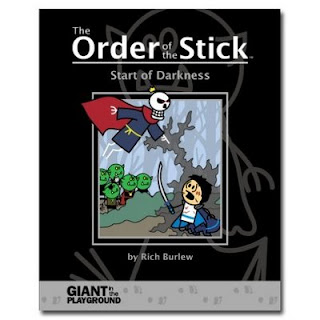
The Comics Page #18: Order of the Stick: Start of Darkness

It’s common for a webcomic to move from simple gag strips to intricate dramatic plotlines that require we suddenly care about the characters. What’s rare is for a strip to do this without completely falling apart. ORDER OF THE STICK, written and drawn (after a fashion) by Rich Burlew, has managed to achieve a careful balance between jokes about DUNGEONS AND DRAGONS rules, character banter, and genuine plot, resulting in what may be one of the best webcomics currently going. To be fair, it got into plot business reasonably early, and has never abandoned its metatextual roots, so it may not be a shift so much as a predetermined blend. Giant In The Playground has released a few trade compilations of the webcomic, but START OF DARKNESS is one of two print-only prequels delving into the surprisingly layered backstory of a stick figure fantasy comic. THE ORIGIN OF PCs deals with the origins of the actual Order, while this delves into the series’ overarching villains: Xykon the lich, Redcloak the goblin priest, and their pet, a fearsome monster lurking perpetually in the darkness. Burlew recommends reading NO CURE FOR THE PALADIN BLUES, the second compiled volume, before this one because this spoils some of the backstory, and that story begins roundabout here if you’re curious. For those already up to speed, START OF DARKNESS marks a change of tone but still shows off what the strip does well, blending sharp comedy writing with solid comics storytelling and a genuine interest in its characters.
We first meet Xykon as a young boy, one who has suddenly developed mystic powers, which he uses to re-animate his dead dog, kill and re-animate his family, and basically to set out to become the most powerful and most evil spellcaster that ever there was. Meanwhile, an entire clan of goblins is slain by the Paladins of the Sapphire Guard, and a survivor, an acolyte of the Dark One (the goblins’ default deity), inherits the Crimson Mantle of the High Priest, and with it knowledge of a great plan to wreak revenge on the “civilized” races that have plagued them since their birth. Taking his younger brother with him, he meets up with Xykon and a partnership is born. Naming himself Redcloak (because Xykon doesn’t have the patience to learn his real name), he persuades the not-yet-undead sorcerer to aid him in taking control of a mystic gate that could give them both the power to rule the world. Things do not go as planned.
The moral dimensions of this story are apparent from very early on, with the ostensibly (and, by the game rules which the strip follows to the letter, objectively) good paladins massacring an entire village of goblins. Further complication is added in the backstory, which implies that the goblins, orcs, bugbears, and hobgoblins of the world were created solely to be killed for experience points by patrons of the good gods (the Dark One having ascended to his position from among the goblin race.) Anyone who’s read a good amount of fantasy has no doubt come across this sort of inversion before- heck, play a Horde character in WORLD OF WARCRAFT and you’ll encounter it. But Burlew doesn’t simply let us off the hook by putting us firmly on Redcloak’s side, either. His quest for justice for the goblins starts to turn into one for vengeance, and Xykon’s growing corrupting influence helps to drag it down even further. Xykon himself is Just Plain Evil, without any redeeming qualities, but he’s still well-rounded; he’s got a short attention span, no head for strategy, and a determination to enjoy life and undeath through causing the suffering of others.
Through this, it’s still funny, and the interesting thing is how broad the humor is allowed to be without obstructing the serious business. The simple artwork makes it easy for us to accept a D&D-esque fantasy world with diners, action figures, and taco joints. Burlew also likes to break the fourth wall a lot, which is particularly fun if you’ve been reading OOTS for a while.
Burlew uses more or less the same page format that is employed for most of the strip, but while the online strip is in full color, this prequel is mostly in black and white (presumably to save on printing costs, but he gets some good gags out of it too.) The art, as mentioned, consists of stick figures in a fairly simplistic 2-D environment, but is surprisingly expressive and carefully rendered.
This is a good fast read, one which depends on familiarity with the strip but not too much. (The main strip’s still free anyway, so why complain?) Obviously it’s a dark chapter, with inevitable tragedy by the end of it all, but at the same time it opens up a lot of possibilities as to where the story will go in the end. For fans of the online strip it’s a must-buy, for everyone else, start reading those archives.
Grade: A-
Saturday, December 08, 2007
The Comics Page #17: Henry and Butcher #2/The Legend of Joe Moon #1


A while back I reviewed a pair of initial offerings from the Argentine small press company Pit Bros. Productions. They’ve since sent me the subsequent issues of these books, and I’m happy to say they’re both still on track. It’s actually a bit hard to write these reviews because there isn’t a major change, but of course other bloggers review series issue-by-issue all the time, so it can be done.
I’ll start with HENRY AND BUTCHER #2 because it’s the one I went to first. This issue sees Henry locked in an insane asylum, the dark, oppressive kind where they still prescribe electric shock for most conditions. Butcher appears in dreams and visions promising to help him escape, which seems to support the “you are crazy” hypothesis, but another visitor to Henry’s cell tells him that some very sinister business is going on. Once again it’s hard to say what’s just insanity and what may be genuine supernatural happenings, and the creepy surrealism is broken up by some very effective fist fights. This story is developing very, very nicely; it’ll be interesting to see how it handles over the long haul. Grade: A-
THE LEGEND OF JOE MOON #1 is once again a much more straightforward affair. I’ve never actually understood the whole “#0” practice in comics, but this does work as a first issue in that it sets up the basics- it’s the Old West, and our main character is a bounty hunter/werewolf. We see him as he collects the bounty from the job in #0, and naturally spends it on whisky and women. All well and good, but the father of the two men he killed is in town and wants payback, and so fighting ensues, with Joe also being put into the awkward position of visibly surviving stabbings and shots that would kill anyone normal. It’s conventional stuff, but the action is sharp and the writing and art solid. Grade: B+
The good news is that you can now actually buy these comics, albeit not on the rack just yet. They’re selling these as POD titles at Indyplanet.com, a site I’ve never used before but which seems on the up-and-up (reasonable shipping rates, at least.) I’ll list all the direct purchase links below. The company is also soliciting work for a horror anthology, and generally seems to be on an upward trajectory. They’re producing good stuff and if they manage to stay in it for the long haul, things may get interesting.
Henry and Butcher #1
Henry and Butcher #2
The Legend of Joe Moon #0
The Legend of Joe Moon #1
Pit Bros. Productions
Monday, September 24, 2007
The Comics Page #16: Essential Dazzler

If there’s something innately appealing about the concept behind DAZZLER, it may just be that it’s so incongruous to the comics world. For at least the past few decades, superhero books have been mostly geared towards men and boys in some state at least close to adolescence. It’s a high-action, high-octane kind of crowd- a metal crowd, if you will. And Dazzler is a disco/pop diva who wears clothing from ABBA and uses her mutant powers to create laser light shows. You have to admire Marvel for trying to expand their audience, and this whole project was apparently cooked up as a cross-media promotion between the comics publisher and Casablanca Records (Casablanca wanted Marvel to create a “Disco Queen” heroine, and the label would put some unknown singer in the role- apparently they vacillated too much for the project to go anywhere). Reading this relatively new ESSENTIALS collection, featuring the retro-fabulous heroine’s early appearances in X-MEN and AMAZING SPIDER-MAN as well as the first twenty-one issues of her own title, one senses the company pushing their new and glorious creation just a little too hard, but it’s a series of fun and vivid stories from Marvel’s flashiest period, and there’s a kind of sincerity to the whole thing too.
Dazzler’s origins are simple; Alison Blaire was born a mutant, and has long had the ability to turn sound waves into light. An aspiring rock singer, she mostly uses this to provide impromptu stage effects for her act; however, when supervillains and such roll around she can focus the light into laser beams and blinding flashes and so on. She’s not really interested in the superheroing game, but keeps getting dragged into it- first the Enchantress engages her in a singing contest to get the gig at a club which happens to have some cosmic significance, then Dr. Doom gets involved with a jewel exhibition tied into a UNICEF concert Dazzler’s performing at, then there are encounters with Nightmare, the Hulk, and even Galactus. Through it all, Alison is distracted by two major issues; her estrangement with her father, who wanted her to follow him into law, and her even greater estrangement with her mother, who left them both when Alison was very young and whom she knows very little about.
From the start one can very easily pick up that Marvel intends this character to be the Next Big Thing. Apart from the big-name guest stars (which is actually common practice when launching a new superhero title), you have a heroine who, in her first issue, sings more mesmerisingly than the Enchantress, whose powers are given no practical limit, and who comes with a ready-made catch phrase- “Go for it!”, which is ALWAYS uttered when she lets loose a giant blast of light energy in order to turn the tide in a crucial battle. Dazzler got a big push, but time was working against her. Though ostensibly a rocker, Dazzler’s look is much more disco, and by the time the series debuted in 1981 (after delays in dealing with the record company), the anti-disco backlash was already well underway, and the face of rock was in flux. Roller skates, KISS-ian facial makeup, and a disco ball necklace were so five seconds ago. Reading the stories now, the character’s wonderfulness is excessive, but the writers do their best to round her out.
You’ve got some of Marvel’s better talents on the early issues- Tom De Falco writes the first seven issues and John Romita, Jr. pencils the first three, and the switch to Danny Fingeroth and Frank Springer respectively is pretty smooth. At this point, buoyed by the success of X-MEN, Marvel had a reliable “house style”, one that was slick, hip, and emphasized the Marvel heroes as celebrities, mixing with the great and powerful (such as the Not Ready for Prime Time Players) and living lives that were slightly more glamorous but no less difficult. Dazzler fits right into this milieu, and personally I’ve always found that approach vaguely appealing- on a fundamental level I believe that superheroing should be fun, and even a reluctant heroine like Dazzler gets some satisfaction from her sideline. The Marvel Comics party needed a singer.
Apart from the general grooviness (and occasional cheesecake in issues wherein Dazzler meets up with She-Hulk and Spider-Woman), the series manages to work on a dramatic level more often than you’d think- Dazzler’s family drama heads towards a strong soap-operatic resolution, appropriately enough in the last issue of the collection (but not the last one of the series, which managed to run 42 issues.) As traditional superheroics go, Dazzler also has a couple of moody voyages across realities and into the center of a black hole. Finally, Dazzler’s love life has a few nice twists- she gets briefly involved with a few men, including the X-Men’s Angel, but she has trouble making it work with any one man, and with family troubles like hers, she really doesn’t have the time. There’s something about her travails that manages to ring true amidst all the glitz, which is nice.
Dazzler is one of those characters that I like precisely because she’s not that popular- which makes me sound like a pretentious cutting edge hipster, but it’s more an empathy with the underdog. I think she also appeals to the part of me that liked XANADU (and there’s a fanfic waiting to be written.) She’s just fun, and this is a fun collection. Dazzler’s still around, sporting a more modern and slightly blander look, but she may yet strap on the skates again. One can hope.
Grade: B+
Monday, August 06, 2007
The Comics Page #15: The Legend of Joe Moon / Henry and Butcher


It’s been some time. I have moved to Kansas City from Columbia, and have just this Friday gotten hooked back to the internet. Still settling in.
Anyway, a short time before the move, I was asked to review a couple of comics by a new small publisher, and sent comp copies on PDF. I am just now getting around to it. Anyway, they’re both promising entries- individual comic issues can be hard to review (which hasn’t stopped me from trying before), but they’re slick and solid, rooted in pulp genre traditions but not overdosing on cliché or camp. Both are mature readers titles, so be warned.
THE LEGEND OF JOE MOON #0 is written by Gonzalo Ventura with art by Manuel and Leonardo Silva; it’s a kind of horror western, about a cowboy vigilante who is also a werewolf. That should be enough for some people to make a decision, but for anyone reading who is not Chris Sims, I guess I need to go into more detail. This first- well, zeroth- issue has Joe going after a thousand dollar bounty on the Harrison brothers, two minor bandits who have just knocked over a saloon and made off with a local girl. We learn just a little about Joe in the thirteen-page story; he was apparently abused as a child, and can apparently transform at will (at the very least he’s not bound to the lunar cycle), but he loses a bit of control when the wolf takes over, and drinks to take away the pain. Some of the dialogue is stilted, and there’s some action missing which makes the end kind of jarring, but it’s atmospheric and engaging overall. The series may need to develop some more, but it’ll be worth taking a look at.
HENRY & BUTCHER #1, also written by Ventura with art by Martin Blanco (who also did letters), is a significant step up. The story centers around Henry White, a boxer with a good career and a wife and child. He takes a few bad blows in the ring and can’t fight anymore, so a local gangster hires him as an enforcer. Doing dirty work depresses Henry, and so he starts to drink more. One night he drives home, and there’s another family living there- he beats the father to a bloody mess and runs back to his local haunt, which has also disappeared. Henry’s dog, Butcher, shows up, and starts talking to him. According to Butcher, there may be a way out of this. Now, the obvious reading of this is that Henry is going insane, but the comic refuses to confirm things either way, and it just may be that something very strange is going on. We have yet to find out by issue’s end just what might explain any of this, but I was left definitely wanting to know more. The noir atmosphere of this is perfectly pitched, just vivid enough to be creepy but not going into full-on Frank Miller territory. It’s less of a pastiche than JOE MOON and more a genuinely original story, so far executed with quite a bit of care. I’ll absolutely be on the lookout for this.
None of Pit Bros.’ titles have yet been put on shelves in America, but Spanish-language versions are apparently already popping up in Argentina, where the company is actually based. (I noticed a couple of translation issues in JOE MOON, but not as many as one would think. It holds up well compared to, say, an average issue of HEAVY METAL.) I certainly hope the titles get good distribution here in the States- the art has a few bugs, as it were, but I’ve seen much worse on shelves. Keep an eye out for these titles, and check out the Pit Bros. Productions website here; some very cool stuff could come from these guys.
Grades:
The Legend of Joe Moon: B
Henry & Butcher: A-
Wednesday, June 20, 2007
The Comics Page #14: Showcase Presents The War That Time Forgot

DC’s Showcases continue to plumb genuinely odd and obscure territory, much to the delight of the comics blogosphere. There is a certain segment of fandom for whom words like “World War II soldiers fighting dinosaurs” mean more than the death of Captain America ever could. Sadly, we’re pretty much in the minority, but at least some part of comics publishing is catering to us. THE WAR THAT TIME FORGOT doesn’t quite live up to what I expected, and suffers from the fact that one big collection isn’t really an ideal format for these hugely episodic and oft-repetitive stories, but it does deliver what it promises, and with a bit of skill.
Some background may be helpful. In the 1960s, war comics were in a decline. You had Sgt. Rock, and Sgt. Fury and his Howling Commandoes, but the Comics Code prevented these and other titles from featuring the kind of lurid and gritty violence that had distinguished the EC-style war books. You could still have plenty of shootings and explosions, but basically you needed a gimmick to get noticed amongst an increasing flood of superheroes. So, for DC’s STAR SPANGLED WAR STORIES, idea man Robert Kanigher started writing stories about soldiers encountering dinosaurs (because everyone loves dinosaurs, right?) It was enough of a success to become a regular feature for at least six years (that’s where the collection cuts off, anyway) and dominated covers, but Kanigher treated almost every entry as a wholly self-contained story with no reference to past episodes. Back in those days, comics were still mostly considered cheap and disposable entertainment, so you could get away with this (though the end was already in sight.)
The plot of each story tends to follow a formula. The focus is on a very small group of soldiers- from as few as one to as many as five- in various branches of the armed forces in the War in the Pacific (apparently Europe was dinosaur-free), usually on assignments to find missing platoons or scout out enemy operations. A sudden attack by a prehistoric creature (pterodactyls and other flyers were the most common) lands them in a lost world, generally an island. They have to use what gear they have and good old Army ingenuity (or Navy ingenuity, or Air Force ingenuity, or Marine ingenuity) to get out alive, often while resolving personal conflicts.
A couple of times Kanigher broke the pattern and tried to establish ongoing characters. For three nicely insane little issues, a GI gets paired with “Joe”, a robot soldier designed to obey his commands. That, needless to say, is awesome, but either sales didn’t merit keeping with that premise or Kanigher just got bored. Later, he works in the Suicide Squad, a kind of American Foreign Legion in which GIs with checkered pasts sign on for missions they’re not likely to return from. From this we get Morgan and Mace, two G.I.s who, as the covers and narrative text constantly remind us, hate each other more than the enemy. See, Mace was an Olympic bobsled runner who froze up on a tough turn and sent the sled flying, which killed Morgan’s brother, and so Morgan gets assigned to make sure Mace never panics during a critical moment again. By making menacing remarks and pointing a .45 at him throughout. While they fight dinosaurs. (Dear GOD I hope these two exist in the canon DCU somewhere.) Kanigher was also fond of teams of acrobats-turned-soldiers, for some reason.
Here’s where I run into a dilemma. Is it really fair to judge these stories by how they read in a collection, when of course they were never intended to be collected? Read together, the stories are fairly repetitive, particularly in the time spent getting the soldiers to the lost world to start with; also, each story being complete in itself means that the potential of a group of soldiers fighting for their lives amidst prehistoric monsters is never fully exploited. I would’ve loved to see an ongoing “Swiss Family Robinson with guns and dinosaurs” approach to the material. But then again, I’m criticizing it for being something it never tried to be, based on my expectations. All I can say is that the pterodactyl dive-bombings do get tiresome after a while. And I never thought I’d write that sentence.
Overall, though, the stories work on their own terms, in the old anthology style that’s all but completely vanished from modern comics. The characters are given just enough definition and personality to last us for 15 pages, often with simple, clear, elegant arcs. At times one feels that Kanigher is just writing normal war stories and putting in dinosaurs to grab our attention, which may well have been the case. And it helps- the art, credited to Ross Andru, Mike Esposito, and others, reflects the classic, scientifically inaccurate view of dinosaurs as big, ponderous reptile monsters, with even the herbivores displaying sharp teeth and a mean attitude. We even get a giant white gorilla and a friendly baby pterodactyl, and some monsters that never show up at the natural history museum. It’s all in fun.
Most of us in this book’s target audience would gladly buy and read it regardless of quality, but for anyone who’s the least bit apprehensive, this is actually good stuff. This is one of those neat collections that brings up material you didn’t even know existed, and though 500+ pages seems like a bit much for such a narrow niche, it actually holds up well. Besides, you never know when you might want to read a story where former circus performers throw torpedoes at a giant snapping turtle monster. It comes up more often than you’d think.
Grade: B
Friday, May 11, 2007
The Comics Page #13: The All-New Atom: My Life In Miniature

If I may briefly interject something personal into my posting, today I made a very big stab at both the "professional writer" and "moving to England" parts of my ambition by sending a radio script to the BBC Writersroom. Vibes, prayers, blessings of the Muses, etc. would be welcome.
On to new business. Gail Simone's ALL-NEW ATOM is the best comic out there that you're not reading, and now it has a trade out so you can at least make up for it. I don't want to sound too haranguing, but it's easy to get frustrated when something great slips past public attention. I won't get into a rehash of the stuff I already talked about in my BLUE BEETLE review. Suffice it to say, THE ALL-NEW ATOM: MY LIFE IN MINIATURE collects the first arc of the new series, including material that previously appeared in BRAVE NEW WORLD. It's a very fun book, full of wild ideas and crazy plot twists that recall the limitless imagination of DC's Silver Age.
Dr. Ryan Choi is the newest professor of Nuclear Physics at Ivy University in Ivy Town, U.S.A., having recently arrived from Hong Kong. A friend of Ray Palmer's, Ray being the miniature hero the Atom up until his mysterious disappearance (at the end of IDENTITY CRISIS, which wild boars could not force me to read), the young doctor wonders where his mentor has got to when he starts finding cryptic messages that lead him to the location of the Atom's shrinking belt. The belt allows Ryan not only to shrink to subatomic size, but control his mass and density, so he can deliver a full-sized punch when the size of an ant and so on. At first he simply wants to continue Palmer's experiments, but he's quickly drawn into a developing war in Ivy Town, one between science and magic, order and chaos, between a group of miniature weird-talking aliens and the Lovecraftian horror M'Nagalah. It seems that Palmer's experiments in shrinking, scientifically impossible as they were, actually managed to distort the fabric of reality, making Ivy Town a nexus for the bizarre, a nexus that will be very useful if either the forces of reason or chaos manage to control it. The upshot of all this is that the Twin Peaks-ian inhabitants of Ivy Town find their cozy little hamlet beset by alien armies, B-list supervillains, and a giant naked woman. There only hope is the Atom, but he's new to all of this.
A sense of joyful craziness pervades this book. Gail Simone is best known for her long run on the more sedate and down-to-earth title BIRDS OF PREY, and here she gets to cut loose in a very Silver Age sort of way. The tone is often comic- the Waiting, the aliens on the side of "order", live on dogs and will have had a sideways relationship to time which been had the effect of will altering their speech. And yet, I wouldn't class this as a "funny" book like the Giffen/DeMatteis JUSTICE LEAGUE- it comes close, but the emphasis is more on action and surrealism. But it is a book that is funny, if the distinction isn't too fine, and the emphasis on humor and imagination is welcome.
It's very hard to tell if something in a DC or Marvel comic that seems like a new idea actually is; some of the characters have fairly solid pedigrees, such as M'Nagalah, created by Len Wein for SWAMP THING before Alan Moore rebooted the series (not to mention the triumphant return of Liza Warner, Lady Cop), but I'm fairly sure the Waiting always having been new, and there's also the serial killer Dwarfstar, who is given a size-changing belt of his own by a mysterious benefactor with instructions to kill either Ryan or everyone close to him or both. The book's blend of old and new is particularly well handled in that there isn't much of a difference between what's "original" and what isn't- the old stuff isn't fanservice, the new stuff isn't pushed more heavily, it's all there to dazzle the reader with neat ideas and sights.
On top of which, the characters work. Ryan Choi is neither a cipher nor a token minority, but a young man with the energy of an undergrad and the curiosity of a mad scientist, not quite as insane as some of his associates but still all too willing to find out exactly what his new toy is capable of, as well as invent some others. (One nice running gag is that, unlike the stereotypical science geek, Choi has a lot of women making the eye at him, students and professors both.) The arrival of his father in the last issue provides some great family tension, and the supporting cast of fellow academics is charming.
The one area where this book falls short of greatness is the art. The first few issues (and the BRAVE NEW WORLD piece) were handled by John Byrne, who has done some very fine work in his career, but here his pencilling seems sloppy and even excessive- there are a lot of unnecessary lines that give images a scratchy and not wholly pleasant look. Eddy Barrows pencils the rest, and his art works out better, but the overall look is inconsistent, and initial dislike of Byrne's art, coupled with dislike of Barrows' art by those fans who had liked Byrne's, probably contributed to the title's struggling sales. I've always followed writers more than artists, so this meant nothing to me, but obviously someone cares.
With a slick cover, a decent price, and a quote from Entertainment Weekly proclaiming THE ALL-NEW ATOM "the best new ongoing comic of 2006", this trade is definitely packaged to reach out to everyone who hasn't been following this book. I hope it works, because I will be very upset if yet another good title goes down while the sales charts continue to be dominated by the same books every month. MY LIFE IN MINIATURE is witty, snazzy, sharp, and sexy, a trade that reflects so much of what draws me to the superhero comic. It's a world where everything's more bizarre, more fantastic, more dangerous and more fun than reality. You will believe a man can shrink.
Grade: A-
Saturday, April 21, 2007
The Comics Page #12: Blue Beetle: Shellshocked

The new BLUE BEETLE series is the kind of comic that's fun and clever and offbeat, and thus not being read by anyone. Though the tastes of the public are forever inscrutable, comics readers seem at this point to be deliberately steering away from anything that might be described as "fun". (It doesn't help that sales charts are based on retailer orders, not actual sales, so the most hyped titles are always on top.) In this case, I share some of the blame; though I was a huge fan of Ted Kord as the Blue Beetle, without that character the title didn't mean much of anything. If you pick up a given issue of THE FLASH, whoever's in the role of the Flash, you can bet it will be a story that involves him running very fast; grab a random GREEN LANTERN and you can bet that rings and glowing green energy will be involved. The Blue Beetle has no such consistent hook, and so I saw no reason to pick up the series based on the name and what little information there was, and to be sure, some resentment over it not being Ted Kord played a role. Eventually, though, I got word that this was a weird and wacky kind of superhero book, the kind I would like, and so I got started on it with issue #11. I enjoyed it and picked up the first trade to catch up. BLUE BEETLE: SHELLSHOCKED collects the first 6 issues of the series, telling the bizarre, confusing, and compelling story of young Jaime Reyes, a normal kid from El Paso who one day finds an ancient artifact which embeds itself in his spine.
The artifact is the Scarab, the one common thread linking all the Beetles; it gave Dan Garret, the original Beetle, his powers, and though Ted Kord never had any superhuman abilities (he was a gadget hero), he kept the blue statue thingy around anyway, and when he died, the Scarab went hunting for a new master. In this trade, the exact nature of the Scarab is still unclear, but it creates for Jaime a suit of strange blue armor that itself can manifest all sorts of weapons and doo-dads, in a way that's similar to Green Lantern's ring. But since Jaime is new to the game and since the Scarab speaks to him in some kind of crazy moon language, it's an awkward partnership. In the meantime, Jaime has to deal with his strained relationships with his family and friends, said straining being the fact that, while fighting a giant evil satellite in the INFINITE CRISIS event, he was somehow away from home for an entire year without realizing.
You'll note that my plot summary is a bit patchier than usual. It's been a while since I read through the trade, which doesn't help, but the book's plotting is pretty loopy, often jumping back and forth to before and after Jaime's disappearance. The distinction between the two time periods isn't always clear, mainly because the revelation that it's One Year Later was meant as a surprise. The opening arc, such as it is, has the Beetle caught between the interests of a superpowered street gang and a woman collecting mystic metahumans off the street, and things get messy very quickly. But it's an entertaining kind of messy, I'll give them that.
Giffen and Rogers have a strong grip on the characters from fairly early on; Jaime's family is written believably, and his scenes with friends Paco and Brenda are full of snappy patter (Rogers is credited as one of the screenwriters for CATWOMAN, but we won't hold that against him.) It really feels like the writers had a solid grip on the book's supporting cast before they started writing, and the series finds its proper vibe pretty early on. This is aided by a very modern art approach, with Cully Hamner doing art duties for three of the six issues, the rest filled out by Cynthia Martin, Duncan Rouleau, Phil Moy, Kevin West, and Jack Purcell. It's a jarring style, reminiscent of manga but with a harder southwest American edge, and it won't please those comic fans who insist on photorealism. But then, I never understood those people. The art contributes to the book's unusual atmosphere, and is often just plain good design (I've got to say I like the new costume.)
It's a nice little collection, and an excellent starting point for a series that needs more exposure. The Blue Beetle is apparently going to play a major role in DC's upcoming COUNTDOWN event, and though I generally don't like big crossover events, anything that helps boost the sales of good comics is something I can live with. The new BLUE BEETLE series is, in a word, funky; though it doesn't really reach outside the boundaries of the superhero genre, it presents the old tropes in a way that makes them seem fresh and unusual.
I patiently await the inevitable return of Ted Kord from the comic book afterlife, where people walk in and out like it's a cocktail party that lasts for eternity. (At least that's how I like to envision it.) But the new kid? He can stay.
Grade: B+
Thursday, April 05, 2007
The Comics Page #11: Showcase Presents Aquaman

Aquaman may best be known as a punchline for jokes by hipster comedians and websites, a poor reputation stemming from his days on the old SUPERFRIENDS cartoon wherein writers had a hard time coming up with plots that required somebody to command the loyalty of sea creatures. (This was a problem in the JUSTICE LEAGUE OF AMERICA comics for many a year as well.) But DC's been taking steps to try and make the character cool again, and in the meantime, have bestowed on us a Showcase volume collecting his early Silver Age adventures, including the first five issues of his own Sixties title. It's a fun collection, with neat visuals and the kind of imagination that DC was known for in that era, although it suffers from that period's stodginess as well.
Aquaman is Arthur Curry, the son of a lighthouse keeper and a woman exiled from the underwater city of Atlantis- he inherited his mother's ability to breathe water and withstand the pressures of the deep, as well as command the creatures of the sea to do his bidding. Unfortunately, this also means that he can't spend more than an hour out of the water, or he'll die. So he sticks to the seas, and uses his army of underwater allies to fight pirates and smugglers and aliens and the like. Eventually he's joined by Aqualad, yet another Atlantean expatriate. (Apparently Aquaman's the only "King of the Seas"- that is, the others can't control octopi and the like- but I'm not clear on why that's so, and I don't think it's explained in this volume.)
At this point most of Aquaman's adventures appeared, appropriately enough, in ADVENTURE COMICS, also home to Superboy and eventually the Legion of Super Heroes. He also made a few appearances in DETECTIVE COMICS, and had guest shots in JIMMY OLSEN and LOIS LANE to boot. What this means, beyond the geekery, is that most of the stories in this collection are fairly short "back-up" adventures rarely taking more than seven pages. The perils are rarely that perilous (though the bad guys do cotton to Aquaman and Aqualad's shared weakness and strand them on land frequently), and frequently the King of the Seas will be engaged in relatively low-action escapades like running an undersea hospital for sick fishes and helping Lois Lane through her difficult time spent as a mermaid. At times the whimsical fantasy approach is actually fairly endearing; there's a consistent sense of fun to these stories, as when the residents of a flooded town decide to convert the whole thing to a modern Venice and Aquaman has to become sheriff of its abused waterways. There are a few "book-length" stories in here- Aquaman's appearances in SHOWCASE followed by his own magazine- and these generally revolve around more serious threats like prehistoric fish monsters, invaders from other worlds and dimensions, evil magicians and the like. (There's also Quisp, a tiny sea sprite with no apparent relation to the cereal mascot, who has an array of vaguely defined magic powers.)
It's always been the "talks to fish" angle that has given Aquaman so much grief from the aforementioned Gen-X snarkers, and I can see why it's dumb summed up like that. In practice, though, it's actually cool. Because DC Comics had yet to introduce personality conflicts into their superhero stories, much of their Silver Age storytelling had an almost puzzle-like quality as the hero or heroes worked to find the solution to the dilemma. So, for Aquaman, part of the fun was seeing the varied uses to which he'd put his undersea subjects. Whales line up to form a landing strip for a crashing plane, octopi (including Topo, another of Aquaman's faithful friends) divert torpedoes and form raiding parties, an anglerfish serves as a nightlight, etc. At some- well, okay, MANY- points the use of sealife defies credibility (I don't think sawfish can actually saw through rock, and the less said about the extensive use of swordfish the better), but then one doesn't read these stories for scientific rigor. The writers occasionally indulge in the classic Silver Age "hero pulls an elaborate ruse to catch criminals he probably could have fought directly anyway" trick, but fortunately not that often.
There is no writing credit for the majority of these stories- comics had yet to get in the habit of crediting writers and artists. Most of the art is by Nick Cardy and Ramona Fradon, and the visuals are consistently clear and polished. Part of the fun of a character like Aquaman is that his stories, naturally, tend to take place underwater, which is to us a weird and fantastic environment even without the fire-trolls or sea serpents. With all that stuff added, Aquaman's adventures become uniquely exotic among superhero romps.
I was personally hoping to get a bit farther into Aquaman's more surreal sixties adventures- just about everything DC put out in the early Silver Age was marked by a certain restraint in levels of weirdness and levels of drama; they were still testing the limits of the renascent superhero genre, not to mention the limits of the Comics Code. But there's still fun and adventure to be had, and the lighter, less consequential stories are usually entertaining enough to hold one's interest for seven pages. The AQUAMAN Showcase doesn't contain any real classics of the era, but it proves the character is a lot more interesting than he's given credit for. I look forward to subsequent volumes.
Grade: B
Friday, March 30, 2007
The Comics Page #10: Nextwave: Agents of H.A.T.E.: This is What They Want

Warren Ellis and Stuart Immonen's NEXTWAVE was one of many cult favorite comic books last year totally buried by events and event tie-ins. It ran for 12 issues, and whether or not it was a limited series from the start was never quite clear, but after it became clear the sales were going nowhere, Ellis publicly declared that we wouldn't get to have any more after a dozen. I discovered this book one issue before the end, and I regret not having done my part to save it (word of mouth about comics doesn't spread fast enough, does it?). Sometimes I wonder if we deserve titles like this. In any case, NEXTWAVE: AGENTS OF H.A.T.E.: THIS IS WHAT THEY WANT collects the first half of the series, presumably with another trade to follow.
Lying somewhere between the Giffen/DeMatteis "comedy" JUSTICE LEAGUE and TEAM AMERICA: WORLD POLICE, NEXTWAVE: AGENTS OF H.A.T.E. is a high-octane action satire in which B-list superheroes, forgoing costumes and code names, beat the crap out of monsters and insult each other against a backdrop of psychedelic visual funkiness. It's intensely funny and, at the same time, quite exciting, while being cool to look at to boot.
H.A.T.E. stands for Highest Anti Terrorism Effort, a top secret agency run by the one-eyed and psychotic Dirk Anger (originally intended to be Nick Fury and S.H.I.E.L.D., but Marvel understandably put their foot down.) Nextwave was intended to be the agency's elite anti-terrorism superteam, but its leader, Monica Rambeau (formerly known as Captain Marvel, and former head of the Avengers, as she will remind you frequently) and her team discovered that H.A.T.E. was funded by the Beyond Corporation, the public, "reformed" face of S.I.L.E.N.T., a terrorist group, intending to use H.A.T.E. to test new and improved WMDs on the American public. So they stole an airship and rebelled. All this happened before the first issue, and now Nextwave are fleeing their bosses and fighting any monsters who happen across their path.
The other members of Nextwave are Tabby Smith, who possesses the mutant powers of pyrotechnics and stealing all your stuff, Aaron, an advanced robot formerly known as "Machine Man", Elsa Bloodstone, a near-immortal monster hunter with a British accent, and the Captain, a vaguely cosmic powered superhuman whose original codename was so obscene Captain America smacked him when he first heard it. They've also got their own theme song, printed in the back of the TPB and available on the Marvel website.
Describing the plot of the series is sort of pointless, suffice it to say that in this trade, the Nextwave gang battles Fin Fang Foom (a giant Chinese dragon in little purple shorts), a cyborg cop, broccoli men, drop bears, pteromen, homicide crabs, and spiky samurai warriors. All the while, they are hunted by H.A.T.E. and the perpetually unstable Dirk Anger, who manifests a number of unusual neuroses. We also get flashbacks to the backstories of some of the Nextwave team, and banter and insults abound.
The tone of the book is hard to describe. The narration is both deadpan and dripping with irony, displaying a very British kind of sarcasm (which makes a certain amount of sense given Ellis is from that general region.) And yet, at the same time, the book is incredibly straightforward in what it offers: superpowered people engaged in senseless violence, with none of the attempts at self-justification you see in more serious books. The trade also prints Ellis' original pitch, which is distinctly simple- every story arc takes two issues, telling an action movie in 44 pages, focusing on the Nextwave team battling some kind of weird monster thingy. There is no character development, no relevance, no moral truth. It is, as as Ellis says, "most especially about THINGS BLOWING UP and PEOPLE GETTING KICKED."
And it's strangely endearing. With crisp, colorful art and a strong sense of design, artist Stuart Immonen helps keep the tone light and bouncy. Heck, it's less gory than the average mainstream title, despite being plainly put in adult action-movie territory. (Listing all the ways in which this is different from modern mainstream comics would get me going on a very unpleasant rant, so let's just stop there.) It's also extremely funny, with a lot of dark-yet-cartoonish humor presented with excellent timing, the highlight being a brilliant throwaway joke about what happened to one of Aaron's mechanical brothers. One develops an affection for these characters, underdogs with deep grudges and personal problems who have banded together to fight the power with guns and explosions. Okay, maybe it's not completely without truth, but then what is?
NEXTWAVE confidently stomped onto comics stands, said its piece, then stomped off without being too upset that not many people were listening, but I suspect that we haven't heard the last of it. Specials have been rumored. Whether or not such things happen, NEXTWAVE is something unique in the genre. Not an idealistic heroic narrative, not a cynical deconstruction, not an existential drama, not really a parody, not in the least bit serious. NEXTWAVE is- well, to quote the last caption of issue #6, "Nextwave is love." I'll let that be the last word.
Grade: A-
Subscribe to:
Comments (Atom)