Friday, November 02, 2007

The Tabletop: Battlestar Galactica- The Roleplaying Game


Roleplaying games. I play them, when I have a group, and I've reviewed them for RPG.net before. They're a unique hobby and medium, and the books are always a fun browse. So, I'm going to start posting game reviews up here, and fellow geeks can enjoy, and everyone else- well you can read them too, or just read the other articles. I said I'd been planning to expand the site's remit a bit. So, to start, the official licensed BATTLESTAR GALACTICA RPG. (The following review, minus this intro paragraph, appears on RPG.net here.)

Back before the new BATTLESTAR GALACTICA actually made its way to our screens, word got out that showrunner Ronald D. Moore, in the series bible no less, had proclaimed that “Our goal is nothing less than the reinvention of science fiction television.” How could we possibly have expected him to deliver on that? As much as the skepticism of sci-fi fans before the miniseries aired is derided now, with the show not just a cult phenom but a mainstream critical darling, comments like this (along with rumors of sexy female Cylons and the like) couldn’t help but make me skeptical, reacting the same way I would to the young guy who walks into a boxing club for the first time and proclaims he’s ready to take down the champ. (Granted, for this metaphor to work you have to assume I’ve been in a boxing club and not just seen them in movies.) Even when the show was on it took me a while to warm to it; it was dark and intense and grueling, not really my style. But around when I caught the second season finale (the one where they demolish the status quo about halfway in) I realized there was quite a lot going on, and quickly became wrapped up in the show’s unique blend of gritty drama, moral ambiguity, and pure mind-frackery. I remember hearing about the RPG a long while back, but was a bit surprised when I happened to see it on the shelf at the local big bookstore. I’m not entirely sure why I wrote all that, but consider it context.

The BATTLESTAR GALACTICA roleplaying game comes to us from Margaret Weis Productions, Ltd., the group behind the popular and award-winning SERENITY RPG from 2005. This isn’t quite as good a pedigree as it sounds, as the SERENITY game, while not bad, lacked a few things like explicit rules for starship combat (and, in early printings, a character sheet), and felt rushed to come out roughly around the same time as the movie. Seeing that this game uses the same system as SERENITY, which didn’t exactly blow me away the first time I saw it, made me seriously question the policy of every game company having one house system that they apply to everything by default. Still, I picked the book up, and I think it’s a success. It’s a solid system matched to setting material that gets the vibe of the series down right and offers many suggestions for expanding the game’s possibilities beyond standing behind Commander Adama as he does everything cool. There are a couple of areas where it doesn’t work so well and a few nitpicks, and it’s a bit pricier than I expected, but none of that really does much harm.

So, the premise. The Cylons, sentient robots who a while back rebelled against their human masters and left to find their own home, have come back with the intention of exterminating us all instead- and they generally do a good job of it, driving humanity from its home on the Twelve Colonies and sending a group of less than half a million survivors off in search of the fabled Thirteenth Colony, known as Earth. The Cylons, who have now evolved to the point where there are versions that are almost indistinguishable from humans and “resurrect” on death to pass their experiences along a nearly-infinite line of clones, are in hot pursuit of the capital ship Galactica and the fleet of civilian transports it both leads and defends. Resources are scarce, tensions are high, and nobody’s really entirely sure that Earth actually exists, let alone knows where it is. So, it’s up to the PCs to defend humanity, or screw the whole thing up, and also to deal with personal drama and the moral question of whether humanity is worthy of survival and so on. Full character write-ups are given for the main characters of the show (well, most of them- it’s a big ensemble), and the thing seems to be “set” at about the start of the series. (Practically, a licensed RPG inevitably lags behind any ongoing source material due to lead time and the approvals process and so on- I’m not exactly sure how long the lag for this game was, though they obviously don’t incorporate a lot of later series developments.)

Characters are defined by six attributes- Agility, Strength, Vitality, Alertness, Intelligence, and Willpower- a decent-sized selection of skills, some derived attributes, and finally general Traits that can have roleplay or mechanical effects. What really defines the Cortex system is that these are all defined by die type- the overall scale reaches from d2 to d12 and some combinations thereof. Human attributes range from d4 to d12+4 (for some characters) and skills start at d2 and go as far as d6, but specialties can go as high as d12+d4. You get points to spend in each category based on whether your character starts as a Recruit, Veteran, or Seasoned Veteran, each level respectively getting more points than the last. Interestingly enough, character generation also incorporates, as a roleplaying mechanic, the idea of a character’s “home colony”- since there are 12, and they all relate to star signs (Caprican, Sagittarian, etc.), you can use the stereotypes for each world to influence your character concept. It’s kinda neat and a nice kick for ideas- after reading that Aquarians had a reputation as storytellers, I latched on to the idea of a grizzled writer of pulpy adventure novels, trying to find a useful place in the middle of a genuine war. Point-buy is relatively easy since every attribute costs its maximum die value in points (6 points for d6 and so on), with skills being similar but kind of different due to specialties. Equipment is basically a matter of GM fiat, since the Colonial economy has more or less devolved to whatever’s on hand. Experience comes in the form of Advancement Points, which can be turned into Attribute Points, Trait Points, and Skill Points (albeit expensively.)

Traits where were I was most apprehensive about how well the game would emulate the source material; I remembered them from SERENITY as not always covering the various psychological quirks I wanted to give my characters, with the expectation that these things would be roleplayed out. Which is all well and good for that setting, but on BATTLESTAR GALACTICA characters don’t just have drama; their drama impacts on their ability to do their job, and it’s not just the obviously crazy people (see Baltar, Gaius) who have issues. Traits are divvied up into Assets and Complications, each rated with a die type, sometimes with that die coming into play on actual tasks, while other times it just represents the cost. Again comparing against SERENITY, there seemed to be just a few more psychological/roleplaying Complications, and most Traits have a variable cost representing degrees to which they work for or against you. This works pretty well, and I haven’t run into any problems yet. Well, one- there’s no “Dark, Potentially Life Destroying Secret”-type Complication, though I’m sure most BSG characters have at least one (and this ties into something I’ll get into later.) I’d still have preferred something like the Madness Meters in UNKNOWN ARMIES or even PENDRAGON’s Virtue/Flaw system, but this’ll do. Of course, there are also the more tangible Assets and Complications, like Two-Hand Fighting and Dull Senses and the like.

Anyway, so far, so good. The basic system is a beat-the-target-number affair- you roll your Attribute plus Skill/Specialty, plus any modifiers, and try to beat a target number. There are 8 categories of action to roll for, ranging from “Easy” (difficulty 3) to “Impossible” (difficulty 31), and each also has a number which, if rolled, represents an Extraordinary Success at said task. Most rolls involve a Skill, but “Attribute” rolls can involve two Attributes or one rolled twice. There are three of these that are actually common enough to have names- Endurance, Initiative, and Resistance. One wrinkle I like is that with opposed rolls, characters can actually roll different Attribute/Skill combos for the same task if they go about it a different way- the example is Starbuck, Tigh, and Boomer playing cards, and one trying to bluff, one trying to be cautious, and one looking for tells. There are Complex Tasks, which have much higher difficulties that you reach over a number of rounds of rolling. Plot Points are supposed to play a big role in overall play- every character starts with six, and they can be spent in play to add dice to an action, add to the total after an action (more expensively, of course), reduce damage, and manipulate the plot in small ways. As far as dice go, one PP gets you a d2, two a d4, and so on up- and each die has a “minimum bonus” equivalent to the points you spent, so if you spend 6 points for a d12 and roll a 1, you still get a 6 added to your total. That’s a good guard against one of the common frustrations of “add a die” mechanics. Judging from the play examples and online chatter, you’re supposed to spend these points frequently, and earn them equally frequently as well- you get them for various plot and roleplaying accomplishments, coming up with cool ideas, etc., as well as playing out your character’s complications.

Combat works mostly in terms of opposed rolls, as you’d expect, and there are a number of modifiers which cover most major situations. Damage is based both on the weapon and by how much you exceed the difficulty, and each character has an equal amount of both Stun and Wound points, both based on Willpower and Vitality plus any relevant Traits. When you run out of Wound Points you’re dying and have to make Endurance rolls to stay alive until treated. Looking at the damage most weapons do and the average number of Life Points characters have, this comes across as a reasonably lethal system- combat is dangerous enough to reflect the rough, gritty nature of the show, and while a lucky shot is unlikely to kill a character outright (especially with Plot Points in play), it’s going to be enough to make him or her think hard about getting out of the situation as soon as possible. It’s hard to say how well this works without having had the opportunity to actually playtest it, but on paper it looks good. We finally get a Starship Combat system in this book, and it works on much the same principles; Ranges are different (given rather counterintuitive names like “Skirmish”, “Capital”, “Short DRADIS”, and “Long DRADIS”), and there are rules for vehicle pursuit and operating a vehicle you’re not quite strong or quick enough for and so on, and it covers some common show situations like escaping from a missile that’s locked on to you (though not shooting it down, which happens a couple times in the miniseries.) One qualm I have is that the damage system for vehicle combat doesn’t really reflect damage to specific ship systems, like FTL drives and landing gear and so on, when in most sci-fi movies and shows, BSG included, that’s most of what happens- a gimbal fails, sensors are acting wacky, so you have to do X to fix the ship and can’t use that system until you do. The rules imply that the GM can roleplay or rule on specific effects, but it’s a bit unsatisfactory. On the other hand, there’s a very good sidebar about how to run the big battle scenes the show is known for- zoom in on the stuff your PCs are involved in, zoom out to show the players some of the major effects of the combat, etc. We get stats for most of the major ships in both the Colonial and Cylon fleets, including, of course, the Galactica itself (there are also some nice interior maps.)

The Game Mastering section combines general advice on running an RPG (involve the players, share the spotlight, that sort of thing) with specific talk on the themes pervading BSG, as well as campaign building and adventure building and all that fun stuff. There’s nothing here that’s terribly new but it’s all solid, and the writers definitely “get” most of the conflicts and ideas inherent in the series. This section also talks about the Cylons a bit, and what we know and don’t know about them. The final chapter contains a number of writeups for supporting characters, both specific and generic, and including the Cylons (numbers 6 and 8 are statted out, albeit without Traits.)

This brings me to the game’s one major omission. When I was thinking of characters I would like to make for this game, the concept of a Cylon infiltrator or sleeper agent came up. I expect this is not atypical thinking. Now, the game doesn’t say you can play a Cylon. It doesn’t say you can’t. It doesn’t say “well, maybe, that’s up to the GM”, or “look for this to be addressed in the BATTLESTAR GALACTICA GAMEMASTER’S GUIDE”, or anything. I find one mention of it that seems to imply it as a possibility, but they never say so explicitly. The idea seems either to have not occurred to the writers altogether, or (more likely) been dealt with somewhere that got cut for space reasons. To be sure, it’s something you can easily kitbash- the basic information on humanoid Cylons is on page 211, and there’s nothing really game-breaking about them except their tendency to come back from the dead with extreme regularity. Now, the timeframe the book covers may have something to do with this. In the early episodes the Cylons were mostly distant and mysterious, and it’s only relatively recently that we’ve actually seen more of their culture and interactions, but even then you have one major character who’s unwittingly a skinjob, and it should have been obvious to everyone involved that every single player group would have at least one guy asking to be Number Six (though come to think of it, the kind of guys who would ask to play that character are usually the people who should not be allowed to under any circumstances.) I really hope they get around to addressing this in supplemental material, because it’s a very curious thing not to mention.

This is an attractive looking book- I’m not sure about $45 attractive, but then again it’s been a while since I’ve bought a new corebook and maybe that’s just what they cost nowadays. As a nice touch, all the pages have these little “missing corner” borders to reflect the look of paper in the BSG universe, and the whole thing has a vague military notebook feel. The text also tries to emulate a kind of genre-appropriate tough-as-nails tone at times as well, but it’s sort of inconsistent about it and the colorful intros don’t mesh well with the straightforward gamespeak. There’s the rare goofy collision between the two, as with “When you need to know if you succeed for (sic) fail, the Cortex System stands tall.” The writing’s not bad but I think there are certain narrative voices that don’t go well with rules for roleplaying games. On the upside, the appendix supplies us with all sorts of military lingo, as well as a full wireless “alphabet” (Alpha Bravo Foxtrot, etc., and this is actually the first time I came across an explanation as to why this practice is used.) There’s a decent-looking character sheet as well, and a good-sized index.

The word that best describes the BATTLESTAR GALACTICA RPG is “solid”. It looks like it’ll work just fine for a campaign based on the show, or even the classic series if you’re so inclined. There’s a degree to which I wish it were as daring and dynamic and wild as the show itself, or at least had more of that spark. But I can’t let such a lofty standard demean the achievements of what is, as far as I can tell, a good RPG that most fans will have a positively grand time with. You could do a lot fracking worse.

Grade: B

Wednesday, October 31, 2007

No More Room in Hell: Land of the Dead


For a long time the DEAD movies were a trilogy, DAY’s financial failure precluding further entries. But as decades passed, zombies came back in vogue, and George Romero actually managed to get Universal involved, on the condition that he’d deliver an R-rated film with the understanding that the unrated version would be on DVD. (This level of studio involvement was a first for the filmmaker, but there were several independent investors involved as well, and he continued to shoot in his native Pittsburgh, as well as Canada.) After a twenty-year absence, we returned to a world ravaged by the undead, and it had changed dramatically. LAND OF THE DEAD takes the series in a truly original direction, moving more into the realm of science fiction than horror, while still serving up plenty of shocks and disembowelments.

Years after the onset of the zombie apocalypse, civilization has unexpectedly started to rebuild itself. The island delta portion of Pittsburgh has become a fortress, guarded by electric fences, armed guards, and a massive armored ATV called Dead Reckoning. In the city, a select rich elite live in Fiddler’s Green, a tower that serves as combination apartment complex and shopping mall, while everyone else toils on the mean streets below. Raiding parties are sent into the zombie-infested outskirts to find supplies, and we open with one such expedition, led by Riley (Simon Baker), the inventor of Dead Reckoning and a man out to retire and head somewhere where he won’t be molested by other people, living or dead. Also along on the ride is Cholo (John Leguizamo), who in addition to gathering supplies does the dirty work for Kaufman (Dennis Hopper), the man who established Fiddler’s Green and basically rules over it like his own private empire. Cholo buries the bodies (literally), picks up the booze, and has earned enough working for the man to buy a place at Fiddler’s Green. In theory. On their return to civilization, Cholo is told that the building has a very long waiting list, and he’s just not elite material. Forced to leave in a hurry by some pushy security guards, Cholo takes Dead Reckoning’s crew and hijacks the vehicle, pointing its rocket launchers at the tower and demanding that Kaufman hand over five million dollars by midnight. Kaufman recruits Riley, his slow, disfigured, but sharp-shooting buddy Charlie (Robert Joy), and a soldier-turned-hooker (or maybe the other way around) named Slack (Asia Argento) who ended up getting the three of them thrown in jail through circumstances too complicated to explain here, to go and take out the terrorist threat. In the meantime, one of the zombies encountered on the raid, a former gas station attendant named in the credits as “Big Daddy” (Eugene Clark), has developed a spark of intelligence, and after seeing several of his fellow dead gunned down by stinking living scum, decides to lead his brothers back to the city, using his advanced intelligence to get them past the humans’ defenses. This, needless to say, is not good.

Between terrorist references and a society with an obvious caste structure, this is the most overtly political of Romero’s zombie films, something critics focused on heavily for good or ill. The allegory is similar to that in DAWN, that of a society that uses luxury to create the illusion of safety, but adds the element of the downtrodden underclass on which the empire is built. Fiddler’s Green brazenly advertises itself, but is very selective about who actually gets to live there, and the people who actually work to keep the city safe aren’t on the list. It’s not what one would call subtle, but it’s well constructed, and never too didactic- the elite of Fiddler’s Green aren’t really evil, just ignorant, nor are the lower classes entirely saintly. Kaufman, ultimately, is the real baddie, and Dennis Hopper is very enjoyable in the part- it’s not one of his more challenging roles, but he adds a nice comic touch to what could have been a bog-standard sneering baddie. Most of all, I think the allegorical aspects work because they’re well-blended into the world Romero creates, with attention lavished on life in the ghettos outside and the details of the city’s defenses, and Dead Reckoning itself, which I suppose is an allegory for something but is also just a badass armored death machine. It’s the emphasis on world-building that really makes the film stick out for me; the level of imagination and care on display in bringing Fiddler’s Green and surroundings to life is almost unheard of for the horror genre, and more readily brings to mind the dystopias of science fiction. The action takes place somewhere that’s tantalizingly real, and it’s an enveloping experience as a result. (Looking back over the series as a whole, there’s a common emphasis on verisimilitude that makes these films so consistently effective.)

At times the movie plays like an action picture- the “main” story, such as it is, resembles the premise for an 80s shoot-’em-up, even if it goes in a radically different direction. But there are quite a few good jolts in here as well, with understandably the best zombie makeup in the series to date and a bit of CGI enhancement (though the digital bloodspray is always just a tad too clean). Romero also indulges in a bit of humor and general quirkiness, not letting the tone get too grim. That the actors, particularly Baker, are all fairly charismatic helps. As mentioned before, the film was cut to an R for theaters, but having seen the film there and the unrated version on DVD I can honestly say there’s not a lot of difference (studio films can get away with a lot more than indie productions anyway.) It’s sort of a moot point now that the unrated version is out there, and I do recommend seeing that version just on principle, but I figured it was worth noting.

LAND OF THE DEAD was released in the summer of 2005 and quickly buried under much bigger pictures, but ultimately earned enough worldwide to justify a fifth entry, DIARY OF THE DEAD, which has started playing festivals and is set to get a proper release any day now. This next installment will apparently go back in the timeline a bit to take place parallel with the events of the early films, to look at the zombie uprising from a different perspective. It’s uncertain whether Romero will ever fully wrap up the series like he planned to, but so far I’ve enjoyed the ride. Looking back, these are films about civilization falling, and people trying to find safe harbor amidst the wreckage. It’s a series that’s continually pushed at and redefined the boundaries of the horror genre, and LAND OF THE DEAD continues in this tradition. It’s a true original, which manages to feel both very fresh and a little familiar at the same time. I can’t wait to see where Romero goes next.

Written and Directed by George A. Romero

Grade: A-

Happy Halloween, everyone, and stay scared.

Tuesday, October 30, 2007

No More Room in Hell: Day of the Dead

The third and initially final installment of the DEAD saga was and is an unusual change of pace. A grim, talky, but weirdly energetic and almost upbeat affair, the film turned off audiences and critics in its initial run only to become something of a cult item. Though possibly the weakest of the series, with more obvious flaws than the other entries, DAY OF THE DEAD has a strong story and atmosphere, reflecting writer/director Romero’s growing interest in building up a world around his zombies instead of focusing on the flesheating shenanigans.

The walking dead outnumber the living by 400,000 to 1. In an underground government facility located beneath the Florida Everglades, a slowly-dwindling group of scientists and soldiers work together to combat the zombie menace. Well, they do in theory; the military force, led by Captain Rhodes (Joe Pilato) and consisting of the most macho, sexist, racist, and generally crude dregs of the army, is losing patience with scientists who still have no solution. While the chief surgeon Dr. Logan (Richard Liberty), known as “Frankenstein” by just about everyone else, has the army round up zombies for his experiments in trying to control the undead and tame their aggression, it falls to Sarah (Lori Cardille), a chemist, to try and keep the entire operation from falling apart. Her soldier boyfriend (AntonĂ© DiLeo) is headed towards a nervous breakdown as a result of working endless shifts, and the most sensible people in the operation seem to be McDermott, an alcoholic radio operator (Jarlath Conroy), and John, a helicopter pilot (Terry Alexander), both of whom live in a trailer outside the complex’s safe zone and don’t believe that anything good is going to come of the project. Logan has been showing some progress with an unusually intelligent zombie named “Bub” (Howard Sherman), but there’s a question of just how stable the Doctor is, and how he intends to “reward” his subjects.

The film Romero planned to make and the one he made ended up being very different. The original script was a grand epic taking place on a tropical island, where a mad general had raised an army of trained zombies. However, the project was deemed too expensive- though both NIGHT and DAWN had been big hits, financiers would only put up the money if Romero could promise an R rating, which he ultimately couldn’t. So he settled for an unrated picture and a lower budget, crafting this smaller-scale apocalypse that could mostly be filmed in an underground cave complex. (The actors, who arrived at the set pre-dawn and left after dark, suffered Vitamin E deficiencies as a result of not seeing the sun for long stretches.) This is a smaller film than DAWN, and not nearly as action-oriented- there is, to be blunt, a lot of talk, and it’s actually a long while before we get to the first proper zombie attack (though the film does have a brilliant opening wherein the team takes a helicopter to scout out a city that is inhabited entirely by the walking dead.)

As a result, the film does seem aimless at times, and Romero’s dialogue and direction of the actors is not what you’d call realistic or understated. The soldiers are, as mentioned, near troglodytic in their machismo, and so slovenly and shiftless it’s hard to believe they passed basic training (though, to be fair, they’ve been living underground for several years and the end of civilization as we know it is bound to bring with it a certain lack of discipline.) McDermott, who is Irish (and drinks quite a bit) and John, who is Jamaican, both have very strong and likely faked accents, and in particular John, with his wise sayings and carefree attitude, comes dangerously close to the “Magic Negro” stereotype, though I’d argue that he gets enough depth in the end to avoid that. Pilato, playing Rhodes, gives what I’m just going to go ahead and call a Romero movie performance- over the top, to the point where it’s goofy and hard to believe at times, but completely appropriate to other moments- and he manages to improvise the PERFECT last line for his character, so I have to give him credit. (Pilato was also the Dean Martin impersonator at Jackrabbit Slims in PULP FICTION, for those who want to know.)

Of course, being comic-booky and exaggerated isn’t necessarily a bad thing for a horror movie, even a more dialogue-driven one; at least one critic spotted similarities to EC’s horror comics, and the film does have that feel- “blood and guts” is an appropriate descriptive phrase for the film in more ways than one. There’s even an element of political satire, as the military’s overriding jingoism seems to parallel the escalation of the Cold War and the return to “traditional values” heralded by the Reagan administration, and of course nuclear anxiety is also mirrored in the weary, nihilistic attitudes of John and McDermott, who are about ready to give up on the whole Western civilization thing and try to escape to an island somewhere. The conflict between basically three separate factions (one could even split it further, arguing that Logan is an entity unto himself) does provide a driving force for the film even when the zombies stay in the background.

Of course, the undead do come out to play in the end, and the climax of the picture features a richly satisfying zombie rampage, with makeup and gore effects once again by Tom Savini; one improvement from DAWN is that we no longer have “zombies” who are simply people with facepaint, and all the hordes of ghouls do look pretty realistic. On the human side, the acting is mostly energetic- Cardille, the daughter of Bill “Chilly Billy” Cardille, who played a reporter in NIGHT, is intense and believable throughout, and there’s something enjoyable in everyone’s performance. The best work, though, comes from Richard Liberty as Logan, who tweaks the mad scientist angle just a little to make his character disarmingly eloquent, soft-spoken, and likable. Sherman’s Bub is a masterpiece of purely physical acting (ironically, the actor has since become mostly known for voiceover work.) Finally, I’d be remiss in talking about this film without praising the lush, Carribean-tinged score by John Harrison (who would later become a director in his own right- his credits include the DUNE miniseries.) This was actually the first film in the series not to include cheap “library” music as part of the soundtrack (NIGHT used it entirely, while DAWN alternated the needle-drop material with an original score by Dario Argento’s Goblin), and it adds an interesting kind of energy to the grim proceedings.

DAY OF THE DEAD is a movie with some obvious problems- it’s not quite as keen and relentless as the first two movies- but it has an undeniable charm to it. It’s a genuinely original horror story, rendered with bloody enthusiasm and more than a little wit to it. If it wasn’t really satisfying as the finale of the series (and the 2-disc DVD set contains a DVD-ROM version of the original unfilmed script), well, time would take care of that.

Written and Directed by George A. Romero

Grade: B+

Monday, October 29, 2007

No More Room in Hell: Dawn of the Dead


So here we come to it: the second film in Romero’s series and my choice for the finest horror film ever made. DAWN OF THE DEAD is, if anything, more innovative and daring than the original film, pushing the boundaries of what constitutes a horror movie, forgoing the traditional buildup of suspense and shocks to tell a sprawling epic of a story that just happens to involve undead flesheaters from Hell. It’s a commentary on consumerism, a harrowing survival drama, a two-fisted action picture and an apocalyptic thriller. More than anything, it’s an experience, strangely immersive and intimate despite its scope. It has a power to it unlike anything else I’ve ever seen. I’ll try to explain.

Taking place presumably not long after the events of NIGHT OF THE LIVING DEAD, DAWN OF THE DEAD starts at a TV station reporting on the undead situation, which has gotten substantially worse. Rescue stations are being overrun, the station is broadcasting outdated information, and people are apparently not cooperating with the whole “incinerate your departed loved ones in a giant bonfire” directive. Two employees, Fran (Gaylen Ross) and Steven (David Emge), make plans to try and get out of the city using the station’s helicopter, while Roger (Scott H. Reiniger), a friend of theirs on a SWAT team, witnesses a rescue operation at a run-down apartment block turn into a massacre, and decides to run with them and Peter (Ken Foree), a fellow member of the force. They get out of the city headed north to Canada (where the situation is not as bad, presumably), but they instantly run into a scarcity of fuel and other supplies. They land the ‘copter on the roof of a shopping mall that’s full of the zombies, holing up in a Civil Defense shelter on the second floor. Roger and Peter make a more or less successful supply run on one of the department stores, and when Steven finds a map of air ducts they can use to get around, they start to get the idea that this might be a good place to stay for a while. Fran is reluctant at first, but ends up joining them in their plan to drive out the zombies and secure the mall as their fortress in the wilderness.

There’s a lot of gore in this film, and a lot of humor, a rare but not unprecedented combination for the time (and of course, doing horror as near-comedy dates at least as far back as 1935’s THE BRIDE OF FRANKENSTEIN.) Released unrated for violence (back when that was still a viable release strategy), the film uses a healthy amount of gore to sell the threat of what’s basically a bunch of slow-moving people in gray facepaint (some of the zombies have more elaborate makeup by Tom Savini, who did the gore effects and also acts in the movie, but obviously the budget didn’t allow for everyone to get such attention.) In some ways, of course, there’s something innately fantastic about the idea of a mob of people taking random bites out of whomever falls into their clutches, and it’s the sort of thing we actually need to see to believe. The gore also helps control the tone; when they’re wandering on their own, the zombies are pitiable, almost comical, but when they start to feed things get serious again. There’s a point in the film where the creatures actually move into the background, and our attitudes to them change frequently. They’re not really the villains of the piece, as they’re just doing what comes to them, and we see plenty of examples of worse brutality inflicted by humans on our own kind (indeed, the first scene of graphic violence in the picture is a shootout with no zombies involved.)

What was unprecedented, or nearly so, for the time was the blending of horror elements with the conventions of an action picture. The zombies can be disposed of rather simply- either by destroying or severing the brain, which basically means aiming for the head- and the protagonists are well armed for what seems like the first time ever, and so the conquest of the mall involves heavy firepower and good strategic thinking. The action sequences are remarkable, staged with remarkable clarity and edited to precision by Romero himself, who cuts between shots from mostly static cameras to create a sort of comic-panel effect. Steven and Fran are explicitly no good with guns, but they try, and the protagonists overall come across as capable and competent, not making the obvious “horror movie character” mistakes that need to be made to advance the plot.

What complicates things for the characters is much more subtle. The film is a satire of consumerism, as many critics before me have pointed out, but apart from the obvious symbolism of mindless zombies wandering through a mall, there’s something more complex. The characters see the mall as a shelter, and conquer it not only for the resources but for the chance at a safe and even luxurious life. The apparent security of the lifestyle it offers distracts them (and even us) from the threat posed by the monsters at the door, and they become almost trapped within their fortress. The safety offered by the mall is ultimately an illusion, one which threatens to destroy them. But the film doesn’t look down on the characters and their desire; this isn’t the kind of emotionally distant satire that invites us to laugh at the victims of consumer culture. We understand and empathize with their need to feel safe and secure, and who doesn’t want to live well? Don’t the survivors of a zombie apocalypse deserve something? The characters’ sin is simply in mistaking their environment for a safe one; the sheen of the consumer lifestyle covers up just how thin the barrier is between civilization and savagery. At the risk of getting political, I’d say this holds true today.

Of course, the use of the mall as a setting also makes this a horror film taking place right smack dab in Middle Class America, moreso even than the suburban slashers of the same period. There’s something very authentic about the world of this film, something so immediate that it may capture the Seventies better than any other film of the decade. The film even uses contemporary distrust of the government to explain why things are breaking apart- the scientists and advisors who go on TV to tell people what to do no longer have any credibility, and not even the journalists on air with them believe what they have to say, even if they happen to be right. This goes back to NIGHT OF THE LIVING DEAD’s distinction between being right and actually getting something useful done, the latter requiring that you make yourself understood to others. This could be a whole essay in itself (as well as the recurrence of shelter as a theme in all the movies), so I’ll wrap up.

DAWN OF THE DEAD is many things at once- funny, thrilling, sad, and thought-provoking. More than anything, though, it gives us a connection with its central characters and makes the viewer a partner in their travails. There’s something inherently distancing about a lot of horror- we know the characters are there to be put through Hell and resist going there with them- and overcoming that is the central challenge of most films in the genre. DAWN OF THE DEAD, by eschewing the obvious trappings and feel of the genre to simply tell the story, becomes more real and more engrossing than any entry before or since. It’s a masterpiece both of its genre and of cinema in general, and I don’t think I’ll ever get tired of it.

Written and Directed by George A. Romero

Grade: A+

Sunday, October 28, 2007

No More Room in Hell: Night of the Living Dead

It’s intimidating to write a review of a movie everyone already regards as a classic. When I cover the obscure material, I can at least rely on originality as something to make my stuff stand out. Here I’m standing on familiar ground. But, it’s close to the end of the month which means it’s time for me to post a bunch of articles in rapid succession to try and compensate for not putting up anything for the rest of the month, and I might as well do something Halloween-ish since it’s one of my favorite holidays, and I actually had a chance to see this movie in a theater recently, so I’ll do the entire Romero zombie tetralogy and hopefully have it up by the 31st.

NIGHT OF THE LIVING DEAD is a legendary achievement in both horror and independent filmmaking, one that, like all great scare films, retains its power even as our ideas of what’s scary change. Deceptively simple, the picture builds dread and fear with layers of psychological conflict, action, and a kind of relentless exposition that gives a nationwide scope to a claustrophobic problem. It was innovative in many ways, and though it didn’t really create the zombie movie as a genre, it crystalized it and set the template for future entries, becoming the standard by which they would be measured.

Barbara (Judith O’ Dea) and Johnny (Russel Streiner) are sister and brother,
who arrive at a cemetery in the countryside to put flowers on their fathers’ grave. An old man wandering in the distant background suddenly attacks Barbara, and Johnny is killed when he intervenes to save her. Barbara runs from her relentless attacker (Bill Heinzman) to an abandoned farmhouse, and as more strange, mindless assassins gather around the house, she meets with fellow survivors of similar attacks: Ben (Duane Jones), a young man who quickly takes control of the situation; Harry and Helen Cooper (Karl Hardman and Marilyn Eastman), a middle-aged couple with an injured daughter (Kyra Schon); and Tom and Judy (Keith Wayne and Judith Ridley), young lovers out on a country drive. As the traumatized Barbara slips into a catatonic state and Ben and Harry argue about the best plan of defense against these monsters, radio and TV broadcasts gradually reveal that they’re facing an army of the walking dead, animated by radiation from space and feeding on the flesh of the living. Things get worse.

One of the things that I always notice about the film whenever I see it is how big a role the media plays. The characters are as isolated as those in any other horror film, but thanks to technology they (and we) get to find out what’s happening, even if this doesn’t actually help them in the long run. That this was very much a contemporary film was significant at the time, as the general trend over the past decade had been towards Hammer’s Gothic/Victorian monsterfests, as isolated from the present day as the Universal horror films of the thirties and forties. Here was something taking place on our doorstep, happening to regular people, and happening to everyone. While not unprecedented, this was still unusual, and the overall effect is to make the horror seem more pervasive and unstoppable; simply being smarter than the average horror movie protagonist isn’t going to get you out of this one.

The film broke a lot of rules that were informally in place. Certain characters die who would be thought invulnerable in other horror movies of the day, the ostensible heroine goes into shock and becomes absolutely useless for the rest of the movie, and the zombies (never actually called that in the film) behave more like a “real” phenomenon than supernatural entities; the rules which apply to them have little to do with ritual or ceremony and everything to do with contagion and a kind of warped biology, their brains still being active and hence their one vulnerable spot, like a vampire’s heart. But I think the emphasis on strategy is really what sets this apart. Everyone is forced to think in practical terms about what can be done right away, and the central conflict between the human characters is about the safest course of action for surviving the night. And it’s here that the film gets really complicated.

Ben, as the eventual protagonist, is a proactive and charismatic figure, generally wise and levelheaded. Harry is, let’s face it, a jerk, twitchy and callous and vindictive. But Ben’s plans do have a way of going awry, and Harry does have the makings of a good idea in that he wants to stay in the cellar, which is the safest room in the house. But whether or not he’s right doesn’t matter, because he’s more preoccupied with being right than with helping people out. The tension between the characters complicates the already difficult task of surviving a zombie attack, and as the series progresses we’ll see Romero’s interest in psychological and social obstacles as ways of showing how humanity just might find itself in a losing war against a brainless slow-moving enemy.

A larger theme of social upheaval is also present, as the zombies represent a kind of new society overthrowing the old. Even at points where it seems like the problem might actually be contained, it’s at the cost of anything resembling a familiar status quo- the dead need to be callously gathered up and burned before they can revive, the bonfires a contrast to the cemetery of the film’s opening. Homes and families are placed under siege and traditional community seems to fall by the wayside. (The legendary ending seems to suggest a final disintegration of essential humanity, even if humans manage to survive.)

The proceedings are always tense, even in the slower moments, something emphasized by a loud score and the frequent bangs of hammering. The performances are manic and generally strong- Judith O’Dea goes overboard at times, but at others is strangely effective (there’s always at least one performance like this in a Romero movie, for some reason.) While it’s always clear that we’re looking at a low-budget movie, there’s something very efficient about the timing and structuring of scenes, and it looks a lot better than it should. (The film’s dubious copyright status kept poor prints in circulation for years and to this day on DVD- watch out especially for a truly abominable “special edition” released in 1998, with new footage that completely ruins the film’s pacing.)

This is one of the best horror movies ever made, but chances are you knew that. But it’s always worth taking a second or twenty-third look at the film, especially around this time of year or whenever you feel like not getting to sleep easily. It may not be the best of the series, but it’s a close second, and it’ll always be a classic in its own right. Horror movies would never entirely be the same after this, and it’s still got a few lessons to teach.

Written by George A. Romero and John H. Russo
Directed by George A. Romero

Grade: A+

Thursday, October 18, 2007

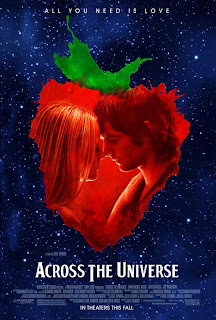
In Theaters: Across the Universe

Image via Impawards.com
ACROSS THE UNIVERSE is a rare achievement in film as visual and musical art, one that made me wonder why other films don’t look as good. Needless to say, anything this good to look at is automatically suspect as regards actual substance. So let’s get to that right away. Is there a plot? Pretty much. Is it any good? I’d say so. Any depth to the characters? More than you’d think. In truth, the film, despite being a celebration of the dewey-eyed idealism of the Sixties, is fairly intelligent in dealing with the themes of revolution and doomed struggles against the state that this sort of thing entails. A rare modern musical specifically crafted for the screen, the film uses the music of the Beatles to examine the social context which influenced and was influenced by the group, and to keep things entertaining wraps it all up in a love story.

The film is the story of Jude (Jim Sturgess), a Liverpool dockworker who takes a ship to America to track down his father, the janitor at an Ivy League school. There, Jude meets and becomes friends with Max (Joe Anderson), a bored and aimless student who focuses more on campus hijinks than education. During a visit to Max’s home, he meets his sister Lucy (Evan Rachel Wood), and is somewhat attracted to her, but her heart belongs to her high-school sweetie, now off in Vietnam. He is killed in action, though, and a heartbroken Lucy runs off to New York to join Max (who has dropped out of college) and Jude (who at this point is an illegal alien), both living in a squalid apartment with aspring singer Sadie (Dana Fuchs, who is indeed sexy). Other characters also move in, like JoJo (Martin Luther McCoy), a black guitarist who moves to the city after a race riot, and Prudence (T. V. Carpio), an at-first deeply closeted lesbian from Ohio. Right now you’re probably having RENT flashbacks, and yes, the ensemble is very deliberately diverse and bohemian. This is, as the geekier among us like to say, a feature, not a bug. The point is, Jude and Lucy fall in love, and they and everyone else get swept up in the turmoil of the decade, a journey into uncertainty that begins when Max is drafted.

Needless to say, the songs are the star attraction here. Beatles covers are always tricky because the originals have such legendary status; it’s much like staging Shakespeare (which director Julie Taymor has also done.) The singing ability of the cast varies, but as with MOULIN ROUGE character is emphasized as much as sheer skill, and there’s nobody really bad in the mix. More importantly, the songs are placed in new contexts and given different emphasis, which is the point of a cover to start with, and it’s really this which the film derives most of its effect from. I’ll get into some of the cooler twists in a bit, but I particularly liked how “I Want You (She’s So Heavy)”, easily my least favorite Beatles song, was turned from stoned makeout music into a dance number for square-jawed military recruiters. I kinda like it now. Outside the songs, nearly everyone is named after someone in a Beatles song, and there are several songs not sung but referenced in the dialogue.

Thinking on it, the timeframe of the movie seems very closely keyed to the actual career of the Beatles, basically encompassing most of the Sixties and trailing off at about the same time the counterculture did. We start with pop love songs and move into psychedelic experimentation and social commentary- the songs themselves are way out of chronological order, mind you, but there’s still a general sense of exploring the same themes and ideas that the group was. Jude becomes an artist in the midst of all the chaos, and the question of what role his art plays in the revolution is a big one. “Strawberry Fields Forever” shows Jude working juxtaposed against scenes of destruction and death in Vietnam, his work speaking to the horror but also seeming to evade it, escaping somewhere where there’s nothing to get hung about. “Helter Skelter”, ostensibly about a relationship if you pay attention to the lyrics, is made political, sung by Sadie in front of footage of protests and riots, and of course I don’t think anyone’s considered that song non-political since Manson. The numbers get nastier and more confrontational as time rolls on- but there’s still a devotion to the basic idealism of the counterculture, no matter what happened to it.

The film’s visuals are truly surrealistic, combining psychedelia with the kind of modern artistic craziness that for some reason you mostly see in television commercials. It’s constantly beautiful, even when looking at fairly ugly things, and if it starts to look like a music video after a while (albeit one with unusually restrained editing), that’s not such a bad thing. It’s colorful, ostentatious, and not scared of looking silly at times. Taymor’s visual brazenness is the sort of thing I like to see in movies, and she also gets points for using a full color palette. God I sound like a crank.

The love story is the sort of thing that’s always required for this sort of movie and therefore the potential weak link, because it’s always a very idealized and simple kind of love story. Jude and Lucy have a giant blinking “Meant to Be” sign over their heads, and their romance is in some ways predictable. It is, however, rendered with more detail than usual, and some subtle playing by the leads helps. It feels natural even if it isn’t written as such. Similarly, there’s a certain cloying quirkiness to all the characters, but they manage to keep themselves likable and relatable (and there are some very amusing cameos). I do think some of the love songs are paced way too slow, though.

ACROSS THE UNIVERSE is a lot smarter than you’d think, and in reimagining and reinterpreting the music of the Beatles, it manages to address the same ideas they were struggling with so often. Jude, in some ways, is fighting the same fight they did- he’s trying to be an artist when both sides of the cultural conflict demanded soldiers, trying to explore something more complex and more universal than the conflicts of the day while recognizing their importance. This is a film with hidden layers, and one I expect will age very well.

Story by Julie Taymor, Dick Clement, & Ian La Frenais
Screenplay by Dick Clement & Ian La Frenais
Directed by Julie Taymor

Grade: A-


Monday, October 15, 2007

Random Movie Report #37: The Host


I’m surprised I hadn’t seen THE HOST before now, as it’s a movie about a giant mutated monster wreaking havoc in coastal Asia, and it received a fair amount of critical acclaim. Heck, I had the DVD out for a while before actually watching it. But it’s a worthy film, certainly one that kicks a lot of life into what’s been a moribund genre for many years (J. J. Abrams has something along these lines coming out next January) and it does so by blending the monster movie tropes with those from a bunch of other genres to create a sprawling and fairly unpredictable adventure.

The film’s monster is some kind of strange sea creature, born when a bunch of toxic chemicals are dumped under bizarre circumstances from a U.S. military base hospital in South Korea into the Han river. It is first seen at a riverfront park in Seoul, where people throw beer cans and peanuts at it until it comes ashore and starts devouring them. The monster snatches up Park Hyun-seo (Ah-sung Ko), the daughter of Park Gang-Du (Kang-ho Song), a struggling single parent working at a food stand owned by his father (Hie-bong Byeon). The child is presumed dead, and Gang-Du’s brother Nam-il (Hae-il Park), an unemployed graduate, and sister Nam-Joo (Du-na Bae) head home to commiserate. Unfortunately, at a memorial, they’re all put under quarantine, as apparently the creature is a host to some mysterious virus. One night in the hospital, Gang-Du receives a call from his daughter on her mobile. She’s alive, somewhere in the sewers. And so the family arrange a breakout, which would be more difficult if the government weren’t making a complete hash of the quarantine operation. At some point the American military decides to step in, and then things get really ugly.

The tone of the film is an odd one, characterized by humor that ranges from farcical to pitch-black. The main character suffers from underachievement and narcolepsy, and everyone has their quirks (Nam-Joo is a championship-level archer, but is extremely slow to act.) The corruption of the local government, as well as its apparent subservience to the U.S., plays heavily into the story. So there’s a conspiracy angle, a quirky family comedy angle, and a black comedy angle, all blending together along with a few other things I can’t think of right now. On top of all this, the actual monster element is played with the kind of psuedo-documentary realism that distinguished the original GODZILLA. The filmmakers play on memories of the SARS outbreak and accompanying paranoia, with everyone wearing breath masks and edging away from people who cough. And of course the American plan involves something called “Agent Yellow”, which can’t be good.

But forget all this side business. What of the monster? Looking like a kind of bipedal mudfish and moving with an awkward-yet-swift gait, the mutant is a very impressive CGI creation. Obviously South Korean movies don’t have the kind of budget American spectacles get, yet the critter is as convincing as anything I saw in the LORD OF THE RINGS films. A lot of work was obviously done to blend skin color and shades with the live-action plates, and this is more impressive given how many times it appears in moving and awkwardly framed shots. The documentary style helps a lot, and the monster’s first appearance at the riverside is ingeniously staged, a scene reminiscent of JAWS in many ways. I would complain that the creature isn’t allowed to develop the personality of a Godzilla or King Kong, but that’s really a limitation of the story; there’s deliberately something unknown and mysterious about all of what’s going on, especially since we’re viewing this on the level of the average man on the street.

There’s a lot going on here, and it does start to come apart near the climax, which is messier than it should have been. It was perhaps asking too much for everything in this film to hold together, but it does a damn good job for the majority of its running time, and it’s not like the ending’s bad. Overall THE HOST is a superior monster movie which stretches the boundaries of what the genre can do, and ends up putting a very fresh spin on something that had become very formalized and ritualized. A nice little surprise of a movie that will hopefully start a trend.

Written by Chul-hyun Baek, Joon-ho Bong, Jun-won Ha
Directed by Joon-ho Bong
Grade: B+