Monday, February 22, 2010

In Theaters: Shutter Island

Shutter Island posters and IMPAwards link
Psychological thrillers are hard. They seem to go off the rails more often than any other genre, because they demand elaborate plots that still somehow stay within the boundaries of reality. There’s none of the wiggle room of horror or science fiction; Hitchcock could get away with plots that stretched credulity, but only in the same way that Babe Ruth could get away with not being able to run bases (and that’s not a fat joke). SHUTTER ISLAND, Martin Scorcese’s latest, manages to be the best such thriller I’ve seen in a long time, partly because it’s being directed by a genuine master of the medium, and partly because it doesn’t cheat the audience. It’s genuinely creepy, with an authentic intensity that builds from the first frame, and it approaches its story and subject matter with a thoughtfulness and care that forms a contrast to its sensationalistic trappings.

Teddy Daniels (Leonardo DiCaprio) is a U.S. Marshall, called in to the titular island to investigate a disappearance at an institution for the criminally insane. A female patient has apparently vanished from her room without leaving a trace, and the seemingly gentle Dr. Cawley (Ben Kingsley) is hoping she can be found before she comes to too much harm. Daniels, haunted by visions of the death of his wife (Michelle Williams) and his service as one of the liberators of Dachau, has a personal interest in the institution. He thinks it’s where the pyromaniac who set the fire that killed his wife ended up, and as he and his partner Chuck Aule (Mark Ruffalo) investigate, more and more details seem to point to sinister goings on. Despite being federal authorities, Daniels and Aule are stymied, overruled, and forced into various directions as they try to investigate, finding themselves opposing whatever dark conspiracy lurks at the heart of the institution.

In the meantime, there’s a storm, the kind of massive hurricane that always hits at dramatically appropriate moments, forcing the Marshalls in with the subjects of their investigation without much power to affect anything. No sooner have we and they become familiar with the institution and the case than the claustrophobia and the oppression start ramping up, and we and they are trapped. There’s almost never a clear sky or a level piece of ground, and as old fashioned and melodramatic as this all seems, it never seems unreal.

This, I think, is Scorcese in his element. He loves old movies and old stories, but sees the reality in them as well as the artifice. He’s got the skill of someone who’s been making great movies for over three and a half decades, he’s working with talented editors and cinematographers and production designers and so on down the line, and he knows how to bring that talent to bear. The film’s scarier sequences and setpieces are beautifully constructed, stylish, but also organic, and the same is true of the surreal dream interludes that let us into Teddy’s increasingly uncertain mental landscape. The music (apparently from outside sources, though I can’t track down details) is used at just the right points as well.

Anchoring all this, DiCaprio has a remarkable intensity but stops short of going over the top, and arguably Mark Ruffalo does a lot to anchor him. If there’s one flaw to pick in all this, the ending is one that at least some in the audience will see coming. It’s a fair twist, the sort where everything makes sense in retrospect (just about, I’m sure there are a few problem areas), but it is one that is, perhaps, done too often in films of this type. I will say nothing more on that subject.

At two hours and eighteen minutes, SHUTTER ISLAND is a bit long for a thriller, but I honestly can’t say my attention ever drifted. This is an overpowering film, heady with mood and mystery and insinuation. It demands your attention, and rewards it; the atmosphere is backed up by a tightly drawn story and believable characters. When someone like Scorcese makes a movie, there’s always the inevitable proclaiming of it as a masterpiece, and the inevitable rush of people saying that it’s not really that good. I’m not sure how well this will hold up in the filmmaker’s body of work, but I will say that I really enjoyed it. And that’s the only judgment I’m qualified to make.

From the novel by Dennis LeHane
Screenplay by Laeta Kalogridis
Directed by Martin Scorcese

Grade: A

Saturday, February 20, 2010

Frasierquest 1.22: Author, Author

Frasier and Niles in creative mode
Frasier: Niles, I would shave my head for you.

Niles: A gesture which grows less significant with each passing year.

As soon as Frasier and Niles first traded quips in “The Good Son”, sibling rivalry started growing to become a crucial FRASIER story engine. Winding down Season One, we find the first episode where it really leaps to the fore; Frasier and Niles go into “Author, Author” as collaborators, but that just makes them worse enemies. Apart from highlighting Frasier and Niles’ inability to work together, the episode also has some fun with the travails of writing, and how collaboration can go terribly wrong. It makes me glad that I usually work alone.

Niles comes to Frasier in a crisis; he had a book deal, but the idea fell through at the last minute. On the spot, he convinces his publishing company rep (the legendary Mako) that he and his brother will write a book on sibling relationships. Frasier is hesitant at first, but starts to enjoy the idea, even collecting anecdotes on the air. However, the publisher wants the first few chapters in a few days, and when the Crane boys lock themselves in a hotel room to try and get them written, they come to understand why they usually don’t spend this much time together.

It needs to be said that beyond anything else, this episode is worth seeing for Niles’ debut on the radio, acting as co-host for Frasier’s show to help collect book anecdotes. I’m not using his opening as one of the quotes because you really have to hear it for yourself, but it’s one of those rare moments of childlike playfulness that adds to Niles’ character. It’s why we like him instead of finding him insufferable.

I’ve done some collaborative work myself, but almost always in a “hand in my stuff and see what the others add” function. I’ve never really sat down and tried with someone to write something line by line, and I’m not sure how professional collaborators- for example, many of the writers on this show- do it.

It probably helps to have a collaborator who is not Frasier or Niles, though. As in life, it’s always people with largely similar personalities who have the hardest time getting along, partly because the little differences become more grating. Niles has a slightly different writing style, he’s a Jungian rather than a Freudian- these things become very important over an evening in a small hotel room. Opposites can always retreat to their corners, but the Crane brothers are determined to accomplish something together, and have no choice but to press forward.

Of course, the other reason similar people find themselves in conflict is because they’re often after the same thing. Niles wants the recognition Frasier gets every day, even if he thinks what he does is unprofessional. He wants his name in the card catalog under “Mental Illness”, which isn’t the most far out dream for a respected psychiatrist, and in the end it feels like a shame that he can’t make it work. Granted, it’s partly his fault, roping his brother in on a whim and promising chapters that haven’t been written yet, but we know why he gets in over his head.

The central joke of the episode is basically that, while Frasier and Niles try to write about sibling relationships, they prove themselves an example of a perfectly dysfunctional one, ultimately resorting to violence and accusations of stealing each other’s mother. It’s not that they can’t get along; throughout the course of the series they spend huge amounts of time with each other with only the occasional meltdown. But every relationship has its breaking point, and with the Crane brothers, this appears to be whenever you give them a common goal.

“Author, Author” is a showcase for the chemistry that Kelsey Grammer and David Hyde Pierce established from their first scene together, and it shows how Frasier and Niles’ sibling rivalry would eventually come to equal (and arguably overshadow) the original driving conflict between father and son. The latter never went away, but by adding a crucial second dynamic, the show was able to keep itself fresh for longer. For whatever reason, seeing these two at each other’s throats never really gets old.

Guest Caller: Christine Lahti as Laura

Written by Don Seigel and Larry Perzigian
Directed by James Burrows
Aired May 5, 1994

Frasier and Niles: Some boys run off to college,/ but we think they’re all wussies,/ ‘cause they get all the knowledge,/ and we get all the/ umpta umpta umpta da-da-da...

Sunday, February 14, 2010

In Theaters: The Wolfman

Wolfman poster and IMPAwards link
I’m the sort of person who’s favorably inclined towards a movie like THE WOLFMAN. Therefore my recommendation has to be a little qualified; I like it because it does a lot of things I like, but my priorities may differ from yours. I like that it’s an old-school monster movie, complete with old-school makeup effects enhanced by CGI rather than replaced by them. I like that it’s apparently not just a remake of the 1941 classic, but set in the same world as the old Universal horror films. I like its attitude and the cut of its jib, and so I may be willing to overlook some flaws to a degree. But I think there’s something here even for non-devotees of classic monsters, as it’s basically a well-constructed thriller with some good shocks and a nice creepy atmosphere throughout. From some accounts the production was a bit of a nightmare, but the results are more consistent than you’d think.

Lawrence Talbot (Benicio Del Toro), renowned stage actor, returns to his ancestral home in Blackmoor, England to investigate the disappearance and, as he discovers upon arrival, murder of his brother. His father (Anthony Hopkins) has been rattling about the house all this time, and his brother’s fiancee (Emily Blunt) is now staying there as well. Searching for the killer, Talbot ends up at a gypsy encampment around the time that it’s attacked by a large wolflike monster, and is bitten. The townsfolk are convinced he’s inherited a curse, and sure enough, as soon as the next full moon rolls around, Larry finds himself growing fangs and hair and tearing people limb from limb. And there’s still the first werewolf hanging around.

As I said, this was a troubled production; apparently director Joe Johnston struggled a bit with the studio, resulting in composer Danny Elfman being fired then rehired, Rick Baker’s monster makeup being “enhanced” or not with CGI, and various other problems. Apparently some 16 minutes cut from the picture will resurface on the DVD (though some have put the amount of cut material at three times that length), and it must all be characterization, because the theatrical cut renders Talbot a bit of a blank slate. He barely ever speaks, and though the plot by nature has him sort of helpless (though not as much as in the original), you’d think a renowned actor would end up with more of a personality. Del Toro has the right look for the role, easy, and has some good scenes with Blunt, but I feel it’s almost unfair to evaluate his performance with so much of it missing.

On the other hand, there are werewolves, and they are great, and just as great songs in a musical can paper over plot holes, so too does great monster work in a monster movie. Despite some obvious CG being added here and there (and of course it’s used to a large extent in the transformation scenes), Baker’s makeup is retained for most of the time we see the wolfmen on screen, and it’s very impressive. It’s more along the lines of the hairy-but-flat faced werewolves of old than the more modern trend of making them wolves on two legs, and personally I like that approach better, but the execution is also convincing and appropriately fearsome. The wolfman attacks are fittingly gruesome; the camera doesn’t linger on the gore (perhaps to avoid a harsher rating), but we see enough to know that this is the kind of monster that mauls its victims. Some of the CGI work does seem patched on (particularly in a climactic scene), but at others it actually does enhance rather than detract from the experience.

The film is actually more of a period piece than the original, which theoretically took place in 1941 (albeit in a hypothetical Europe completely unaffected by war.) Despite moving the clock back 50 years, the film does retain some of the feel of the old Universal classics. The locals are always superstitious, there are always gypsies, there’s always fog and weird parts of the landscape that don’t seem to have appeared naturally, and of course it’s not long before a Scotland Yard inspector (Hugo Weaving, droll as ever) shows up to complicate things for our antihero even further. The pace of the film sometimes becomes patchy, no doubt partly owing to the cuts the studio made, but the environment is so engrossing that I didn’t mind the slower bits.

This film is getting fairly bad reviews, and to be sure, I don’t think it’ll go down as one of the classics of lycanthrope cinema. But for all the faults, the film delivers what it promises- brutal werewolf action (including a fight between werewolves, which you don’t see often enough) in a ghoulish fantasy realm on the border between England and Transylvania. If nothing else it’s a wonderful change of pace from current horror trends, and good counter programming to that Valentine-themed epic that’s just opened. Everyone knows werewolves are romantics at heart, anyway.

Based on a screenplay by Curt Siodmak
Written by Andrew Kevin Walker & David Self
Directed by Joe Johnston

Grade: B

Saturday, February 13, 2010

Frasierquest 1.21: Travels With Martin

Frasier and the gang on the road
Daphne: How’s it feel behind that wheel, Dr. Crane?

Frasier: Manly! This is mine and it’s big!

A road trip was inevitable. You don’t see them every week, but as any sitcom progresses, the probability of their doing a road trip episode approaches 1. They’re great for throwing characters together, and you don’t need that many sets. “Travels With Martin” is an episode that trades a lot off of the rapport its ensemble has built up over most of the season, and with good results; arguably it shows the series’ first tenative steps towards the outright farces which highlighted later seasons. It’s not quite there yet, but the fun is in the journey.

Roz suggests Frasier use his vacation time to take his dad somewhere, just like she’s doing with her mom. Martin elects to see some of America’s sights in a Winnebago, but goads Daphne into coming along to act as a cushion between him and Frasier. Needless to say, this results in Niles coming along as well. Martin wants to head straight out to Mount Rushmore and straight back, but Frasier wants to ramble, so they compromise and ramble across the countryside at top speed, not stopping for anything. While Daphne takes a nap, they speed over to Canada, but this poses a problem; she doesn’t have her green card and isn’t supposed to be out of the country. The gang have no choice but to try and sneak her back across the border. This goes about as smoothly as you would imagine.

This is a story you can really only do when you’re confident the audience knows who everybody is. Sure, you’ll get some casual viewers tuning in for the first time, but “Travels of Martin” takes some character beats as a given, most notably “Frasier and Martin don’t get along”, with a dollop of “Niles has a thing for Daphne.” Someone who’s never seen FRASIER before could probably pick these elements up by implication- the curse of series television is that you always have to assume somebody’s coming in late- but the episode also benefits from the characters themselves knowing where they stand.

One thing I noticed rewatching this episode is that the relationship between Frasier and Martin has already softened considerably in comparison to where it was early in the season. They’ve had the big arguments, Frasier has learned to live with the chair, etc.; now, they bicker, but the actual hostility has ebbed. Instead the major conflict is more philosophical. Martin wants to cover ground and see the landmarks, while Frasier wants to follow Jack Kerouac (to say nothing of Buzz and Tod) and enjoy the journey more.

The gang’s attempt at getting back across the Canadian border without giving away the presence of a foreigner on board is probably the episode’s comic high point. It’s probably the silliest thing any of them have had to do so far (Frasier’s performance in a school play in “Give Him The Chair” not counting, as it’s offscreen), and it’s the kind of elaborate misunderstanding that epic farce is based on. It’s not really the central story of the episode, even though it’s the most pressing problem. In fact, the more I think about it, the less a story-driven episode this is.

The real point is just to shake everyone up a little by putting them in a different environment. The normally adventurous and high spirited Daphne gets a fright put into her, Niles puts on a baseball cap (backwards, even), Frasier drives an RV, and Martin puts away his itenerary. This is what makes comedy happen, and though it’s a shame Roz can’t join in on the craziness, this is still a memorable and eminently rewatchable episode.

No Guest Caller

Written by Linda Morris & Vic Rauseo
DIrected by James Burrows
Aired April 14, 1994

Roz: Listen, there is nothing wrong with pampering yourself on your vacation. After all, you
do work three hours a day.
(Pause) I’m sorry, that one even surprised me!

Monday, February 08, 2010

Frasierquest 1.20: Fortysomething

Frasier and Carrie at the store
Martin: The sands of time are shiftin’, buddy. Mostly south.

As befits a psychiatrist, every once in a while Frasier gets introspective. His internal conflicts can drive stories just as often as external ones, and “Fortysomething” is an example of the show’s ability to stray into conceptual territory. As the title implies, it’s about getting older, but what Frasier experiences isn’t so much a midlife crisis as it is the first of many midlife episodes, moments and experiences that remind him that he’s no longer a young man.

It starts when Frasier forgets Roz’s name on the air. At home he finds himself stuck near the start of a piano piece he’s played many times before. His arm’s not quite long enough to hold out a medicine bottle far enough to read it. He’s 41, and finally starting to feel it when he meets Carrie (Sara Melson), a young and attractive department store salesgirl who seems to take a liking to him. She eventually asks him out, which puts him in an awkward position. He’s afraid that his attraction to her may simply be compensation for his anxiety over aging, and doesn’t know how to proceed.

It doesn’t help that Carrie is extremely charming. Sara Melson turns in a great guest performance, giving the character a very real enthusiasm and warmth. There’s no sense that she is an unattainable fantasy or (dare I even say the words) manic pixie dream girl; she’s simply a shop girl who finds Frasier attractive. It’s tempting to make guest characters fairly broad and one-note, but Carrie is well rounded and displays a real chemistry. It is, for lack of a better word, cute.

The overall tone of the episode, however, is one of mild melancholy. An early scene in Frasier’s apartment is set during a rainy Seattle afternoon, and that light drizzle seems to hang in the air (in fact, it’s the only glimpse we have of an exterior in the entire half hour.) Arguably, aging isn’t inherently a negative process, but there are parts of it that suck, and Frasier happens to run into a whole bunch of them at once. There’s nothing he can do about it, he’s just going to be a little down. Meeting Carrie does some good, but Frasier inevitably finds himself more stressed than excited at the prospect of a relationship with a much younger woman.

Maybe that’s what makes this one tough to review; it’s a very low-key piece, showing a subtle but meaningful moment in the main character’s life. It’s almost a short story, and the script and direction both show a literary level of restraint.

This actually isn’t without precedent. CHEERS, in its fourth season, aired an episode called “Dark Imaginings”, in which Sam suffers a hernia and finally has to stop denying that he’s getting older. It ends with him sitting in a hospital bed looking out the window as rain falls, an unusually wistful image for a screwball ensemble comedy. Ultimately, the ability to do serious little moments like this has become increasingly important for the sitcom over the past few decades. It’s not necessary- a show like 30 ROCK can run towards the purely farcical and be brilliant- but it does help establish a bond between the characters and the audience over the long run.

Bulldog has an amusing scene in this one, leading up to Carrie asking Frasier if the sports jockey is actually gay, a bit of an in-joke since Dan Butler has been well out of the closet for some time now. The character’s appearance in a story that he doesn’t have much impact on is a nice sign of the show’s recurring characters being folded into the ensemble. I really only have those two observations about his scene, but it’s very funny. (And while we’re on peripheral business, can anyone identify the piano piece Frasier tries to play? It’s quite distinctive, but I don’t really know enough music to recognize it.)

This one ends up being kind of sad, but again, only kind of. There’s not a lot of conflict to resolve; Frasier’s getting older and he has to get used to it, and that’s that. Arguably he deals with it by letting himself be distracted by the possibility of dating Carrie, and maybe that’s enough to shake him out of his funk for the time being. He’ll face the issue again, obviously, but he takes it a little at a time, and it just seems to work.

Guest Caller: Reba McEntire as Rachel

Written by Sy Dukane and Denise Moss
Directed by Rick Beren
Aired March 31, 1994

Daphne: I learned a long time ago there are three questions you never
answer honestly. “How old do I look?” “Do you like my hair?” and “Was
it good for you too?” [to Niles] Coming, Dr. Crane? ...Dr. Crane?

Niles: I'm sorry, I was someplace else. [to Frasier] It was a warm and friendly
place.

(As per usual, quote assistance comes from John Masson's transcripts at Twiztv.com. Remember: watch out for popunders.)

Wednesday, February 03, 2010

Frasierquest 1.19: Give Him The Chair

Frasier, The Chair, Niles
Leo: Excuse me, but I happen to be a professional. I take a lot of
pride in my work, and I would never-

He hits a table, knocking over some objet d'art.

Leo: Whoa... how'd that get there? Hey look, at least I didn't
lose my license this time, right?

Frasier: All right, all right. Quickly, quickly. I'm sure Beavis will
start to wonder where you are.

It waits. In the midst of African erotic art and replica fainting couches, situated with a perfect angle on the TV and optimum position near the dinner table, it waits. It is sustained by duct tape, survives catastrophic spills, festers within Frasier’s apartment like a pea-green fungus. And it does not wish to be moved.

The Barca Lounger sits on the divide between “prop” and “character”, much like the Doctor’s TARDIS, only it’s stuck in the shape of an affront to design aesthetics. Since the whole show is based around Frasier’s dad moving into his life, the chair makes a great symbol of that intrusion; even if Martin isn’t in the apartment for a scene or two, the chair reminds Frasier and us of his presence. It makes sense that Frasier’s first (and only really sustained) attempt to remove this blight comes in the first season; it was a plot hook from the moment Martin had it wheeled in, and eventually the writers had to run with it.

Frasier decides that replacing Martin’s chair is something long overdue, reasoning that, as the chair is a “transitional object,” getting rid of it would actually be good for his father, to complete the process of settling into his new home. So, without Martin’s knowledge or consent, he has the thing taken out, and a sleek black recliner with Swedish massage put in its place. Despite rave reviews from Niles and especially Daphne on this new feature, Martin just doesn’t take to the new arrival, and wants his old chair back. Unfortunately, Leo the building lackey (Phil Buckman) forgot that Frasier has a storage space, and put the chair outside, where it was quickly snatched up, meaning that in order to appease his father, Frasier must scour Seattle for the billious monstrosity.

It’s interesting how little set-up is needed for this plot to get moving; there’s no particular embarassment which causes Frasier to want to throw the chair out, he just decides that enough is enough. This episode could fall almost anywhere in the season, or even the next few, and while that’s true of other episodes, the Frasier v. Chair conflict is an element which doesn’t change for a long time.

If the beginning isn’t much, then the climax is an interesting twist, as Frasier finds the chair being used as a prop in a high school play. Valerie Curtin (who actually is related to Jane, surprisingly enough) is great as the increasingly frazzled drama teacher who is deadset on keeping what is, by far, the most interesting thing on stage. It’s an odd direction for the story to go, and a great little mini-story in itself. Come to think of it, between Curtin, Buckman, and a great voice appearance by Malcolm McDowell as an eccentric psychiatrist being interviewed by Frasier, the guest stars do a lot to carry this one.

This is also a return to the show’s initial conflict between Frasier and Martin, which was sidelined for the last few episodes. To Martin, the chair is a reminder of the life he used to have, bound up with all sorts of positive memories, including those of Hester. (Hester is sort of the trump card in these arguments.) Ultimately Frasier can’t deprive his father of that; while some change may be inevitable or necessary, that’s no reason to cut ties with the past entirely.

And so the chair wins this round, as it will many others. There are certain forces Frasier cannot prevail against, and comfortable bad taste is one of them. The chair’s vengeance is mighty; violate its will and one must not only repent, but go to even greater lengths to atone than it ever took to confront it in the first place.

It will not be moved.

Guest Caller: Malcom McDowell as Dr. Bruga

Written by Anne Flett-Giordano and Chuck Ranberg
Directed by James Burrows
Aired March 17, 1994

Niles: Well, at least I don't have to live with something unattractive.

Frasier shoots Niles a look from under raised eyebrows. Niles, taking
his meaning, looks offended.

Frasier: Oh Niles, Niles, I'm just having some fun with you. Actually,
I think Maris is rather attractive - in a, a minimalist sort
of way.

[Quotes again via John Masson and TWIZTV.com. IMDB, seriously, you are losing ground here.]

Sunday, January 31, 2010

Academy of the Underrated, TV Version: Dollhouse

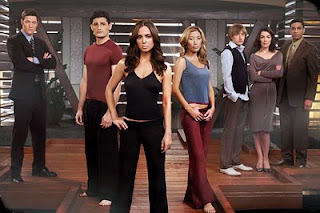
Dollhouse cast photo and Amazon link
So, to the sadness of some and the outright joy of others, the series DOLLHOUSE came to an end this Friday. Joss Whedon’s latest was a polarizing beast, to put it mildly, and while some of the issue seems to be that the geek favorite was due for a backlash, it was also a weird and uneven show. It was the mutant product of a deal between Fox and star Eliza Dushku that produced a show that would not have been greenlit otherwise, on a network that the showrunner had previously been badly burned by. Its cancellation was anticipated well before it aired, and its survival to a second (albeit brief) season was received with shock. On top of it all, there’s a whole host of gender politics and sexual issues invoked by the subject matter, which leads to fun times and accusations for all.

But what about the show itself? Well, I liked it. I liked LADY IN THE WATER too, so take anything I say with enough salt to kill a man, but I feel weirdly compelled to speak about what I think made this show worth watching. The premise was creepy, the tone jumped from 80s action series to cyberpunk mindfuck and back and forth without much warning, and arguably Ms. Dushku was in over her head, but just about every time the series seemed on the verge of total breakdown, something came along and prodded it back into engaging weirdness. I’m not sure what kind of piece I’m writing here, it’s got the bones of a review but there are various extratextual thingies I want to get into as well, but if you bear with me just a moment I’m sure we’ll have this sorted by the end.

So, the Dollhouse is a project put together by the Rossum corporation, home to all sorts of brain-breaking technology. Clients pay exorbitant amounts of money for the service of one of their “actives”, people programmed with a specific personality for the situation at hand. Many use it for a high class, highly specific brothel, others use it to hire bodyguards, negotiators, midwives (though that’s a weird story), surrogates for dead loved ones, etc. Dushku plays Echo, the most popular active, who has a habit of retaining bits of memories and skills from every imprinted personality she’s ever had, as well as flashes of her original self, who’s stored away on a hard drive as part of a contract signed when she needed to disappear for a few years.

The first few episodes in both seasons focused on individual jobs Echo took on, a “bottle show” approach that seemed to backfire on the show pretty quickly. On the one hand, it’s the obvious approach- the gimmick of the show is that the protagonist can become anyone, do anything, so throw them into some standard action show situations and have fun. Honestly, I did not hate these kinds of episodes, for the most part. I even have a soft spot for “Stage Fright”, the admittedly goofy as Hell installment in which Echo becomes a bodyguard for a pop star whose life has been threatened. It hit a weird nostalgia that I don’t even have for shows I never even watched, shows like KNIGHT RIDER and CHARLIE’S ANGELS where the point was to see which basic story concept got picked out of the pile each week (“Angels, I need you to go undercover... at Las Vegas' newest casino resort!”) I dunno. The basic problem was, Echo is usually tabula rasa without a specific personality, so there’s no character to get attached to, and while the second season established more of a baseline personality for her based on her accumulation of imprints, the bottle shows felt more like an anthology than anything else. And anthologies have not played well on TV for a while.

(As a side note, it’s worth investigating why that is. Seriously, we used to have THE TWILIGHT ZONE and PLAYHOUSE 90 and ALFRED HITCHCOCK PRESENTS but now every show has to have continuing characters and an ongoing storyline. What happened there? Changing the subject, sorry.)

In any case, the bottle shows did start to feel rather uninspired, and eventually the show got around to the more popular (critically, at least- commercially the show was dead in the water more or less the whole time) approach of episodes focused on the machinations of the Dollhouse itself. From the start you had the subplot of a former FBI man named Ballard (Tahmoh Penikett) obsessed with revealing this clandestine operation, and with Caroline, Echo’s original self, who apparently found out way too much about Rossum. And of course, the technology to reprogram people can be used for a lot more than just prostitution and temp jobs, and it’s suggested that the Dollhouse is basically a moneymaking machine and R&D house used in support of whatever Rossum really has planned.

This raises some very weird issues. In theory, all the actives have joined the program by choice. They serve 5 years or so on a contract, and are released back into their normal selves with a ton of money and whatever unpleasantness drove them there erased somehow. Clean criminal records, selective memory wiping to remove traumas, that sort of thing. But even if you were to overlook the coercion involved in getting some of the actives hired, the question is whether or not you can pre-emptively consent to indentured servitude, without any way of backing out in the middle if you change your mind. (In fact, since your mind is on ice, you can’t change it.)

So it’s uncomfortable, and that the show did not immediately come out and say that this was bad, bad, bad made some people argue that it was a glamourized prostitution fantasy. Not that the Dollhouse was ever unambiguously positive either- rather, its manager, Adelle DeWitt (Olivia Williams), about whom I will say more later, was a morally conflicted figure trying to justify the sleazier engagements by balancing it out with pro bono work.

Now, there’s a lot of additional stuff that comes up here, regarding Joss Whedon’s own reputation as either a feminist or not-really-a-feminist and whether sights like Eliza Dushku in bondage gear have any place in “feminist” work for whatever definition that has, and it’s all very inflammatory and impossible to discuss because it’s more polarized than a pair of 3-D glasses, and so on. I’m tempted to dismiss this with the old David Cronenberg adage of “an artist has no social responsibility whatsoever”, which may seem like an extreme statement but did you ever make VIDEODROME, but in this case I think it may be enough to say that the subtle wrongness of everything fit the material quite well. The Dollhouse has a pleasant veneer; it’s the appealing face of a company out to control your mind, after all. Every character is dealing with difficult and morally uncertain situations, so it makes sense that we’re made a little uncomfortable alongside them. And if it’s problematic, well, so’s any work worth discussing.

Cronenberg seems like an appropriate authority to appeal to here, because DOLLHOUSE evokes a lot of the themes and concepts that he’s dealt with as a filmmaker. You’ve got identity and transformation thereof, massive corporate conspiracies, sex and violence, and as we just talked about, moral ambiguity up the wazoo. I’m not sure if Whedon was specifically influenced by anything Cronenberg did, but I would wager money that at the very least he’s drawing on Philip K. Dick.

Of course, similarities aside, the show does trade a bit more on moral certainty in the end; the unaired DVD-exclusive episode “Epitaph One” (the result of some weirdness between Fox and the show over how many episodes were ordered) reveals that the Dollhouse tech is ultimately responsible for bringing about the end of civilization as we know it, Adelle’s attempts to keep her Dollhouse ethical put her at odds with Rossum, and the emotional toll all this takes on the characters is not ignored.

Still, the discomforting nature of the show was probably what, more than anything, doomed it commercially. The success of Whedon’s BUFFY THE VAMPIRE SLAYER (and most other genre shows) was partly due to fans’ identification and empathy for its main characters. He could and did put them through the emotional wringer, but there was still a certain safety in their friendships and our knowledge of them as fundamentally good people. While FIREFLY was a commercial failure, I’d argue that the reason it has such a fiercely devoted fanbase is because the crew it created is so damn likable, and even the ship itself took on a certain “safe haven” quality, even when invaded by bounty hunters and the like.

DOLLHOUSE doesn’t really offer that- every character is morally compromised on some level, the place’s Zen garden quality is a mask for the ugliness of what gets done, and even if this show had gotten good numbers, dark intense conspiracy thrillers really only work for a few years before they inevitably lose focus. (David Duchovny, early in the run of THE X-FILES, said it shouldn’t run for more than five seasons. He may have been right.) Heck, even BATTLESTAR GALACTICA had more of a comfort zone.

Eliza Dushku took a bit of criticism for her work as the lead. It’s funny- I remember that when she was on BUFFY, people liked her performance a lot, but she is apparently now a terrible actress who couldn’t carry an infomercial let alone a series. (This kind of hyperbole is intrinsic to fandom- I have pretty much heard the same about every DOCTOR WHO companion, everyone on TORCHWOOD, every Bond Girl since I started paying attention to Bond movies, etc.) Now, I do think she’s limited, and in the first aired episode there are a couple of very obvious, very stagey moments where she doesn’t quite convince. But if she got pushed out of her zone now and again, I think she held up most of the time. The overall ensemble fares better; in particular, Enver Gjokaj, playing the active Victor, steals the show on several occasions, and someone needs to cast him in something now because he is awesome.

And as long as this is getting, I want to talk about one more thing.

Adelle. Fucking. De Witt.

Olivia motherfucking Williams as Adelle motherfucking DeWitt

In retrospect I could just mention her and that would be all the defense this show needs. She is arguably one of the very best characters that Joss Whedon has created. Indeed, for those who say that he doesn’t *really* write strong women, well, there’s Adelle. True, she’s got issues. She’s got trade paperbacks. She is conflicted from the start, the pleasant face of the Dollhouse, the ruthless protector of it, and the jailer of a whole alphabet’s worth of men and women. But her moral journey is the show’s most compelling arc, and Olivia Williams plays it superbly. What I said about the show not having the most identifiable ensemble is true, but Adelle- I love Adelle.

Also, whoever is responsible for the character’s fashion needs, if not an Emmy, some sort of medal for distinguished service. I normally don’t notice these things, and Williams would look good wearing a potato sack, but not only is Adelle reliably fabulous, her wardrobe and hair reflect character and mood in the most wonderful way. Whether it’s the gentle look when she’s setting up deals with clients, or a black power suit when the gloves are off, she’s like a mature, morally conflicted Emma Peel.

The whole thing ended on an understandably rushed but still satisfying apocalyptic cyberpunk bash-up, which brought the characters’ various arcs to mostly satisfying conclusions. When the show was renewed for a second season, I took it as a gift, and apparently the showrunners did as well, and we got to have closure. The whole thing was a freak, a mutant that got away from Fox, Whedon, and everyone else and did some neat stuff in its short time. It won’t go down as a classic, but it’s one of the most idiosyncratic things I’ve seen on network TV in a while, and that should guarantee it a minor place in history.

In other words, Grade: B+.