Thursday, November 09, 2006

Random Movie Report #14: The Libertine


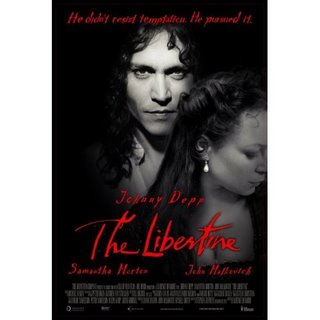
Okay, now that the election is past (mostly, as of this paragraph a couple of Senate seats are still in the air), I feel more at liberty to think about things like movies and comics and not who will control the actions of the nation. THE LIBERTINE isn't exactly apolitical fantasy, but it's an escape of sorts, to a world of no "family values" and precious little concern for moral purity of any kind. Not a pleasant world, but a refreshing change. A costume drama that avoids any hint of stuffiness, THE LIBERTINE is a nicely dry tonic, and a minor triumph for star Johnny Depp, who has had many.

Depp plays John Wilmot, the Earl of Rochester, courtier to King Charles II (John Malkovich.) Prone to boozing, wenching and writing smutty lampoons, Rochester (as he's usually called) has, at the start, come back from a brief exile to the country imposed after one of his works of verse pushed a few too many buttons. Not that anyone cares too much- after the deposition and execution of the Puritan dictator Oliver Cromwell, Britain has entered an age of art, culture, and decadence. Upper class gentlemen openly cheat with whatever whores are available, in theater boxes and in the streets. The theaters have been reopened, and female actors are now common. Rochester finds himself drawn, and not just carnally, to struggling actress Elizabeth Barry (Samantha Morton), who is on the verge of being fired when he makes a bet with his friends that he can make her a star. Meanwhile, the King commissions Rochester to write a play to be performed at a royal function for the French ambassadors, while Britain seeks a loan from the often-rival nation. The resulting work, a pornographic satire of the court, doesn't go well, and Rochester flees to avoid punishment, beginning a slow decline.

Describing the plot is difficult because of the film's structure; it's mostly episodic, albeit with events from one episode bleeding into another and so on. Adapted from Stephen Jefferys from his play (originally staged with Malkovich as the star), the script has nothing stagy about it; we leap from location to location and scene to scene in such an obviously cinematic way that I was surprised to learn that it was an adaptation to start with. Shot in desaturated color (something I normally dislike), the film portrays a particularly grimy, grey late Restoration, a foggy haze (or hazy fog) drifting through the streets. Not only does it feel authentic, it reflects the sort of fatigued hedonism that dogs the protagonist. Director Laurence Dunmore used a handheld camera almost entirely throughout, and relied on lighting from candles in most scenes, again adding both realism and a since of intimacy that's necessary for us to connect with the growing unpleasantness on screen. And, I have nowhere else to put this, so I'll just say that this film may have the tiniest credits in the history of film. Seriously, I had to use the zoom function just to read the prologue.

Johnny Depp's performance does little to challenge the conventional wisdom that he's a consistently great actor. Rochester doesn't change much, to his ruin, but Depp captures a certain nuance in his strident antiheroism. The character begins things by addressing the audience, insisting up front, "you will not like me." However, it seems a desire for attention drives him constantly, which makes it all the more lethal for him when he is forced to hide. Depp manages to make Rochester a compelling and very charismatic figure, even as he lounges in a drunken, syphilitic stupor, putting great burdens on his wife (Rosamund Pike) and the housemistress (Clare Higgins of the HELLRAISER saga). Also amusing is COUPLING's Richard Coyle as Rochester's slovenly manservant Alcock (Jack Davenport also appears as Harris, the theater director.)

It may have been possible for the film to better develop any one of the portions of Rochester's life we see fly by; his relationship with Barry and the genesis of his briefly-performed magnum opus play out too briefly for my tastes. But the film is engaging and perversely fun throughout, and manages a bit of psychological complexity on top of it. Above all else it's worth seeing for Depp's performance and for its vivid portrait of a seldom-explored age. At the end, I was forced to admit that maybe I did like Rochester, just a little.

GRADE: B+

Friday, November 03, 2006

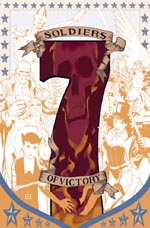
The Comics Page #7: Seven Soldiers #1


Grant Morrison's SEVEN SOLDIERS #1 officially came out last week, but didn't arrive in some areas until this Wednesday- I got it, but any excuse to procrastinate. The long-delayed capstone to the most exciting comics "event" of this year and the last (which isn't as high praise as it should be, given my general distaste for these things) is, as expected, dense, mind-boggling and full of weird ideas. It is also beautiful, sophisticated, and a brilliantly experimental approach to comics storytelling. It is unlikely to make any sense to anyone who hasn't followed the series, and even for those people, it's probably not going to be easily understood until maybe the third reading. This makes it accessible by Morrison-standards. And for anyone else that would be a substantial negative, but- well, read on. (Mild spoilers within.)

Okay, for those who weren't on board for this, the bulk of SEVEN SOLDIERS is comprised of seven four-part miniseries each revolving around a different character- all of them B-list-or-below on the scale of superhero popularity, most new incarnations of old concepts. Frankenstein (more accurately his monster, but I suppose only folks like me still care to make the distinction), Zatanna, the Manhattan Guardian, Shining Knight, Bulleteer, and Klarion the Witch Boy all become embroiled with the schemes of the Sheeda, a race of evil fairy creatures who can control humans and plan to consume the world. Also, they never meet. (Well, not all of them, never at once anyway.) Instead their stories subtly intertwine and destiny causes them to each play a role in combatting the Sheeda invasion. Look, the whole thing has been collected in three lovely trade paperbacks, with a fourth on the way, and it's great reading- Morrison likes to tell fast-paced stories full of weird ideas that don't quite make sense the first time, but are cool enough that it doesn't matter.

Anyway, here we are at the climax. The Sheeda arrive in their timeship in the middle of the city and prepare to do some serious Harrowing. The Manhattan Guardian does most of the fighting on the ground, protecting the innocent populace as shown in photographs and columns from the newspaper that gave him his name. Bulleteer, occupied with trying to save her nemesis Sally Sonic, careens into the middle of the fray. Zatanna tries to cast some good mojo for the team, while Klarion wanders the streets and decides to use a magical talisman to his advantage. Shining Knight confronts the Sheeda queen. Frankenstein has commandeered a Sheeda flagship and is contemplating destroying the entire race when fate intervenes. And Mister Miracle is hunting down Dark Side (aka Darkseid), who has bargained with the Sheeda to gain possession of what's left of Aurakles, first of the New Gods. Meanwhile, one of the soldiers trapped and seemingly killed in SEVEN SOLDIERS #0 turns out to play a key role.

Here's the thing about Grant Morrison. Well, one of the things. He's willing to write stories so dense and bizarre that they don't quite make sense the first time you read them. But one comes away thinking not "what a cheat, can't he tell a good story?" but "I'll have to read that again." And one of the reasons for this is that comics are one of the most easily re-readable media out there- especially in the American "short magazine" format. It's easy to flip back, let the eye wander, and find important information- even more so than in prose, as the pictures provide convenient memory anchors. So Grant Morrison knows you can and, if he doesn't lose you from the start, will look back and get the whole picture. Or at least he acts like he does.

This has two benefits. One, he can write in a compressed style that delivers more story-per-page than most American comics do; I understand that the "widescreen" style can produce some good effects and work for certain kinds of stories, but too often it seems to be used to make sure a story's long enough to be collected as a trade. More importantly, though, Morrison's approach means you get a story that reveals more with each reading. There are layers of plot and symbolism and theme that slowly unravel themselves as you go back and forth over the panels.

One criterion I've slowly been developing for evaluating a work of art or entertainment is how well it exploits the possibilities of its chosen medium. CITIZEN KANE is a great movie because it uses every cinematic trick the filmmakers could conceive of to tell its story, without obstructing that story; Ray Bradbury's stories resonate with a love of language and a fast, ephemeral, flash-of-lightning quality; Monty Python took a 25-minute block of television and filled it with whatever was funniest. It's not the only criterion, nor is it a necessary one per se (a movie can be play-like and still be good, for example), but it helps because it reminds the reader of the fundamental excitement of the activity itself. SEVEN SOLDIERS #1 is a very playful, experimental and above all comic book-y sort of comic book. There are a variety of layout styles and art styles used to convey each of the different worlds the soldiers come from and move in; the Guardian's adventures are presented as a newspaper (complete with a British-style crossword whose answers are apparently derived completely from the series; I'll have to get to that at some point), Aurakles' story is brought to us through a series of extremely Kirby-esque panels, and Shining Knight's Arthurian history is rendered in rich static drawings, almost like a tapestry. A key moment between Klarion and Misty, Zatanna's ward, is presented with both pictures and prose text, almost like a children's book. Zatanna breaks the fourth wall like she did in her eponymous SS series, in a very "do you believe in fairies?" moment. This is a story that could only work as a comic book, and it reminds you of just what the medium can do.

The highest of high praise must also be given to J. H. William III's art. Lush and complex, it encompasses a wide variety of styles, effectively recalling each of the seven miniseries leading up to this. It's eye-popping stuff, and the layouts are just as wildly intricate as the story. (I must also credit Dave Stewart on colors.)

This comic is incredibly smart and incredibly fun, a beautiful and wholly satisfying topper to a great project. Normally I despise the lax schedules of the comics industry, but I'll make an exception when something's this damn brilliant. I look forward to rereading the entire saga. I don't know what's going to come next for the Seven Soldiers and how they'll fit into the DC Universe as a whole, but they've already taken their place as legends.

Grade: A

Monday, October 30, 2006

The 15 Best Horror Movies

A fellow blogger has called for lists of the 15 best horror movies, and I, memewhore that I'm becoming, have joined in. Plus, Halloween is basically the horror film holiday, with candy and costumes as nice accessories. Note that this list, like any list I make, is subject to change at any time. I enjoy making lists but I can never decide on them.

1. DAWN OF THE DEAD (1978). One thing I've never liked is the use of the phrase "scary movie" in reference to horror films; it seems limiting. DAWN OF THE DEAD has a few good shocks and scares, but they're not really the point. The film is an epic which pushes the limits of the genre in several places. It incorporates shocks, humor, drama, action, and social commentary in a way that no film in the genre has before or since. It's also just very, very well made, with beautiful photography and sharp editing. A unique experience.

2. ROSEMARY'S BABY. Subtle yet intense, this is a brilliant example of how suspense can be built gradually through good writing and acting. Though it's an interesting time capsule, drawing on the shifting culture of the 60s, the contemporary decline of organized religion, and the seeming rise of neopaganism (which ended up having very little to do with Satan at all, but it gave us some great imagery), it really works best as a piece of biological horror, tapping into women's anxieties about pregnancy and the uncertainty and loss of control that seem to accompany it. Thick with an atmosphere that starts out charming but soon becomes oppressive, this is a perfect example of the "less is more" school of horror filmmaking.

3. THE HAUNTING (1962). Then again, maybe this is. A remarkably faithful adaptation of THE HAUNTING OF HILL HOUSE by Shirley Jackson, this slick Robert Wise chiller juxtaposes the psychological terror of Nell's increasing madness with scenes where actual ghosts seem to undeniably make their presence known. The line between external and internal horror is nicely blurred, and a superb performance by Julie Christie in the lead seals the deal.

4. NIGHT OF THE LIVING DEAD (1968). George A. Romero's subgenre-defining directorial debut is a classic of low-budget filmmaking. Still terrifying to this day, it's a relentless, savage drama about the collapse of civilization, and not only created the rules for zombie films, but broke new ground for "siege" pictures as well.

5. THE BRIDE OF FRANKENSTEIN. This seems to have been the first horror film to make humor a major element of its story, as James Whale moves the Universal horror series fully into the realm of gothic opera and fantasy. The injection of camp into the proceedings, alongside a daring gay subtext, makes for one of the most *fun* horror films ever made.

6. DRACULA (1931). Tod Browning's at-times-underrated rendition of the definitive vampire story is indeed talky and stagy and typical in some ways of the early sound pictures (lack of musical score included). It is also hauntingly atmospheric, intimate, and dreamlike, while showcasing amazing performances from Bela Lugosi, Dwight Frye, and Edward Van Sloan.

7. CURSE OF THE DEMON. The demon may be on screen just a tad too long, but damn if it isn't a great monster. The atmosphere of this one is amazing- everything's windblown fields and skeletal trees and Celtic runes and black magic. A masterpiece of style.

8. EVIL DEAD 2: DEAD BY DAWN. This was a tough call from among the three films, but ultimately Raimi's first sequel is probably the best as a movie. It's hard not to like a horror film which draws from slapstick, Ray Harryhausen, and 1930s cartoons, and which, for a long stretch of its running time, is essentially one actor being abused in several interesting ways.

9. HALLOWEEN. Maybe the film that best captures the holiday in America: suburbs, jack-o-lanterns, late night horror movie marathons, and costumed maniacs roaming the streets. The slickest low-budget indie film I've ever seen (Carpenter never seems to miss a beat technically), with an infectious score and good acting by Jamie Lee Curtis and Donald Pleasance. However, I think what really makes this stand out, even after years of imitations, is the sheer nihilistic evil of its killer. I still want to know what store in the world sells white William Shatner masks, though.

10. THE TEXAS CHAIN SAW MASSACRE (1973). A crude, energetic, and relentless grindhouse thriller which, though short on actual gore, manages to repulse mainly through the sheer unpleasantness of its subject manner and the killers' "meat is meat" attitude. Beneath the rough surface, though, it's an efficiently constructed picture, the first "appearance" of Leatherface being a perfectly assembled shock.

11. THE EVIL DEAD. Another great example of how a really gifted filmmaker can get the most out of very little money, this over-the-top shocker is easily the scariest of Raimi's EVIL DEAD trilogy and possibly the best film for simple splatterhouse thrills. The story is pure campfire stuff, the demons are annoyingly sadistic bastards, and the gore is without parallel. The horror film that makes you think maybe you've seen enough horror movies for the current month. (This is why I'm saving it for Halloween night.)

12. FRANKENSTEIN (1931). James Whale's unique adaptation of the legendary novel isn't as slick and well-paced as its camp sequel, but the expressionist imagery is still unsettling, with an interesting contrast between the distorted, unnatural world of the doctor and his experiments, and the natural, pastoral landscape into which the monster intrudes. Jack Pierce's legendary makeup design and Boris Karloff's astonishing performance make this essential viewing, even if it has dated a bit.

14. HOUSE ON HAUNTED HILL (1959). Cheesy as hell, but still effectively spooky, like a carnival funhouse. Lots of weird 50s style shocks, some impressive screaming by the tiny Carolyn Craig (EDIT notice: Not Carol Ohmart, who's the gorgeous blonde), and great performances by Vincent Price and Elisha Cook, Jr. (whose character gets increasingly bombed as the story progresses).

15. HELLBOUND: HELLRAISER II. Most folks prefer the original, but somehow I found this surrealistic sequel more satisfying. Clive Barker didn't write or direct this one, but his stamp is all over it, from the uniquely arty visions of Hell to the heavy sexual overtones. And the music- my GOD, the music. A collection of gorgeously bloody images with just enough story to hang them together.

Thursday, October 26, 2006

Random Movie Report #13: Magic


Why not follow cheesecake with stuff that will make my readers unable to sleep? I walk a weird line with this blog- film blogdom and comic blogdom are two entirely different worlds (converging only with the occasional superhero movie) and when I veer very far into one, I feel a need to swing back wildly towards the other. Plus, my Netflix queue is giving me movies again.

MAGIC is the story of Charles "Corky" Withers (Anthony Hopkins), a struggling magician who, on his first night, stumbles and begins to rant at the audience for not paying any attention. Months later, he returns triumphantly to the club where he bombed, watched by network talent scouts as he transfixes the audience with the assistance of his ventriloquist dummy, Fats. The dummy's schtick provides both misdirection and enough laughs to make Withers a star, and his agent Ben Greene (Burgess Meredith) lands him a deal for a TV pilot. However, Corky backs out of taking the required health exam, panics and flees to his old hometown in the Catskills. He rents a cabin from Peggy Ann Snow (a near-unrecognizable Ann Margret), an old high school crush who is feeling alienated from her oft-absent husband. The two begin to rekindle a relationship, and soon are having an affair. But there's a problem: it seems Fats has an unnatural hold on Corky, as ventriloquist dummies often do, and Withers has a hard time being himself without Fats on his knee. The problem is exacerbated when Greene tracks him down and decides that Corky needs to see a psychiatrist, and gets even worse when Peggy Ann's husband Duke (Ed Lauter) returns.

So the central premise is nothing new; the ventriloquist as split personality is an old movie cliché, and I was vaguely reminded of Chuck and Bob from the classic series SOAP (particularly when Chuck, with Bob stolen from him, desperately tries to make puppets out of a grapefruit, a banana, an English muffin and a pitcher of orange juice.) However, a good execution can make a stale idea seem fresh, and MAGIC is a professional effort all around. William Goldman, adapting his novel, constructs a psychological thriller that's essentially character-driven; Corky and Peggy are both well-drawn, believable figures, and their relationship develops in a natural way. It's touching even as a tragic fate becomes inevitable. Even Fats, as he comes to embody Corky's darker side, is difficult to nail down; he acts as a voice of self-preservation and concern for Corky's career, as well as a general id. Sir Richard Attenborough directs with a surprisingly Hitchcockian flair, at least as the thriller angle develops. It's not something he's known for, and it seems he took this gig just to get financing for GANDHI, but he knows what he's doing.

It's not surprising that the film really stands out due to its performances. We all know Anthony Hopkins can play crazy; here, he plays crazy and sane in fits, as well as effectively giving two performances. Corky undergoes moments of growth and maturity before it all falls apart, and he makes the character sympathetic enough for his fate to really hurt. The high point is easily a scene where Greene, unconvinced of Corky's sanity, gives him a simple test: "Make Fats shut up for five minutes." It proves difficult. Meanwhile, Ann Margret tones down her normal levels of glamour and is effective as a warm but tired woman stuck in a very bad situation.

The film does lack any real explanation for just when and how Corky became unhinged, as well as any detail of how he came up with the whole dummy act in the first place. Neither of these are crucial pieces of information, but it would have been nice to have them. I also wonder if the very last scene doesn't twist the knife just a bit much.

Honestly, I rented MAGIC primarily out of interest in seeing the above TV spot about which others have raved (by the time I discovered YouTube it was already on my queue.) But I'm glad to have seen it; it's a slick, sad little chiller which plays more as tragedy than suspense, and it showcases some amazing acting. A curiosity that's definitely worth your time.

Grade: A-

And this post took far too long to write, so that's it for this week, I think. Will begin writing again as soon as I finish the first draft of my audio drama.


Saturday, October 21, 2006

Cheesecake Appreciation Week, Pt. 3: Power Girl, Fire, and Ice

Decided to mix things up this time. Here are three lovely ladies from the DC Universe, each deserving a full post in herself, but it's Saturday already. Hope they don't mind. First up, Power Girl!


Power Girl (aka PG, aka Peej) is Superman's cousin from another dimension ("Earth-2", the home of various Golden Age superheroes until CRISIS ON INFINITE EARTHS smushed everything together.) She's basically Supergirl with a sassier, more 70s-feminist attitude (introduced as she was in the 70s.) She's the sort of superheroine you imagine enjoys her work, which makes her more appealing. She's also known for her, well, physical endowments- she was originally drawn by Wally Wood, who liked him some cheesecake, and the figure he gave her has remained pretty consistent, her breasts even being the subject of more than a few jokes and innuendos, making her the one character who's actually supposed to be drawn that way and isn't given a huge chest just by default (as with- well, every other superheroine in existence.) I particularly like this drawing (an alternate cover for JSA CLASSIFIED #1) because it shows her casual attitude- superheroes normally fly stomach-down with their arms outstretched, but it's not like they have to, and hey, why not relax a little? Peej likes to do things in style.


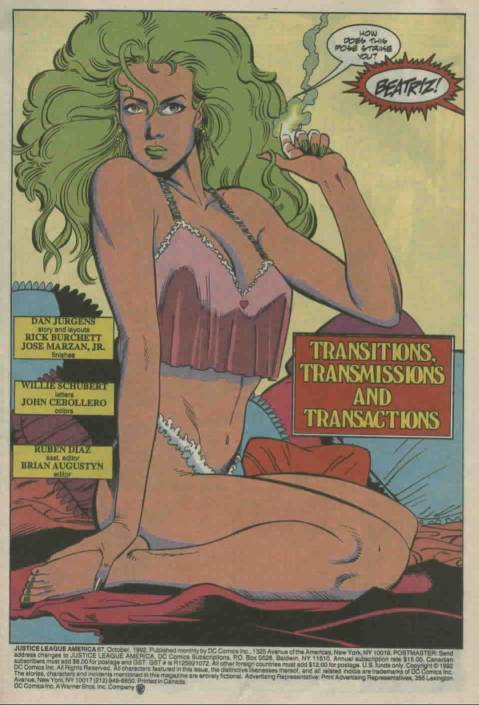
Fire/Beatriz da Costa is a fashion model from Brazil (hence the reason she's dressed like that) with, as you might imagine, flame powers- she can turn herself into a blazing green fire elemental and create (also green) fires at will. Though created in 1979 as a guest character, she didn't hit her stride until '88 when she and buddy Ice/Tora Olafsdötter, superheroes without a job thanks to the dissolution of the Global Guardians, applied for membership in Justice League International. A major supporting player throughout the Giffen/De Matteis run on the League, Fire developed an interesting personality- part sexbomb, part sharp businesswoman, part firebrand and part loyal friend. Recently she's gone all dark-assassin-y in the pages of CHECKMATE, but considering she's from the "Bwah-ha-ha" era, she's lucky to be alive.


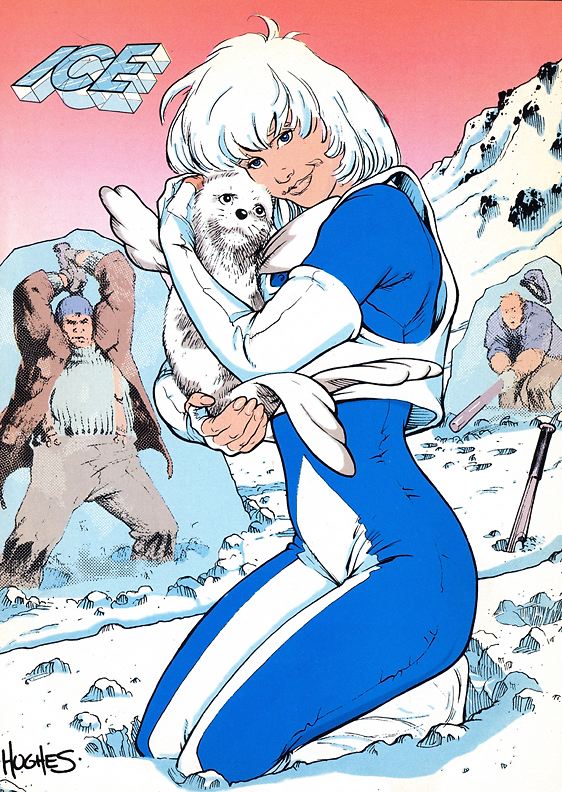
And here's the lovely Ice. The princess of a tribe of Norsemen with mystical powers (thanks Wikipedia!), Tora Olafsdötter was originally one of the Global Guardians (as well as a fashion model), but when that team disbanded, she and best friend Fire went to join the JLI. A sweet, shy girl with a bleeding heart, Ice inexplicably became romantically linked to the abrasive Guy Gardner in what turned out to be a surprisingly sweet subplot. Though killed sometime in the Nineties (something writer Mark Waid regrets now), Ice is fondly remembered. And of course, for a comic book superhero, death is just a temporary inconvenience.


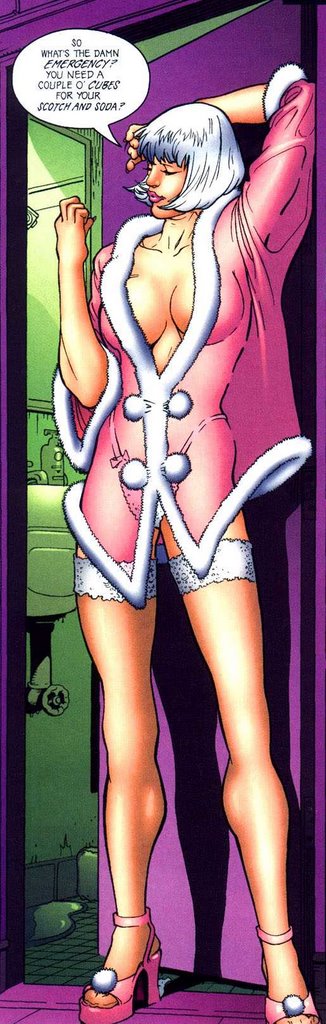
And... uh... oh, yeah, this is Ice from a parallel universe, as seen in Giffen and DeMatteis' I CAN'T BELIEVE IT'S NOT THE JUSTICE LEAGUE. And a nice way to cap off cheesecake appreciation week. Thanks for following, and thanks again to Ragnell and Kalinara for getting this going. If nothing else, I appreciate the traffic.

Thursday, October 19, 2006

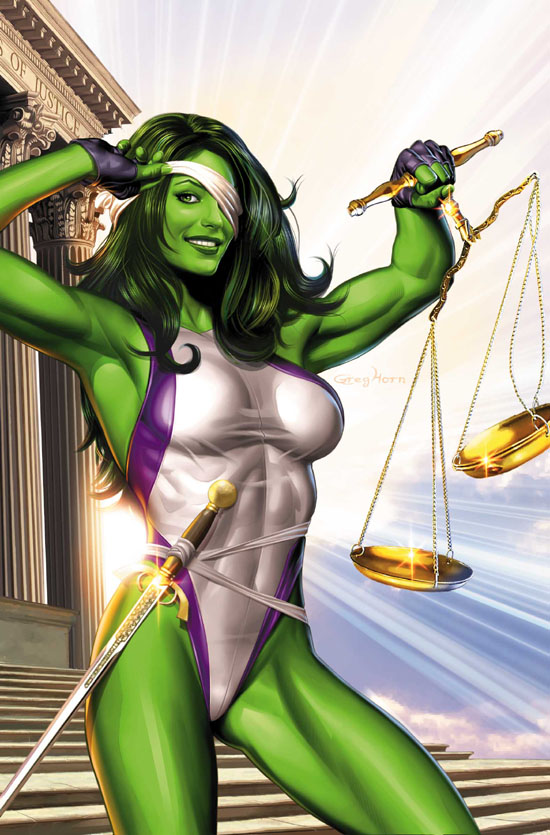
Cheesecake Appreciation Week, Pt. 2: She-Hulk

My contribution to the meme-age continues, and I've decided to go back to the theme its creators intended. In other words, here's She-Hulk!


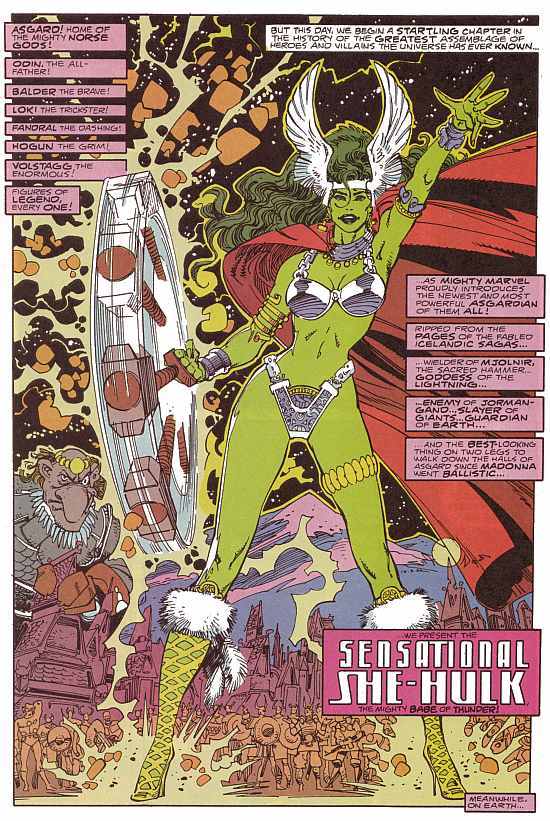
The last Marvel hero created by Stan Lee, She-Hulk ("Shulkie") was actually rushed into existence to stake a claim on a trademark. Back when the Bill Bixby INCREDIBLE HULK series was popular, a rumor circulated that the show would introduce a "female hulk" character. Now that the idea had been mooted, Marvel had to publish it before someone else did, and so the She-Hulk was born. Jennifer Walters was a young lawyer shot by mobsters, who received an emergency blood transfusion from her cousin, Bruce Banner. She inherited his "ability" to turn into a big green monster, but with a couple of twists- she could usually control her transformation, and retained her intelligence and self-control (and, as one can see, good looks to boot.) She's been a part of the Avengers and the Fantastic Four, and currently works for a law firm specializing in superhuman cases.


She-Hulk (or "Shulkie" as she's sometimes called) is a great heroine for a number of reasons. She's gorgeous, has a sense of humor, a job that actually lets her do neat stuff besides fight villains (Dan Slott, writing the current series, has used the "superhuman law" angle to make some inspired commentaries on the inherent goofiness of the Marvel Universe), and the occasional ability to run through the fourth wall.


Generally speaking, she rules, and as much as it pains me that her title is due to turn "serious", I'll still follow it. But enough blather! More cheesecake!


I might finish off the week with Power Girl. Watch this space.


Monday, October 16, 2006

Because I'm too busy for real content.

I'm fairly occupied on the writing end, working on a radio script for a competition.

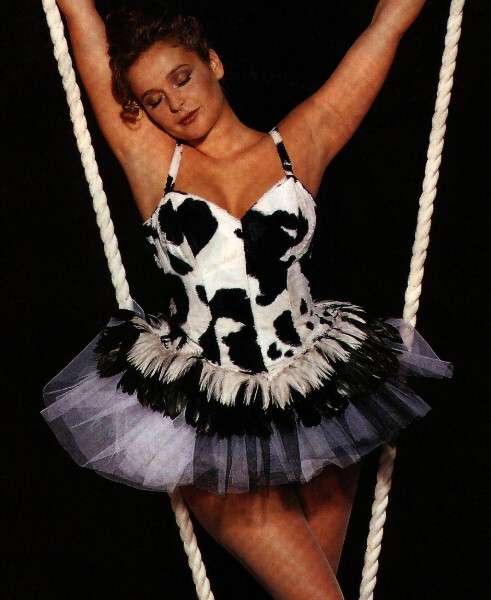
Fortunately, comics bloggers Ragnell and Kalinara (now part of the Club Parnassus blogroll), have declared it Cheesecake/Beefcake Appreciation Week, for the posting of lovely pictures of either sex. Specifically I think it's supposed to be for comics images, but Postmodern Barney (who will be added to the blogroll shortly) went and posted Paul Rudd, so I guess real people are okay. And I've been waiting for an excuse to gush about this lady for a while, so- here's Julia Sawalha.

If you know Julia at all, it's likely due to ABSOLUTELY FABULOUS, the brilliant UK sitcom where she played Edina's put-upon daughter Saffron. I always felt she got less credit than she
deserved for her part in the ensemble, especially in the US- the press always loved Edina (Jennifer Saunders) and Patsy (Joanna Lumley), but Julia's work as the "straight man" of the group served as a good entry point for a normal viewer. She also delivered some very funny put-downs, and gave Saffy a wonderfully withering death stare that I've since made into a JournalFen icon. You also have to admire the fact that she actively insisted on Saffy wearing frumpy sweaters and starchy shirts and the like- against attempts by Saunders and others to give her nicer-looking outfits- forgoing glamour for sake of the character.


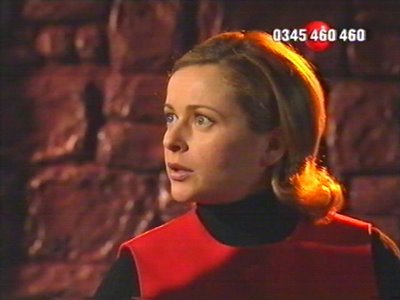
Julia was also the star of Steven Moffat's PRESS GANG, and has appeared in a number of television shows and a couple of films (most notably Kenneth Branagh's IN THE BLEAK MIDWINTER, aka A MIDWINTER'S TALE, and Nick Park's CHICKEN RUN.) Another favorite of mine was her appearance in the charity DOCTOR WHO send-up "The Curse of Fatal Death" as the Doctor's lovely companion Emma, seen below (Moffat wrote that as well). Around 2003-4 she took a leading role in the mystery series JOHNATHAN CREEK, alongside Alan Davies, with whom she became romantically linked. A storm of unexpected publicity from that seems to have scared her out of the limelight for the moment; for a time she didn't seem to be doing anything, which led the Daily Mail (think Fox News without the honesty) to "report" that she'd given up acting altogether. For a while I feared this was true, but as it turns out a broken clock isn't necessarily right twice a day, and she's done a few smaller things- a commercial here, a charity ABFAB special there, and in spring of this year it was reported she was doing a radio comedy. So we can probably hope to see her again, at some point.


Julia (now 38, if you can believe it) was my first celebrity crush. It wasn't a sudden thing. I'd been watching ABFAB, and liked Saffy in that I could identify with her, and in an intro to a script book Saunders was summarizing the cast's coming together and mentioned "the lovely Julia Sawalha", and though she likely meant it in the British "great person overall" sense, I thought to myself, "yeah, she is lovely, isn't she"? This was when I was about 14, and at 15 I wrote her a fan letter. After a few months I got a reply including a lovely autographed photo- I still have both. I haven't given up hope of meeting her in person someday, and since my writerly aspirations include getting to make movies, I've also dream-cast her in a script that I haven't even written. So, if her agent's reading and she needs another job...


So, uh, I'm going to go and... do... other things. Another Cheesecake post may follow this week.