Sunday, May 08, 2011

In Theaters: Thor

Thor one-sheet and IMPAwards link
As comic book adaptations go, Thor must have been a tall order from the start. The original Marvel comic’s complex revision of Norse mythology, coupled with the traditional superheroics and a story of a god living on Earth due to family disputes, called for an expensive and elaborate epic about a character who doesn’t have a lot of recognition value for the average moviegoer. (Unless said moviegoer is a fan of Adventures in Babysitting.) There was a lot of skepticism about this film, and even I wasn’t quite prepared for how much I would enjoy it. Kenneth Branagh and a host of writers have managed a warm, funny, and engaging spectacle, and despite its purpose to build up to the eventual big screen debut of Marvel’s Avengers, there’s not a cynical bone in its body.

Thor (Chris Hemsworth) is the son of Odin (Anthony Hopkins), ruler of the Asgardians, an advanced, godlike race of beings who once saved Earth from an invasion of frost giants, and so inspired the myths of the Norse pantheon. As Odin ages, Thor is to be named king (over the objections of his brother Loki, played by Tom Hiddleston), but the ceremony is disrupted by an attempt by the frost giants to break into Asgard and steal a precious artifact. Though the attempt fails, Thor is outraged and over his father’s objections leads his friends to the frost giant’s homeworld, trying unsuccessfully to discover the secret of how the giants were able to reach Asgard to begin with. For his act of aggression, Thor is stripped of his godlike powers and exiled to Earth, where he is discovered by Jane Foster (Natalie Portman), a young scientist researching the gates between worlds that the Asgardians use for travel. She’s not sure who he is at first, but when government agents start confiscating her work and constructing a base around a mysterious hammer which fell from the sky the same time Thor did, she starts to have her suspicions. Meanwhile, Odin falls into a deathly slumber from the stress of his actions, and Loki seizes power, putting dark designs into practice.

One of the benefits of the superhero genre’s popularity is that filmmakers now don’t seem afraid to embrace the wild and crazy aspects of the comics they’re adapting. Marvel’s version of the Norse gods was a blend of high fantasy and science fiction aided to no end by the wild visual imagination of Jack Kirby, the sort of thing that might get toned down, but then again this is a Kenneth Branagh film. He’s never worked with a picture quite this size before, but he’s never one to hold anything back, and we get Asgard in all its colorful glory, an at times downright breathtaking metropolis, populated by actors who were somehow persuaded to take their job of playing comic book space gods with the utmost seriousness.

Which is not to say the film lacks humor. Both in Asgard and on Earth, there are a lots of moments of realistic comic relief which somehow lend the more ridiculous plot events more credibility. Thor has a nice rapport with his friends, the Lady Sif (Jaimie Alexander) and the Warriors Three (Ray Stevenson as Volstagg, Tadanobu Asano as Hogun, and Josh Dallas as Fandral)- fearsome fighters all, but also a lot of fun. Portman is warm and charming as Jane, and is aided by the amazing Stellan Skarsgard, and Kat Dennings as the loveliest comic relief I’ve seen in a while. The script has a lot of good banter, something which has served the Iron Man films exceedingly well and which I hope catches on.

There’s a surprising believability to the characters, aided no doubt by Branagh being very good with actors- Loki in particular becomes a complex villain, devastated by Odin’s revelation that he is actually born of the frost giants and thus driven by emotions that don’t become entirely clear until the film’s climax. Hiddleston and Hemsworth both play their roles very well despite being among the freshest faces in the cast. Hopkins is, well, Hopkins, and Idris Elba as the gatekeeper Hemdall has some wonderful scenes. The action is grand and imaginative without being overly contrived, and the 3-D effect is well done for the most part, though you could probably get the same impact from a 2-D screening.

The proliferation of writers on this film (the plague of big budget filmmaking is that coherent voices often get lost) does result in a story that’s not entirely seamless. Some thematic elements aren’t hit as strongly as they should be and some character movements are a touch too fast or too slow. None of these are really glaring, but they do add a bit of sloppiness to what is otherwise a well-crafted production.

Thor is just plain fun in a way that many blockbusters aspire to but often miss because they’ve thrown character and emotion under the bus. It’s technically possible for a film to get by without these things, but the ones that stay with me are the ones that try to have it all, that try to be clever and funny and sincere despite the best efforts of studios to breed out these characteristics. Of the Avengers set-up pictures, Thor may actually be the best, or at least my favorite, and while he’s guaranteed a return to the big screen there, I hope the god of thunder has another solo outing or two in him.

Based on the comic book character created by Stan Lee, Larry Lieber, and Jack Kirby
Story by J. Michael Straczynski and Mark Protosevich
Screenplay by Ashley Edward Miller, Zack Stewart, and Don Payne
Directed by Kenneth Branagh

Grade: B+

Saturday, April 30, 2011

The Lis Sladen Tribute

Sarah Jane, gone too soon
I feel bad about having taken too long to do this. Elisabeth Sladen's death took many people by surprise- it was not widely known that she had been struggling with cancer, and her sudden loss felt wrong, unjust, disorienting.

There's not a lot I can say, as a result. I will miss her despite never having met her, never having actually known a woman who from all accounts was as sweet and selfless in person as on television. On Doctor Who and The Sarah Jane Adventures, Sladen was a favorite aunt, a wonderful first grade teacher, a friendly and trustworthy guide into a world of wonder and danger. There will never be another person like her. In this context all I feel I can do is point to those accomplishments I have already noted, and hope I can do some form of justice.

There are, of course, other roles that Sladen filled, and I regret not knowing them. This is a terrible loss by any measure and I just hope that I can do her some justice- and I can only hope that somewhere she knows how much she was loved.

Friday, April 29, 2011

Frasierquest 3.19: Crane vs. Crane

Frasier meets fireman/hobo/industrialist Harlow Safford
Martin: What father doesn’t look forward to the day he gathers his friends around the TV and says, “Hey, that’s my boy! The one making the old man cry!”?

“Crane vs. Crane” is interesting because it teases a brother against brother conflict that ultimately never takes place. The old sibling rivalry`formula is given a twist, in that what they’re arguing about is ultimately too important for their petty disagreements. A potentially very serious issue, that of senility and senior capacity as it pertains to huge sums of money, is turned into a strong comic story that lets us revisit Niles and Frasier’s endless game of oneupsmanship without feeling like it’s just a retread.

The story starts with Niles being retained to appear as an expert witness at the capacity hearing of timber baron Harlow Safford (the legendary Donald O’ Connor), a trial which is going to air on Court TV and thus give Niles a bit of celebrity. Frasier is approached by lawyers for the eccentric Safford, and finds the man a charming and clear-headed individual who just happens to like riding the rails and giving money to charity. He agrees to testify as well, setting himself against Niles on the other side of the aisle. Niles refuses to believe that Frasier is doing this out of any sincere conviction of Safford’s sanity rather than a desire to hog the spotlight. Both men enter the courtroom with cutting speeches prepared, but fate intervenes.

Thinking about it now, there’s something topical about the entire “Court TV” angle of the show. The 90s often seemed like the decade of the sensational show trial, and by the time this aired most people were still trying to get the O. J. Simpson case out of their heads. Little did anyone know we had a Presidential impeachment to look forward to. So of course Niles sees the courtroom as his chance at stardom. The show doesn’t try to hammer this home in any way, and it’s only on my most recent viewing that I recognized Court TV fame as a contemporary emergent phenomenon. (And speaking of contemporary references, Daphne’s Eddie-repelling shriek sounds a lot like the battle cry of Xena, Warrior Princess. That's probably coincidence but I prefer to think that it isn’t.)

The irony of Niles’ paranoia is that for once Frasier isn’t acting in his self interest. Usually when these two clash it’s purely ego vs. ego, but Frasier sincerely believes he is in the right for once. It ends up being a question of perception- Niles just happened to visit Safford when he was less lucid- and for a time we share Frasier’s, as he visits Harlow in what turns out to be a particularly sane period. It would have been interesting to see this from Niles’ perspective.

It’s always disheartening to think that we must, inevitably, decline in our abilities as we grow older- that after decades of self-improvement there is a peak. Frasier’s worried about this before, and that’s why he falls under Harlow’s spell. O’ Connor does a great job playing both the lucid and less-so sides of his character, showing how easily he can put up the appearance of normality and be his old vibrant self.

In the end, Frasier and Niles shouldn’t be the ones deciding the old man’s fate, and taking the outcome out of their hands not only works as a basic comic twist but also a way of deflating the seriousness of the situation. There’s no indication that Harlow is going to suffer for his incapacity beyond losing control of his money, so that makes the audience feel a little better too. While Martin justifiably grouses about the rush to declare senior citizens incompetent, sometimes it’s unavoidable.

Ultimately, the episode is memorable for how it balances the “new” elements- the guest star, the jump to televised courtroom antics- with the familiar spine of Niles and Frasier trying to outdo each other. This is ideally how most sitcoms work on a given week, taking a basic formula and introducing things to spice it up. The trick is actually making it happen week in and week out, and while some more unusual episodes are coming up in the season’s home stretch, it’s shows like this that keep the show’s reputation up.

Guest Caller: Debbie “Mrs.” Fields as Beth

Written by David Lloyd
Directed by Philip Charles Mackenzie
Aired April 9, 1996

Frasier: Yes, but you weren’t fooled! Somehow you pick up on some tiny clue that I missed! Remember what it was?

Niles: (thinks) Yes. Midway through our interview he took off his trousers and tried to put them on the cat.

Frasier: I’d like to think that I might have picked up on that one too.

Saturday, April 23, 2011

Club Parnassus' Fifth Anniversary


Welcome, one and all, to the blog's five year anniversary! Yes, on this day in 2006 I made my very first post, unsure of what I'd do with this place or whether I'd even spend much time on it.

Oh, to be innocent again. Keeping this place updated in the midst of creative writing and job searching hasn't always been easy, but it's worth the trouble to have a place to speak one's mind. I like to think of the Club (and I'm sentimental enough to picture it as a place instead an online journal) as a celebration of my various pop culture loves. I started with movies, then television, music, comics, books, audio theater, RPGs, live theater, pro wrestling, and of course, the eternal beauty of Julia Sawalha.

There's a lot I'd like to do still. Frasierquest continues rolling on. I've been thinking of starting a second blog solely to post some of my prose and creative work, but I need to figure out the best way to present that kind of content in blog form.

I'm gonna put this here because I'd still like people to see it if they haven't already, and I'd especially like some Youtube feedback. More machinima is on the horizon, but the next one will be a more complex undertaking, with voice actors and sound effects and the like.


New Doctor Who is on tonight, and I plan in the coming week to put up something as a tribute to the dear, recently departed Lis Sladen, taken from everyone far too soon.

And to send you all out with something inspirational, just remember that no matter what anyone tries to tell you, no matter how overwhelming the consensus is, no matter how you much you are made to feel you are objectively wrong, the 1998 Avengers is awesome.

Tuesday, April 19, 2011

Frasierquest 3.18: Chess Pains

Frasier contemplates his next move.
Martin: Those guys at the park make it look great. Eatin’ baloney sandwiches, smokin’ cigars... sometimes a fist fight even breaks out.

Frasier: Well, let’s just start with name calling and see where it goes, all right?

So. Chess. A great strategic pasttime, and a game where it’s quite possible to lose 2 moves after you start. It’s the sort of thing Frasier would naturally gravitate towards, so “Chess Pains” is an episode they had to do sooner or later. The main plot is not really one that lends itself to being a main plot, and it ends up a little slow, but it is a return to the conflict between Frasier and his dad, which we haven’t seen in a while despite it being the premise on which the show was based.

Frasier has ordered an expensive and elaborate chess set, a glorious antique which has him itching for a game against someone. He ropes Martin into a game, and though dad is not a very experienced chess player, he whoops Frasier’s butt. This upsets the good doctor more than it should, and he spends a lot of time contemplating how he lost, concluding that dad just happened to blunder into a good offensive strategy. So he asks for a rematch, and loses again. And again. And again.

This is one of those cases where Frasier’s reaction to a problem makes it much worse than it is. Anyone else by this point would have assumed that Martin just has a mind for chess (there’s a bit of a plot hole in that he’s been shown playing the game before, but acts like it’s mostly new to him here). He’s not a dumb guy, as much as he acts like it at times- he was a detective, for cryin’ out loud. But Frasier refuses to be outclassed in an intellectual pursuit, at least not without some deep underyling reason.

Frasier’s reasoning in this case is that he is afraid of toppling his father, and he expects this conflict to resolve itself simply by his having confronted it. And there may actually be some of that at work. Obviously the episode doesn’t show us too many details of their games, and I wouldn’t know enough to analyze them if it did. (It doesn’t help that Frasier’s fancy chess set is sufficiently fancy that I’m not entirely sure which piece is which.) But the overall impression we get is that he’s just covering, and that Martin is just the better player. Still, it’s left open for us.

There are a couple of highlights from the supporting cast to help pad out a thin central story. Niles, at Daphne’s suggestion, decides to get a dog to keep him company during his separation from Maris. Said dog ends up being Maris’ canine double, a thin whippet with a haughty attitude. It’s kind of adorable in a bizarre way (the actual breed is lovable enough), and a nice touch is that nobody ever actually says she looks like Maris; we’re expected to connect the dots ourselves. I also like the touch that Niles naturally takes Daphne’s advice; it’s something people in love do, not even necessarily to impress the object of our affection but because they’re so wonderful that they must be right about something. Then there’s Daphne’s attempt to cheer up Frasier with a sock puppet, which is a trainwreck.

I find myself wondering now whether I wouldn’t like this episode a lot more if I didn’t have to write about it. It’s a story about which not a lot can be said, but that doesn’t mean it’s bad. This is, in the end, a 30-minute sitcom, and in that format there will inevitably be non-special episodes in which amusing things happen for a while and then stop, without a lot of room for thematic dissection. “Chess Pains” could have been better, but it’s not without its redeeming elements- it’s entertaining, but not one for the ages. Given the streak we’ve been on, it was inevitable.

No Guest Caller (though Luck Hari graces us with her presence at the Café Nervosa)

Written by Rob Greenberg
Directed by Gordon Hunt
Aired March 26, 1996

Frasier: Daphne, I would rather have a tarantula lay eggs in my ear than listen to any more of this puppet show.

Wednesday, April 13, 2011

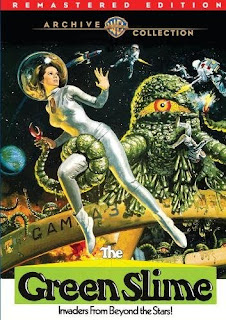
Random Movie Report #89: The Green Slime

DVD cover and Amazon link
Having a DVR has in some ways really thrown me back to my old days as a sci-fi fan who sorta knew how to program the VCR. I would scour the TV listings for old monster movies, usually playing late at night, set the timer and hope for the best. One holy grail that eluded me for a while was The Green Slime, scheduled to air on TNT one afternoon in the event that a World Cup game finished on time, so of course it never did. For months, possibly years, I looked for it to crop up again, finally getting a 3 A.M. airing. Years later, the film never popped up on mass release DVD, but eventually made its way to the Warner Archives print-on-demand program, and has shown up on the TCM Underground, allowing me to discover it again.

Kind of a lofty status for what is, to be honest, a pretty bad movie. The Green Slime is a historical curiosity, a pre-Alien monsters-in-space movie with cute blobby aliens, swinging mod space women, and a funky rock theme song. It’s cheesy and has problems beyond that, and I like to think I recognized them even as a youngin’. However, it’s so odd and fun that I still enjoy it, big though the stumbling blocks may be.

In the near-ish future (Next Sunday A.D.), an asteroid is suddenly detected on a collision course with Earth. Two-fisted, ginger-haired Commander Rankin (Robert Horton) is sent to space station Gamma III to head a mission to blow the thing up, and as if to prove that the makers of Armageddon were just wasting our time, they manage to do so in the first 20 minutes of the movie. However, the asteroid was covered in a strange green sludge, some of which rubs off on one of the crew’s space gear. Energy from the station’s decontamination process causes it to grow, turning into a one-eyed green monster that feeds off energy and can electrocute people with its tentacles. When the creature is wounded, its blood turns into more of the monsters, and soon the station is overrun. Rankin, distracted briefly by his contempt for the “soft” station leader Commander Elliott (Richard Jaeckel) and his love for the sexy Dr. Lisa Benson (Luciana Paluzzi), must find a way to destroy the creatures and prevent their reaching Earth.

The film’s major flaw is easy to identify; Rankin is a dick. Not just kind of a dick, but really an unpleasant and egotistical embodiment of all that was wrong with old school machismo. Some of his criticisms of Elliott make sense, but he takes it way too far, makes no real effort to get along or show respect to a man whom he does not technically outrank, and keeps insisting that Lisa still loves him despite being engaged to Elliott. What was supposed to be a love triangle just comes off as a guy too full of himself to understand why anyone would reject him for anyone else. The writers (one of whom was Bill Finger, Batman’s uncredited co-creator) really seem to want to make a point about the necessity of leaders who make hard choices and don’t try to be nice, but they completely miss the mark.

Fortunately, this is a monster movie, and the monsters are effective in a way that the filmmakers probably didn’t anticipate. The Green Slime are, frankly, adorable. They’re a neat old school design with cyclopean eyes and flailing tentacles, and they make a wonderful ululating sound that makes them seem more like curious, electric children than evil aliens. The movie doesn’t skimp on the critters once they start showing up, and there’s a nice feeling of increasing chaos as they take over the station.

Another nice thing about this movie is how very Sixties it is. How Sixties is it? Well, Dr. Lisa spends most the entire movie in a variety of space-age minidresses, there’s a booze-heavy party scene with the nurses acting like office secretaries, and there’s the theme song. The lyrics are gloriously stupid, but it’s so damn catchy. I’ve been looking for an MP3. The visuals are appealing and colorful, and while the special effects of this American/Japanese co-production aren’t great, they get the job done.

Basically The Green Slime is a battle between some very entertaining monster action and an almost offensively tone-deaf human story. The results are not what one would call, from an aesthetic standpoint, good- you have to suffer through the dull macho bullshit to get to the fun action, and as a result you really start to root for the creatures more than usual. They don’t get bogged down in the chain of command or ancient love triangles, and they don’t waste the viewer’s time. For some they will make the movie worth watching, and the whole shebang also inspired the excellent boardgame Awful Green Things from Outer Space, so there’s that. Purely a guilty pleasure, but one I’m probably going to revisit more than I should.

Story by Ivan Reiner
Screenplay by Bill Finger, Tom Rowe, and Charles Sinclair
Directed by Kinji Fukasaku

Grade: C+

And now, let's rock out!

Thursday, April 07, 2011

In Theaters: Rango

Rango poster and IMPAwards link
Rango starts off with the main character engaging in a one-man show and delivering a highly theatrical, slightly psychedelic monologue wondering about his true identity. That is our first sign that this is not a typical animated family adventure. The components of the movie are familiar, but writer John Logan and director Gore Verbinski have done something special with them, creating a picture that’s part parody of spaghetti westerns, part mystical vision quest, and part witty comedy adventure.

Johnny Depp plays the title role, as Rango is what he comes to call himself. At first he’s a nameless chameleon accidentally thrown out of his tank and cast onto a desert highway. He treks across the hostile landscape before stumbling upon the Old West-y town of Dirt, a village straight out of Sergio Leone with a grizzled populace and a severe water shortage. The chameleon decides to blend in, getting the moniker “Rango” off a bottle of cactus juice and talking himself up as the most brutal, stone cold killer in the West. This gets him made lawman, just in time to tangle with hawks, lizard gangsters, and a monstrous serpent known as Rattlesnake Jake (Bill Nighy). Along the way he romances the fiery and eccentric Beans (Isla Fisher), and discovers that there’s something very suspicious about what’s happened to the water supply.

You’ve heard this story before, probably. It’s a little bit like Three Amigos, or Chicken Run, or A Bug’s Life, but the plotting, while it holds together, isn’t really the point. The film, instead, is a lot more interested in directly engaging the themes a story like this brings up. Rango is a performer, an artist, but also kind of a blank slate, and enters into his charade less out of a desire to fit other’s expectations than a desire to actually become somebody. It’s telling that the character has no name until he gives himself one, and that he spends much of the opening scenes in the desert trying to blend in one way or another. The film’s surreal opening is paired with an equally bizarre, elaborate dream sequence later which hammers home the character’s identity crisis, and which leads to an utterly wonderful scene of Rango confronting the true Spirit of the West (about whom I shall say very little, save that he is voiced by Timothy Olyphant.)

The animation, done by Industrial Light and Magic (this is their first animated feature), is something else. The lizards and vermin of Dirt have skin so detailed you can almost touch them, and a subtlety of expression that holds through many close-ups, which is what the genre calls for. There are some amazing tricks of light and shadow, and a look that’s gritty and also colorful. I don’t normally look too much at the technical aspects of a movie, let alone the animation, but Rango is such a visual marvel that it has to be noted. On top of this, Verbinski’s grasp of action has grown a lot stronger, and there are some genuinely thrilling as well as comical sequences.

Also serving the story well is a wry and rather dark sense of humor. In some ways it’s a film for older kids, with touches of violence, innuendo, and a more direct confrontation of death than you normally see in animated features. The script is witty and often fast-talking. The voice cast worked closely together during recording to create a believable rapport, and it helps that the casting is as inspired as it is; turns from Ned Beatty, Harry Dean Stanton, Abigail Breslin, Claudia Black, Ray Winstone, and Stephen Root among others all fit in so well that it’s actually hard to recognize most of them.

It’s good to be genuinely surprised by a movie now and then, especially if it’s not because of what happens but because of how it’s done. Rango could easily have been one of many animated pictures crowding the marketplace, but instead you get the feeling that Verbinski, Logan, and company used whatever clout they had to tell the story they wanted to tell the way they wanted to tell it. It’s bold and striking, but it’s also fun. It delivers what we expect from an animated feature- laughs, thrills, a message about being true to those who depend on you- but also more, offering kids and adults a little to think about. This is a really fun movie that goes that extra step, and as I’ve said before, we need more like that.

Story by John Logan, Gore Verbinski, and James Ward Byrkit
Screenplay by John Logan
Directed by Gore Verbinski

Grade: A-